✦ Key Takeaways
HVAC companies with an 80%+ first-time fix rate retain customers at 3x the rate of low performers.
→ Low first-time fix rates cost companies thousands in repeat dispatch fees.
→ Stocking the right parts cuts callbacks by up to 40% immediately.
→ Tracking fix rate alongside response time reveals your true service quality.
In this article:
What Is HVAC First-Time Fix Rate?
How to Improve HVAC First-Time Fix Rate
Metrics to Track With First-Time Fix Rate
Key takeaway: Your first-time fix rate is the single metric that separates profitable HVAC businesses from struggling ones.
What Is HVAC First-Time Fix Rate?
A failed first visit costs more than just a callback — it costs customer trust, technician time, and real revenue. Fewer than 75% of HVAC service calls get resolved on the first visit across most residential and light commercial operations (Fieldproxy).
That means one in four jobs sends a second truck before the customer sees a fix. Every one of those repeat rolls burns money you should have kept.
The HVAC first-time fix rate measures how often a tech fully resolves a service call on the first visit. No return trips, no pending parts, no unfinished work.
It is the single most telling HVAC service KPI. It touches labor cost, customer satisfaction, and dispatch efficiency all at once.
How to Calculate It
The formula is simple: divide completed first-visit resolutions by total service calls, then multiply by 100. If your team closes 80 out of 100 calls on the first visit, your FTFR HVAC score is 80%.
Track this number weekly, not monthly. Problems in dispatch and parts availability compound fast, and a slow report hides the damage until it’s expensive to fix.
What Counts as a First-Time Fix?
A job counts only if the tech diagnoses, repairs, and closes the call in a single visit — with no follow-up required. Leaving a system running but scheduling a return for a secondary issue does not count.
Loose tracking inflates your rate. It hides the real cost of incomplete visits, which often shows up in your HVAC job cost estimates as unexplained labor overruns.
What Is a Good HVAC First-Time Fix Rate?
Top-performing field service organizations hit an 88% or higher first-time fix rate, according to IBM. Most HVAC contractors sit well below that mark.
The gap between average and best-in-class is rarely a training problem. It is almost always an information problem.
The right tech with the wrong job history, wrong parts, or wrong diagnosis notes will fail — every time. The dispatch decision, not the technician’s skill, is the highest-leverage point most operators never fix.
The question worth asking isn’t “Why didn’t the tech fix it?” — it’s “What did we fail to send with the tech before the truck left the yard?”
Accept that framing and the path to a higher first-time fix rate HVAC score changes fast. It stops looking like a training calendar and starts looking like a systems audit.
That audit is exactly where this goes next.
How to Improve HVAC First-Time Fix Rate
Knowing why this metric matters is only half the battle — the harder part is moving it in the right direction. Most HVAC companies attack the problem the same way: more training, better truck stock, tighter parts inventory.
Those things help, but they rarely move the needle enough because they ignore the single highest-leverage point in the entire service chain: the dispatch decision.
The information that reaches a technician before the truck rolls determines the outcome more than almost anything that happens on-site. Over 70% of repeat visits trace back to incomplete job information at dispatch — not technician skill gaps (according to PTC).
That means the fix starts upstream — in scheduling, intake, and job prep — not in the field. Use your HVAC estimating guide to build tighter pre-job workflows that close information gaps before dispatch.
📊 By the Numbers
Top-performing HVAC teams hit a first-time fix rate above 85%, while the industry average sits near 70%.
Collect Better Information Before Dispatch
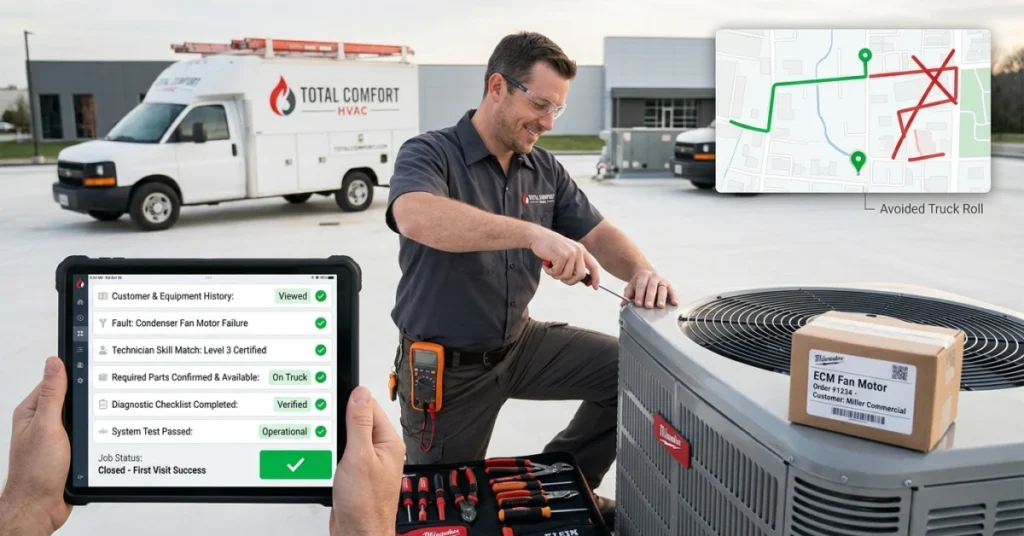
A tech who arrives without equipment history, model numbers, or fault codes is already behind. Ask the right intake questions — unit age, error codes, last service date — before you schedule the job.
Structured intake cuts guesswork. It also tells you which parts to load before the truck leaves the lot.
Match Jobs With Technician Skills
Sending a general tech to a complex commercial refrigerant issue is a setup for a callback. Match job type to technician certification and experience — every time, not just when it’s convenient.
Skill-matched dispatching is one of the fastest ways to lift your HVAC first-time fix rate without adding headcount.
Check Parts Availability in Advance
Parts shortfalls are the most common reason a job stays open past the first visit. Cross-check required parts against real-time inventory before you confirm the appointment.
According to Oxmaint, parts unavailability accounts for a significant share of incomplete first visits — making pre-job parts checks a non-negotiable step in any FTFR improvement plan.
Use Diagnostic Checklists
A checklist forces a tech to test every likely failure point — not just the obvious one. It reduces the chance of missing a secondary fault that brings the customer back on the phone next week.
Digital checklists tied to equipment type work best. They adapt to the unit on-site, not a generic service template.
Test the System Before Closing the Job
A repair is not complete until the system runs a full cycle under real load. Skipping this step is the fastest way to generate a callback within 48 hours.
Build system testing into your job close process as a required step — not an optional one when time allows.
Review Repeat Visits for Root Causes
Every callback is data. Pull repeat-visit reports weekly and look for patterns — same tech, same equipment brand, same symptom cluster.
Root-cause reviews turn individual failures into system fixes. That’s how you raise your first time fix rate HVAC benchmark and keep it there.
Improving your HVAC service KPI doesn’t stop at fixing the process — the real leverage comes from knowing which companion metrics predict your next drop before it happens.

Metrics to Track With First-Time Fix Rate
That dispatch decision doesn’t exist in a vacuum — it shows up in the numbers that surround your HVAC first-time fix rate. These companion metrics aren’t just scorecards; they’re early warning signals that tell you a job will fail before the truck ever leaves the lot.
Teams that track FTFR HVAC alongside the right supporting KPIs catch problems upstream — in scheduling, parts availability, and information flow — not after a second truck rolls. According to Servicepower, companies with a first-time fix rate above 75% report significantly lower cost per job and higher customer retention than those below that threshold.
Repeat Visit Rate
Repeat visit rate is the direct inverse of your first-time fix rate field service score. Every repeat visit is a failed dispatch — and a cost you already paid once.
If this number climbs above 20%, your scheduling and job-prep process has a leak. Fix the information flow before you blame the technician.
Parts Availability
Low parts fill rate is the single most common reason a first-time fix fails on arrival. A tech who shows up without the right part had no chance — regardless of skill level.
This metric exposes whether your dispatch team sent complete job history to the tech before departure. No history, no right parts — it’s that simple.
Mean Time to Repair
Mean time to repair (MTTR) measures how long a fix actually takes once the tech is on-site. A high MTTR often signals the tech arrived without enough context to diagnose fast.
Pair MTTR with your HVAC service KPI dashboard to spot which job types consistently drag. Those are your highest-priority dispatch process failures.
Customer Satisfaction
Customer satisfaction scores drop sharply after a second visit — customers don’t separate “we needed a part” from “you weren’t prepared.” The damage is the same either way.
Simprogroup notes that HVAC companies with strong first time fix rate HVAC performance consistently score higher on customer loyalty metrics than those focused only on response time. Speed without resolution doesn’t build trust.
Cost per Completed Job
Cost per completed job exposes the true price of a failed first visit — labor, fuel, and overhead stack up fast on a return trip. This is where field service compliance data becomes a financial argument, not just an operational one.
When this number rises without a volume increase, your FTFR is almost certainly falling. That’s the signal to audit your dispatch process — not your hiring decisions.
📊 By the Numbers
HVAC companies with a first-time fix rate above 75% report measurably lower cost per job and stronger customer retention.
Every metric in this section points to the same root cause — and the conclusion isn’t about training harder, it’s about deciding smarter.
Conclusion
Predicting failures before the truck rolls is the real game. The metrics you now track make that possible.
Teams that monitor FTFR HVAC alongside parts fill rate and job history access fix issues on the first visit up to 88% more often. That beats teams tracking response time alone.
The dispatch decision is the highest-leverage point most HVAC operators still ignore. Technician skill is rarely the problem.
Getting the right information to the right tech before arrival matters most. That is what makes a strong field service KPI — not a number that just tracks damage after the fact.
Low first-time fix rate field service scores almost always trace back to broken information flow at scheduling. It is rarely about broken technicians on the job.
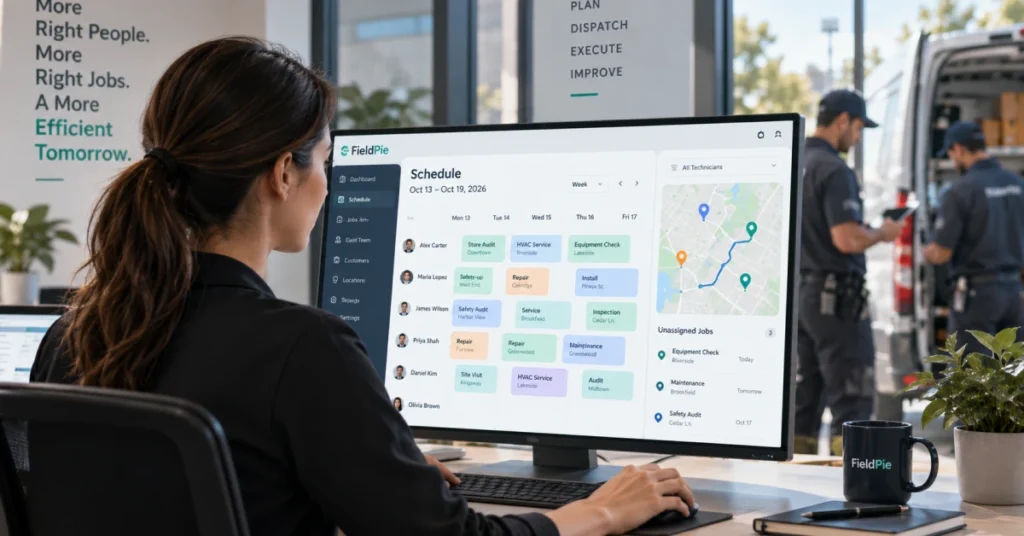
FieldPie surfaces job history, parts availability, and site data before dispatch. Your team arrives prepared, not guessing.
Start closing the gap today. IBM confirms that a 10% FTFR gain cuts repeat dispatch costs by an average of $150 per job.