



✦ Key Takeaways · 7 min read
Mystery shopping follow-ups turn store findings into assigned actions, clear deadlines, and verified improvements.
→ Unresolved findings make mystery shopping a costly, pointless exercise.
→ Turning reports into action requires clear ownership and accountability.
→ Tracking follow-up performance reveals whether mystery shopping drives real change.
In this article:
Why Mystery Shopping Reports Fail to Fix Store Problems
5 Steps to Turn Mystery Shopping Findings into Fixes
Mystery Shopping Follow-Up Examples: From Finding to Resolution
4 KPIs to Measure Mystery Shopping Follow-Up Performance
How FieldPie Supports Mystery Shopping Follow-Ups
Frequently Asked Questions About Mystery Shopping Follow-Ups
Key takeaway: Mystery shopping only earns its place when every finding gets a concrete, verified fix.
Why Mystery Shopping Reports Fail to Fix Store Problems
According to Intouchinsight, 78% of businesses use mystery shopping to collect direct customer feedback. Most of those programs produce reports that nobody acts on. The scorecard lands in an inbox, a manager skims it, and the store moves on. The audit design isn’t the problem; the follow-up infrastructure is.
A mystery shopping program is only as valuable as what happens after the PDF arrives. Most organizations spend heavily on building the perfect customer service evaluation. They spend almost nothing on the system that turns findings into confirmed fixes. That gap is where ROI disappears.
Findings Have No Clear Owner or Deadline
Say your team runs a brand compliance audit and flags three violations at a single location. If the report goes to a district manager with no assigned owner and no due date, those violations just sit there. They won’t get touched until the next visit. Unassigned findings are, in practice, ignored findings.
A shopper assignment that surfaces a real problem but names no one responsible creates only the illusion of accountability. The store team assumes someone else is handling it. The district manager assumes the store already did.
Tasks Get Closed Without Verifying the Fix
Even when someone does own a finding, most teams mark it resolved the moment a corrective action is submitted. They don’t wait until the fix is confirmed in the field. A photo of a restocked shelf or a signed checklist becomes proof of completion, even if the root behavior never changed.
This is why mystery shopping follow-up systems matter more than the audit itself. Without a verification step, closure is just paperwork.
The Same Problems Return Across Visits
When issues aren’t truly resolved, they show up again on the next visit, and the one after that. Teams start treating recurring problems as background noise rather than signals worth addressing. The program loses credibility, and executives start questioning its value.
The real failure isn’t audit frequency or scorecard format. Nobody built a process to close the loop between what shoppers uncover and what store teams actually change. Fixing that loop is what changes outcomes.
The five steps that follow give you exactly that process.
5 Steps to Turn Mystery Shopping Findings into Fixes
Closing that gap takes a repeatable system, not good intentions after the report arrives.
1. Validate the Finding and Supporting Evidence
Before you assign blame or schedule retraining, confirm the finding is solid. One shopper’s observation can reflect a bad day, not a broken process.
Cross-check the mystery shopping report against other signals: recent customer complaints, manager notes, or a prior brand compliance audit. If two or more sources point to the same issue, it’s real and worth acting on.
2. Prioritize Problems by Severity and Customer Impact
Not every finding deserves the same urgency. A missed upsell script is a coaching opportunity. A safety violation or a failed customer service evaluation needs a fix the same day.
Rank each finding by two factors: how badly it hurts the customer experience and how often it likely occurs. Say staff skipped the greeting at three out of five locations. That pattern outranks a one-off signage error every time.
3. Assign an Owner, Deadline, and Corrective Action
Every finding needs one named owner, a specific corrective action, and a hard deadline. Shared responsibility is no responsibility, and vague directives like “improve service” produce nothing measurable.
Assign the store manager to complete greeting-protocol coaching by Friday, with the district manager reviewing completion. A training record confirms that coaching happened; a follow-up mystery shop checks whether staff behavior improved.
Understanding mystery shopping program ROI starts here, at the moment accountability is assigned.
4. Verify the Fix with Evidence or a Follow-Up Visit
Marking a finding “resolved” without proof is just paperwork. Require the owner to submit evidence: a photo, a signed checklist, a training completion record, or a follow-up mystery shopping visit.
Build verification into your process as a standard step, not an optional one. If the corrective action can’t be confirmed, the finding stays open until it can.
5. Track Recurring Issues Across Locations
A single resolved finding is a win. When the same finding shows up at multiple locations across back-to-back mystery shopping cycles, that points to a systemic failure. It needs a different response.
Review your closed findings every month and look for patterns. If the same customer service evaluation failure keeps surfacing in different stores, more store-level coaching won’t solve it.
The real problem is likely a broken standard, a hiring gap, or a training program that isn’t working. Catching that distinction is what makes a mystery shopping program worth the investment.
Validate each finding against at least one other data source before acting.
Rank findings by customer impact and how often the issue likely occurs.
Assign one named owner with a specific action and a firm deadline.
Require proof of the fix before marking a finding closed.
Review closed findings monthly to catch patterns across locations.
The real test of this system is simple: can you name a specific finding, say who fixed it, and show the proof? That’s exactly what the best follow-up examples make visible.

Mystery Shopping Follow-Up Examples: From Finding to Resolution
Prioritizing by impact is only useful if someone actually closes the loop on each finding. The three scenarios below show what that looks like in practice, from the moment a shopper flags an issue to the moment a manager confirms it’s fixed.
Each example follows the same pattern: a confirmed finding, an assigned owner, a specific corrective action, and a recheck. That sequence is the follow-up infrastructure that turns a mystery shopping report into a real operational change.
Missed Customer Greetings: Coach Staff and Recheck Service
A shopper reports that no one acknowledged her within 60 seconds of entering the store. A follow-up shop is scheduled for the next two weeks to confirm the behavior changed, not just that the huddle happened.
Data backs up how common this gap is. In a study of 753 mystery shops across 10 quick-service restaurant brands, 27.9% of guests weren’t greeted. That’s not a training problem you fix once; it’s a behavior you verify repeatedly.

Incorrect Promotional Prices: Correct Labels and Verify Checkout
A shopper flags that a promoted item rang up at full price at checkout. The district manager assigns the finding to the store’s operations lead, who must audit every promotional label on the floor and run a test transaction before close of business that day. The corrective action isn’t complete until both steps are confirmed in writing.
Say your team finds this issue across three locations in one region. That pattern signals a systemic breakdown in how promotional updates get pushed to stores, not a one-off error. Fix the process, not just the label, and document what changed so the next mystery shopping ROI review shows a real trend shift.
Missing Products: Check Availability and Confirm Shelf Replenishment
A shopper notes that two SKUs from a featured display were out of stock during peak hours. The finding goes to the inventory lead with a 24-hour window to check back-stock, confirm a replenishment order if needed, and photograph the restocked shelf as proof of resolution. A photo without a timestamp doesn’t count as closed.
Proof of resolution matters as much as the fix itself. Without it, the same finding reappears on the next audit, and the team looks like it ignored the last one. Build the confirmation step into every corrective action template so it’s never optional.
📊 By the Numbers
753 mystery shops across 10 QSR brands found that 27.9% of guests weren’t greeted and 27.4% received no parting remark, per InTouch Insight.
Knowing what good resolution looks like is only half the equation. The harder question is whether your follow-up process is actually working at scale, and that’s exactly what the right KPIs will tell you.
4 KPIs to Measure Mystery Shopping Follow-Up Performance
Knowing what to fix is only half the job. You also need to know whether the fix actually happened.
Most mystery shopping programs track audit scores closely but measure nothing about what happens after the report lands. That gap is where ROI disappears. These four KPIs move your focus from the scorecard to the system that acts on it. That system is where real performance lives.
On-Time Corrective Action Completion Rate
Average Time to Verified Resolution
Repeat Finding Rate
Follow-Up Verification Pass Rate
On-Time Corrective Action Completion Rate
This KPI measures the percentage of assigned corrective actions closed before their due date. It tells you whether your follow-up process has teeth or just paperwork.
That number alone shows a manager exactly where accountability is breaking down, by location, by region, or by action type. Review it every week, not every quarter.
Average Time to Verified Resolution
This measures how long it takes from a finding being logged to a verified fix being confirmed. It counts confirmed resolution, not just a completion checkbox ticked by the person who owns the problem. Self-reported closure is not resolution.
A long average here usually points to one of two problems. Either owners don’t have the authority to fix the issue, or nobody is checking that the fix actually held. Both are process failures, not people failures.
Your mystery shopping report structure should make verified resolution the default, not an optional step.
Repeat Finding Rate
When the same issue shows up in two or more back-to-back shopper assignments at the same location, the corrective action didn’t work. Repeat findings are the clearest signal that your follow-up process is producing activity, not outcomes.
Track this by location and by finding category. A high repeat rate on a specific brand compliance item often points to a training gap, not a motivation problem. Fixing the wrong root cause wastes everyone’s time.
Follow-Up Verification Pass Rate
This KPI tracks how often a re-check visit confirms that a corrective action resolved the original finding. It’s the only KPI that closes the loop with hard evidence.
A low pass rate means your customer service evaluation process is catching problems the organization isn’t truly fixing. PwC’s 2025 Customer Experience Survey found that 83% of executives say they need better tools to measure what drives purchases. Intouchinsight reported those findings. A strong verification pass rate is exactly that kind of measurement, applied to your own follow-up system.
These four KPIs only work if your team can collect, assign, and track follow-up data reliably. Spreadsheets and email threads won’t hold up at scale. That’s why the right infrastructure matters as much as the metrics themselves.
How FieldPie Supports Mystery Shopping Follow-Ups
Tracking those four KPIs manually across spreadsheets, email threads, and shared drives is exactly where follow-up systems collapse. The coordination overhead alone causes managers to deprioritize follow-up, which means your mystery shopping program produces findings that quietly expire without resolution.
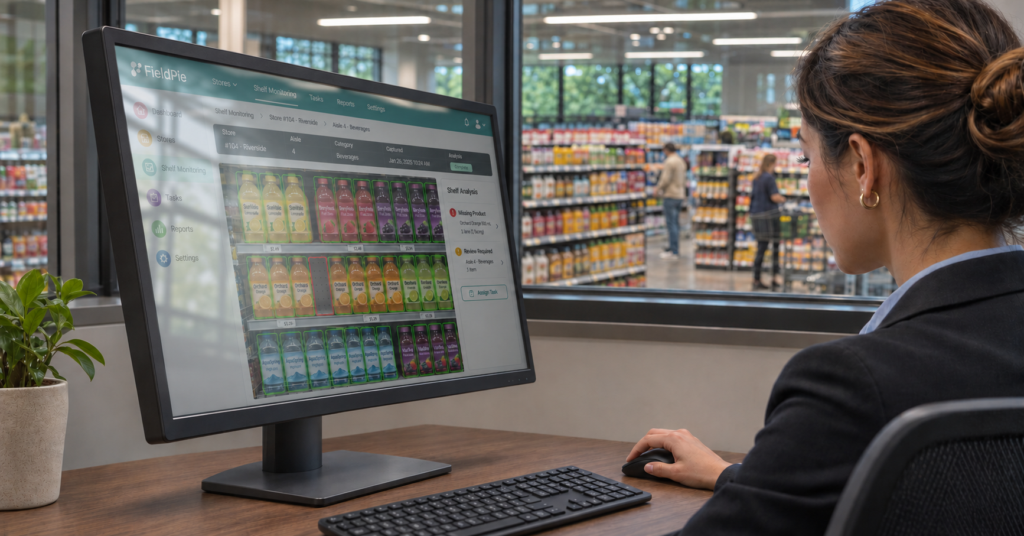
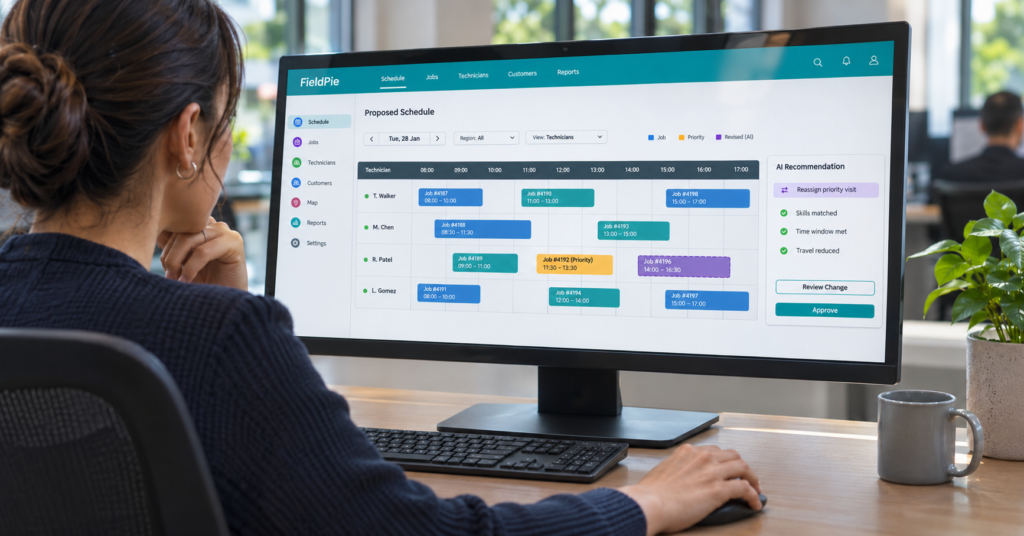
FieldPie fixes this at the operational level. From any mystery shopping questionnaire result, you can assign corrective actions, set deadlines, and track closure status in one place. No finding sits unowned.
Say your brand compliance audit flags three locations with non-compliant displays. FieldPie routes each task to the right field rep and timestamps every update. Overdue items surface automatically before they slip through.
Structured follow-up is what separates a mystery shopping program that drives real change from one that generates a monthly PDF nobody acts on. Without it, findings stall. If you are still unsure how to build the case internally, or how to handle pushback from field teams, the most common objections have clear answers.

Frequently Asked Questions About Mystery Shopping Follow-Ups
Even with a solid follow-up system in place, specific edge cases stall execution and erode executive confidence in the whole program.
Ownership confusion: When no single role holds accountability, corrective actions drift and expire without resolution.
Timing gaps: Delayed action on a mystery shopping finding lets the root behavior solidify before anyone intervenes.
Re-visit triggers: Not every finding warrants a second shopper assignment, but some absolutely do, and teams often can’t tell the difference.
Closure standards: Without a defined evidence threshold, “fixed” means something different to every store manager.
Scope creep: A brand compliance audit finding sometimes exposes a systemic training gap, which requires a different response than a one-location fix.
Who Should Own Mystery Shopping Follow-Up Actions?
Assign ownership to the person with the authority to implement the fix, often the store manager or operations lead. Use a district manager or another independent reviewer to verify closure when appropriate. Separate responsibility for completing the action from responsibility for confirming the result.
How Soon Should Teams Act on Mystery Shopping Findings?
Behavior that goes unaddressed for weeks tends to get treated as acceptable by the team on the floor.
Speed signals seriousness to field teams far more than any policy document does.
When Does a Finding Require Another Mystery Shopping Visit?
Schedule a repeat visit when a finding scores below your minimum threshold on two straight shopper assignments. Send a shopper back when a corrective action was marked closed but the same issue reappears. One low score is a data point; two in a row is a pattern that needs verification.
Structural issues need closer attention. A location that consistently fails brand compliance audit checks on signage or staff greeting protocols almost always needs a follow-up visit. That visit confirms the fix actually held. Isolated incidents usually don’t. Use a mystery shopping questionnaire designed to detect recurrence, not just initial compliance.
What Evidence Is Needed to Close a Store Issue?
Closure requires documented proof, not a manager’s verbal confirmation. Acceptable evidence includes a timestamped photo of a corrected display. It can also be a training completion record for the staff member involved. A supervisor sign-off tied to an on-site check works too.
FieldPie’s mystery shopping tools connect visit evidence with assigned tasks and follow-up workflows. Define the evidence and review required for each issue type, then confirm the result before treating the finding as resolved.
The real question isn’t whether your team can answer these objections in a vmeeting. It’s whether your follow-up system answers them automatically, every time, without anyone having to ask.
Conclusion
Clear ownership, defined timelines, and agreed standards for “done” are not administrative details. They are the actual product of a mystery shopping program. Without them, even a well-designed customer service evaluation produces a report that sits in someone’s inbox. Nothing changes on the floor.
Mystery shopping ROI doesn’t live in the scorecard. It lives in what happens after the shopper assignment closes. Who gets the finding? Who owns the fix? Does anyone check that the fix held? Mystery shopping vs. surveys is a common debate, but a more urgent question comes first. Ask whether your follow-up system is built to convert findings into closed actions at all.
Most teams lose weeks of potential improvement because no one tracks the follow-up process itself. They track only the brand compliance audit scores. FieldPie assigns findings directly to field managers, sets resolution deadlines, and flags overdue items before they fall through the cracks.
FieldPie is an AI-powered field operations platform. It helps businesses manage scheduling, routing, audits, sales, merchandising, and team tracking from one mobile-friendly tool.