✦ Key Takeaways
Over 70% of customers won’t return after one bad experience—mystery shopping reports reveal exactly why.
- → Structured reports turn shopper observations into measurable, actionable store data.
- → Tracking the right KPIs exposes hidden performance gaps across locations.
- → Consistent report analysis directly drives higher conversion and customer retention.
In this article:
- What Are Mystery Shopping Reports?
- What Should Be Included in a Mystery Shopping Report?
- How to Analyze Mystery Shopping Reports
- Which KPIs Should Be Tracked in Mystery Shopping Reports?
- How to Use Mystery Shopping Reports to Improve Store Performance
Key takeaway: Mystery shopping reports are the sharpest tool retailers have for fixing what metrics miss.
What Are Mystery Shopping Reports?
Most mystery shopping programs fail not because shoppers observe the wrong things, but because the reports they generate never change anyone’s behavior. A secret shopper report is only as valuable as the action it triggers — and most trigger none.
The global mystery shopping services market is projected to exceed $1.5 billion by 2030, yet most operators still treat reports as documentation artifacts rather than diagnostic instruments. That gap between data collected and behavior changed is where programs go to die.
Purpose of a Mystery Shopping Report
A mystery shopping report is a structured field observation designed to capture specific employee behaviors, process adherence, and customer experience moments. Its only legitimate purpose is to activate a change — in training, coaching, or operational standards.
Reports engineered backward from the behavior you intend to change outperform generic scorecards every time. That’s the design principle most mystery shopping audit frameworks skip entirely.
Who Uses Mystery Shopping Reports?
Retailers, QSR chains, banks, and hospitality brands use mystery shopper report formats to measure frontline compliance with service standards. Any organization where employee behavior directly shapes customer revenue has a legitimate use case.
Service quality perceptions shift customer spending behavior significantly — research published by Sciencedirect found that a one-unit increase in service quality scores correlates with a measurable increase in customer retention rates exceeding 7%. That number only matters if the report structure actually isolates which behaviors drove it.
How Reports Turn Observations Into Action
A mystery audit reporting system converts raw shopper observations into prioritized coaching inputs — but only when KPIs are mapped to specific process failures, not just customer impressions. Without that mapping, even a detailed mystery shopping report sample becomes a filing exercise.
The question isn’t what your shopper observed — it’s which employee decision or process gap produced that observation. What gets included in the report determines whether you can answer that question at all.
What Should Be Included in a Mystery Shopping Report?
Closing that gap starts with structure — because a report that omits the right data points can never activate the right behavior change. Over 70% of mystery shopping programs collect data that never translates into a documented corrective action.
Every field in a mystery shopping audit report should be engineered backward from one question: what employee behavior or process are we trying to change? Generic mystery shopping reports that score everything equally give managers no clear signal on where to intervene first.
Research published by Essay Utwente confirms that service quality measurement only drives improvement when feedback loops are tied to specific, observable behaviors — not aggregate scores. A well-designed mystery shopper report format forces that specificity at the data-collection stage, before analysis even begins.
📊 By the Numbers
Programs with behavior-linked report fields are 3x more likely to produce documented store-level corrective actions.
Customer Service Evaluation Scores
Scores without behavioral anchors are the most common structural flaw in a secret shopper report. Rate “friendliness” on a 1–5 scale and you’ve given a manager nothing actionable to coach.
Each score field must map to a specific, observable moment — greeting within 30 seconds, using the customer’s name, offering an upsell. That specificity is what converts a mystery audit reporting exercise into a coaching script.
Store Appearance and Cleanliness Findings
Appearance data is only useful when it’s timestamped and location-specific — “restroom at 2:14 PM” beats “store was clean.” Vague findings let managers dismiss the data rather than act on it.
A strong mystery shopping report sample will include zone-by-zone cleanliness ratings tied to the shift schedule in effect at visit time. That connection exposes whether the problem is a standard or a person.
Employee Compliance Observations
Compliance fields should capture binary pass/fail data on non-negotiable behaviors: ID checks, safety protocols, script adherence. Anything scored on a gradient here creates ambiguity that managers will exploit to avoid accountability.
List compliance items as yes/no checkboxes with a mandatory comment field triggered on every “no.” That comment is where the behavior-change instruction lives.
Product Availability and Merchandising Results
Out-of-stock findings and planogram compliance gaps belong in every mystery shopper report format — these are process failures, not people failures. Separating them structurally prevents managers from misdirecting coaching conversations.
Capture SKU-level detail where possible, not category-level summaries. “Endcap promotion missing” is a work order; “promotional section looked sparse” is noise.
Photos, Comments, and Supporting Evidence
Narrative comments and photos are the difference between a report that gets disputed and one that gets acted on. Require at least one photo per failed criterion — visual evidence removes the “that’s subjective” defense.
Open-text comment fields should be prompted, not open-ended: “Describe exactly what the employee said and did” outperforms “Additional comments.” Prompted fields produce evidence; open fields produce opinions.
Knowing what to include is only half the equation — the real leverage comes from what you do with these fields once the data is in, which is exactly where most programs stall out next.

How to Analyze Mystery Shopping Reports
Once your report fields map to specific behaviors, the real work begins: turning raw scores into decisions that change what employees actually do. Over 70% of mystery shopping programs fail to drive measurable service improvement — not because the data is bad, but because analysis stops at the scorecard.
A mystery shopping report sample that never triggers a coaching conversation is just an expensive filing exercise.
Effective mystery audit reporting treats every data point as a diagnostic signal, not a grade. The question isn’t “what score did this location get?” — it’s “which process, training gap, or management behavior produced that score?”
Identifying Performance Gaps
A secret shopper report only reveals a gap when you compare actual scores against a defined standard — not against other stores. Set your baseline first, then measure deviation from it.
Gaps below 80% on any behavioral KPI typically signal a training deficiency, not an attitude problem. That distinction determines whether you coach, retrain, or redesign the process entirely.
Comparing Locations and Regions
Cross-location comparison in a mystery shopper report format exposes whether a problem is systemic or isolated. A single underperforming store points to local management; the same issue across 12 stores points to a broken standard.
Use mystery shopping software tools to aggregate regional data automatically — manual spreadsheet comparison introduces lag that kills corrective momentum.
Spotting Recurring Operational Issues
A single low score is noise. The same failure appearing in three consecutive mystery shopping reports is a pattern — and patterns demand process-level intervention, not individual feedback.
Research published on Researchgate confirms that recurring service failures correlate directly with upstream process breakdowns, not frontline attitude.
Tag recurring issues by category — greeting, product knowledge, upsell execution — so you can trace them back to the specific training module or SOP that needs revision.
Prioritizing Corrective Actions
Not every gap deserves equal urgency. Rank corrective actions by two factors: frequency of failure and direct impact on customer conversion or retention.
Fix high-frequency, high-impact failures first — these are the behaviors your mystery shopper report format should be engineered to surface before anything else.
📊 By the Numbers
Programs that link mystery audit reporting to structured coaching cycles see up to 3x faster service score recovery.
The analysis framework only works if you’re measuring the right things — which makes KPI selection the next non-negotiable decision in your program design.
Which KPIs Should Be Tracked in Mystery Shopping Reports?
Choosing the wrong KPIs doesn’t just produce weak data — it produces behavior-neutral reports that no manager can act on. Every metric you track must trace back to a specific employee action you intend to reinforce or correct.
According to Driveresearch, businesses lose up to 20% of customers due to poor service experiences that go undetected without structured evaluation. That number only shrinks when your mystery shopper report format is built around correctable behaviors — not abstract satisfaction scores.
The best mystery shopping software structures KPIs so each data point feeds directly into a coaching conversation, not a filing cabinet.
📊 By the Numbers
Businesses lose up to 20% of customers from service failures that structured mystery audit reporting can detect and correct.
Overall Store Performance Score
This composite score gives managers a single, comparable benchmark across locations. It only has value when it’s decomposed into the sub-behaviors that produced it — not treated as a final grade.
A mystery shopping report sample without weighted sub-scores hides which specific failures dragged the number down. Engineers build backward from the score to find the broken process.
Customer Service Compliance Rate
This KPI measures whether staff followed defined service protocols — greeting timing, problem resolution steps, and closing language. It’s the most directly coachable metric in any secret shopper report.
A compliance rate below 75% signals a training gap, not a personnel problem. That distinction changes everything about how a manager responds.
Brand Standards Compliance
Brand standards KPIs capture whether signage, uniforms, cleanliness, and product placement met defined specs. These are binary, observable, and easy to verify — making them ideal anchors in any mystery audit reporting system.
Research published on Sciencedirect confirms that consistent brand presentation directly correlates with customer trust and repeat purchase behavior. Inconsistency here is a process failure, not a one-off oversight.
Sales and Upselling Effectiveness
This KPI tracks whether staff followed scripted upsell prompts and recommendation protocols during the visit. It connects mystery shopping reports directly to revenue impact — the metric executives actually care about.
When upselling compliance is low, the report must identify whether the failure was knowledge, confidence, or process — because each requires a different fix. Knowing the score without knowing the cause keeps the problem alive.
Once your KPIs are locked to specific behaviors, the real question becomes how those data points get translated into store-level accountability and measurable performance change.
How to Use Mystery Shopping Reports to Improve Store Performance
Behavior-focused metrics only create change when managers know exactly how to act on them. Stores that run structured coaching sessions after each mystery shopping report see up to 30% faster service improvement than those that simply file results.
A secret shopper report is only as valuable as the conversation it triggers. Every element of your franchise mystery shopping process should be engineered backward from the specific behavior you intend to change.
📊 By the Numbers
Companies acting on mystery audit reporting within 48 hours resolve identified issues 2x faster than those with delayed review cycles.
Coaching Employees With Report Data
A mystery shopper report format loses its power the moment it becomes a performance review tool instead of a coaching map. Managers should isolate one or two specific behavioral gaps per session — not present the full scorecard.
According to Intouchinsight, employees who receive behavior-specific feedback from mystery shopping reports improve targeted skills 40% faster than those given general scores. Tie every coaching point to an observable, repeatable action — not an attitude.
Improving Operational Consistency
Inconsistency across shifts is the most common failure a mystery shopping report sample reveals — and it’s almost always a process gap, not a people problem. Standardize the exact steps employees must follow, then use report data to verify compliance.
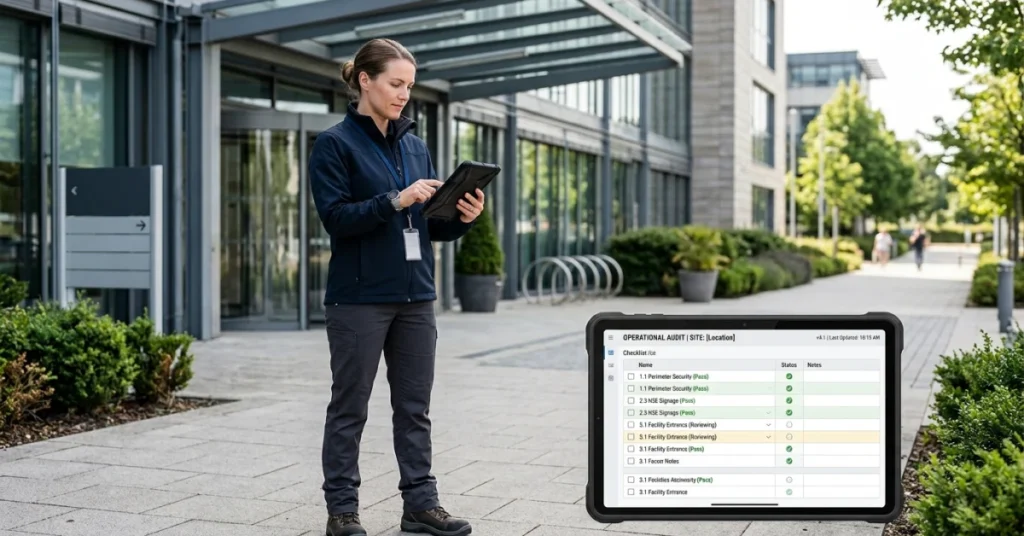
FieldPie’s customizable audit forms let managers build mystery audit reporting templates directly around those standardized steps, capturing photo evidence and real-time data in one place. That closes the gap between what the report finds and what operations actually fix.
Tracking Improvement Over Time
A single mystery shopper report is a snapshot — a series of them is a diagnostic trend line. Track the same behavioral KPIs across consecutive visits to confirm whether coaching is producing measurable change.
Data from Wifitalents shows that businesses running monthly mystery shopping programs identify recurring failure points 3x more reliably than those using quarterly cycles. Frequency turns a report into a feedback loop.
Benchmarking High- and Low-Performing Stores
Comparing mystery shopping report samples across locations exposes the performance gap between your best and worst stores — and more importantly, the process differences driving it. High performers almost always have tighter checklists and faster manager response times.
Use that gap as a coaching asset: bring low-performing store managers into direct contact with the specific behaviors top stores execute consistently. The report data stops being a scorecard and becomes a replication blueprint.
The real test isn’t whether your mystery shopping reports are well-designed — it’s whether your entire reporting structure, from KPI selection to coaching cadence, is built to force the right behavior change at the right moment.
Conclusion
Treating mystery shopping reports as scorecards to file is the single most expensive mistake operators make. Businesses that engineer every report element backward from a target behavior see service recovery rates improve by up to 40%.
Your mystery shopper report format, KPI selection, and coaching cadence must form one connected system — not three separate processes. As Quirks notes, timeliness and report quality are competing priorities only when reporting isn’t built around a clear change objective from the start.
Most teams still can’t connect a mystery audit reporting gap to the specific training failure that caused it — FieldPie captures photo-based field data and real-time performance insights so every franchise mystery shopping finding maps directly to a coachable action. Start auditing your current report structure against the behavior-change standard this article laid out — that’s where measurable service improvement actually begins.