



A retail audit is a systematic, on-site inspection of a retail environment that measures how well a store executes brand standards, merchandising guidelines, inventory levels, and operational compliance. It produces actionable data that helps brands and retailers close the gap between planned and actual in-store execution.
What Is a Retail Audit — and Why Does It Matter in 2026?
Retail is won or lost at the shelf. Yet according to industry research, nearly 25% of planned promotions never execute correctly at the store level — meaning marketing budgets evaporate before a single shopper sees them. A retail audit closes that gap by creating a structured feedback loop between head office strategy and store-level reality.
The business case is straightforward:
- Revenue protection: Out-of-stocks cost global retailers an estimated $1.75 trillion annually. Audits surface stockouts before they become lost sales.
- Brand equity: Inconsistent shelf presentation erodes shopper trust. Regular audits keep visual merchandising on-brand across every location.
- Compliance assurance: Regulatory requirements — food safety, labeling, pricing accuracy — carry legal liability. Documented audits provide a defensible paper trail.
- Competitive intelligence: Auditors capture competitor pricing, promotions, and shelf share data in real time.
For CPG brands managing hundreds of SKUs across thousands of stores, a disciplined audit program is not optional. It is the operational backbone of retail execution.
What Are the Types of Retail Audit?
Not every audit serves the same purpose. Choosing the right type for the right objective is the first strategic decision any brand or retailer must make.
| Audit Type | Primary Focus | Who Conducts It | Frequency |
|---|---|---|---|
| Store Operations Audit | SOPs, staffing, safety | Internal teams | Weekly / Monthly |
| Merchandising Audit | Shelf placement, planogram compliance | Field reps / 3rd party | Monthly / Quarterly |
| Inventory Audit | Stock levels, shrinkage, storage | Store managers / auditors | Monthly |
| Mystery Shopper Audit | Customer experience, service quality | Mystery shoppers | Quarterly |
| Compliance Audit | Pricing, labeling, regulatory rules | Internal / external | Quarterly / Annual |
| Competitive Audit | Competitor shelf share, pricing | Field teams | Ongoing |
How Does a Mystery Shopper Audit Differ from a Standard Audit?
A mystery shopper audit is conducted by an anonymous evaluator posing as a regular customer. Unlike a standard operational audit — where store staff know they are being assessed — the mystery format captures authentic service behavior. Mystery audits are particularly valuable for brands that want unfiltered information about how frontline employees represent their products. The tradeoff is cost: mystery programs require rigorous recruiter vetting, detailed briefing, and calibration to ensure consistent information across auditors.

How Do You Conduct a Retail Audit? (Step-by-Step)
Conducting a retail audit without a defined process produces inconsistent information and unreliable benchmarks. The following framework is used by leading CPG brands and retail chains to standardize execution across their field teams.
Step 1: Define the Audit Scope and Objectives
Before any auditor walks into a store, the team must answer three questions:
- What specific behaviors or conditions are we measuring?
- Which stores and which channels are in scope?
- What threshold constitutes a pass or a fail?
Vague objectives produce vague findings. If the goal is planogram compliance, the checklist must specify exact shelf positions, facing counts, and price tag placement — not just “product is on shelf.”
Step 2: Build a Structured Checklist
The checklist is the audit’s backbone. A high-quality checklist uses binary (yes/no) and scored questions, covers every critical execution variable, and is short enough to complete in under 30 minutes per store.
Step 3: Train and Calibrate Audit Teams
Inter-rater reliability is a common failure point. Two auditors visiting the same store should reach the same score within a 5% variance. Calibration sessions — where teams audit a reference store together and reconcile discrepancies — are standard practice among mature field organizations. Your teams need clear scoring rubrics, photo documentation requirements, and escalation protocols built into their training.
Step 4: Execute the Audit in the Field
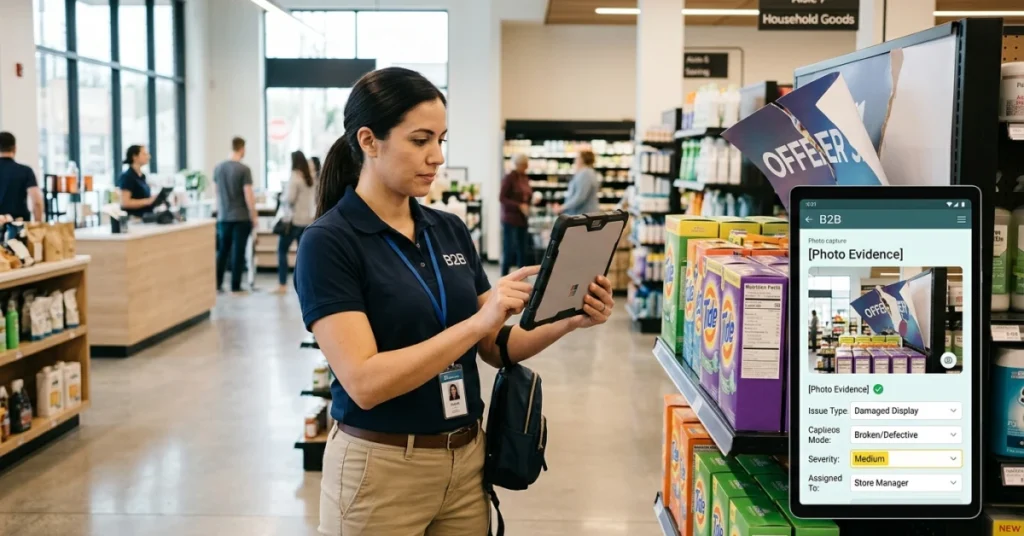
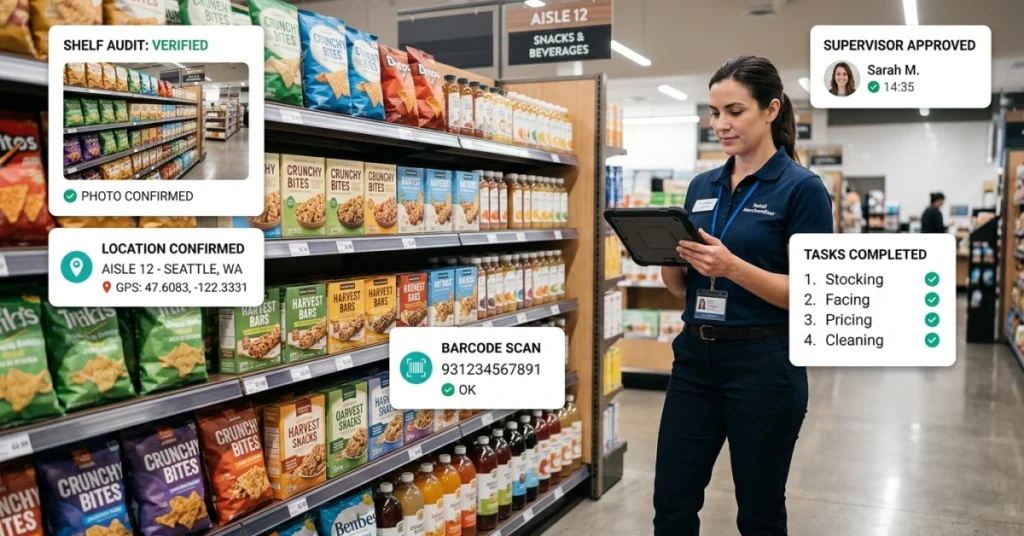
Auditors should arrive unannounced where possible, follow a consistent store walk sequence (typically entrance → gondola ends → main shelf → storage area → checkout), and capture timestamped photos as evidence. Digital audit software eliminates paper forms, auto-syncs data, and flags anomalies in real time — a critical advantage when managing large store portfolios.
Understanding how field team management software improves audit accuracy and reporting speed can help operations leaders make the case for technology investment internally.
Step 5: Analyze Results and Identify Root Causes
Raw scores mean little without context. Segment results by region, store format, account, and auditor to isolate systemic execution gaps from one-off incidents. A store scoring 62% on merchandising compliance in three consecutive audits has a structural problem — likely a training gap, a storage issue, or a distributor failure — not a random variance.
Step 6: Close the Loop with Corrective Actions
Every finding must generate a timestamped corrective action assigned to a named owner with a due date. Audits that produce reports but no follow-through are a waste of field resources. Best-in-class organizations re-audit corrective action items within 30 days to verify resolution.
The Essential Retail Audit Checklist (2026 Edition)
The following checklist covers the five core domains of any comprehensive store audit. Adapt it to your category, channel, and brand standards.
1. Shelf & Merchandising Compliance
- Products are stocked to the agreed planogram — correct shelf position, facing count, and height
- Shelf talkers, price labels, and promotional POS materials are present and undamaged
- No out-of-stocks on top 20 SKUs
- Competitor products have not encroached on allocated shelf space
- Seasonal or promotional displays are built to specification
2. Inventory & Storage
- Back-of-store storage is organized and accessible
- FIFO (First In, First Out) rotation is being followed
- No expired or damaged products on the shelf or in storage
- Inventory counts reconcile with system records within acceptable variance
- Replenishment orders are timely and accurate
3. Store Operations
- Store is clean, well-lit, and safe for customers and staff
- All required safety signage is posted and legible
- Staff-to-customer ratios meet brand standards during peak hours
- Opening and closing procedures are documented and followed
- Cash handling and POS procedures comply with company policy
4. Customer Experience
- Staff greet customers within 30 seconds of entry
- Product knowledge questions are answered accurately
- Fitting rooms (if applicable) are clean and fully stocked with size options
- Checkout wait times meet the brand’s service-level agreement
- Loyalty program enrollment is being actively promoted
5. Compliance & Legal
- All price labels match the POS system — no pricing discrepancies
- Product labeling meets applicable federal and state requirements
- Age-restricted products are secured and ID-check protocols are followed
- Food safety temperature logs are current (if applicable)
- Health and safety inspection records are up to date
Brands that embed this checklist into a mobile audit software platform report a 40–60% reduction in audit completion time and a significant improvement in data consistency across stores.
What Are the Most Common Retail Audit Challenges — and How Do You Solve Them?
Even well-resourced field teams run into the same recurring problems. Recognizing them early prevents them from becoming systemic.
Challenge 1: Inconsistent Data Quality
When auditors use paper forms or unstructured spreadsheets, the information collected varies wildly. One auditor photographs the shelf; another writes a text note. The result is data that cannot be aggregated or trended.
Solution: Standardize on a digital audit software platform that enforces mandatory photo fields, dropdown selections, and auto-calculated scores. This produces structured, comparable information across every store visit.
Challenge 2: Low Audit Coverage
Many brands can only audit 10–15% of their store estate in any given month due to field team capacity constraints. Low coverage means execution gaps go undetected for weeks.
Solution: Combine field rep audits with third-party crowd-sourced auditing for high-frequency, lower-cost coverage. As research on retail execution models confirms, blended audit models consistently outperform single-source approaches in coverage breadth.
Challenge 3: No Corrective Action Follow-Through
Brands produce detailed audit reports that store managers never action. Findings age in an inbox. The next audit finds the same defects.
Solution: Build corrective action workflows directly into your audit software. Automatically assign tasks, set deadlines, and trigger escalation alerts when items remain unresolved past their due date. Teams that manage corrective actions inside the same platform used for auditing close issues 3x faster than those relying on email follow-up.
Challenge 4: Auditor Bias and Score Inflation
Field reps auditing stores managed by colleagues they know personally tend to score more generously. This distorts benchmarks and masks real execution problems.
Solution: Rotate auditors across territories on a quarterly basis and use calibration audits to establish inter-rater reliability standards. Mystery shopper audits are a particularly effective check on score inflation because the auditor has no relationship with the store team.
How Do Brands Use Retail Audit Data Strategically?
Audit data is most powerful when it moves beyond compliance tracking into strategic decision-making. Here is how leading brands operationalize their findings.
Distributor performance management. Audit scores by distribution territory reveal which distributors consistently deliver on-shelf availability and which do not. This information drives contract negotiations, incentive structures, and distributor development programs.
New product launch validation. During an NPL window, daily or weekly audits confirm that new SKUs are achieving target distribution, correct shelf placement, and promotional execution on schedule. Brands that audit aggressively in the first four weeks of a launch can course-correct before velocity data from the retailer arrives — which often lags by 4–6 weeks.
Category management. Aggregated shelf data across hundreds of stores gives category managers a real-world picture of how space is actually being used versus how it was planogrammed. This information strengthens joint business planning conversations with retail buyers.
Mystery shopper benchmarking. Tracking mystery shopper scores over time — by store, region, and staff tenure — helps HR and training teams identify where service delivery is strongest and where intervention is needed. Brands that share mystery audit results with their retail partners as part of a joint scorecard report stronger collaborative relationships and better in-store execution outcomes.

Conclusion
A retail audit is the most direct mechanism brands and retailers have to verify that strategy translates into store-level reality. Done well, it protects revenue, strengthens brand equity, and creates a continuous improvement culture across the entire field organization. Done poorly — or not done at all — it leaves execution gaps that competitors are happy to exploit.
The shift from paper-based, ad hoc auditing to structured, software-enabled programs is no longer a competitive differentiator. It is the baseline. Brands that invest in the right checklist design, calibrated field teams, and integrated audit software will consistently outperform those that rely on intuition and anecdote to manage their in-store presence.
The checklist, frameworks, and best practices in this guide give you the foundation. The next step is execution.
Frequently Asked Questions (FAQ)
What is the difference between a retail audit and a store visit?
A store visit is an informal, relationship-focused interaction between a field rep and a store manager. A retail audit is a structured, scored assessment against defined standards. Audits produce comparable, trackable data; store visits do not. Both have a role in a field execution program, but they serve different purposes and should not be conflated.
How often should a retail audit be conducted?
Frequency depends on store tier, category velocity, and business risk. High-priority stores in key accounts typically warrant monthly audits. Mid-tier stores are commonly audited quarterly. Brands launching new products or running major promotions should increase audit frequency during those windows — weekly audits in the first four weeks of a launch are standard practice for leading CPG companies.