




In sales, good intentions don’t close deals — structured execution does. An action plan for sales translates your revenue targets into concrete daily tasks, giving every member of your team a clear answer to the question: “What should I be doing right now?”
What Is a Sales Action Plan?
An action plan for sales is a written document that connects your sales goals to the specific activities required to achieve them. It defines what needs to happen, who is responsible, by when, and with what resources.
It’s worth distinguishing it from a sales strategy: a strategy tells you what you want to achieve and why; an action plan tells you how, broken down into weekly and monthly tasks.
Who Should Use a Sales Action Plan
Sales reps use it to prioritize their pipeline and manage their time against quota. Sales managers use it to align the team, spot performance gaps early, and structure coaching. Small business owners use it to build a repeatable process before scaling.
Without a plan, even experienced salespeople default to comfortable habits rather than high-impact activities.
The Five Building Blocks
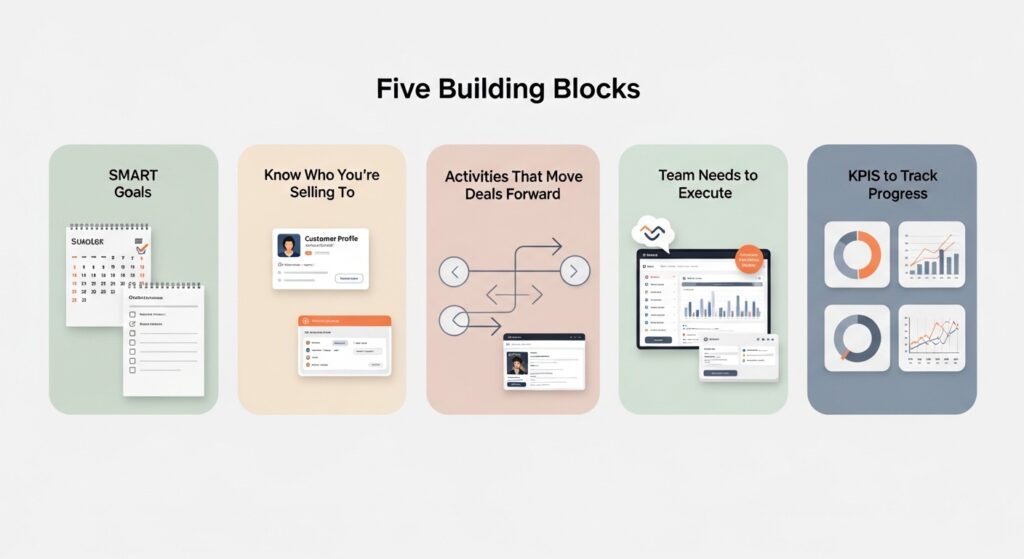
1. SMART Goals
Vague targets produce vague results. Every goal in your plan should be:
| Component | Question it answers | Example |
|---|---|---|
| Specific | What exactly? | Increase new customer acquisition |
| Measurable | How much? | By 20% |
| Achievable | Is it realistic? | Based on current pipeline capacity |
| Relevant | Why does it matter? | Supports Q3 revenue target |
| Time-bound | By when? | By September 30 |
Combined: “Increase new customer acquisition by 20% by September 30, in line with the Q3 revenue target.”
2. Know Who You’re Selling To
Before defining activities, you need a sharp understanding of who you’re selling to:
- What problems are they trying to solve?
- What does their buying process look like?
- Who are the decision-makers and what objections do they typically raise?
This isn’t a one-time exercise. Customer profiles should be updated as you gather real data from won and lost deals.
3. The Activities That Move Deals Forward
List the specific actions that will move deals forward at each stage of your pipeline:
- Lead generation: outbound outreach, referrals, inbound content
- Qualification: criteria for advancing or disqualifying a lead
- Presentation and proposal: format, key messages, approval process
- Follow-up: timing, channel, escalation path
- Closing: negotiation parameters, sign-off authority
The more precisely these are defined, the easier it is to identify where deals stall.
4. What Your Team Actually Needs to Execute
Identify what your team needs to execute the plan — and make sure it’s actually available:
- CRM and sales tools
- Training or onboarding time
- Marketing materials and content
- Budget for outreach and events
5. KPIs to Track Progress
Choose metrics that reflect activity and outcomes:
- Number of qualified leads generated per week
- Lead-to-opportunity conversion rate
- Opportunity-to-win conversion rate
- Average deal size
- Sales cycle length
Track these consistently. A metric that’s only reviewed at quarter-end is too late to act on.
How to Build the Plan: 8 Steps
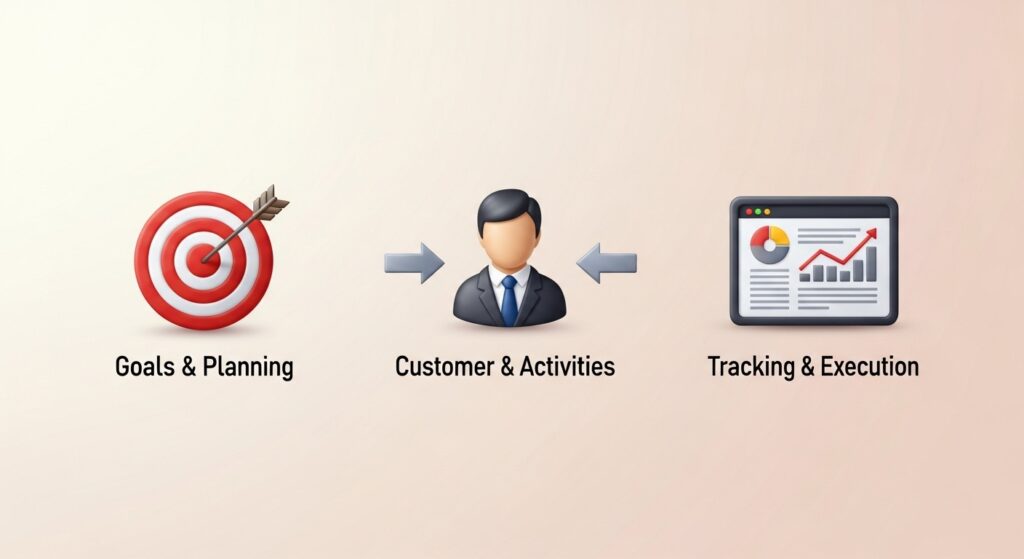
Step 1 — Set your goals
Start with your top-line number — revenue, new customers, or market share — and work backwards. An annual target means nothing without quarterly and monthly breakdowns that tell reps what they need to hit this month to stay on track.
One thing most plans skip: account for seasonality and known gaps. If Q1 is historically slow, don’t divide your annual target by four and call it a plan. Your action plan for sales is only as reliable as the assumptions behind the numbers.
Step 2 — Define your target customer
Don’t start with a broad market description. Start with your last 20 closed deals and ask: what do the best ones have in common? Industry, company size, budget range, buying trigger, decision-maker title.
Focus on segments where you have the shortest sales cycle and the highest win rate. That combination tells you where your offer fits naturally — and that’s where you should concentrate first before expanding.
Step 3 — Map your sales process
List every stage from first contact to signed contract. For each one, define two things:
- Entry criteria: What has to be true for a deal to move into this stage?
- Exit criteria: What has to happen before it moves to the next one?
Without these, reps will use stages inconsistently and your pipeline data becomes unreliable. A deal that’s been in “proposal sent” for 60 days isn’t in that stage — it’s lost or stalled, and you need to know which. A solid action plan for sales depends on pipeline data you can actually trust.
Step 4 — Assign activities and owners
For each stage in your process, list the specific tasks that need to happen and name who is responsible for each. This is where most plans stay vague — and where execution breaks down.
“Follow up with the prospect” is not a task. “Send a comparison document to the CFO within 48 hours of the demo” is a task. Specificity removes the need for interpretation.
Step 5 — Identify your tools and resources
Go through the activities you defined in Step 4 and ask: what does someone need to complete this well? Then check whether those things actually exist and are accessible.
Common gaps teams discover here: outdated case studies, CRM fields that don’t match the actual sales process, or tools that are paid for but barely used. Don’t add new platforms before fixing these.
Step 6 — Build your messaging
For each customer segment, answer one core question: why should they choose you over doing nothing or choosing a competitor?
Then turn that answer into usable assets:
- Email templates for each stage of the process
- Call frameworks that give reps structure without making them sound scripted
- Objection-handling guides based on the objections your team actually encounters, not hypothetical ones
Update these regularly. Messaging that was working 12 months ago may no longer reflect how the market is thinking. Keeping these assets current is one of the most overlooked parts of maintaining an effective action plan for sales.
Step 7 — Set up tracking
Decide which KPIs you’ll monitor, how often, and who is responsible for reporting them. A reasonable baseline for most teams:
| Frequency | What to review |
|---|---|
| Weekly | Pipeline movement, activity metrics, deals at risk |
| Monthly | Conversion rates, average deal size, cycle length |
| Quarterly | Win/loss analysis, forecast accuracy, goal progress |
The point isn’t to generate reports — it’s to catch problems early enough to do something about them.
Step 8 — Schedule reviews and revisions
Put review dates in the calendar before the plan goes live. Not as optional check-ins, but as fixed commitments.
When you review, ask three questions: What’s working and should be reinforced? What isn’t working and needs to change? What do we know now that we didn’t know when we wrote the plan?
The answers should update the plan. A plan that never changes isn’t being used — it’s just being filed.
Execution: Where Plans Actually Succeed or Fail
A well-built action plan for sales fails if execution is inconsistent. Most teams don’t lose in strategy meetings — they lose in their daily habits.
1. Daily Activity Targets
Setting a target number isn’t enough — you also need to define what counts. When you say “10 calls,” do you mean voicemails left, or actual conversations? Attempts that don’t result in a connection should be tracked separately.
Practical tip: Set daily activity targets with the team at the start of the week, then compare them against what actually happened at the end of it. If there’s a consistent gap, either the target is wrong or the obstacle is somewhere else.
2. Short Feedback Loops
Weekly one-on-ones are the only reliable way to intervene before problems become losses. But these meetings need structure — they can’t turn into casual catch-ups.
An effective weekly check-in answers three questions:
- Which opportunities moved forward this week, and which ones stalled?
- What’s blocking the ones that stalled, and how can I help?
- What’s your focus for next week?
It shouldn’t exceed 45 minutes. If it does, the scope is drifting.
3. Written Accountability
“I’ll handle it” is not a commitment. A task without an owner and a deadline is a suggestion — nothing more.
Every action item needs three pieces of information: what will be done, who will do it, and by when. If any one of those is missing, the task hasn’t been defined yet. Track this in your CRM, in meeting notes, or in a shared document — what matters is that everyone is looking at the same list.
4. Regular Pipeline Hygiene
Stale deals distort your forecast, drain your team’s energy, and prevent you from seeing where you actually stand. An opportunity that hasn’t moved in six months isn’t “in the pipeline” — it’s just taking up space.
On a fixed schedule — for example, the last week of every month — ask one question: Has there been any meaningful progress on this opportunity in the last 30 days? If not, either re-qualify it or close it out.
A clean pipeline is a small but reliable pipeline. That’s always more valuable than one that looks impressive but can’t be trusted. This is the standard every action plan for sales should hold itself to.
Conclusion
A strong action plan for sales doesn’t just define what should happen — it ensures it actually does. When your team has clear goals, structured activities, and real-time visibility into performance, execution stops being inconsistent and starts driving predictable results.
Turn your sales plan into consistent execution with FieldPie. Book a demo today and see how you can streamline your processes, improve team performance, and close more deals.