


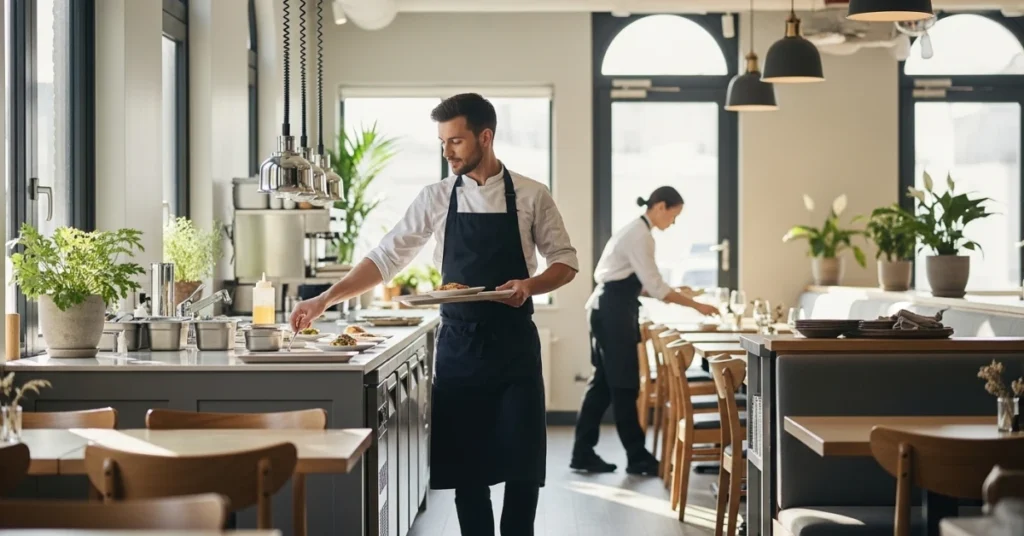
Restaurant standard operating procedures (SOPs) are written, step-by-step instructions that standardize every recurring task in a food service operation — from handwashing protocols and food temperature controls to opening checklists and customer complaint handling — ensuring consistent quality, regulatory compliance, and staff accountability across every shift.
What Are Restaurant Standard Operating Procedures — and Why Do They Matter in 2026?
Running a restaurant without documented SOPs is like navigating without a map. Every manager interprets tasks differently, every new hire reinvents the wheel, and every health inspection becomes a gamble.
The stakes are real: a staggering 60% of restaurants fail within their first year, with operational inefficiency cited as a major contributing factor. Restaurant standard operating procedures directly address that inefficiency by removing guesswork from daily operations.
Here’s what well-documented SOPs deliver:
- Consistency — Guests receive the same food quality and service on a slow Tuesday as on a packed Saturday night.
- Regulatory compliance — State and federal food safety laws (including FDA Food Code requirements) mandate written procedures for critical control points.
- Faster onboarding — New staff can follow documented steps rather than relying on tribal knowledge.
- Reduced liability — Written records demonstrate due diligence during health inspections and legal disputes.
- Lower turnover costs — Clear expectations reduce frustration and improve staff confidence.
Regulatory note: Michigan’s Food Law, for example, legally requires standard operating procedures to be established before a food establishment opens. Similar requirements exist in most U.S. states under their respective modified food codes.
What Are the Core Categories of Restaurant SOPs?
Restaurant standard operating procedures fall into five primary operational areas. Each area requires its own documented protocols.
| SOP Category | Key Procedures Covered | Regulatory Anchor |
|---|---|---|
| Food Safety & Handling | Temperature control, FIFO, thawing, cooling, reheating | FDA Food Code, HACCP |
| Sanitation & Hygiene | Handwashing, surface sanitizing, dishwashing | FDA 21 CFR, state health codes |
| Front of House (FOH) | Guest greeting, table turns, complaint resolution | Brand standards |
| Back of House (BOH) | Prep procedures, recipe execution, equipment checks | OSHA, local fire codes |
| HR & Staff Management | Scheduling, training, uniform standards, employee health | FLSA, state labor laws |

How Do You Write a Restaurant SOP From Scratch?
A strong SOP is not a policy statement — it’s an actionable instruction set. Follow this six-step framework:
Step 1: Identify the Task
List every recurring operation that affects food safety, guest experience, or legal compliance. Prioritize tasks where inconsistency causes the most damage.
Step 2: Observe Current Best Practice
Shadow your top-performing staff member executing the task. Document exactly what they do — sequence, tools used, time taken, and decision points.
Step 3: Define the Standard
Set measurable benchmarks. Not “cook chicken thoroughly” but “cook chicken breast to an internal temperature of 165°F (74°C), verified with a calibrated thermometer.”
Step 4: Write the Procedure
Use plain language. Structure it as:
- Purpose — why this task matters
- Scope — who is responsible
- Materials — tools and supplies needed
- Steps — numbered, sequential instructions
- Verification — how completion is confirmed
Step 5: Train and Test
Walk staff through the SOP before their first solo execution. Use skills demonstrations, not just verbal explanations. University of Minnesota Extension recommends using SOPs as active training documents, not binders that collect dust.
Step 6: Review and Update
Schedule a formal SOP review every 6–12 months, or immediately after a health violation, menu change, or equipment upgrade.
What Are the 8 Essential Restaurant SOPs Every Operation Needs?
1. Handwashing SOP
The single most critical food safety procedure. Per FDA Food Code guidelines, staff must wash hands:
- Before handling food
- After touching raw proteins
- After using the restroom
- After handling garbage or chemicals
Specify: 20-second minimum wash time with soap, water temperature at least 100°F, single-use paper towels for drying.
2. Food Temperature Control SOP
Cold foods must stay at or below 41°F (5°C). Hot foods must stay at or above 135°F (57°C). The danger zone — 41°F to 135°F — is where bacterial growth accelerates.
Require staff to log temperatures at minimum every 2 hours during service, using calibrated thermometers checked at least once per day.
3. FIFO (First In, First Out) Inventory SOP
All incoming product is labeled with the receipt date and placed behind existing stock. Older product always moves to the front. This single procedure dramatically reduces food waste and spoilage-related illness risk.
4. Cleaning and Sanitizing Food Contact Surfaces SOP
Distinguish between cleaning (removing visible soil) and sanitizing (reducing pathogens to safe levels). These are two separate steps — sanitizer applied to a dirty surface is ineffective.
Per Michigan’s Fixed Food Establishment SOP Manual, all food contact surfaces must be washed, rinsed, and sanitized after each use and at minimum every 4 hours during continuous use.
5. Employee Health and Illness SOP
Document the specific symptoms that require an employee to be excluded from food handling: vomiting, diarrhea, jaundice, sore throat with fever, or diagnosed infection with Salmonella, E. coli O157:H7, Hepatitis A, or Norovirus.
This SOP protects both guests and the business from liability.
6. Opening and Closing Checklist SOP
Standardize every opening and closing task to ensure equipment is checked, food is stored correctly, security is confirmed, and the next shift inherits a clean, ready operation.
7. Guest Complaint Resolution SOP
Define a clear escalation path: front-line staff response → manager involvement → compensation authority → incident documentation. A scripted, empathetic response process turns negative experiences into loyalty opportunities.
8. New Employee Onboarding and Training SOP
Specify exactly what a new hire must learn, demonstrate, and be tested on before working unsupervised. Include food handler certification requirements (most states mandate this within 30–60 days of hire).
Frequently Asked Questions (FAQ)
What is the difference between a restaurant SOP and a policy?
A policy states what the rule is (“Employees must wash hands before handling food”). An SOP explains exactly how to execute it — the specific steps, sequence, materials, and verification method. Policies set expectations; SOPs make compliance actionable.
How many SOPs does a restaurant need?
Most full-service restaurants require a minimum of 20–30 documented SOPs to cover core food safety, sanitation, FOH service, BOH operations, and HR functions. Quick-service and fast-casual concepts may need fewer, but food safety SOPs are non-negotiable regardless of format.
Are restaurant SOPs legally required in the United States?
Yes, in most jurisdictions. The FDA Food Code — adopted in full or modified form by all 50 states — requires written procedures for critical food safety functions. States like Michigan explicitly require SOPs to be submitted and approved before a new establishment opens. Always verify requirements with your local health authority.
Conclusion
Restaurant standard operating procedures are not bureaucratic paperwork — they are the operational backbone of every profitable, compliant, and consistent food service business. From handwashing protocols grounded in FDA Food Code requirements to guest complaint resolution scripts, a well-built SOP library reduces risk, accelerates training, and protects your brand on every shift.
The restaurants that win in 2026 aren’t the ones with the most talented staff — they’re the ones whose talented staff operates within a system that makes excellence the default outcome. Start with the checklist above, prioritize your food safety SOPs first, and digitize your entire library as quickly as operationally feasible.
Ready to digitize your restaurant SOPs and manage compliance in real time?
FieldPie gives restaurant operators a mobile-first platform to deploy checklists, track task completion, and build an audit-ready SOP system — across one location or fifty.
👉Book a free demo with FieldPie today and see how leading operators are turning SOPs into a competitive advantage.