


Construction safety refers to the systematic set of policies, procedures, and physical controls designed to protect workers, contractors, and the public from injury, illness, and death on construction sites. It encompasses hazard identification, risk assessment, regulatory compliance, and the ongoing management of site conditions throughout every phase of a project.
What Is Construction Safety and Why Does It Matter in 2026?
The construction industry remains one of the most hazardous sectors in the U.S. economy. According to OSHA’s construction industry data, the “Fatal Four” — falls, struck-by incidents, electrocutions, and caught-in/between accidents — account for more than 60% of all construction worker fatalities each year. Eliminating these four hazards alone would save more than 400 lives annually.
The numbers carry real weight. The Bureau of Labor Statistics consistently places construction among the top three industries for fatal occupational injuries. For project owners, contractors, and safety officers, understanding and enforcing construction safety standards is not optional — it is a legal obligation and a moral imperative.
On a purely financial level, every $1 invested in safety programs returns an estimated $4 to $6 in reduced workers’ compensation costs, lower insurance premiums, and avoided project delays.
What Are the Core Legal Standards Governing Construction Sites?
How Does OSHA Regulate the Construction Industry?
In the United States, the Occupational Safety and Health Administration (OSHA) sets and enforces the primary federal standards for construction site safety under 29 CFR Part 1926. Key subparts include:
- Subpart E — Personal Protective Equipment (PPE)
- Subpart L — Scaffolding
- Subpart M — Fall Protection (the single most-cited OSHA standard, year after year)
- Subpart O — Motor Vehicles and Mechanized Equipment
- Subpart P — Excavations
- Subpart Q — Concrete and Masonry Construction
- Subpart R — Steel Erection
OSHA’s construction standards require employers to provide a workplace free from recognized hazards. Violations can result in penalties exceeding $16,131 per serious citation and up to $161,323 for willful or repeated violations as of 2026.
What Role Do International Standards Play?
Beyond U.S. borders, the International Labour Organization (ILO) has published foundational guidance on safety health and welfare on construction sites. As the ILO’s training manual on construction safety outlines, effective safety health management requires tripartite cooperation among governments, employers, and workers — a principle that translates directly into site-level safety culture.
In the UK, the Health and Safety Executive (HSE) governs construction under the Construction (Design and Management) Regulations 2015 (CDM 2015). The HSE’s guidance on health and safety in construction identifies pre-construction planning, competence verification, and site management as the three pillars of effective hazard control.

What Are the Most Common Hazards on a Construction Site?
Understanding hazard categories is the foundation of any risk management program. The following table summarizes the most prevalent hazard types, their primary causes, and the applicable OSHA standard.
| Hazard Category | Primary Cause | Applicable OSHA Standard |
|---|---|---|
| Falls from height | Unguarded edges, unstable scaffolding | 29 CFR 1926 Subpart M |
| Struck-by objects | Falling tools, moving vehicles | 29 CFR 1926.502 |
| Electrocution | Unprotected wiring, overhead power lines | 29 CFR 1926 Subpart K |
| Caught-in/between | Unguarded machinery, trench collapses | 29 CFR 1926 Subpart P |
| Hazardous substances | Silica dust, asbestos, lead paint | 29 CFR 1926.1153 |
| Heat stress | High ambient temperatures, physical exertion | OSHA Heat Illness Prevention |
| Manual handling | Repetitive lifting, awkward postures | General Duty Clause |
Falls alone account for roughly 36% of all construction fatalities in the U.S. Scaffolding deficiencies and unprotected roof edges are the leading contributors. Any site with work at heights above 6 feet must have a written fall protection plan — a non-negotiable requirement under OSHA regulations.
Silica dust exposure is a rising concern. Workers who cut, grind, or drill concrete and masonry may inhale respirable crystalline silica, which causes silicosis — an irreversible and potentially fatal lung disease. OSHA’s silica standard (29 CFR 1926.1153), effective since 2017, mandates exposure assessment, engineering controls, and medical surveillance on all affected construction sites.
How Should You Build a Construction Safety Management System?
A robust safety management system (SMS) is not a binder on a shelf. It is a living operational framework. The most effective systems follow a Plan-Do-Check-Act (PDCA) cycle aligned with OSHA’s Injury and Illness Prevention Program (I2P2) guidelines.
Step 1: Conduct a Baseline Hazard Assessment
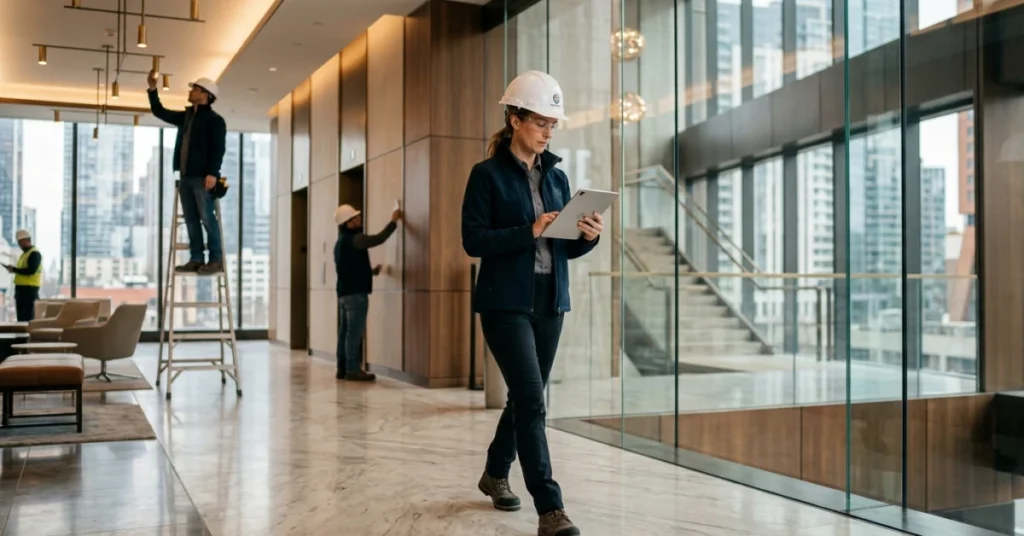
Before work begins on any project, the site safety officer should walk every work zone and document:
- Existing physical hazards (unstable ground, overhead utilities, confined spaces)
- Planned activities and their associated risks
- Worker competencies and training gaps
- Emergency egress routes and assembly points
This assessment feeds directly into the site-specific Safety and Health Plan (SHP), which should be updated whenever site conditions change materially.
Step 2: Establish a Clear Safety Health Policy
Management commitment is the single strongest predictor of safety performance. Leadership should issue a written safety health policy that:
- States zero tolerance for preventable incidents
- Assigns accountability by role (project manager, foreman, subcontractor)
- Allocates a defined budget for PPE, training, and equipment inspection
- Sets measurable leading indicators (near-miss reporting rate, toolbox talk completion rate)
Step 3: Implement Hazard Controls Using the Hierarchy of Controls
The hierarchy of controls — from most to least effective — should guide every risk mitigation decision:
- Elimination — Remove the hazard entirely (e.g., prefabricate components off-site)
- Substitution — Replace with a less hazardous method (e.g., water suppression instead of dry cutting)
- Engineering controls — Physical barriers, guardrails, ventilation systems
- Administrative controls — Safe work procedures, permit-to-work systems, job rotation
- PPE — Hard hats, high-visibility vests, fall arrest harnesses, respiratory protection
PPE is the last line of defense, not the first. Over-reliance on PPE without upstream controls is a systemic failure.
Step 4: Train Every Worker Before They Enter the Site
OSHA requires site-specific safety training before workers begin any task. Training should be:
- Delivered in the worker’s primary language
- Task-specific (scaffold erection, confined space entry, crane signaling)
- Documented with signatures and dates
- Refreshed whenever new hazards are introduced or an incident occurs
The University of Minnesota CCAPS recommends that construction safety training cover not only physical hazards but also mental health awareness — a growing concern given elevated suicide rates in the construction trades.
Step 5: Enforce a Permit-to-Work System
High-risk activities — confined space entry, hot work, work at height, energized electrical work — should require a formal written permit before execution. The permit system forces a structured hazard review, designates a competent person to supervise, and creates a documented audit trail.
Step 6: Conduct Regular Site Inspections
Scheduled and unannounced inspections are critical to maintaining compliance. Inspections should use standardized checklists and should result in time-bound corrective actions assigned to named individuals. Tracking open findings through a field inspection and reporting tool ensures nothing falls through the cracks.
Step 7: Investigate Every Incident and Near-Miss
Near-misses are free lessons. Every incident — including those with no injury — should trigger a root cause analysis (RCA). The RCA should identify systemic failures, not just individual behavior, and should produce corrective actions that prevent recurrence.
Construction Safety Checklist: 25 Non-Negotiable Items for Every Site
Use this checklist at project kickoff and repeat weekly. Items marked with ★ are OSHA-citable if absent.
Site Access and Perimeter
- ★ Perimeter fencing and signage in place
- ★ Authorized personnel list maintained and enforced
- Emergency contact numbers posted at site entrance
- First aid kit stocked and location communicated to all workers
Fall Protection
- ★ Guardrails installed on all edges above 6 feet
- ★ Personal fall arrest systems inspected and documented
- ★ Ladder safety: proper angle (4:1 ratio), secured at top
- ★ Scaffold inspection completed by a competent person before each shift
Electrical Safety
- ★ GFCI protection on all temporary power
- ★ Overhead power line clearance distances maintained (minimum 10 feet)
- Lockout/tagout (LOTO) procedures posted and trained
Excavation and Trenching
- ★ Competent person on-site for all excavations deeper than 5 feet
- ★ Spoil piles set back minimum 2 feet from trench edge
- Utility locates (811 call) completed and documented
Equipment and Tools
- ★ Equipment pre-use inspections logged daily
- Operators hold valid certifications for cranes, forklifts, and aerial lifts
- Defective tools tagged out and removed from service
PPE
- ★ Hard hats worn in all active work zones
- ★ High-visibility vests worn near vehicle traffic
- Respiratory protection fit-tested and in use where silica or dust exposure exists
Emergency Preparedness
- Emergency action plan posted and communicated
- Muster point identified and marked
- Workers trained in first aid and CPR (minimum 1 per crew)
Documentation
- Toolbox talk completed and signed off this week
- Safety data sheets (SDS) accessible for all hazardous materials on site

What Are the Key Roles and Responsibilities in Construction Safety?
Accountability must be distributed — not siloed in a single safety officer. The following role matrix clarifies who owns what on a compliant construction site.
| Role | Primary Safety Responsibility |
|---|---|
| Project Owner / Client | Appoint a Principal Designer; ensure CDM/OSHA compliance in contract terms |
| Project Manager | Integrate safety into schedule and budget; escalate unresolved hazards |
| Site Safety Officer | Develop SHP; conduct inspections; manage incident reporting |
| Competent Person (OSHA) | Identify and correct hazards in specific areas (excavations, scaffolding) |
| Foreman / Supervisor | Deliver daily toolbox talks; enforce PPE and work procedures |
| Subcontractor | Submit site-specific safety plan; ensure their workers are trained |
| Every Worker | Report hazards and near-misses; refuse unsafe work |
Construction Safety Week, an industry-wide annual initiative, reinforces this shared accountability model through its “Recognize, Respond, Respect” framework — a call to action that applies to every level of the organizational chart, from the C-suite to the newest apprentice on the job.
Conclusion
Construction safety is not just about meeting OSHA requirements — it is about creating a culture where every worker returns home safely at the end of the day. From fall protection and hazard assessments to worker training and regular site inspections, effective safety programs reduce accidents, improve compliance, and protect both people and project performance.
As construction projects become more complex and regulations continue to evolve, companies that invest in proactive construction safety management will be better positioned to reduce risk, avoid costly delays, and maintain long-term operational success.