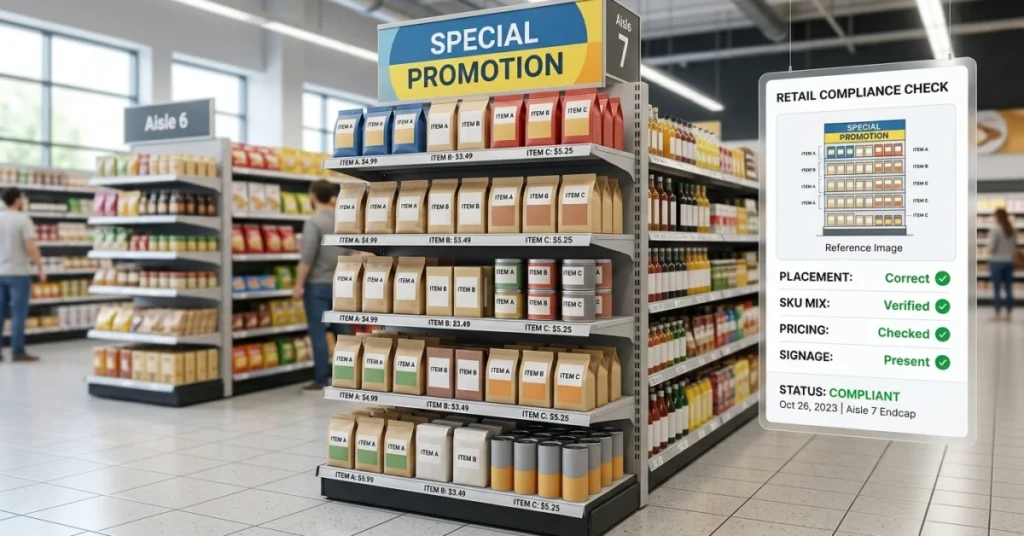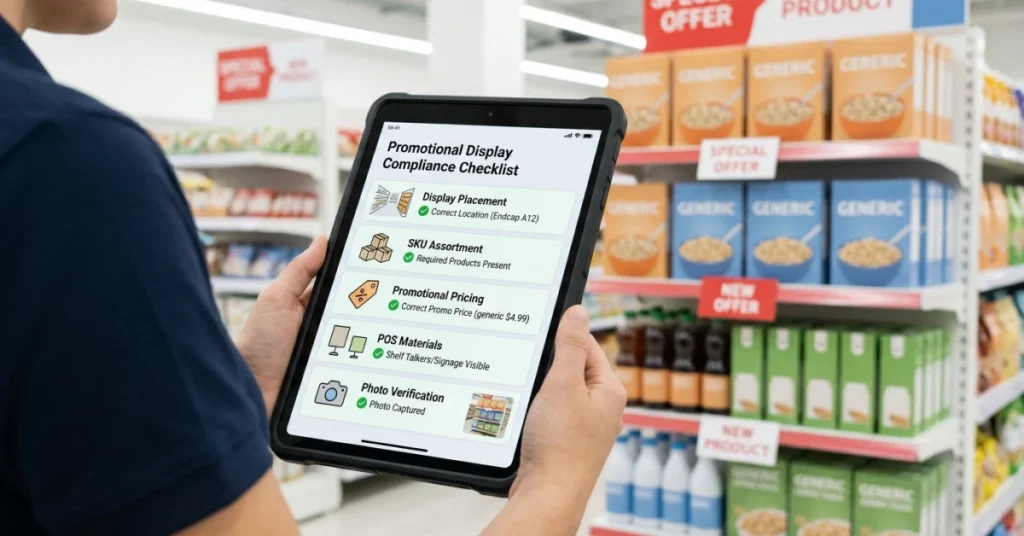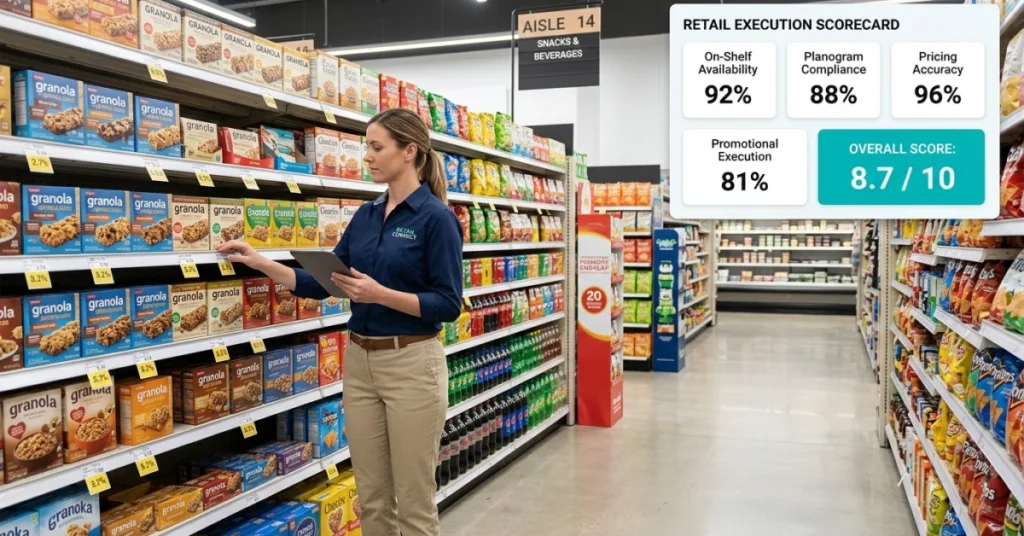



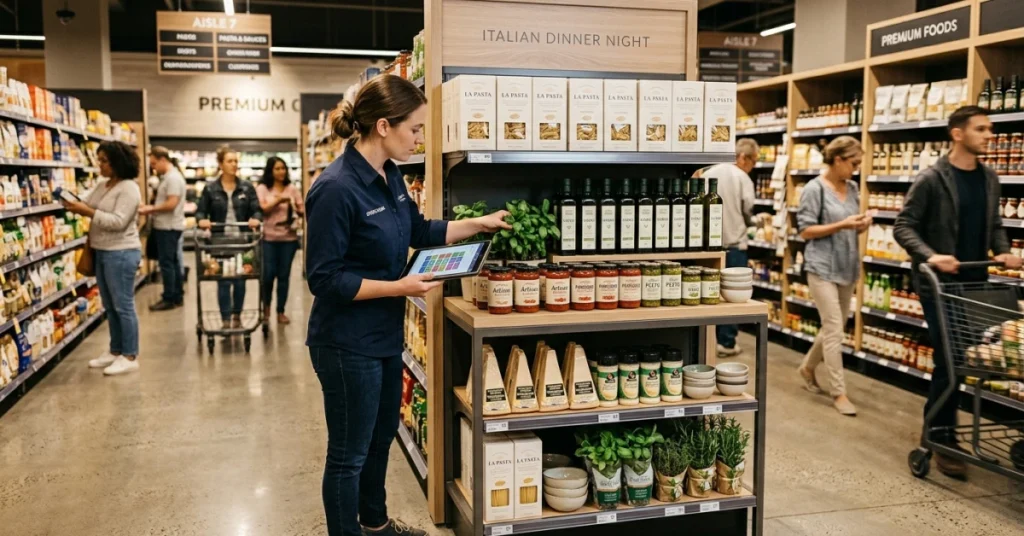
Cross merchandising is the practice of displaying complementary, non-competing products together at the point of sale to encourage customers to purchase additional items, increase basket size, and improve the overall shopping experience. Done right, it can lift sales by as much as 20%.
What Is Cross Merchandising and Why Does It Matter in 2026?
Cross merchandising sits at the intersection of retail psychology and strategic product placement. Rather than letting customers navigate a store on autopilot, crossmerchandising creates deliberate product pairings that spark discovery, solve problems, and drive unplanned purchases.
The logic is straightforward: a customer who picks up a bag of pasta is already thinking about dinner. Place marinara sauce and parmesan cheese within arm’s reach, and you’ve just solved their meal—and tripled the transaction.
According to the Cambridge Dictionary, the term is formally defined in commerce and marketing as the placement of related products from different categories to stimulate additional buying behavior. That definition, while precise, undersells the strategic depth the practice demands in today’s omnichannel retail environment.
In 2026, crossmerchandising has expanded well beyond the grocery aisle. It now shapes e-commerce product pages, digital shelf layouts, and even mobile app recommendation engines. Brands that master it gain a measurable edge in customer lifetime value and average order value (AOV).
How Does Cross Merchandising Actually Work?
At its core, cross merchandising works by exploiting the principle of contextual relevance. When customers encounter items that logically belong together, their brain registers convenience rather than a sales pitch. That psychological shift is the difference between a shopper who feels helped and one who feels pressured.
The mechanics break down into three layers:
- Product pairing logic: Items must share a clear use-case connection. Coffee and filters. Sunscreen and after-sun lotion. Running shoes and moisture-wicking socks.
- Physical or digital placement: Products must be close enough that the customer can act on the suggestion without friction—adjacent shelving, end-cap displays, or “frequently bought together” modules online.
- Visual storytelling: The display itself must communicate the connection instantly. Signage, color coordination, and lifestyle imagery all accelerate the customer’s decision.

What Are the Core Types of Cross Merchandising Displays?
Not all crossmerchandising looks the same. Retailers deploy several distinct display formats depending on store layout, category, and customer behavior.
| Display Type | Description | Best Used For |
|---|---|---|
| End-Cap Displays | Positioned at the end of aisles; high visibility, high traffic | Seasonal pairings, promotional bundles |
| In-Aisle Cross Placement | Secondary product placed within a primary product’s aisle | Everyday complementary items |
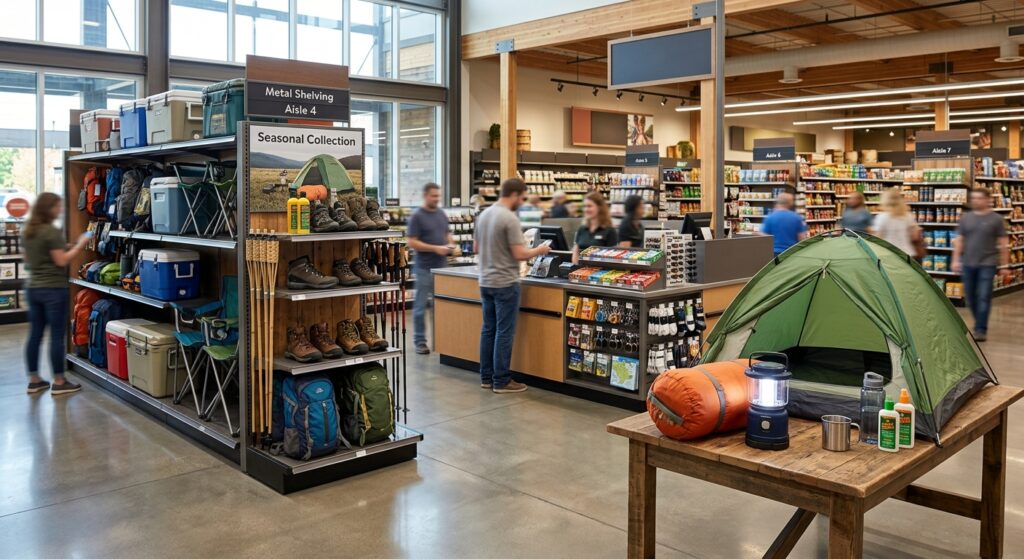
| Power Aisle / Feature Tables | Freestanding tables or islands in open floor space | Lifestyle groupings, new product launches |
| Point-of-Sale (POS) Displays | Small-format displays near checkout | Impulse items, low-cost add-ons |
| Digital / E-Commerce Modules | “Customers also bought” or “Complete the look” widgets | Online retail, app-based shopping |
| Themed Vignettes | Full lifestyle scenes (e.g., a staged kitchen or camping setup) | Specialty retail, home goods, apparel |
As planohero.com notes, the most effective cross merchandising setups follow a clear planogram logic—meaning product placement is documented, measurable, and repeatable across store locations rather than left to individual store managers’ discretion.
Cross Merchandising vs. Upselling vs. Cross-Selling: What’s the Difference?
These three tactics often get conflated, but they operate differently:
- Cross merchandising is a physical or digital placement strategy. It’s a visual cue that prompts customers to consider complementary items they hadn’t planned to buy.
- Cross-selling is an active sales technique—a cashier suggesting batteries when a customer buys a flashlight, or a chatbot recommending a case after a phone purchase.
- Upselling persuades a customer to trade up to a higher-value version of the product they’re already buying.
Cross merchandising is the silent salesperson. It works 24/7 without requiring staff intervention, which makes it one of the highest-ROI tactics available to retailers operating on lean labor budgets.
Where Does Cross Merchandising Work Best? Industry Examples
Grocery and Fresh Produce
Fresh produce departments are arguably the birthplace of crossmerchandising. A display of avocados positioned next to tortilla chips and salsa doesn’t just sell more avocados—it sells a complete snacking experience. According to Produce Business, fresh departments that use strategic cross merchandising consistently outperform those that organize purely by category, particularly for seasonal and impulse-driven items.
Cross placement of fresh herbs next to bagged salads, or fresh lemons next to seafood, creates a “meal solution” narrative that customers find genuinely useful—not promotional.
Apparel and Fashion Retail
A mannequin wearing a complete outfit—jacket, shirt, trousers, belt, shoes—is the oldest form of crossmerchandising in fashion. Modern retailers extend this to digital lookbooks and “shop the look” features on product pages. The goal is identical: reduce the cognitive load on customers and show them a finished vision.
Home Improvement and Hardware
Placing paintbrushes, painter’s tape, and drop cloths adjacent to paint cans is a textbook cross merchandising move. Customers come for the paint; the store earns incremental margin on every accessory they grab along the way.
E-Commerce and Digital Retail
Online, crossmerchandising takes the form of algorithmic product recommendations. Amazon’s “Frequently Bought Together” module is perhaps the most studied example in digital marketing. For independent e-commerce operators, manual curation of product bundles on category and product detail pages replicates the same effect.
How to Build a Cross Merchandising Strategy: Step-by-Step
Step 1: Audit Your Current Product Assortment
Map your top-selling SKUs and identify natural use-case clusters. Look for products that customers regularly purchase together (check basket analysis data) but that currently sit in separate store sections.
Step 2: Identify High-Traffic Zones
End caps, checkout lanes, store entrances, and feature tables are your highest-value real estate. Reserve these locations for your most strategically important cross merchandising pairings.
Step 3: Design the Display with the Customer in Mind
Every display should answer a question or solve a problem. “What do I need to make guacamole?” “What should I wear to a summer wedding?” Lead with the solution, not the product.
Step 4: Build a Planogram and Document It
Create a visual map of each display—what products go where, how they’re stacked, what signage accompanies them. This documentation is essential for multi-location retail businesses that need consistent execution across dozens or hundreds of stores.
Step 5: Train Your Field Teams
Store associates need to understand the why behind each display, not just the what. When field reps know the sales rationale, they defend the setup better during restocking and can flag compliance issues proactively.
Step 6: Measure, Iterate, and Scale
Track sales lift for each cross-merchandised SKU over a 4–6 week window. Compare against the same period in the prior year or against non-cross-merchandised control locations. Double down on what works; cut what doesn’t.
Measuring Cross Merchandising ROI: The Metrics That Matter
Cross merchandising without measurement is decoration. Here are the six metrics every retail marketer should track:
| Metric | What It Measures | Target Benchmark |
|---|---|---|
| Average Order Value (AOV) | Incremental spend per transaction | +10–20% vs. baseline |
| Units Per Transaction (UPT) | Number of items per purchase | +0.5–1.5 units |
| Cross-Sell Rate | % of customers who buy the secondary item | 15–30% for well-executed displays |
| Sales Lift (%) | Revenue increase for featured SKUs | +15–25% during display period |
| Planogram Compliance Rate | % of stores executing display correctly | >85% for reliable results |
| Display ROI | Revenue generated vs. display production cost | Minimum 3:1 ratio |
Retailers who track these metrics consistently—and connect field execution data to sales outcomes—are the ones who can justify increasing their cross merchandising investment year over year.

Frequently Asked Questions (FAQ)
What is the difference between cross merchandising and cross-selling?
Cross merchandising is a passive, placement-based strategy—products are physically or digitally positioned together to encourage additional purchases without direct sales intervention. Cross-selling is an active technique where a salesperson or automated system explicitly recommends a complementary product to a customer during the buying process. Both tactics increase basket size, but cross merchandising operates at scale without incremental labor cost.
How many products should be included in a cross merchandising display?
Best practice is 2–4 complementary SKUs per display. Exceeding four items risks visual clutter, which reduces customer engagement and can actually suppress sales. The display should tell a single, clear story—”everything you need for X”—rather than function as a general product dump.
Does cross merchandising work for small retailers and independent stores?
Absolutely. Cross merchandising is arguably more impactful for small retailers because every square foot of floor space carries more financial weight. A neighborhood hardware store that groups caulk, caulking guns, painter’s tape, and prep wipes near its paint section will consistently outperform one that shelves those items in separate aisles. The strategy requires planning and consistency, not a large budget.
Conclusion
Cross merchandising remains one of the highest-leverage, lowest-cost tactics available to retailers in 2026. By placing the right products together—whether on a physical shelf or a digital product page—you reduce customer friction, increase basket size, and build a shopping experience that feels genuinely helpful rather than transactional.
The strategy works across every retail vertical: grocery, apparel, hardware, home goods, and e-commerce. What separates high-performing programs from mediocre ones is execution discipline—planogram compliance, field team training, display rotation, and rigorous measurement.
If your business is ready to move from ad hoc product placement to a systematic, data-driven cross merchandising program, the checklist and frameworks in this guide give you the foundation to start immediately.