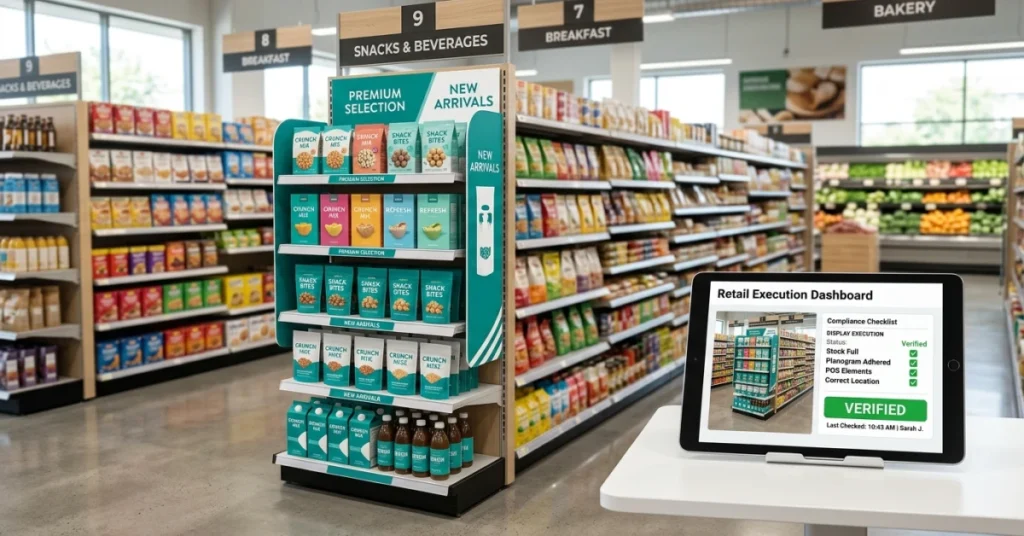



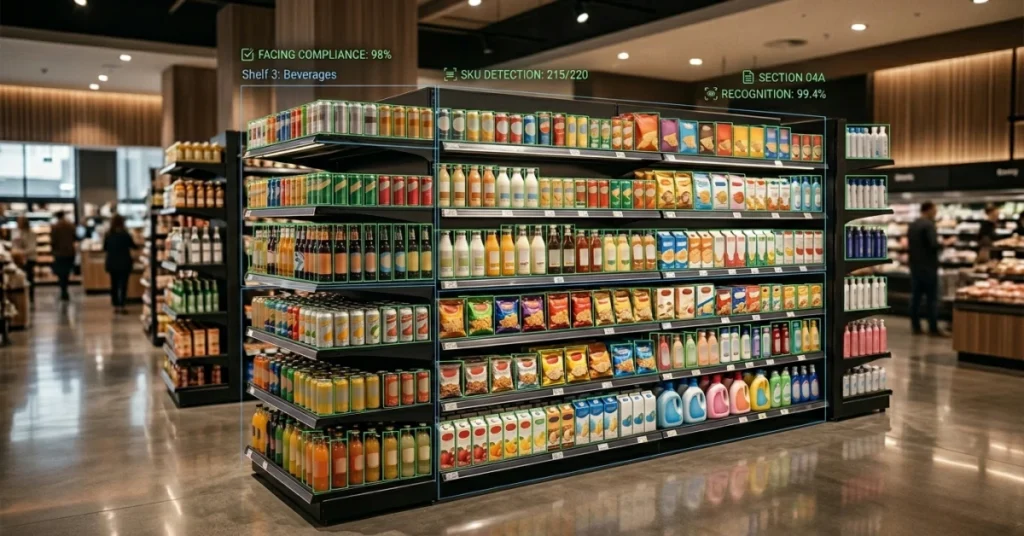
AI image recognition for planogram compliance is the use of computer vision and deep learning models to automatically compare real-world shelf photos against approved planogram layouts — detecting SKU misplacements, out-of-stock gaps, and facing violations in seconds, without manual audits.
What Is AI Image Recognition for Planogram, and Why Does It Matter in 2026?
Walk into any grocery store, drug chain, or big-box retailer and you’re looking at a planogram in action. Every SKU has an assigned slot, a prescribed facing count, and a defined position relative to competing products. The gap between that blueprint and what field reps actually find on the shelf is costing CPG brands and retailers billions.
According to industry research on planogram compliance, every 10% gap in planogram compliance translates to approximately 1% in lost sales — and typical compliance rates hover between 60% and 70% industry-wide. That’s a structural revenue leak, not an occasional oversight.
Manual shelf audits can’t solve this at scale. A field rep must visually scan dozens of shelves, cross-reference a printed or digital planogram, note every deviation, photograph evidence, and file a report — all before moving to the next store. Time studies confirm that reps spend nearly twice as long auditing as they do actually fixing problems.
AI image recognition closes that gap by doing the audit work automatically, in real time, from a single smartphone photo.
How Does AI Image Recognition Work for Planogram Compliance?
What Are the Core Technical Components of the Model?
Modern planogram image recognition systems stack several AI layers:
- Image capture — A field rep or store associate photographs the shelf using a mobile device. No specialized hardware is required in most deployments.
- Object detection — A computer vision model identifies individual products, their positions, and their facing counts within the image.
- SKU classification — The model matches detected products to a master product catalog using visual features: packaging shape, color, label graphics, and barcode data.
- Planogram mapping — Detected shelf state is translated into a structured layout — sometimes called a “RealOGram” — that mirrors the format of the approved planogram.
- Compliance scoring — The system compares actual shelf state to the reference planogram and generates a compliance score, flagging specific violations with location coordinates.
- Reporting and escalation — Violations are pushed to field management dashboards, triggering corrective tasks for in-store teams.
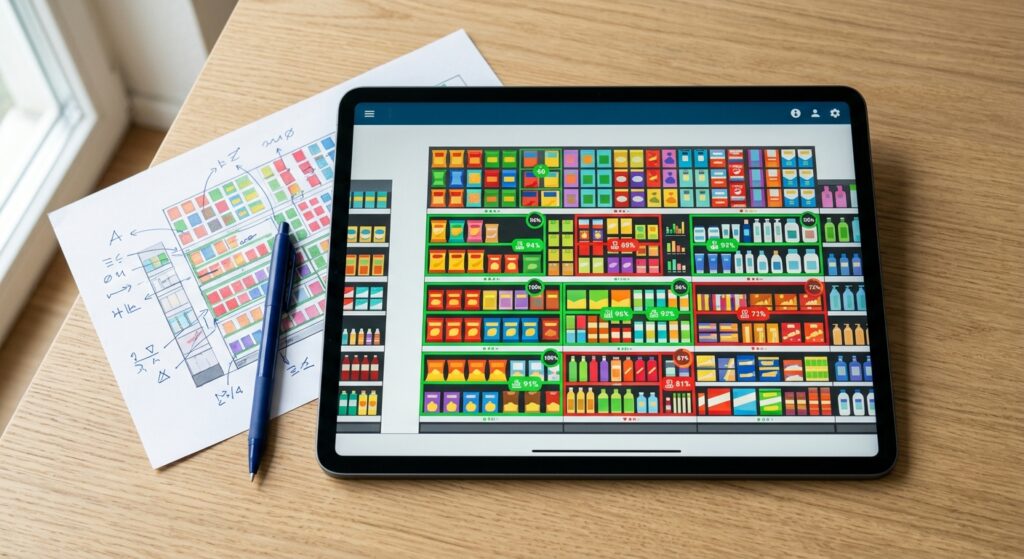
The underlying vision models are typically built on convolutional neural networks (CNNs) or transformer-based architectures, trained on millions of labeled shelf images. Leading platforms continuously retrain their models as new products enter the market, which is critical for CPG brands that rotate seasonal SKUs frequently.
What Types of Violations Can the System Detect?
AI image recognition for planogram compliance catches a wider range of violations than any manual audit:
- Wrong product in the assigned slot
- Incorrect number of facings
- Misplaced price tags or shelf talkers
- Out-of-stock (OOS) gaps
- Incorrect product sequence or block adjacency
- Non-compliant use of point-of-sale materials (POSM)
- Competitor products placed in brand-designated shelf space

What Are the Operational Limits of Traditional Field Audits?
Manual audits introduce three compounding problems:
Speed. A field rep can realistically audit 8–12 stores per day. An AI-powered mobile solution can process a shelf section in under 30 seconds, enabling reps to cover more ground and spend time on execution rather than documentation.
Consistency. Two reps auditing the same shelf will rarely produce identical compliance scores. Human judgment varies based on fatigue, training quality, and category familiarity. AI models apply the same detection criteria every single time.
Recency. A weekly audit captures one snapshot. Shelf conditions change hourly — restocking events, customer interference, and vendor resets all shift product placement throughout the day. AI-enabled stores or high-frequency mobile audits provide a far more current picture of actual shelf state.
What Are the Measurable Business Benefits?
The business case for AI image recognition for planogram compliance is grounded in three categories of value:
| Benefit Category | Metric | Typical Improvement |
|---|---|---|
| Compliance Rate | % of shelves matching planogram | +15–25 percentage points |
| Field Rep Efficiency | Stores audited per day | 2–3× increase |
| Out-of-Stock Reduction | OOS incidents detected and resolved | 30–40% reduction |
| Sales Uplift | Revenue attributable to compliance gains | 1–3% of category revenue |
| Audit Cost | Cost per store visit | 40–60% reduction |
CPG brands gain particular leverage because they operate across retail partners where they have no direct store employees. Image recognition gives brand field teams objective, photographic evidence of compliance — or non-compliance — that can support retailer conversations and trade spend accountability.
How Do AI Image Recognition Solutions Fit Into CPG and Retail Operations?
Deployment models vary by organization size and existing tech stack, but most follow a common architecture:
Step 1 — Planogram library integration. The AI platform ingests the retailer’s or brand’s planogram library. This becomes the reference against which all field images are compared.
Step 2 — Product catalog onboarding. Every SKU that appears in any planogram must be registered in the vision model’s catalog, typically with multiple reference images from different angles.
Step 3 — Mobile app rollout. Field reps download the image recognition app, which guides them through a standardized photo capture process to ensure consistent image quality.
Step 4 — Real-time analysis. Captured images are processed — either on-device or via cloud API — and compliance results are returned within seconds.
Step 5 — Dashboard and task management. Store-level compliance scores, violation images, and corrective action tasks flow into a central operations dashboard accessible to field managers and brand teams.
Step 6 — Continuous model improvement. Flagged images that were incorrectly classified are fed back into the training pipeline, improving model accuracy over time.
As Ailet’s CPG platform documentation outlines, the combination of precise image recognition and structured field execution workflows is what separates high-performing CPG field operations from those still relying on spreadsheet-based audits.
What Are the Leading AI Image Recognition Platforms for Planogram in 2026?
How Do Top Solutions Compare?
The market has matured significantly. As Vision Group Retail’s 2026 platform analysis documents, the top solutions now differentiate on model accuracy, speed of SKU onboarding, and integration depth rather than basic detection capability.
Key evaluation criteria when selecting a platform:
- Model accuracy rate — Best-in-class platforms achieve 90–95%+ SKU recognition accuracy under real-world store lighting conditions.
- SKU onboarding speed — How quickly can new products be added to the recognition catalog? Days vs. weeks matters for CPG brands with seasonal launches.
- Offline capability — Can the mobile app function in stores with poor connectivity and sync when signal is restored?
- Integration ecosystem — Does the platform connect natively with your ERP, CRM, or retail execution software?
- Analytics depth — Does the system provide store-level, region-level, and brand-level compliance trending, or just point-in-time scores?
Platforms built specifically for CPG field operations — rather than adapted from general computer vision tools — tend to outperform on the metrics that matter most to brand and retail teams: compliance score accuracy, violation categorization specificity, and field rep adoption rates.
For organizations evaluating how AI audit tools connect to broader field workforce management, reviewing how retail execution software integrates with mobile audit tools provides critical context before vendor selection.
What Are the Common Implementation Pitfalls to Avoid?
Even well-resourced deployments underperform when organizations make these mistakes:
Incomplete product catalogs. If 15% of active SKUs are missing from the recognition model, the system will misclassify those products consistently. Catalog completeness is non-negotiable before go-live.
No change management for field reps. Field teams that don’t understand why they’re capturing images — or who feel surveilled rather than supported — will take low-quality photos that degrade model performance. Training must address the “why,” not just the “how.”
Treating compliance scores as the end goal. A 78% compliance score is only useful if it triggers a specific corrective action. Organizations that track scores without connecting them to task management see little shelf improvement.
Infrequent model retraining. A CPG brand launching 50 new SKUs per quarter will see model accuracy degrade rapidly without a structured retraining cadence. Build this into your operational calendar.
Ignoring store-level context. A store in a high-traffic urban location may have legitimate reasons for temporary planogram deviations during peak hours. AI flags should be reviewed against store context before triggering compliance penalties.
As Infilect’s planogram compliance research notes, the brands that extract the most value from image recognition are those that embed it into a continuous improvement cycle — not those that treat it as a one-time audit upgrade.

Conclusion
AI image recognition for planogram compliance has moved from experimental technology to operational standard. In 2026, CPG brands and retailers that still rely on manual shelf audits are accepting a structural disadvantage: lower compliance rates, slower violation resolution, and weaker trade spend accountability.
The technology is proven. Compliance improvements of 15–25 percentage points, 30–40% reductions in out-of-stock incidents, and 2–3× gains in field rep efficiency are achievable with a properly deployed solution. The differentiator is no longer whether to adopt AI image recognition — it’s how well you connect detection to execution.
Organizations that pair a high-accuracy vision model with a disciplined field operations platform will consistently outperform those running image recognition as a standalone audit tool. The checklist, implementation framework, and platform evaluation criteria in this guide give you everything needed to move from assessment to deployment.
Frequently Asked Questions (FAQ)
What is the difference between AI image recognition and traditional planogram auditing?
Traditional planogram auditing relies on field reps manually comparing shelf layouts to printed or digital planogram documents — a process that is slow, inconsistent, and limited to scheduled visit windows. AI image recognition automates this comparison using computer vision models that analyze shelf photos in real time, delivering objective compliance scores and specific violation data within seconds of image capture.
How accurate are AI image recognition models for planogram compliance in real retail environments?
Leading platforms achieve 90–95%+ SKU recognition accuracy under real-world conditions, including variable store lighting, product rotation, and label variations. Accuracy is directly tied to catalog completeness and model retraining frequency. A model trained on a comprehensive, current product catalog and retrained quarterly will significantly outperform one with static training data.
Can small and mid-size CPG brands afford AI image recognition for planogram compliance?
Yes. The SaaS deployment model has made image recognition accessible well below the enterprise price thresholds of five years ago. Most platforms price per field rep per month or per store visit, making costs directly proportional to field team size. For brands managing even 200–300 retail doors, the sales uplift from a 10–15 percentage point compliance improvement typically generates a positive ROI within the first two quarters of deployment.