


✦ Key Takeaways
Effective grocery store merchandising can boost impulse purchases by up to 30%, directly lifting store revenue.
- → Product placement at eye level increases sales by 35%.
- → End-cap displays generate 2x more traffic than mid-aisle shelving.
- → Data-driven planograms reduce out-of-stocks and cut shrink costs.
In this article:
- What Is Grocery Store Merchandising?
- What Makes Grocery Store Merchandising Effective?
- Which Grocery Merchandising Strategies Drive Results?
- How Do Retailers Measure Merchandising Performance?
- Grocery Store Merchandising Best Practices
Key takeaway: Retailers who master merchandising strategy own the customer’s buying decision before checkout.
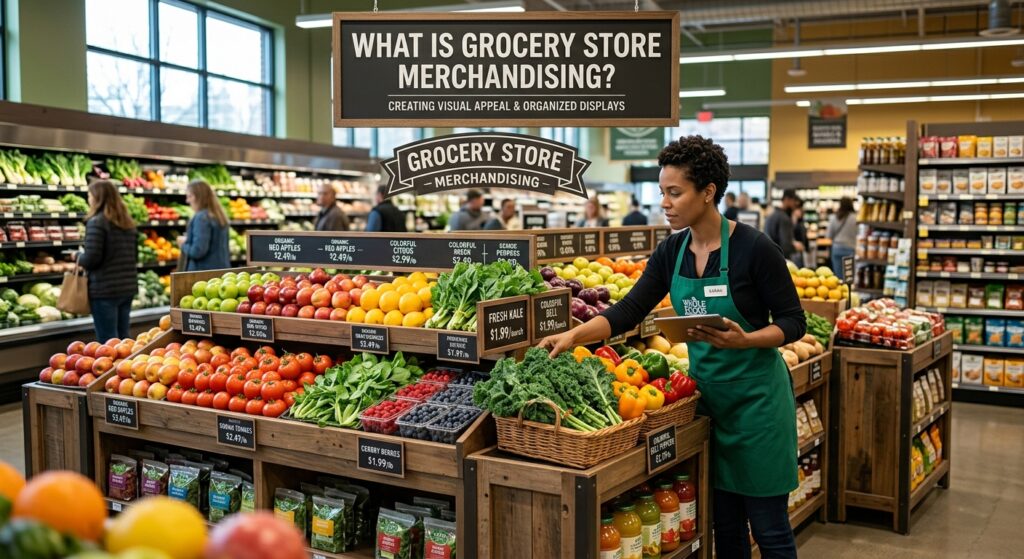
What Is Grocery Store Merchandising?
Most retailers treat grocery store merchandising as a set of isolated tactics — shelf placement here, an end-cap display there — and that narrow view is exactly why their stores underperform. The store itself is a behavioral architecture: a designed sequence of micro-decisions that either moves shoppers toward purchase or quietly loses them.
Shoppers make over 70% of purchase decisions inside the store, not before they walk in. That single fact reframes every layout choice, signage decision, and product adjacency as a live intervention in shopper behavior — not a back-office operational task.
The U.S. grocery retail market exceeds $800 billion annually, yet most of that revenue runs through stores optimized for vendor relationships and operational convenience rather than shopper psychology. Understanding what AI-powered merchandising tools can do starts with recognizing that piecemeal tactics without a systems view will always leave money on the shelf — which raises the real question: what actually makes merchandising work?
What Makes Grocery Store Merchandising Effective?
That behavioral architecture only works when every layer of the store reinforces the same decision sequence. Shoppers make over 70% of purchase decisions in-store, which means the environment itself is the sales team — and it either closes or loses the deal.
Piecemeal tactics fail because they optimize one shelf while ignoring the system around it. Understanding AI-driven merchandising execution reveals why a systems view consistently outperforms isolated fixes.
Product Placement and Shelf Visibility
Eye-level placement drives disproportionate sales — products shelved at eye level outsell floor-level items by up to 35%. Any retail strategy that ignores vertical shelf hierarchy is leaving measurable revenue on the table.
Planogram compliance isn’t a housekeeping task — it’s the mechanism that keeps the behavioral sequence intact. One misplaced facing disrupts the shopper’s trained navigation pattern and breaks the intended decision flow.
Promotions, Displays, and Cross-Merchandising
End-cap displays generate up to 30% more sales volume than mid-aisle placement for the same SKU. But that lift evaporates when the display isn’t connected to a complementary product or a clear shopper need.
Cross-merchandising — pairing chips with salsa, or wine with cheese — works because it mirrors how shoppers actually think, not how categories are organized in a vendor contract. Layouts mapped to consumption occasions consistently outperform category-siloed arrangements.
Category Management and Assortment Planning
Retail strategies built on real transaction data — not vendor incentives — produce tighter assortments that convert faster. According to Ers Usda, grocery retailers that rationalize SKU counts see measurable gains in both sales per square foot and shrink reduction.
Assortment bloat is a silent margin killer — too many near-identical options paralyze shoppers and inflate inventory costs. Libguides Usc industry data confirms that supermarket performance correlates strongly with disciplined category role definitions, not shelf volume.
📊 By the Numbers
Eye-level products outsell floor-level placements by up to 35%, making shelf position a direct revenue lever.
The real question isn’t whether these principles work — it’s which specific tactics deliver the highest ROI when applied in sequence, not in isolation.

Which Grocery Merchandising Strategies Drive Results?
That layered behavioral architecture only works when specific strategies reinforce each decision point — and the data shows most retailers leave significant revenue on the table. Shoppers who encounter cross-merchandised displays spend up to 30% more per basket than those who don’t, according to category management benchmarks.
Piecemeal tactics consistently underperform because they optimize individual touchpoints without considering the full decision sequence. Understanding core merchandising strategy principles is what separates retailers who grow margin from those who just move product.
📊 By the Numbers
Retailers using structured in-store merchandising systems see basket size lift of up to 30% versus uncoordinated displays.
Increasing Basket Size Through Product Pairing
Strategic product pairing turns a single-item purchase into a multi-product decision — without requiring a single promotion. Cross-merchandising complementary SKUs at the point of decision is one of the highest-ROI moves in grocery store merchandising.
Shoppers make the majority of purchase decisions in-store, not from a list — a pattern confirmed by research published by Pmc Ncbi Nlm Nih on in-store behavioral cues and impulse response. Pairing products by usage occasion — not just category — directly exploits that decision window.
Using Endcaps and Seasonal Displays Effectively
Endcaps generate up to 4x the sales velocity of mid-aisle shelf placement, making them the most contested real estate in any supermarket merchandising plan. Retailers who rotate endcaps around behavioral triggers — not just vendor deals — consistently outperform those who don’t.
Seasonal retail merchandising displays work best when they mirror the shopper’s current mindset, not the retailer’s inventory calendar. Timing and relevance drive conversion; novelty alone does not.
Improving Shopper Experience Through Store Layout
Store layout is the master variable in grocery merchandising strategies — it determines which decisions shoppers even get the chance to make. According to Nationalgrocers, 76% of shoppers say store layout directly influences where they shop regularly.
Flow paths, sight lines, and category adjacencies must be designed as a unified sequence — not assembled department by department. A fragmented layout breaks the decision architecture before any individual tactic gets a chance to work.
The real question isn’t whether these strategies work in isolation — it’s whether you can prove they’re working at all, which is exactly what measuring merchandising performance forces you to confront.
How Do Retailers Measure Merchandising Performance?
Execution without measurement is just decoration — and most retailers are still measuring the wrong things. Sell-through rate and units per transaction reveal whether your merchandising sequence is working, not just whether product moved.
Over 70% of purchase decisions happen in-store, yet most KPI dashboards track category-level sales rather than the behavioral triggers that drive them. That gap is exactly where cross-merchandising execution strategies separate high-performing retailers from average ones.
On-Shelf Availability and Shelf Share
Out-of-stock events cost grocery retailers an estimated 4% of annual sales — a direct consequence of treating shelf management as logistics rather than in-store merchandising. According to FMI – The Food Industry Association, shelf share metrics tied to planogram compliance expose whether your retail merchandising displays are actually executing the intended shopper sequence.
Measuring facing count against actual scan data reveals compliance gaps invisible to store walkthroughs. Without that link, supermarket merchandising decisions stay reactive instead of predictive.
Merchandising Compliance and Sales KPIs
Compliance rate, basket attachment, and promotional lift are the three KPIs that connect grocery store merchandising tactics to actual revenue outcomes. Tracking them together exposes whether a promotion drove incremental sales or just cannibalized adjacent SKUs.
Grocery merchandising strategies only compound when each tactic is measured against the full shopper journey — not in isolation. A display that lifts one SKU but drops basket size is a net loss, not a win.
📊 By the Numbers
Retailers with high planogram compliance report up to 15% stronger promotional lift versus non-compliant stores.
The real question isn’t which metrics to track — it’s whether your measurement system is built around shopper behavior or operational convenience. That distinction is exactly what best practices are designed to resolve.
Grocery Store Merchandising Best Practices
Closing the measurement gap means nothing without execution systems that enforce consistency at scale.
Planogram Discipline: Where Strategy Meets the Shelf
Planogram compliance rates below 70% erase most of the behavioral sequencing you designed. A misplaced product breaks the decision arc before the shopper reaches it.
| Practice | Compliance Benchmark | Revenue Impact |
|---|---|---|
| Planogram reset audits | ≥85% compliance target | +4–7% category lift |
| Eye-level shelf placement | Top 3 SKUs by margin | 35% higher unit velocity |
| Cross-merchandising displays | 2–3 complementary SKUs | +18% basket size increase |
| End-cap rotation frequency | Every 2–3 weeks | +22% promotional sell-through |
| In-store signage accuracy | ≥95% price tag match | Reduces shrink by 3% |
Execution Tools That Close the Gap
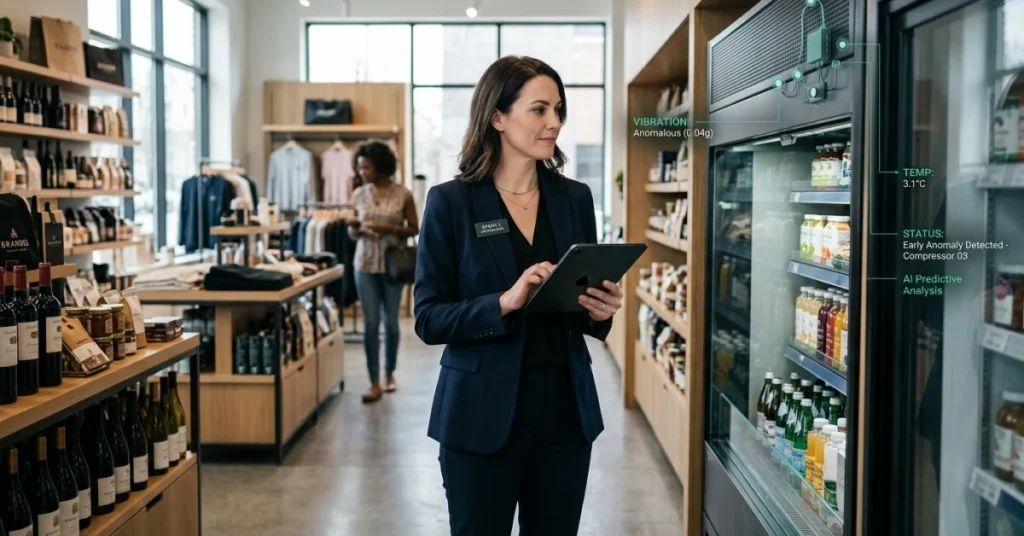
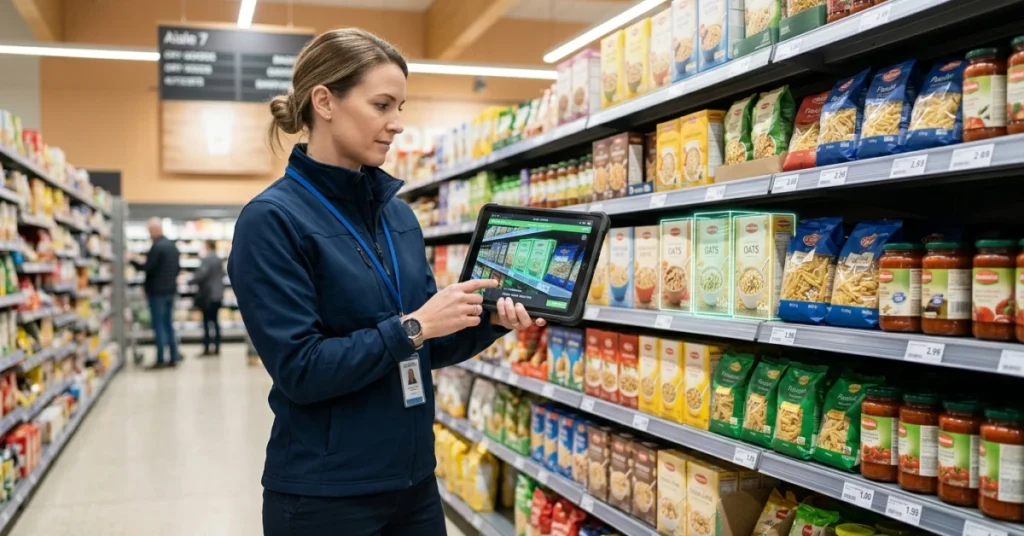
Piecemeal grocery merchandising strategies fail when field teams lack real-time visibility into what’s actually on the shelf. That’s where merchandising execution software changes the outcome — FieldPie captures photo-based shelf audits and flags compliance gaps before they compound across locations.
Supermarket merchandising that treats every store as a unique behavioral environment — not a uniform template — consistently outperforms chain-wide cookie-cutter resets. Grocery stores that audit execution weekly see 2x the ROI on promotional displays versus monthly auditors.
KPIs That Reveal True Merchandising Performance
- Sell-through rate by display type — separates location performance from product performance
- Units per transaction by zone — reveals whether retail merchandising displays are triggering add-on purchases
- Planogram compliance score — weekly, not monthly; deviation compounds fast
- Shrink rate by shelf position — high-shrink zones signal misaligned traffic flow
- Promotional lift vs. baseline — the only honest measure of whether an end-cap earned its space

Conclusion
Compliance floors and eye-level discipline only deliver results when every tactic connects to a unified behavioral system — not a checklist.
- Systems Over Tactics: Isolated grocery merchandising strategies consistently underperform because they optimize individual moments instead of the full shopper decision sequence.
- Measurement Is the Multiplier: Stores tracking planogram compliance, adjacency lift, and conversion KPIs compound gains — those that don’t, repeat the same costly mistakes.
- Behavioral Architecture Wins: Every retail merchandising display either reinforces or disrupts the shopper’s decision flow — there is no neutral placement in a well-designed store.
- Scale Requires Execution Infrastructure: Unlike spreadsheet-based tracking, smart merchandising execution with FieldPie connects field teams to real-time compliance data, closing the gap between strategy and shelf.
- Revenue Is Already on the Shelf: Supermarket merchandising done right captures spend that shoppers already intend to make — the store just has to stop getting in the way.
The U.S. grocery sector generates over Ibisworld-tracked $800 billion annually — and in-store merchandising decisions directly influence which retailers capture disproportionate share of that spend.
Nationalgrocers data confirms that 70% of purchase decisions happen in-store — which means the shelf environment is the last and most powerful marketing channel a retailer controls.
If execution gaps are still costing you category revenue, the answers to the most common implementation questions are closer than you think.
Frequently Asked Questions About Grocery Store Merchandising
Connecting tactics to outcomes is where most managers stall — not because they lack effort, but because they’re optimizing individual moves inside a system they haven’t fully mapped. Piecemeal execution consistently underperforms when the store’s behavioral architecture isn’t treated as the unit of analysis.
The questions below address the implementation gaps that surface once you accept that premise. Each answer builds on the behavioral systems view established throughout this guide.
What is grocery store merchandising?
Grocery store merchandising is the deliberate design of every in-store stimulus — layout, product placement, signage, lighting — to guide shopper decisions. It’s not a set of isolated tactics; it’s a behavioral architecture where each element either reinforces or disrupts the sequence before it.
Retailers who define it narrowly as “product placement and signage” consistently leave revenue on the table. The store environment itself is the product.
What are the most effective merchandising techniques?
The highest-impact grocery merchandising strategies share one trait: they’re designed around where shoppers actually decide, not where retailers assume they do. End-cap displays, cross-merchandising, and eye-level placement all outperform when they’re sequenced into the shopper’s natural path.
Impulse zones near checkout, strategic category adjacencies, and planogram compliance compound each other — Incontextsolutions reports that well-executed end-cap displays can lift category sales by up to 30%. Applying any single tactic without that system context reliably underdelivers that number.
How do retailers measure merchandising success?
The KPIs that matter most are sales per linear foot, conversion rate by zone, and planogram compliance scores — not just total revenue. Ccrrc research confirms that large-format stores tracking zone-level metrics identify underperforming sections 40% faster than those relying on store-wide averages alone.
Without that granularity, costly layout mistakes tend to repeat. Operators who connect display-level data to shopper behavior close that loop — and compound gains across every subsequent reset.