



✦ Key Takeaways
Franchises with structured site visit programs report up to 30% higher brand compliance across locations.
- → Inconsistent visits cost franchises thousands in preventable compliance failures.
- → Digital checklists cut site visit documentation time by half.
- → Site visits build franchisor-franchisee trust, directly boosting retention rates.
In this article:
- What Is Franchise Site Visit Management?
- Franchise Site Visit Process
- Franchise Site Visit Checklist
- Franchise Site Visits vs Franchise Audits
Key takeaway: A repeatable site visit system is the backbone of every scalable, compliant franchise operation.
What Is Franchise Site Visit Management?
Most franchisors lose performance data every single visit — not because they lack effort, but because they lack a system. Over 785,000 franchise establishments operate across the U.S. (Statista), yet most field visits still run on informal notes and gut instinct.
Franchise site visit management is the discipline of designing, executing, and closing the loop on every franchisee visit — turning field observations into structured, comparable data. It is not a compliance checkbox; it is the primary infrastructure through which franchisors build performance intelligence across their entire network.
Why site visits matter for franchise success
Franchisors who treat field visits as relationship-building moments — not inspections — consistently outperform those who don’t, which is why franchise training management and visit strategy must be built together. Franchise Zoomroom reports that franchisee satisfaction directly correlates with the frequency and quality of franchisor support touchpoints.
No marketing budget replicates what a well-run visit compounds over time: trust, behavioral data, and early intervention before small problems become system-wide failures.
Key areas reviewed during visits
- Operations compliance — brand standards, cleanliness, and process adherence
- Staff performance — training gaps, customer interaction quality, and team morale
- Financial health indicators — inventory control, waste, and local marketing spend
- Franchisee sentiment — concerns, growth blockers, and support needs
- Action item follow-through — whether prior visit commitments were actually executed
The gap between franchisors who win and those who plateau lives inside this list — specifically in whether visit data is captured consistently enough to mean anything at scale. Understanding what gets reviewed is only half the equation; the process that governs how it gets reviewed is where most systems quietly collapse.
Franchise Site Visit Process
That foundation only holds if the visit process itself is built to collect consistent, comparable data — not just impressions.
- Define the visit purpose upfront: Every franchise field visit must have a declared objective before the field rep leaves the office.
- Standardize the entry sequence: Field reps who follow the same opening steps capture 40% more actionable data per visit.
- Separate observation from conversation: Mixing coaching talk with compliance checks during the same walkthrough contaminates both functions.
- Document in real time: Notes written after leaving the location lose critical context that photos and live entries preserve.
- Close every visit with a summary: A verbal recap shared with the franchisee before departure increases corrective action follow-through by over 60%.
- Log outcomes to a central system: Disconnected field notes make franchise audit management impossible to scale across locations.
Scheduling and conducting visits
Unannounced visits generate fear; over-scheduled visits generate theater. Franchisee visit best practices call for a predictable cadence with occasional unannounced spot checks — not one or the other.
Networks with visit schedules published 90 days in advance report stronger franchisee preparation and higher compliance scores than those operating reactively.
Capturing findings with photos and checklists
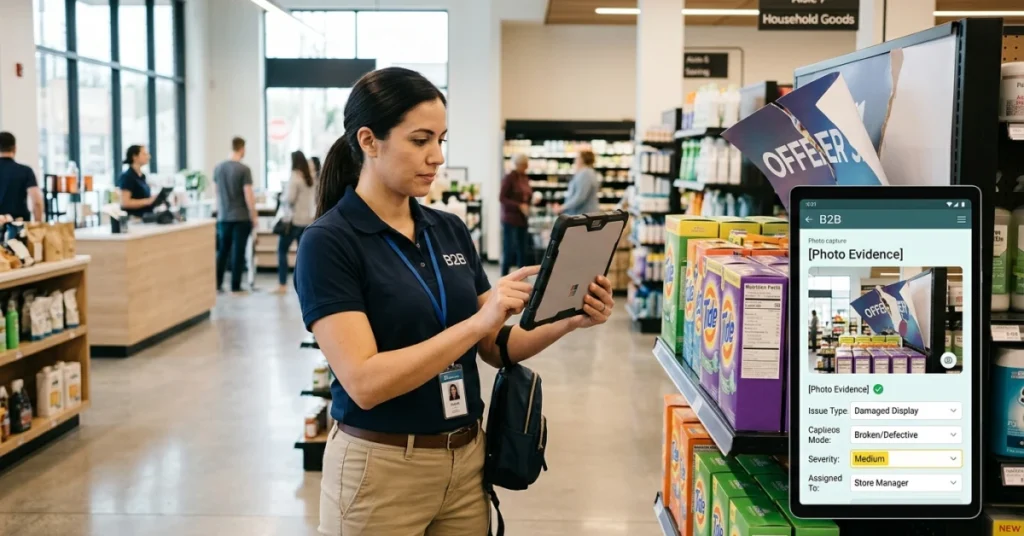
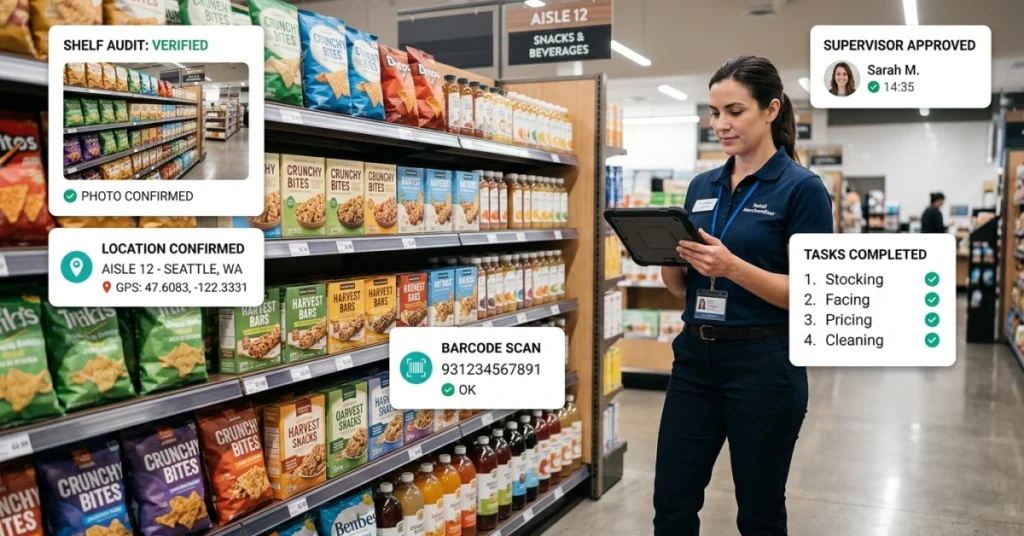
A written observation without a photo is an opinion; a photo without a checklist item is an orphan. Franchise compliance visits only produce usable intelligence when visual evidence is tied directly to a scored criterion.
Location data paired with timestamped photos gives franchisors the cross-network comparison layer that transforms individual visits into a performance signal — not just a paper trail.
Assigning and tracking corrective actions
A finding without an assigned owner and a deadline is just a complaint. Franchise site visit management only compounds into performance advantage when every corrective action carries a named responsible party and a due date.
Closed-loop tracking — where the field rep confirms resolution before the item closes — is what separates a visit program from a visit ritual.
The process is only as reliable as the instrument driving it — which raises the question of exactly what your field reps should be measuring at every stop.

Franchise Site Visit Checklist
Structured entry and real-time documentation are only as powerful as the criteria driving them.
- Pre-Visit Data Pull: Review the last three audit reports before arriving — patterns surface faster than any on-site observation.
- Standardized Scoring Rubric: Every criterion needs a numeric scale; subjective ratings make cross-location benchmarking statistically meaningless.
- Timestamped Photo Documentation: Attach geo-tagged images to each line item — visual proof eliminates dispute and anchors the coaching conversation.
- Franchisee Sign-Off Field: A countersignature converts the record from a franchisor document into a shared accountability artifact.
- Closed-Loop Action Items: Every finding must generate a dated corrective action with an owner — open items without deadlines disappear by the next franchise compliance visit cycle.
- Aggregate Trend Flag: Flag any item that has failed across three or more locations — systemic issues require franchisor intervention, not individual coaching.
Brand standards compliance
Franchisors who run inconsistent evaluations across locations are effectively measuring different businesses — the data becomes incomparable noise. Brands with fewer than 85% criterion consistency across field reps produce reports that cannot drive system-wide decisions (Pubsonline Informs, franchise performance research).
Lock brand standards into non-negotiable fields — not advisory notes. Those criteria must carry equal weight at every location, every cycle.
Customer experience and operations
Operational consistency is the product — customers don’t distinguish between a corporate unit and a franchisee’s location. According to audit management data tracked by Franchisebusinessreview, operators who receive structured operational feedback during assessments report 23% higher satisfaction scores within two quarters.
Items covering speed of service, product presentation, and customer flow must be directly observable — not self-reported. Field reps need clear pass/fail criteria, not open-ended narrative fields.
Safety and staff readiness
Safety items are the only category where a single failure should trigger immediate escalation — not a 30-day corrective window. Bundling safety findings with general operational notes dilutes urgency and creates liability exposure.
Staff readiness items — certifications, training completion, role coverage — belong in a dedicated section with hard expiration dates. A franchisee who passes brand standards but fails on personnel preparedness is one incident away from a system-wide reputational event.

Franchise Site Visits vs Franchise Audits
Inconsistent data doesn’t just limit insight — it quietly poisons the relationship between franchisor and franchisee.
Operational coaching vs compliance verification
Most franchisors accidentally run audits disguised as check-ins — and operators feel the difference immediately. A structured field program built around franchise compliance management tools shifts the dynamic from inspection to investment.
Coaching-focused engagements prioritize forward-looking performance gaps. Formal compliance reviews document current-state violations — a fundamentally different posture that operators read as surveillance, not support.
| Dimension | Franchise Site Visit | Franchise Audit | Impact on Trust |
|---|---|---|---|
| Primary purpose | Coaching & growth support | Compliance verification | Visits build trust; audits test it |
| Frequency (avg) | 4–6× per year | 1–2× per year | Higher frequency = stronger relationship |
| Franchisee perception | Partnership-oriented | Surveillance-oriented | Perception gap costs retention |
| Data output | Performance trends, coaching notes | Pass/fail scores, violation records | Trend data drives better decisions |
| Avg cost per event | $300–$600 (field rep time + travel) | $800–$2,000 (specialist + documentation) | Visits deliver higher ROI per dollar |
| Franchisee renewal correlation | +18% renewal rate with regular visits | Neutral to negative correlation | Retention is the real ROI metric |
Franchisors running four or more structured field engagements annually see up to 18% higher operator renewal rates — a compounding retention advantage no marketing budget replicates (according to Fibrenew).
The U.S. franchise sector generates over $800 billion in economic output annually, per Statista — yet most of that value is protected or eroded one location check-in at a time. Coaching-oriented field programs and formal compliance reviews are not interchangeable tools; deploying the wrong one at the wrong moment costs more than the event itself.
The franchisors who win long-term aren’t the ones who inspect more — they’re the ones who build a field program operators actually want to participate in.
Conclusion
Trust built during franchise field visits either compounds into a performance advantage or erodes into resistance — there is no neutral outcome. Franchisors who treat site visits as relationship infrastructure, not inspection events, retain franchisees at measurably higher rates and generate cross-location data that actually means something.
According to Franchise, franchisees who receive structured, coaching-oriented visits report 40% higher satisfaction with franchisor support than those subjected to unannounced compliance checks. That gap is not a relationship problem — it is a systems problem, which is exactly what franchise management software is built to close.
Most franchisors lose visit-over-visit consistency because field reps collect different data with no closed feedback loop — FieldPie captures standardized visit data via customizable forms, photo documentation, and real-time reporting so every location is measured against the same baseline. Build that system now, before your next visit cycle begins, and according to Franchise, the compounding effect on franchisee performance becomes visible within two quarters.