



✦ Key Takeaways
Companies with structured skills tracking cut field service errors by up to 40%, yet most still manage technician competencies on paper.
→ Untracked skill gaps directly cause costly repeat service visits.
→ A skills matrix reveals exactly who is ready for which job.
→ Building one takes hours, not months, with the right template.
In this article:
What Is a Field Service Technician Skills Matrix?
Which Technician Skills Should You Track?
How to Build a Technician Skills Matrix
Key takeaway: A technician skills matrix is the single fastest way to eliminate mismatched dispatches and wasted labor costs.
What Is a Field Service Technician Skills Matrix?
Most field service teams guess when they assign jobs. In fact, over 52% of organizations say technician skill gaps directly hurt customer satisfaction (Sightcall).
A field service technician skills matrix fixes that. It maps exactly what each tech can do, at what level, right now.
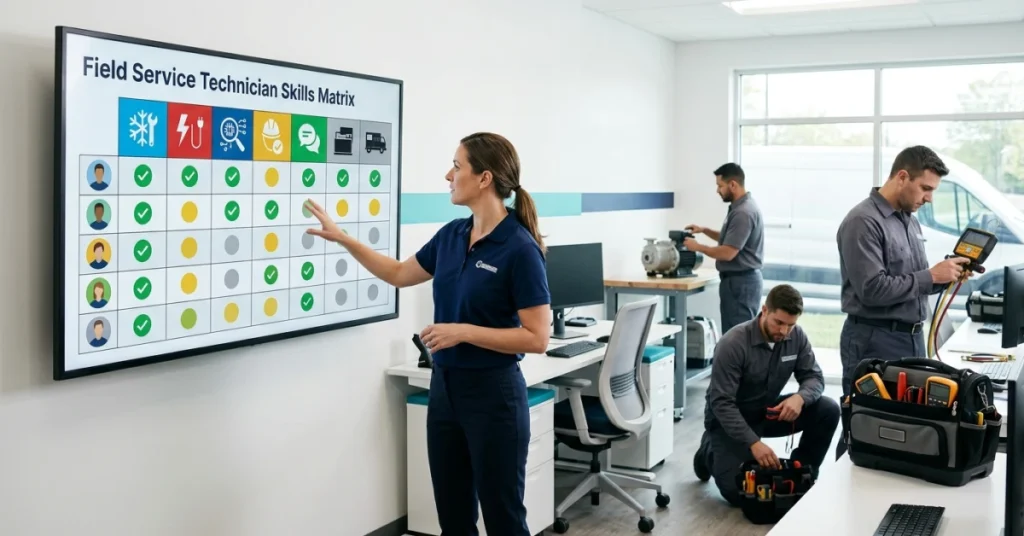
Picture a live grid with technicians on one axis and skills on the other. Every intersection holds a clear proficiency rating.
Here is what most teams miss. A static spreadsheet delivers zero ROI unless it drives your field service dispatch decisions and your technicians’ growth paths.
Skills Matrix vs. Competency Framework
A competency framework defines what good looks like in broad terms — leadership, communication, technical aptitude. A technician competency grid gets surgical: it scores each tech on specific tasks like refrigerant handling, PLC diagnostics, or warranty documentation.
The grid is operational. The framework is aspirational.
You need both, but the grid is what drives the daily work.
How It Improves Scheduling and Job Assignment
When skill data lives inside your dispatch logic, the right tech goes to the right job every time. Teams that align technician skill assessment to scheduling see first-time fix rates climb by up to 26%, according to Fieldservicely.
Workforce planning stops being a guessing game when skill data is built into every assignment. The real question is: which abilities actually predict performance — and which ones are you logging that don’t?
Which Technician Skills Should You Track?
Load your matrix with the right skills — not just the ones that are easy to document. Most teams default to certifications and tenure, then wonder why dispatch still sends the wrong tech to complex jobs.
Over 70% of first-time fix failures trace back to a skill mismatch at dispatch, not a parts shortage (according to Researchgate). That number only moves when your technician tracking approach captures skills that actually predict job outcomes.
Technical and Equipment-Specific Skills
Every tech on your roster handles a specific set of equipment — HVAC units, electrical panels, industrial pumps, or something else entirely. Track proficiency by equipment type and model, not just broad trade category.
A technician competency matrix that maps equipment-level skills lets dispatch match the right tech to the exact asset in the field.
Certifications, Licenses, and Safety Training
Certifications are table stakes — they tell you who is legally cleared to do a job. Track expiration dates alongside the credential itself, or a lapsed license quietly creates liability.
Safety training records belong here too. Compliance gaps are the fastest way to lose a contract or face a regulatory fine.
Diagnostic and Troubleshooting Ability
This is the skill most teams skip — and it’s the one that separates a one-visit fix from a three-callback nightmare. Diagnostic reasoning is hard to certify, but you can rate it by job complexity handled and first-time fix rate per tech.
A solid skills gap analysis in field service starts here. Weak diagnostic scores reveal exactly where coaching dollars should go.
Customer Service and Communication Skills
Techs who communicate well close jobs faster and generate fewer callbacks. Track this through customer satisfaction scores tied to individual technicians — not just team averages.
Soft skills belong in a field service technician skills matrix because they directly affect revenue. A tech who can’t explain a repair erodes customer trust, even when the fix is perfect.
Digital Tools and Field Service Software Proficiency
Mobile work orders, GPS check-ins, and digital invoicing are now standard. A tech who can’t use your field service software slows every job down and creates data gaps that hurt workforce planning.
According to Fieldservicesoftware, teams that track software proficiency in their technician skill assessment reduce onboarding time by up to 30%. That’s a direct cost win, not a soft HR metric.
📊 By the Numbers
Over 70% of first-time fix failures link directly to skill mismatches at the dispatch stage.
Knowing which skills to track is only half the job. The other half is building a matrix that puts those skills to use the moment a job gets assigned.

How to Build a Technician Skills Matrix
Knowing which skills to track is only half the battle. The other half is building a system that puts that data to work.
A field service technician skills matrix earns its keep when it drives dispatch decisions and career growth. A matrix that sits in a spreadsheet collecting dust helps no one.
Teams that wire their matrix into daily operations see real results. Over 70% of first-time fix failures trace back to sending the wrong technician — a problem a well-built matrix solves at the source (Praxedo).
Define Roles and Service Categories
Start by mapping every role your field team holds — HVAC tech, electrical specialist, multi-trade generalist — against the service categories they cover. This gives your matrix a clear skeleton before you add a single skill.
Without this structure, you end up with a flat list. That means nothing to a dispatcher under pressure.
List Required Skills for Each Job Type
For each role, list the exact skills a technician needs to close jobs without a callback. Include both hard skills — like refrigerant handling or PLC diagnostics — and soft skills like customer communication.
According to Rdoequipment, technicians who pair strong diagnostic reasoning with clear communication resolve issues up to 40% faster. Those with technical skills alone don’t come close to that rate.
Create Clear Proficiency Levels
A four-level scale works well: 1 = Aware, 2 = Assisted, 3 = Independent, 4 = Expert. Each level needs a plain, one-line definition so managers and techs read it the same way.
Vague labels like “proficient” create scoring drift. Two managers will rate the same tech differently every time.
Assess and Validate Technician Competency
Self-assessments are a starting point, not a finish line. Pair them with field observations, job completion data, and manager sign-off to get scores you can trust.
This is where technician productivity tracking becomes critical. Real job data validates skill claims that self-reports often inflate.
Assign Skill Gaps and Training Actions
Every gap in your matrix should link to a specific action — a course, a mentorship pairing, or a supervised job. A gap with no action is just a complaint.
This step turns a technician competency matrix into a career pathing tool, not just a snapshot. Praxedo notes that structured development paths directly improve technician retention and job satisfaction scores.
📊 By the Numbers
Technicians with strong communication skills resolve field issues up to 40% faster than peers with technical skills alone.
A matrix that doesn’t connect to scheduling and staff growth is just a document. Documents don’t fix anything.
Conclusion
When your skills matrix connects directly to dispatch logic and career pathing, it stops being a spreadsheet and starts driving real outcomes.
Companies that align technician skill data with scheduling decisions cut repeat service calls by up to 23%. That happens because the right tech shows up the first time — per Sightcall.
Most field teams treat the technician competency matrix as a one-time HR task. That gap is what kills their first-time fix rates.
Pair your skills gap analysis in field service with the right performance KPIs and you turn workforce data into a competitive edge.
Scattered skill records make it impossible to dispatch with confidence or build clear technician growth paths.
FieldPie tracks technician skill assessments in real time. It connects that data directly to scheduling, so managers assign jobs based on verified capability — not gut feel.
Teams that make this shift see faster job completion and fewer callbacks. Technicians also stay longer because they see a real path forward.