✦ Key Takeaways
Brands lose up to 70% of planned in-store sales impact when POSM execution fails at the point of purchase.
→ Poor placement kills ROI before a single customer engages.
→ Standardized workflows cut execution errors by half across locations.
→ Real-time field audits expose gaps competitors never catch.
In this article:
What Is POSM Execution?
How to Plan a POSM Execution Campaign
POSM Execution Workflow
How to Measure POSM Execution
Key takeaway: Flawless POSM execution is the difference between a campaign that sells and one that sits.
What Is POSM Execution?
Nearly half of all purchase decisions happen at the shelf. Most brands treat the materials that drive those decisions as a shipping problem — not a performance channel.
That gap is where campaigns quietly fail.
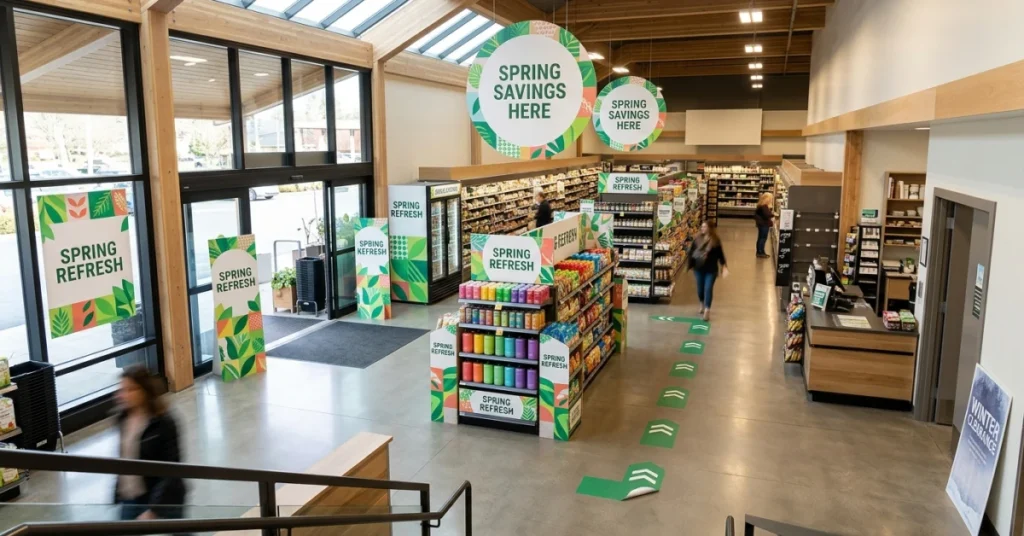
POSM execution moves Point of Sale Materials from production to the retail floor. Those materials include displays, shelf talkers, floor stickers, banners, and branded fixtures. Each item must be placed correctly and actively.
It sounds operational. It is actually a compliance discipline.
Common POSM Types in Retail
In-store POSM covers a wide range of physical touchpoints. Each type has its own placement rules and compliance risks. Getting the type right matters — but correct placement is what drives results.
Shelf talkers — small cards that highlight price, promotion, or product features at eye level
Floor displays and standees — freestanding units placed in high-traffic aisles or store entrances
Wobblers and danglers — hanging or spring-mounted signs that draw attention from a distance
Branded cooler wraps and counter units — permanent or semi-permanent fixtures tied to planogram compliance
Window and floor decals — high-visibility placements that require exact positioning to meet brand standards
Why POSM Execution Matters for Sales and Visibility
Promotional displays boost sales by up to 20% when placed correctly (Heraldmailmedia). That lift disappears when materials sit in a stockroom or go up in the wrong spot.
The material itself is not the asset. Correct placement is.
Repsly notes that brands relying on self-reported field data consistently overestimate their actual in-store compliance rates. That overestimation is the core problem with how most teams run retail POSM strategy today.
Most marketing teams measure POSM by spend and units shipped. They never check what actually appeared on the shelf. Perfect store execution means closing that gap with structured field checks — not assumptions.
The real failure in POSM tracking is not production quality or budget. It is the unmeasured distance between the warehouse and the retail floor.
That compliance gap is exactly what a strong campaign plan must be built to close.
How to Plan a POSM Execution Campaign
Treat POSM execution as a compliance discipline. Your plan must cover what happens after materials leave the warehouse — not just before.
Most campaign briefs define goals, creative, and media spend. But no one is assigned to field compliance. That gap is where campaigns quietly fail.
Define Campaign Goals and Store Coverage
Start with a specific number. Decide which stores, which zones, and what compliance rate counts as success. A target like “95% correct placement across 400 stores” is a goal — “nationwide rollout” is not.
Vague coverage targets make audits impossible. They also make it hard to hold field teams accountable. Define your store tier priorities before a single unit ships.
Distribute Materials and Share Placement Guidelines
Distribution without clear placement guidelines is just shipping. It does not guarantee execution. Every store rep needs a one-page visual guide. It should show exact placement, height, and position for each material type.
Brands that skip this step see compliance rates drop by as much as 40%. That is compared to campaigns with documented placement standards, according to Nrsplus.
Good retail execution tools make sharing those standards fast and trackable.
Set Installation and Removal Dates
Every piece of Point of Sale Materials needs a hard install date and a hard pull date — no exceptions. Without removal deadlines, expired POSM stays on shelves. That actively damages brand credibility.
The global POSM market is growing fast. Yet most brands still treat date management as optional, according to Grandviewresearch. Locking in dates at the planning stage forces accountability before the campaign launches.
📊 By the Numbers
Campaigns with documented placement guidelines achieve up to 40% higher in-store POSM compliance rates.
A plan with no built-in audit step is just a wish list. Every strong POSM execution campaign needs a clear workflow to back it up.

POSM Execution Workflow
That compliance gap won’t close itself. It closes when teams follow a clear, repeatable field process.
Without a defined workflow, even a well-funded POSM deployment falls apart fast. The moment a field rep walks into a store, guesswork takes over.
Brands that treat POSM execution as a field compliance program — not a marketing deliverable — consistently outperform those that don’t.
Over 70% of purchase decisions happen at the point of sale. Every missed or misplaced display is a direct revenue leak (Insights Ehl).
Confirm Material Delivery
Field reps must confirm that every item on the materials list actually arrived at the store. Checking that it shipped from the warehouse is not enough.
A signed delivery check against a SKU-level manifest catches shortages before installation begins.
Install POSM in the Correct Location
Placement is not optional — it’s the whole point. Each Point of Sale Material must go in the pre-approved zone set during campaign planning. Putting it wherever the store manager prefers is not acceptable.
Using retail execution tools with planogram references gives reps a clear visual target. This cuts placement errors by a measurable margin.
Capture Photo and Location Evidence
A rep’s verbal confirmation is not proof — a timestamped, geotagged photo is. POSM tracking requires hard evidence tied to a specific store, date, and display position.
According to Deltasalesapp, brands that require photo proof on every visit catch compliance failures 3x faster. That beats any team relying on self-reported field data.
Review Compliance and Assign Corrective Actions
Every visit report must go to a single compliance owner — the same person named during planning. That owner flags non-compliant stores and assigns a fix with a deadline, not a suggestion.
Retail POSM strategy only works when corrective actions are tracked to closure, not just logged and forgotten.
📊 By the Numbers
Over 70% of purchase decisions happen at the point of sale — every misplaced display costs real revenue.
A workflow without measurement is just a checklist. Audit the numbers after the campaign runs. That’s the only way to know if your POSM execution worked.
How to Measure POSM Execution
That workflow only delivers value if you can measure what actually happened on the retail floor. Without hard numbers, you’re running a faith-based program.
Faith doesn’t protect shelf space or budget. Most brands track spend and creative approvals. But they never audit in-store compliance rates — the one metric that proves whether Point of Sale Materials appeared correctly.
That gap is where POSM execution budgets quietly disappear.
Installation and Compliance Rates
Compliance rate measures how many stores correctly installed POSM versus how many were supposed to. According to Engageconsultants, non-compliant displays can reduce a campaign’s sales impact by up to 40%.
Track this at the store level, not the regional average. Averages hide the worst offenders.
A 90% regional rate often masks a cluster of stores sitting at 60%.
On-Time Execution Rate
This metric tracks how many stores completed installation by the campaign launch date. Late installs mean your in-store POSM deployment misses the peak traffic window entirely.
Set a hard deadline — not a range — and measure every store against it. Even a 48-hour delay during a product launch can cost real revenue at the shelf.
Missing or Damaged POSM Rate
Field teams should log every missing, damaged, or wrong-version material as a separate data point. This rate shows where your supply chain and retail execution tools are breaking down.
A high damage rate points to a packaging or logistics problem. A high missing rate points to a warehouse or dispatch failure — two very different fixes.
Store and Regional Performance
Break POSM tracking and proof of execution down by store format, region, and field rep. Patterns emerge fast — certain reps, regions, or store types will consistently underperform.
Heraldmailmedia-cited research shows that visibility drives purchase. But that only holds when the material is actually in place.
Regional scorecards make accountability visible and hard to ignore.
Conclusion
Compliance rate is the one number that tells you whether your last POSM campaign actually worked. Most brands never measure it.
According to Paralleldots, poor in-store POSM deployment can cut campaign effectiveness by up to 40%. Yet most teams only audit spend — never shelf compliance.
Materials often leave the warehouse and never appear correctly on the retail floor. That gap is the real failure point in any retail POSM strategy.
Strong retail execution tools close that gap. They turn POSM tracking and proof of execution into a repeatable field discipline — not a post-campaign guess.
Most teams start planning the next campaign before they audit the last one. That habit is exactly what keeps compliance rates invisible.
FieldPie captures photo-based proof of execution and real-time field data at every store visit. Your team knows what actually went up before the next print run is approved.
Grandviewresearch projects steady growth in Point of Sale Materials investment. Brands that treat POSM execution as a field compliance program will capture that value — those that don’t will keep funding a black hole.