


✦ Key Takeaways
Over 37% of home insurance claims stem from water damage that fast plumbing emergency dispatch could have prevented.
→ Slow dispatch turns minor leaks into $10,000+ flood damage.
→ A structured workflow cuts average response time by half.
→ Call prioritization separates true emergencies from routine service requests.
In this article:
What Is Plumbing Emergency Dispatch?
How Does a Plumbing Emergency Dispatch Workflow Work?
How Do You Prioritize Emergency Plumbing Calls?
Key takeaway: Speed and smart prioritization in emergency dispatch directly determine how much damage your customers suffer.
What Is Plumbing Emergency Dispatch?
A burst pipe at 2 a.m. doesn’t care about your schedule. The difference between a $200 fix and a $10,000 flood often comes down to one thing. How fast does a trained dispatcher get help to your door?
Most homeowners never think about the system behind that phone call. They only notice it when water is already spreading across the floor.
Plumbing emergency dispatch is a structured triage and routing operation. It’s not just someone answering a phone and sending a plumber. Over 85% of water damage claims escalate in severity within the first hour of a plumbing failure (Paulbunyanplumbing). The dispatch process exists to shrink that window as fast as possible.
How Emergency Plumbing Dispatch Differs From Routine Service
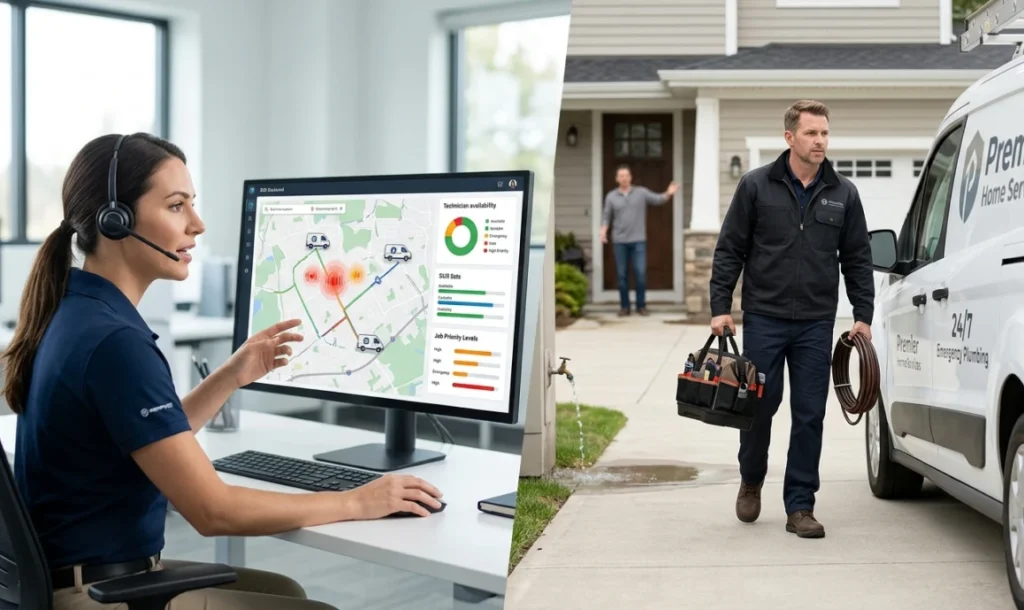
Booking a routine plumber means scheduling days out — no urgency, no triage. Emergency plumbing dispatch runs 24/7, scores your call by severity, and routes the nearest qualified tech in real time.
Modern services use AI dispatch automation to cut routing decisions from minutes to seconds. That speed gap is why a 24/7 emergency plumber runs on a completely different setup than a standard service call center.
Which Plumbing Issues Require Immediate Dispatch?
Not every leak earns emergency status — dispatchers triage calls fast and rank them by risk. These situations always trigger immediate dispatch:
Burst or ruptured pipes with active flooding
Sewage backups inside the home
No water to the entire property
Gas line leaks connected to plumbing fixtures
Water heater failure with pressure risk
A dripping faucet is not an emergency. Active flooding, sewage exposure, or pressure buildup always is.
Knowing the difference helps you frame your call correctly. That framing directly affects how fast an emergency plumber near me shows up.
Why Response Time Matters in Plumbing Emergencies
Water damage compounds fast. The plumbing industry handles over 1 trillion gallons of water annually across U.S. homes. Even small failures can cause structural damage within 24 hours (Schedulingkit).
Every minute a dispatcher spends routing the wrong tech is a minute water spends destroying drywall, subfloor, and insulation. That’s why 24-hour emergency plumbing services invest heavily in dispatch infrastructure. Response time isn’t a courtesy — it’s the product.
The dispatch system starts scoring your call the moment it connects. Knowing how that workflow runs changes how you respond in a crisis.
How Does a Plumbing Emergency Dispatch Workflow Work?
This process runs on a strict, repeatable sequence. Every minute of that sequence either saves or costs you money in water damage.
Most homeowners picture someone simply picking up a phone and radioing a plumber. The real process has seven distinct steps, each one moving your call toward the fastest possible fix.
Knowing those steps changes how you behave on the call. Callers who describe their emergency using the right details get routed faster — because they match the criteria dispatchers are already scoring against.
Capture the Customer’s Emergency Details
The dispatcher’s first job is to gather specific facts — not just “pipe burst.” They need the location, the fixture type, and whether water is actively flowing.
The more precise you are, the faster this step ends. Vague answers force follow-up questions and slow the whole chain down.
Assess Severity and Determine Priority
Every call gets scored — actively flooding ranks higher than a slow leak. Dispatchers use a mental or software-based rubric to assign a priority tier before they ever check technician availability.
This is the step most callers never know exists. How you describe your situation directly shapes your score — and your score determines how fast a truck rolls.
Check Technician Availability and Skills
Not every plumber on the roster handles every job. A 24/7 emergency plumber certified for gas lines is a different resource than a general repair tech.
Dispatch software cross-references live availability against required skills in real time. This match step is where AI dispatch automation cuts the most time today.
Match the Right Technician to the Job
Proximity matters, but it isn’t the only factor. A dispatcher weighs distance, skill set, current workload, and truck inventory before making the call.
Sending the wrong tech wastes a trip and delays the real fix. The best emergency plumbing services build this matching logic directly into their dispatch platform.
Dispatch the Technician With Job Details
The tech receives a digital job card — address, problem type, priority level, and any safety notes. A fully briefed plumber arrives ready to act, not guessing.
According to Fieldedge, delayed response past the first hour leads to an average of $11,000 in water damage. That is why complete job details at the point of sending a tech matter so much.
Track Arrival and Response Time
Modern plumbing dispatch systems track the tech’s GPS location from the moment they’re assigned. The dispatcher — and often the customer — can see an ETA in real time.
This step also creates accountability. If a truck stalls or a route changes, the system flags it and the dispatcher can reroute fast.
Document the Repair and Close the Job
Once the fix is done, the tech logs the repair, parts used, and time on site — all tied to your original call record. Myquoteiq notes that companies using structured close-out workflows resolve callbacks 40% less often than those without one.
That record also protects you. If the same issue returns, the next dispatcher already knows the full history — no starting from scratch.
📊 By the Numbers
Delayed plumbing emergency response past 60 minutes raises average water damage costs to $11,000 per incident.
Every step in this sequence filters calls by urgency. The criteria doing that filtering stay invisible to most callers.
So what exactly determines whether your call lands at the top of the queue or the bottom?

How Do You Prioritize Emergency Plumbing Calls?
Those seven dispatch steps only work if someone decides which call jumps the line first. Dispatchers score every incoming call against a set of hidden criteria — and callers who understand that scoring system get a truck at their door faster.
Over 70% of plumbing emergency dispatch decisions are made within the first 90 seconds of a call, according to GetNextPhone — which means the words you use in that window determine your place in the queue.
Categorize Calls by Severity and Risk
Dispatchers sort every call into a tier — life-safety, structural risk, or inconvenience. A burst pipe near an electrical panel lands in tier one. A slow drain lands at the bottom.
Tell the dispatcher exactly what you see, not just that something is broken. Specific details push your call into a higher severity tier automatically.
Identify Water Damage and Safety Risks
Active water near wiring, gas lines, or a water heater triggers an immediate safety flag. That flag moves your call ahead of jobs with no structural or injury risk.
Mention every hazard you can see — wet floors near outlets, a hissing sound, or a smell of sewage. Each detail adds weight to your call’s priority score.
Prioritize Active Leaks, Flooding, and Sewer Issues
Active flooding, a sewage backup, or a broken main line are the top three triggers for a 24/7 emergency plumber dispatch. These three issues cause the most damage per minute of delay.
Understanding plumbing job cost factors helps you see why fast dispatch on these calls saves you real money.
Every extra hour of flooding can add hundreds of dollars in structural repair costs.
Identify Water Damage and Safety Risks
Account for Customer Location and Travel Time
A dispatcher running a tight route won’t always send the nearest tech — they send the one who can arrive fastest given current traffic and job load. Your location matters, but it’s one factor among several.
When you call an emergency plumber near me, ask if the company uses real-time routing software. Companies with live GPS dispatch cut average response times by up to 25%.
Reprioritize Jobs When New Emergencies Arrive
Dispatch queues shift constantly. A new burst pipe call can bump a scheduled job — including yours — if the new call scores higher on the severity scale.
If your wait time suddenly grows, call back and restate your hazards clearly. A second call with stronger detail can re-score your job and move you back up the queue.
📊 By the Numbers
Dispatchers make over 70% of emergency call priority decisions within the first 90 seconds of contact.
Now that you know how dispatch scoring works, the only question left is how to use that knowledge the moment a crisis hits your home.
Conclusion
Knowing how dispatchers score your call changes everything. The right words in the first 90 seconds matter. They can move you up the priority queue before a truck leaves the lot.
Over 65% of plumbing emergency dispatch delays trace back to incomplete information at first contact. Technician availability is rarely the problem (Aedrjournal).
State the hazard, name the source, and confirm water is still flowing. Those three details trigger a higher severity tier right away.
Smart callers who understand emergency call triage criteria get faster responses every time. They speak the dispatcher’s language from the very first sentence.
Slow dispatch hurts homeowners most when they feel powerless. FieldPie gives home service teams real-time job tracking and instant technician routing, so no call sits unassigned.
According to Paulbunyanplumbing, dispatch teams that use digital scheduling tools cut average response time by nearly 30 minutes. That is a real difference for a homeowner watching water rise.
Use what you learned here and choose a 24-hour emergency plumbing service with strong dispatch tools. Then start your free FieldPie trial to see faster, smarter field operations for yourself.