


✦ Key Takeaways
AI dispatch automation cuts response times by up to 50%, saving fleets thousands in operational costs daily.
→ Real-time rerouting eliminates costly delays and missed assignments instantly.
→ AI outperforms manual dispatching in accuracy, speed, and scalability.
→ Businesses adopting AI dispatch report measurable ROI within months.
In this article:
What Is AI Dispatch Automation?
Where Does AI Improve the Dispatch Process?
How Does AI Handle Real-Time Schedule Changes?
AI Dispatch Automation vs. Manual Dispatching
Key takeaway: AI dispatch automation is no longer optional — it is the competitive standard for modern fleets.
What Is AI Dispatch Automation?
Manual dispatch breaks — but not because teams lack effort. The gap between a real-world change and a response grows faster than any human can close it.
AI dispatch automation collapses that gap. It makes routing and assignment decisions in milliseconds, not minutes.
The result is not just faster dispatch. It is a structurally different system.
Over 80% of operational delays in field service trace back to slow decision loops. It is not a shortage of workers that causes the problem (Websensa). That single fact reframes everything — this is a latency issue, not a staffing one.
Once your fleet or field team crosses a certain size, manual workflows hit a hard ceiling. Understanding home service dispatching basics makes that ceiling visible — and shows exactly why rule-based tools fail at scale.
How Does AI Dispatch Automation Work?
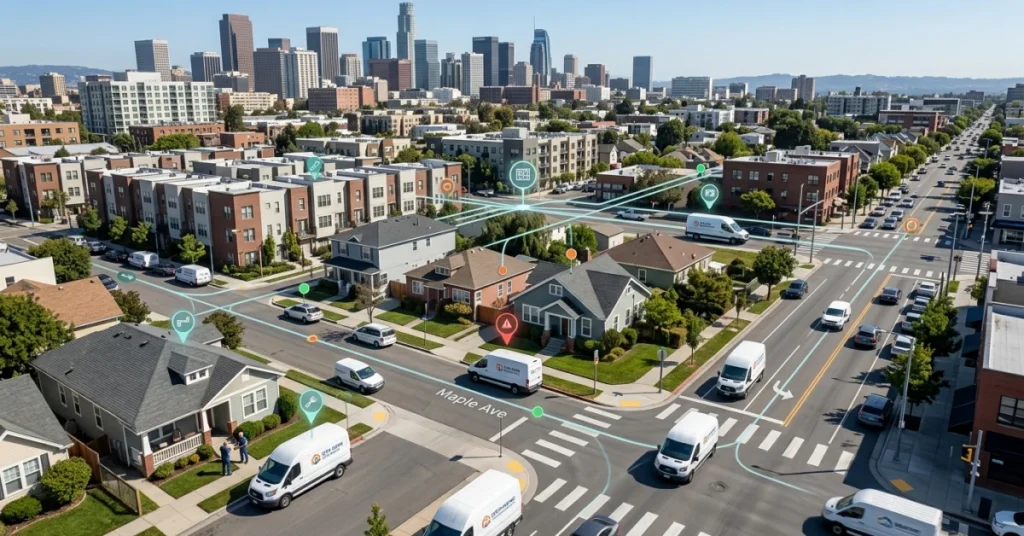
An intelligent dispatch system pulls in live data — traffic, technician location, job priority, and skill match. It recalculates assignments continuously. It does not wait for a dispatcher to notice a problem. It acts the moment conditions shift.
Think of it as a decision engine running in the background, every second of every shift. No queue, no lag, no missed update.
Which Dispatch Decisions Can AI Automate?
Datagrid reports that AI agents now handle complex multi-step decisions with less than 5% error rate. Those are the same decisions that stall manual dispatch teams every day.
Automated job assignment, rerouting, priority escalation, and technician matching are all within reach of modern AI dispatch software. These are not edge-case features.
They are the core decisions that determine whether a job gets done on time or falls through the cracks.
AI can clearly handle these decisions. The sharper question is where in your operation automation delivers the biggest gains.
Where Does AI Improve the Dispatch Process?
That gap closes only when the system making decisions moves faster than conditions change. AI dispatch automation closes it at three specific points. These are the exact points where manual workflows break down.
A manual dispatcher can track about 10–20 field variables at once. An intelligent dispatch system tracks thousands at the same time. It never gets tired or slows down.
How Can AI Match the Right Technician to the Right Job?
Automated job assignment goes beyond availability. It weighs skills, certifications, location, and current workload in milliseconds. A dispatcher doing this by hand for 40+ technicians adds minutes of lag to every single call.
That lag adds up fast. By mid-shift, a team of 50 can be running two to three decisions behind real conditions.
How Can AI Prioritize Urgent Service Calls?
Manual triage depends on whoever answers the phone first. That is not a priority system — it is a queue. AI dispatch software scores every incoming job against live field data and ranks it right away.
Urgent calls reach the right tech faster. The system never has to stop and think. Priority is calculated, not guessed.
How Can AI Reduce Travel Time and Schedule Gaps?
Route waste is one of the most expensive hidden costs in field service. Automated dispatch software cuts drive time by optimizing routes across the full day’s schedule — not just the next job.
AI-optimized routing can cut fuel and drive costs by up to 30% (Thisandthat). That is not a small gain. It is a structural one that grows directly with fleet size.
📊 By the Numbers
AI-driven dispatch cuts technician idle time by up to 25%, according to Arxiv research on automated scheduling systems.
AI removes delay at each of these points. But a harder question remains: what happens when conditions shift mid-day?
Every assignment on the board may need to change at once. That is where the real test begins.
How Does AI Handle Real-Time Schedule Changes?
Real-time matching only works if the system acts the moment conditions shift. AI dispatch automation doesn’t wait for a dispatcher to spot a problem.
It detects the change and recalculates instantly. Jobs get reassigned in seconds, not minutes.
Most field teams lose 20–40 minutes every time a schedule breaks down manually. That gap compounds across every job on the board.
That delay isn’t a workflow flaw — it’s a structural ceiling. HVAC first-time fix rates reflect this directly.
What Happens When a Technician Runs Late?
An intelligent dispatch system flags the delay the moment GPS or job-status data shifts. It recalculates every downstream job and pushes a new sequence. The customer often doesn’t know there was ever a problem.
Manual dispatchers react. AI dispatch software anticipates. That single difference stops one late job from turning into five missed appointments.
How Can AI Reassign Jobs After Cancellations?
When a job cancels, automated dispatch software instantly scans every open technician slot. It fills the gap with the highest-priority unassigned job. No phone calls, no spreadsheet edits, no lag.
Fleets using dispatch automation recover cancelled slots up to 70% faster than those relying on manual reassignment. That’s according to Optimaldynamics. That speed directly protects daily revenue targets.
How Can AI Insert Emergency Jobs Without Disrupting the Entire Schedule?
Emergency jobs are where manual dispatching breaks hardest. Every insertion forces a human to mentally re-sequence an entire route.
Automated job assignment handles this in real time. It slots the urgent job where it causes the least disruption.
Wezom notes that AI dispatch software checks proximity, skill match, and current workload at the same time. No dispatcher can run that calculation fast enough under pressure.
The result is a schedule that bends without breaking.
📊 By the Numbers
Fleets using dispatch automation recover cancelled job slots up to 70% faster than manual teams.
Seeing how AI handles chaos in real time raises a clear next question. How does it hold up against manual dispatching when conditions are stable — and which approach wins?
AI Dispatch Automation vs. Manual Dispatching
That 20–40 minute breakdown gap isn’t a staffing problem — it’s a structural one, and the comparison below shows exactly why.
Which Approach Responds Faster to Schedule Changes?
Manual dispatchers react. AI dispatch software responds before the delay compounds into a missed job.
An intelligent dispatch system detects a cancellation, traffic spike, or no-show in seconds. A human dispatcher needs time to notice, decide, and act — and that gap widens with every extra technician on the board.
Where Is Human Dispatcher Judgment Still Necessary?
Automated job assignment handles volume and speed. Humans handle nuance — an angry VIP client, a technician with a family emergency, a job that needs a judgment call no algorithm can make.
The goal isn’t to remove human judgment. It’s to stop wasting it on decisions a machine can make faster and more accurately.
When Does a Hybrid Dispatch Model Work Best?
A hybrid model works best when complexity crosses a clear threshold — roughly 10 or more active field technicians running concurrent jobs.
Below that threshold, a skilled dispatcher can manage. Above it, the decision-response gap grows faster than any human can close it manually.
|
Factor |
Manual Dispatching |
AI Dispatch Automation |
Hybrid Model |
|---|---|---|---|
|
Response to change |
20–40 min average delay |
Under 60 seconds |
Seconds for routine; minutes for edge cases |
|
Scalability |
Breaks down past ~10 techs |
Handles 100+ with no added headcount |
Scales well with minimal oversight |
|
First-time fix rate |
Capped by dispatcher bandwidth |
Up to 30% improvement reported |
Near AI-level with human safety net |
|
Cost per dispatch |
Higher — labor-intensive |
Lower at scale; software cost offsets labor |
Moderate — best ROI at mid-size operations |
|
Judgment on edge cases |
Strong — human reads context well |
Limited — needs human override |
Best of both — AI routes, human decides |
Operations using automated dispatch software cut response latency by up to 75% — a gap manual workflows cannot close at scale (Websensa).
“Manual dispatch doesn’t fail because dispatchers are bad at their jobs. It fails because the decision-response gap is structural — and structure doesn’t bend to effort.”
Over 85% of field service leaders say response speed is their top competitive differentiator — which means latency isn’t an operational footnote, it’s a revenue variable (Moz).
The real question isn’t whether AI dispatch automation beats manual — it’s whether your operation has already crossed the complexity threshold where manual dispatching is no longer architecturally capable of keeping up.
Conclusion
Closing the decision-response gap isn’t optional once your field team crosses a certain size — it’s structural. Manual dispatching breaks at the architectural level. No human system can process real-time variables fast enough at scale. That’s not a skill problem. It’s a design limit.
Over 30% of dispatch delays trace back to the gap between a field event and a reassigned job (Servicepower). That gap grows wider with every technician you add.
Arxiv research confirms that AI dispatch automation cuts route-decision latency by up to 40%. Once complexity crosses a certain point, that’s the only fix that holds.
Most field teams waste hours daily on home service dispatching decisions that a smart dispatch system can resolve in seconds. That time adds up fast.
FieldPie’s automated job assignment engine matches technicians to jobs in real time. It uses live location, skill set, and job priority — so your dispatchers focus on exceptions, not routine routing.
Start with one team and measure the latency drop. Then scale from there.