


✦ Key Takeaways
AI catches up to 90% of manipulated insurance photos before fraudulent claims ever get paid.
→ Fake audit photos now face detection before causing real damage.
→ AI removes human bias from visual evidence review entirely.
→ Field teams can no longer rely on staged photos going unnoticed.
In this article:
What Is AI Photo Verification in Field Auditing?
How Does AI Photo Verification Work?
How Does AI Detect Fake or Incorrect Audit Photos?
Where Is AI Photo Verification Used?
Key takeaway: AI photo verification makes dishonest field auditing a losing game for everyone who tries it.
What Is AI Photo Verification in Field Auditing?
Most businesses assume the photos their field teams submit are accurate. That assumption is the crack in the foundation of every audit built on photo evidence. AI photo verification in field auditing confirms whether a submitted image is real, unaltered, and actually shows what it claims to show.
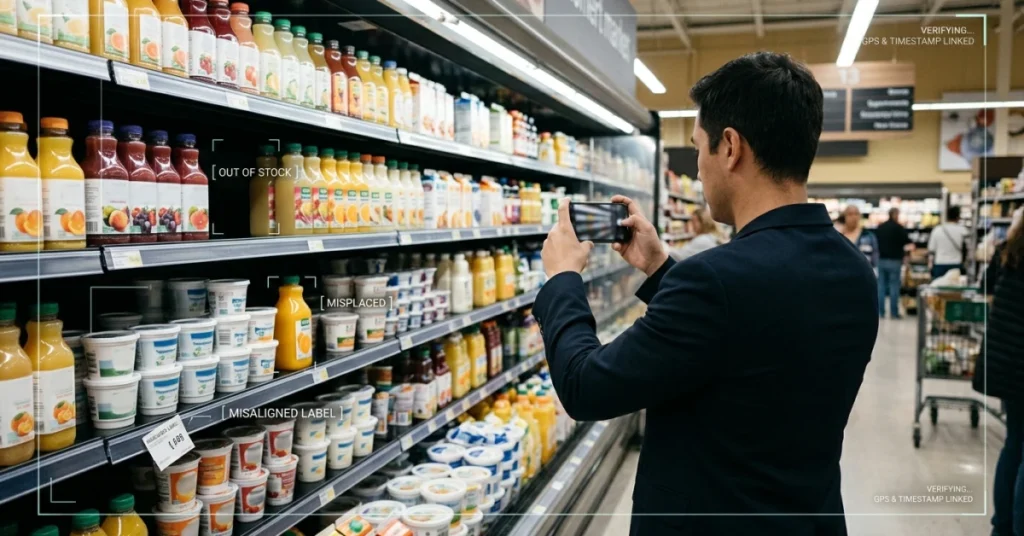
Say your retail team submits a shelf photo to prove a product display is compliant. Without automated checks, a reviewer glances at it and moves on. With automated visual compliance verification, the system can flag that a photo was taken three days earlier and reused. It catches the problem before a human ever opens the file.
What Can AI Detect in Audit Photos?
AI analyzes far more than image content. It reads metadata, checks GPS coordinates, detects pixel-level edits, and compares timestamps against known schedules, all in seconds.
Duplicate photos: the same image submitted across multiple audit reports
Metadata mismatches: location or time data that contradicts the submission
Pixel manipulation: edits that alter what the photo actually shows
Compliance gaps: missing labels, incorrect setups, or safety violations visible in the frame
One insurer recovered over $1.3 million after AI flagged thousands of duplicate claim photos, according to Fieldpie. The same detection logic now powers real-time photo audit AI across retail, construction, and food safety operations.
Photo Authenticity vs. Compliance Verification
These are two distinct jobs, and strong field audit photo analysis handles both. Authenticity checks confirm an image is genuine and unaltered. Compliance checks confirm the scene inside the image meets your standards.
Separating these two functions matters because a photo can be completely real and still show a failed audit. That distinction is why AI in franchise auditing has moved from a nice-to-have to a core operational need. Your photos may look fine. But the real question is whether your review system can tell compliant from non-compliant.
How Does AI Photo Verification Work?
Automated visual checks don’t just replace a human reviewer’s eyes. They rebuild the trust that manual review was never designed to guarantee. Every photo entering an audit pipeline gets measured against objective criteria. No tired inspector’s gut feeling at the end of a long shift decides the outcome.
Photo Capture and Quality Validation
The process starts the moment a field worker submits a photo through an audit app. The system checks image sharpness, lighting, and resolution before anything else, rejecting blurry or cropped shots that could hide non-compliance. If your team submits a shelf photo with half the display cut off, the AI flags it right away. It then requests a retake before the image moves any further.
That immediate rejection stops a reviewer from having to guess what the missing portion contained. Alongside visual quality, the system validates metadata: GPS coordinates, device ID, and timestamp all get cross-checked against the assigned task location and schedule. A photo taken three miles from the audit site, or submitted hours before the visit was logged, fails that check automatically.
AI Analysis and Compliance Detection
Object recognition and pattern matching are the core tools the AI uses to read what a photo actually shows. The system compares shelf layouts, signage placement, product facings, or safety equipment against a stored compliance template. That template is the approved reference image for what that location should look like. This is where AI photo fraud detection moves beyond simple quality checks into genuine content analysis.
The AI doesn’t need to see a perfect photo to reach a verdict.
Flagging Issues and Triggering Corrective Actions
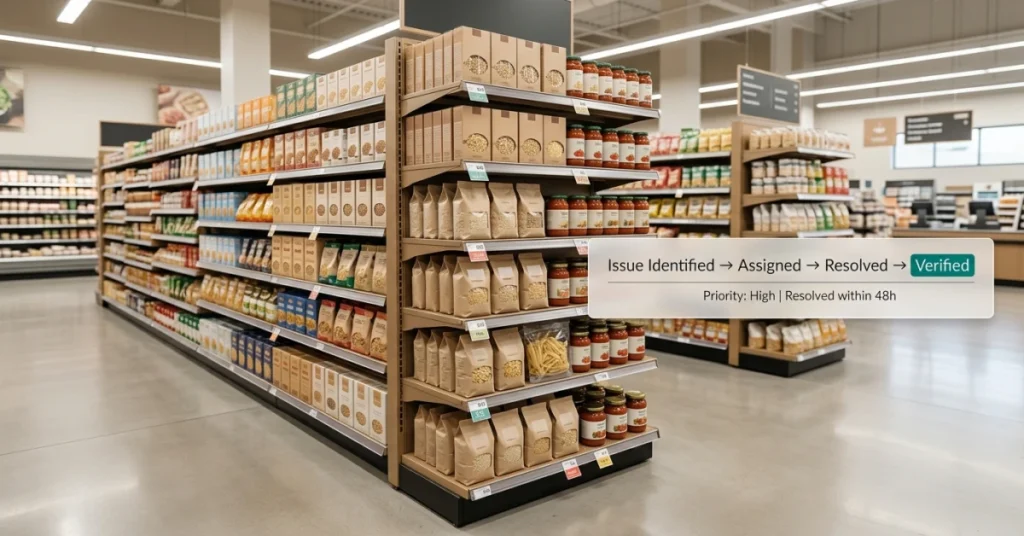
When the AI spots a problem, it doesn’t just log it. It routes a specific alert to the right person, attaching the flagged photo and a plain description of what’s wrong. A manager gets a notification, a field worker gets a task, and the issue gets resolved before the audit window closes.
That closed loop between detection and action is what separates real-time photo audit AI from a passive record-keeping system. This chain of accountability turns raw photo submissions into decisions a business can actually trust. The harder question is what happens when photos are deliberately manipulated before they ever reach the system.

How Does AI Detect Fake or Incorrect Audit Photos?
Once a photo clears that initial quality check, the real analysis begins. AI photo verification in field auditing goes further than confirming a photo exists. It examines the image itself for signs that something was swapped, edited, or reused from a previous visit.
Think of it like a fingerprint check for every image your team submits. The system compares metadata, pixel patterns, and location data against what the audit required. Anything that doesn’t line up gets flagged before a human reviewer ever opens the file.
Duplicate, Edited, and Reused Photos
One of the most common tricks in field auditing is submitting an old photo from a compliant visit to cover a non-compliant one. AI catches this by running a hash comparison against every photo already in the system. A hash comparison is a mathematical fingerprint of the image file, and a reused image triggers an alert instantly.
Edited photos leave a different kind of trail. Tools built on AI photo fraud detection scan for compression artifacts, cloned regions, and pixel-level inconsistencies. These flaws appear when someone crops, pastes, or retouches an image. They’re invisible to the human eye, but a trained model spots them clearly. Research published through PMC and NIH confirms that manipulated photo detection models spot forgery artifacts with accuracy above 95% on benchmark datasets, per Fieldpie.
GPS, Timestamp, and Image Verification
A photo can look perfectly legitimate and still be fraudulent if taken at the wrong place or time. Real-time photo audit AI cross-checks the embedded GPS coordinates and timestamp against the scheduled audit window. A photo snapped at a warehouse three miles away won’t pass as an in-store compliance shot.
Say your team audits a refrigerated display at a grocery chain every Monday morning. If a submitted photo carries a Saturday afternoon timestamp or coordinates from a different zip code, the system flags it automatically. No manual digging required.
False Positives and Human Review
No automated system is perfect. Automated visual compliance verification works best when it hands edge cases to a human reviewer rather than making the final call alone. A photo taken in poor lighting might trigger a quality flag that a trained auditor can clear in seconds.
This is exactly why AI photo verification rebuilds trust rather than just policing behavior. It removes inconsistency from routine checks, so human reviewers focus where judgment actually matters. They no longer sort through hundreds of routine submissions.
📊 By the Numbers
Manipulated photo detection models spot forgery artifacts with accuracy above 95% on benchmark datasets, per Fieldpie.
The real question isn’t whether AI can catch a fake photo. It’s which industries are already depending on it to keep their ground-level data honest.
Where Is AI Photo Verification Used?

This filtering runs inside real operations where a bad photo carries a real price: lost sales, failed inspections, or regulatory fines. AI photo verification in field auditing has taken hold in industries that need proof a photo shows what actually happened. Someone has to trust the image before acting on it.
Say your team manages a hundred store locations and needs proof that a seasonal display went up correctly at each one. Without automated checks, a reviewer might spend hours comparing photos manually and still miss a reused image from last quarter. That’s the structural gap AI closes.
Retail and Merchandising Audits
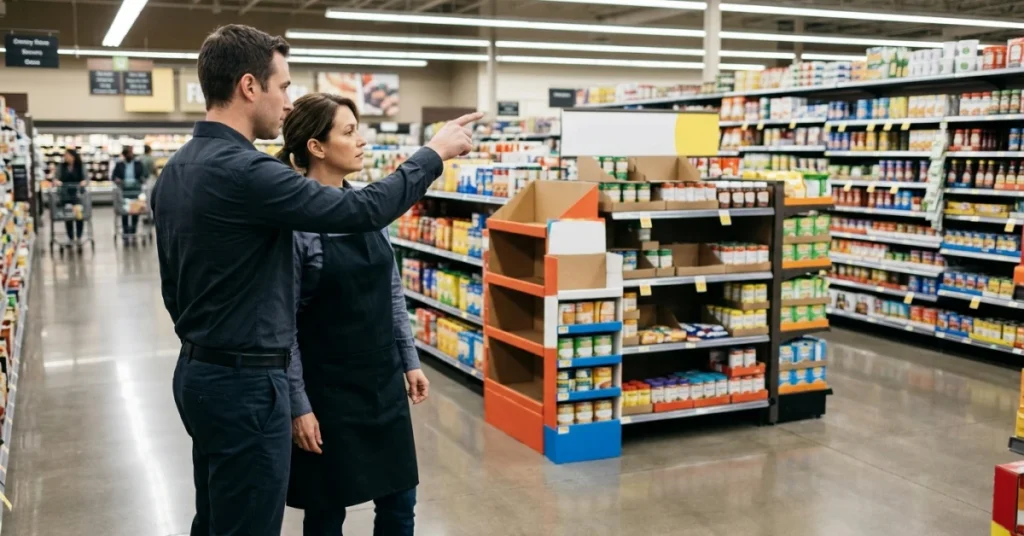
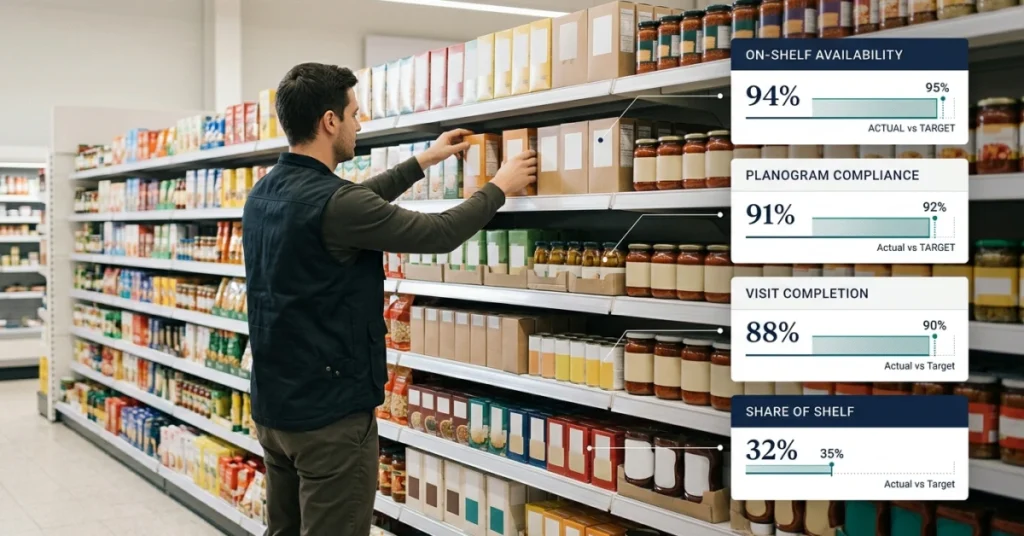
Retail is where automated visual compliance verification first proved its value at scale. Brand teams need shelf photos to confirm product placement, pricing, and promotional displays match the planogram, the exact layout the brand paid to execute.
AI scans each submitted photo against the required layout and flags anything that doesn’t match before a manager reviews it. You can see how this fits into broader merchandiser task verification workflows that keep field teams accountable without micromanaging every rep.
Safety and Facility Inspections
Construction sites, warehouses, and food facilities all run photo-based safety checks. A field worker photographs a fire exit, a piece of equipment, or a storage area to confirm it meets code. A photo alone proves nothing, though, because it can be taken anywhere at any time.
Real-time photo audit AI cross-checks each image against GPS coordinates, timestamps, and visual markers specific to that site. A photo of a clean storage unit taken at the wrong facility gets caught before it reaches a compliance officer. The same goes for any image pulled from a previous inspection.
Multi-Location Compliance Audits
Franchise networks, insurance adjusters, and public health inspectors all face the same problem: too many locations and too few reviewers. The pressure to move fast makes it worse. Field audit photo analysis lets one compliance team cover far more ground without sacrificing accuracy.
A tired human reviewer can miss a duplicated background, a manipulated timestamp, or a photo that matches no known location in the system. AI fraud detection in field operations catches those patterns consistently. If photos are the proof, someone needs to actually verify them.
Conclusion
The real stakes of AI photo verification in field auditing aren’t just catching a faked timestamp or a recycled image. They’re about whether the people making decisions at headquarters can actually trust what they’re seeing from the field.
Say your team manages fifty retail locations and a compliance issue surfaces at one store. Without merchandiser task verification tools, you’re relying on someone’s word and a photo that no one has truly checked. Automated visual compliance verification closes that gap by checking each image the moment it’s submitted. That way, no one acts on bad data before the problem is caught.
Most field teams don’t have a fraud problem. They have a trust problem, and AI makes honesty the default rather than the exception. FieldPie captures and analyzes field photos in real time, flagging issues before they reach your reporting layer. Your team acts on verified ground-level data, not guesswork.
See how it works and start building a field audit process your whole organization can rely on.