



✦ Key Takeaways
Retailers lose up to 25% of campaign revenue when store teams execute visual merchandising inconsistently across locations.
→ Poor briefs are the #1 reason frontline teams skip compliance.
→ You can’t fix what you can’t measure — store audits expose hidden gaps.
→ Scalable execution systems eliminate the need for extra headcount.
In this article:
The Execution Gap Quietly Draining Retail Revenue
Why Do Visual Merchandising Campaigns Fail Consistently?
How to Build a Brief Frontline Teams Actually Follow
How Do You Measure Compliance Across Every Store Location?
Scale Consistent Execution Without Adding Headcount
Key takeaway: Consistent merchandising execution is a revenue strategy, not a housekeeping task.
The Execution Gap Quietly Draining Retail Revenue

Retailers lose an estimated $1.75 trillion in annual revenue to poor in-store performance. Most of that loss never shows up on a standard sales report.
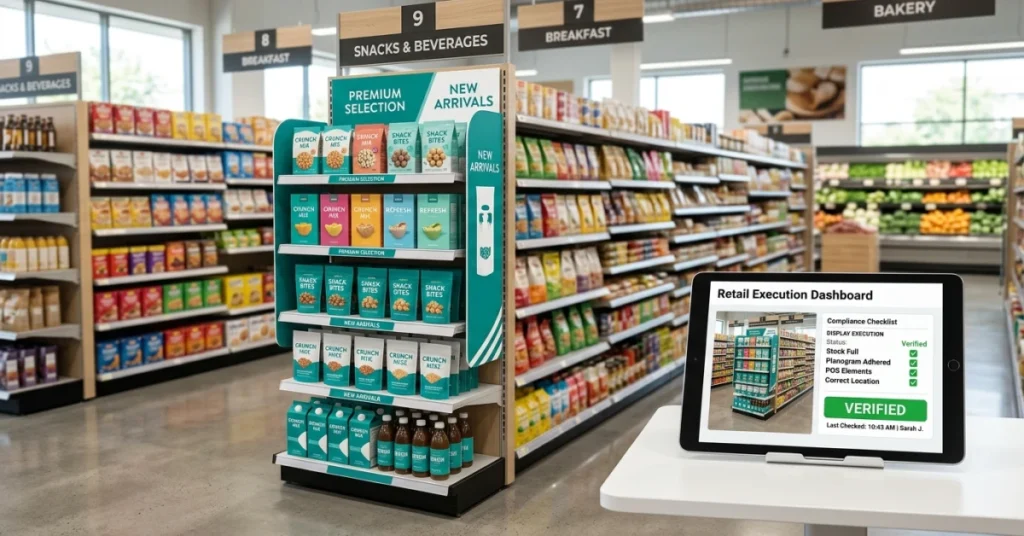
The display looks fine from headquarters. On the floor, it’s a different story.
This gap between what HQ designs and what shoppers actually see is called the execution gap. It drives missed promotions, misplaced product, and flat sales weeks no one can explain.
What benchmark data says about off-script stores
Stores that drift from the approved planogram lose measurable sales — fast. Strong retail reset execution closes that gap before a single shopper notices.
Stores with consistent floor standards outsell off-script locations by up to 15% in category sales (McKinsey). That margin doesn’t come from better product. It comes from better follow-through.
Shopper impact vs. HQ’s assumed compliance rate
Most HQ teams assume stores are on-plan about 80% of the time. Field audits from Onedoor tell a different story. The real number often falls under 50%.
Shoppers don’t know what a display was supposed to look like. They only see what’s in front of them. A broken setup quietly sends them to a competitor’s shelf.
Your stores are likely missing the standard. The real question is why trained teams keep making the same mistakes every campaign.
Why Do Visual Merchandising Campaigns Fail Consistently?
That revenue leak isn’t caused by careless store teams. It happens because the instructions they receive are built for the wrong audience.
Most retailers pour energy into perfecting the visual standard. Then they leave delivery of that standard to chance.
Planogram compliance rates average just 40–60% across multi-location retailers (Webtonic). That means nearly half of all displays never match the approved design.
The cause isn’t bad intent. It’s broken communication. Shared merchandising frameworks exist to close this gap before it costs revenue.
Instruction Clarity vs. Frontline Interpretability
A brief that makes sense to a category manager can be unreadable to a stock associate on a Saturday shift. The writer and the builder rarely share the same context or vocabulary.
They also rarely share the same amount of time. That gap is where execution breaks down.
According to Webtonic, retailers lose up to 25% of potential in-store sales tied to poor execution. That number drops fast when briefs are written for the builder, not the designer.
Consistent execution starts with clear communication. A better-looking planogram won’t fix a confusing brief.
Feedback Loops That Activate After Damage Is Done
Most retailers only spot an execution failure when sales data flags a dip. By then, the promotional window has closed. The revenue is gone.
As Fieldpie points out, real-time field audits catch compliance gaps while there’s still time to fix them. A strategy that waits for sales reports is always playing catch-up.
📊 By the Numbers
Retailers with poor in-store execution lose up to 25% of potential sales per campaign.
The fix isn’t a longer training session. A more detailed planogram won’t solve it either.
It’s a brief that a frontline associate can act on right away. No guessing what headquarters meant.

How to Build a Brief Frontline Teams Actually Follow
A brief written for the wrong reader is just noise — and noise costs money.
The fix starts with how you structure the document itself, not how much detail you pack into it.
Stores that redesigned their brief format around frontline workers — not planners — saw compliance rates jump by as much as 27% with zero added training hours (Repsly).
That gap closes when the instruction matches the reader, not the writer’s expertise.
Non-negotiables vs. sanctioned local adjustments
Every brief needs two clear zones: what must never change, and what the store team can adapt.
Without that split, associates either follow nothing or freeze up trying to follow everything.
Label non-negotiables in bold at the top — shelf position, hero SKU placement, price call-outs.
Then list approved local swaps in a separate block so teams feel trusted, not micromanaged.
Training embedded in the brief, not after it
Most retailers send a brief, then book a training session to explain it. That’s two steps where one should do the job.
Build the “why” directly into the document: one sentence per rule, written at a 7th-grade reading level.
Customerimpactinfo case data shows that self-explanatory briefs cut manager follow-up time by nearly a third.
Add strong retail reset execution habits to that foundation. Then consistent merchandising stops depending on who happens to be working that shift.
📊 By the Numbers
Briefs redesigned for frontline readers drive up to 27% higher planogram compliance — with zero added training time.
Getting the brief right solves the communication problem — but how do you know it’s actually working across every single store location?
How Do You Measure Compliance Across Every Store Location?

How Do You Measure Compliance Across Every Store Location?
A brief built for the frontline associate is only half the job. The other half is knowing whether that associate actually followed it — across every store, every week.
Most retailers track the wrong thing. They measure sales lift after a promotion ends — not the compliance behaviors that drove or killed that lift.
Photo Verification vs. Self-Reported Checklists
Self-reported checklists feel like accountability. They are not. Associates check boxes to close the task — not to confirm the display is correct.
Photo verification changes everything. A timestamped photo of the actual shelf is evidence. A checked box is just a promise. Retailers using store opening checklists with photo capture catch execution gaps in hours, not weeks.
Leading Indicators That Catch Drift Before It Compounds
Planogram compliance rates, brief open rates, and photo submission timing are leading indicators. They flag problems before sales data confirms them.
Consistent merchandising execution depends on watching these signals. Don’t wait for the revenue report.
Track compliance behavior every week. Catching drift early stops one bad store week from becoming a bad quarter.
McKinsey found that top retailers review in-store execution data at least twice as often as average performers. That frequency is the edge.
📊 By the Numbers
Retailers using photo-based audits report up to 30% faster compliance issue resolution versus checklist-only methods.
The audit loop is only as strong as the brief that started it. That raises a real question: how do you enforce visual merchandising consistency at scale without a large field team?

Scale Consistent Execution Without Adding Headcount
Measuring compliance gives you proof. But proof alone doesn’t fix the next store — or the fifty after that.
The real question is simple. How does a small team enforce consistent merchandising execution across dozens of locations? Not by hiring a field rep for every zip code.
The answer isn’t more people. It’s smarter communication — the system that delivers the right instruction, to the right person, at the right moment, every time.
Where retail execution software outperforms manual audits
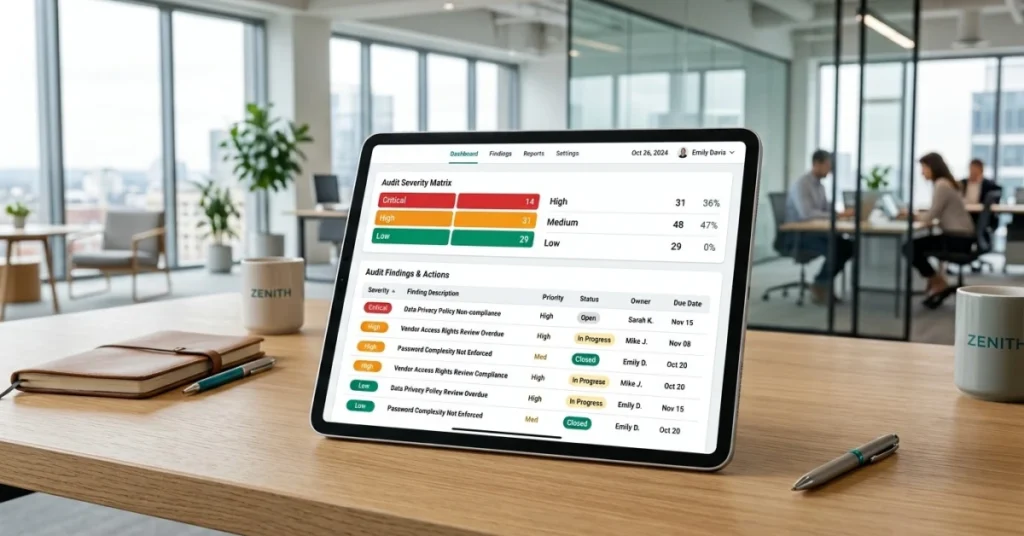
Manual audits catch problems after the fact. Software flags a compliance gap the moment a photo upload doesn’t match the planogram — cutting response time from days to hours.
According to Contravision, visual merchandising consistency can lift sales by up to 30%. That only happens when standards are enforced at the store level — not just designed at headquarters.
FieldPie’s photo-based reporting and customizable audit forms give small teams real-time visibility into secondary display execution across every location. No extra headcount needed.
Post-campaign data that hardens your next rollout
Every completed audit is a data point. Stack enough of them and patterns emerge.
You’ll see which store types comply fastest. You’ll learn which brief formats drive the fewest errors and which steps field teams skip under pressure.
Webtonic reports that retailers with structured in-store execution feedback loops see planogram compliance rates rise by over 20% within two rollout cycles. That gain doesn’t come from hiring. It comes from using post-campaign data to redesign how instructions are built and delivered before the next launch.
📊 By the Numbers
Retailers using structured execution feedback loops improve planogram compliance by over 20% in just two rollout cycles.
When your process learns from itself, scale stops feeling like a staffing problem. All that’s left is deciding what a winning execution looks like from start to finish.
Conclusion
Smarter systems beat bigger teams. The proof shows up on the sales floor every time instructions reach the right person at the right moment.
Retailers who fix their merchandising rework rate don’t hire more reps. They redesign how direction travels from HQ to the shelf.
The real driver of consistent merchandising execution isn’t the planogram. It’s the communication architecture behind it.
Stores that get this right see up to 15% more sales lift from the same promotions. That happens because the display actually gets built as intended (Sciencedirect).
Most retailers track outputs — sales, shrink, foot traffic — while ignoring the compliance behaviors that drive those numbers. Repsly notes that teams with structured audit loops catch execution gaps early. They fix problems before those gaps cost revenue.
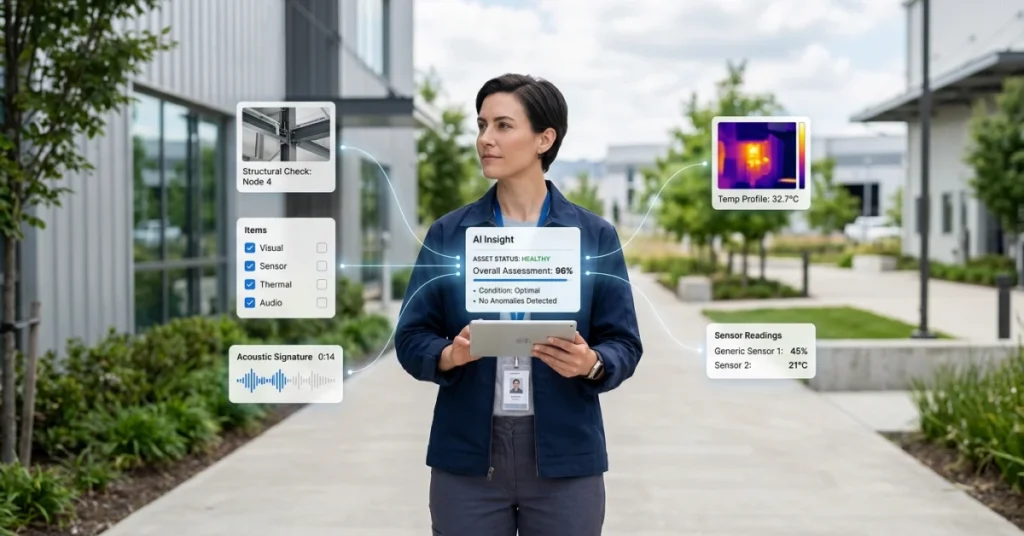
Scaling visual merchandising across dozens of locations breaks down when instructions are built for the writer, not the builder. FieldPie captures real-time photo proof, customizable audit forms, and field data at the point of execution.
Your team sees exactly what’s happening on the floor. That means you can catch a bad display before it costs you a full promo cycle.
Start with one location. Audit one display, fix the brief, then scale what works.