


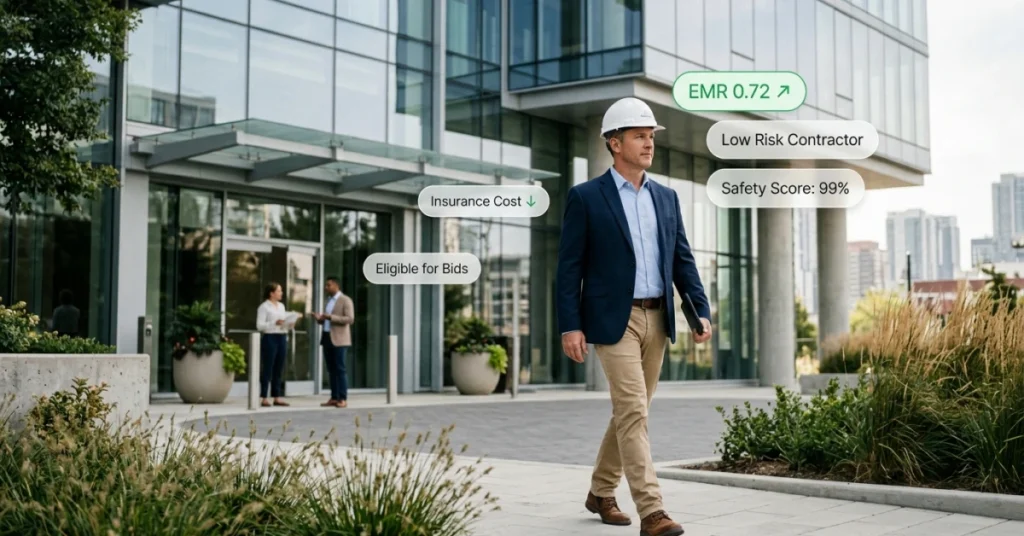
EMR construction safety refers to the use of the Experience Modification Rate — a workers’ compensation insurance metric — as a direct indicator of a contractor’s on-site safety performance. An EMR of 1.0 is the industry average; scores below 1.0 signal a safer-than-average operation, while scores above 1.0 trigger higher premiums and can disqualify firms from competitive bids.
What Is EMR in Construction, and Why Does It Matter in 2026?
The Experience Modification Rate (EMR) is calculated by the National Council on Compensation Insurance (NCCI) or a state-equivalent rating bureau. It compares your company’s actual workers’ compensation claims history against the expected loss data for your industry classification over a rolling three-year period — excluding the most recent policy year.
Here is why this single number carries outsized weight in 2026:
- Insurance premiums: An EMR of 1.3 can increase your annual workers’ comp premium by 30% or more, directly eroding job profitability.
- Bid eligibility: Most federal agencies, general contractors, and large private owners require a minimum EMR threshold — typically 1.0 or lower — before a subcontractor can even submit a proposal.
- Prequalification platforms: ISNetworld, Avetta, and Veriforce all pull EMR data as a core compliance signal during contractor vetting.
- Bonding capacity: Surety companies factor EMR into bond underwriting, capping the contract value available to high-EMR firms.
As noted by industry safety consultants, even a single large lost-time incident can push a small contractor’s EMR above 1.5, making the company effectively unbiddable on major projects for three full years.
How Is the EMR Score Calculated?
The NCCI formula compares your actual incurred losses to your expected losses based on payroll size and industry classification code. The simplified relationship looks like this:
EMR = Actual Losses ÷ Expected Losses
In practice, the formula applies a split-point adjustment that weights smaller, more frequent claims more heavily than catastrophic single events. As of 2013, NCCI raised the primary split point from $5,000 to $15,000, then to $17,500, giving more predictive weight to high-frequency, low-severity losses.
Key variables that feed the calculation:
| Variable | Description | Impact on EMR |
|---|---|---|
| Primary losses | Claims up to the split-point threshold | High weight — drives EMR up fastest |
| Excess losses | Claim amounts above the split point | Lower weight in the formula |
| Payroll (exposure) | Total payroll by class code | Larger payrolls lower per-unit risk |
| Expected loss rate | Industry average loss per $100 payroll | Set by NCCI annually |
| Three-year window | Excludes the most recent policy year | Lags actual performance by ~12 months |
Because the formula excludes the current policy year, improvements you make today won’t fully appear in your rating for up to 18 months. That makes early, consistent risk management — not reactive fixes — the only viable strategy.

What Is a Good EMR Rating for Construction Contractors?
According to data compiled by HCSS and industry safety researchers, EMR benchmarks break down as follows:
- Below 0.75: Exceptional safety performance; qualifies for premium credits and elite prequalification tiers
- 0.75 – 1.0: Above average; competitive on most bids; eligible for most prequalification programs
- 1.0: Industry average baseline; no premium modifier applied
- 1.0 – 1.25: Below average; premium surcharges begin; some bid opportunities close
- Above 1.25: High-risk classification; significant premium increases; disqualified from many public and large private contracts
The average EMR for construction contractors that actively invest in formal safety programs sits between 0.8 and 0.9, according to GoContractor’s analysis of contractor safety data. Firms without structured training and documentation programs cluster near or above 1.2.
How Does EMR Directly Affect Construction Costs and Profitability?
The financial impact of a poor EMR compounds across multiple cost centers simultaneously.
Direct insurance costs: A contractor with $2 million in annual workers’ comp base premium and an EMR of 1.4 pays $2.8 million — $800,000 more than a competitor with a 1.0 rating doing identical work.
Indirect costs: OSHA research consistently shows that indirect costs of a workplace incident — lost productivity, retraining, schedule delays, equipment damage, and legal fees — run 4 to 10 times the direct medical and compensation costs.
Bid competitiveness: When two contractors submit similar pricing, the one with the lower EMR wins the risk-adjusted evaluation every time. For government and institutional projects, a high EMR is an automatic disqualifier regardless of price.
Bonding limits: A surety underwriter who sees an EMR trending above 1.2 will reduce aggregate bond capacity, limiting the size and number of simultaneous jobs a contractor can pursue.
What Are the Most Common Causes of High EMR in Construction?
Understanding root causes is the first step in any credible improvement plan. The most frequent drivers of elevated EMR include:
- Inadequate new-hire and subcontractor onboarding — workers unfamiliar with site-specific hazards account for a disproportionate share of first-year incidents
- Absence of formal incident reporting protocols — near-misses go undocumented, removing the early-warning data needed for proactive risk management
- Inconsistent toolbox talk and safety training cadence — sporadic programs fail to build the behavioral habits that prevent claims
- Poor return-to-work programs — claims that stay open longer dramatically increase total incurred costs and EMR impact
- Inadequate documentation of safety compliance activities — without records, insurers and rating bureaus assume the worst
A well-structured safety management system addresses each of these gaps systematically, not episodically.
EMR Construction Safety Improvement Checklist: 12 Proven Steps
Use this checklist to audit your current program and identify the highest-leverage improvement opportunities.
Pre-Incident Prevention
- Establish a written safety plan with site-specific hazard identification for every active job
- Conduct structured new-hire safety orientation — document completion with signed acknowledgment forms for every worker, including subcontractor personnel
- Implement a weekly toolbox talk program with attendance logs and topic documentation stored in a central system
- Run pre-task planning (JHA/JSA) for all high-risk activities — falls, confined space, electrical, and crane work at minimum
- Assign a dedicated safety officer or third-party safety consultant on projects above a defined dollar threshold
Incident Response and Claims Management
- Report all incidents within 24 hours to your insurance carrier — delayed reporting increases total incurred costs
- Launch a formal return-to-work (RTW) program — modified duty assignments reduce claim duration and total cost significantly
- Conduct a root-cause analysis (RCA) within 72 hours of every recordable incident and document corrective actions
- Monitor open claims monthly with your carrier and risk manager to drive timely closure
Documentation and Compliance
- Audit your NCCI unit statistical report annually — errors in payroll classification or loss data directly inflate your EMR
- Maintain digital documentation of all training completions, safety inspections, incident reports, and corrective actions
- Review your EMR calculation letter from NCCI or your state bureau each year and dispute inaccuracies within the appeal window
What Role Does OSHA Compliance Play in EMR Management?
OSHA recordkeeping and EMR are separate systems, but they are deeply interconnected in practice.
OSHA’s recordkeeping standard (29 CFR 1904) requires employers with 10 or more employees to log work-related injuries and illnesses on OSHA 300 logs. Those records feed your OSHA Incident Rate (TRIR and DART), which prequalification platforms and general contractors use alongside EMR to assess contractor risk.
Key compliance intersections:
- A recordable OSHA incident is not automatically a workers’ comp claim — but many are, and those claims drive EMR
- OSHA citations for safety violations signal systemic program failures that insurers and clients treat as leading indicators of future claims
- The OSHA 300A summary must be posted from February 1 through April 30 annually — failure to comply triggers fines and creates audit risk
How Do Prequalification Systems Use EMR Data?
Prequalification platforms have become the gatekeepers of contractor access to major projects. Understanding how they use EMR data is essential for bid strategy.
ISNetworld (ISN): Assigns a RAVS® (Review and Verification Services) score that incorporates EMR alongside TRIR, DART, and safety program quality. An EMR above 1.0 can lower your RAVS score below a client’s minimum threshold.
Avetta: Uses a weighted scorecard where EMR carries significant weight. Contractors with EMR above 1.2 are frequently flagged for manual review or disqualification.
Veriforce: Similar weighted approach; some owner-clients set hard EMR cutoffs at 0.85 for high-hazard work classifications.
Federal contracting (FAR/DFARS): While no single federal EMR threshold exists by regulation, contracting officers routinely use EMR as a responsibility determination factor under FAR 9.104-1.
EMR Construction Safety Program: What Should a Formal Plan Include?
A defensible, EMR-reducing safety plan is not a binder on a shelf. It is an active management system with the following components:
1. Written Safety Policy Statement Signed by the company’s senior leadership, establishing safety as a core business value — not a compliance checkbox.
2. Hazard Identification and Risk Assessment Site-specific Job Hazard Analyses (JHAs) for all high-risk activities, updated at the start of each new phase of work.
3. Training Programs and Competency Verification Structured onboarding, OSHA 10/30 certification tracking, and role-specific training with documented completion data for every worker on every job.
4. Incident Reporting and Investigation Protocol A clear, low-friction process for reporting incidents and near-misses, with a defined RCA methodology and corrective action tracking.
5. Return-to-Work Program A formal modified-duty program that reduces claim duration — the single most impactful lever for controlling total incurred costs.
6. Safety Metrics and Management Review Monthly review of leading and lagging indicators — near-miss frequency, inspection completion rates, training compliance, and open claim status — by senior management.
7. Documentation and Records Management A centralized, auditable record of all safety activities, capable of producing compliance reports on demand for insurance audits and prequalification submissions.
EMR Benchmarks by Construction Trade: What’s Typical?
EMR norms vary by trade because underlying hazard exposure differs significantly. The following benchmarks reflect industry averages based on NCCI classification data and published safety research:
| Construction Trade | Typical Average EMR Range | Primary Hazard Drivers |
|---|---|---|
| General Building Contractors | 0.90 – 1.10 | Falls, struck-by, overexertion |
| Electrical Contractors | 0.80 – 1.00 | Electrical shock, falls, repetitive motion |
| Mechanical / Plumbing | 0.85 – 1.05 | Burns, cuts, confined space |
| Concrete / Masonry | 0.95 – 1.20 | Falls, overexertion, struck-by |
| Roofing Contractors | 1.00 – 1.30 | Falls (highest frequency in trade) |
| Specialty / Demolition | 1.05 – 1.35 | Structural collapse, hazmat exposure |
| Painting Contractors | 0.80 – 1.00 | Falls, chemical exposure |
Roofing and demolition contractors face the steepest climb because their baseline expected loss rates are high — but that also means even moderate improvement in incident prevention produces significant EMR reductions.

How Long Does It Take to Lower Your EMR?
Because EMR is calculated on a rolling three-year window that excludes the most recent policy year, the timeline for improvement follows a predictable pattern:
- Year 1: Implement safety programs, reduce incident frequency and severity — no EMR change yet
- Year 2: First year of improved loss data enters the calculation window — modest EMR improvement visible
- Year 3: Second year of improved data incorporated — more significant score reduction
- Year 4: Full three-year window reflects new safety culture — EMR reaches its improved steady state
This lag is why contractors who wait until their EMR spikes to act pay a steep price. The time to invest in safety programs is before the claims accumulate, not after. As Raken’s construction safety research confirms, contractors with proactive, documented safety cultures consistently maintain lower EMR scores across all trade categories.
Effective return-to-work programs accelerate the timeline by reducing total incurred costs on existing open claims — the fastest lever available for immediate financial impact. Tracking claim status and return-to-work compliance digitally ensures nothing slips through during the critical improvement window.
Conclusion
EMR construction safety is more than a compliance metric—it is a direct reflection of how effectively a contractor manages risk, protects its workforce, and sustains long-term profitability. Companies that treat EMR as a lagging indicator to be managed, rather than a number to be explained, consistently outperform their peers.
In 2026, where prequalification standards are tighter and project risk tolerance is lower, a strong EMR is not optional—it is a competitive requirement. Contractors that invest early in structured safety programs, proactive incident management, and accurate documentation build a measurable advantage across bidding, insurance costs, and operational stability.
Ultimately, lowering your EMR is not about short-term fixes. It is about building a repeatable safety system that prevents incidents, controls costs, and positions your business for sustainable growth.