



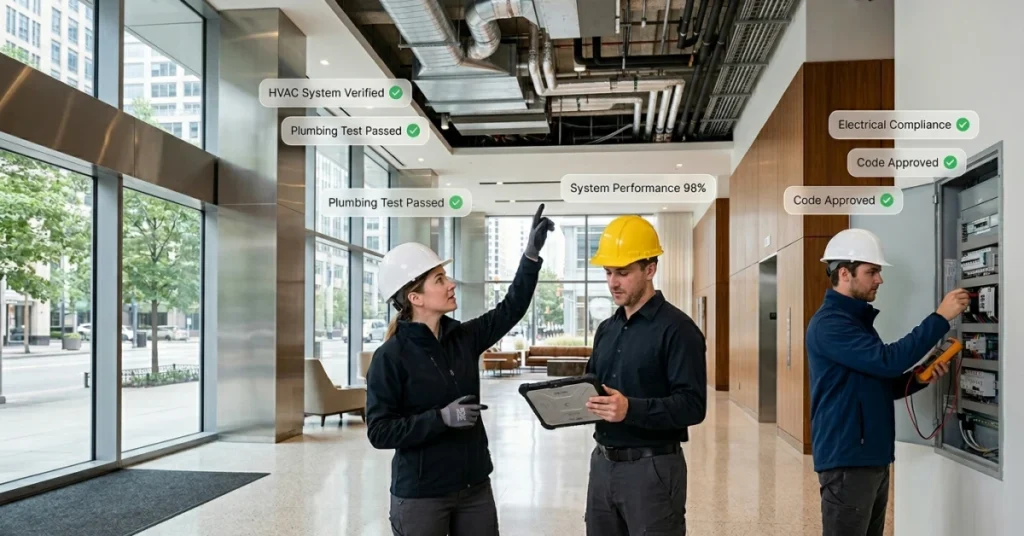
MEP inspection in construction is the systematic examination of a building’s mechanical, electrical, and plumbing systems to verify code compliance, operational integrity, and safety standards. Conducted at defined project milestones, these inspections confirm that installed systems perform as designed before a structure receives occupancy approval.
What Is MEP Inspection in Construction — and Why Does It Matter?
Every commercial building depends on three interconnected systems to function safely: mechanical (HVAC), electrical (power distribution, lighting, fire alarm), and plumbing (supply, drainage, gas). When any one of these systems fails a code check or performs below spec, the consequences range from costly rework to catastrophic safety incidents.
According to MEP inspection and certification framework, third-party verification of MEP systems is now a baseline expectation on mid-to-large commercial projects — not an optional add-on. Owners, insurers, and authorities having jurisdiction (AHJs) all require documented proof that systems were installed correctly and tested under load before occupancy.
The stakes are high. MEP systems account for roughly 40–60% of total construction costs on commercial buildings. Defects discovered after handover cost 3–10x more to remediate than those caught during installation.
How Do MEP Inspections Fit Into the Construction Workflow?
MEP inspections are not a single event. They are a structured series of hold points embedded throughout the project lifecycle. Missing one hold point often voids the entire inspection sequence downstream.
Pre-Construction Phase
- Design review and coordination: Confirm MEP design drawings align with architectural and structural plans.
- BIM clash detection: Use BIM models to identify spatial conflicts between duct runs, conduit, and pipe routing before any material is ordered.
- Submittal review: Approve shop drawings, equipment data sheets, and material specifications against the contract documents.
Rough-In Phase
- Mechanical: Verify duct sizing, hangers, seismic bracing, and clearances.
- Electrical: Inspect conduit routing, wire gauge, junction box placement, and grounding continuity.
- Plumbing: Check pipe slope, support spacing, pressure testing of supply lines, and drain-waste-vent (DWV) rough-in.
Above-Ceiling / In-Wall Inspections
This is the last opportunity to inspect concealed systems before drywall and ceilings close them in. AHJs typically require a formal inspection sign-off at this stage.
Systems Testing and Commissioning
- Air and water balancing reports
- Electrical load testing and insulation resistance testing
- Plumbing pressure tests and flow rate verification
- Fire suppression system hydrostatic testing
- Building automation system (BAS) functional testing
Final Inspection and Punch List
All systems must demonstrate full functionality under normal operating conditions. Deficiency items are logged, corrected, and re-inspected before the certificate of occupancy is issued.

MEP Inspection Checklist: 30 Critical Items for Commercial Projects
Use this checklist as a minimum baseline for MEP inspection in construction on commercial projects. Adapt it to your jurisdiction’s adopted code edition.
Mechanical Checklist
| # | Inspection Item | Code Reference | Status |
|---|---|---|---|
| 1 | HVAC equipment model/capacity matches approved submittals | IMC / Project Specs | ☐ |
| 2 | Duct supports at max 10-ft intervals (rigid duct) | SMACNA | ☐ |
| 3 | Seismic restraints installed per IBC requirements | IBC 2021 | ☐ |
| 4 | Duct leakage test ≤ 4% of system airflow | ASHRAE 90.1 | ☐ |
| 5 | Combustion air openings sized correctly | IMC 701 | ☐ |
| 6 | Exhaust system CFM verified at each terminal | Design Drawings | ☐ |
| 7 | Refrigerant type and charge documented | EPA 608 | ☐ |
Electrical Checklist
| # | Inspection Item | Code Reference | Status |
|---|---|---|---|
| 8 | Service entrance labeled and accessible | NEC 230 | ☐ |
| 9 | All conductors properly terminated and torqued | NEC 110.14 | ☐ |
| 10 | AFCI protection in required locations | NEC 210.12 | ☐ |
| 11 | GFCI protection in wet/damp locations | NEC 210.8 | ☐ |
| 12 | Grounding electrode system bonded | NEC 250 | ☐ |
| 13 | Emergency egress lighting tested (90-min battery) | IBC 1006 / NFPA 101 | ☐ |
| 14 | Fire alarm devices spaced per NFPA 72 | NFPA 72 | ☐ |
Plumbing Checklist
| # | Inspection Item | Code Reference | Status |
|---|---|---|---|
| 15 | Supply pipe pressure test at 100 psi for 15 min | IPC 312 | ☐ |
| 16 | DWV system air test at 5 psi for 15 min | IPC 312 | ☐ |
| 17 | Drain slope minimum 1/4″ per foot for ≤ 3″ pipe | IPC 704 | ☐ |
| 18 | Backflow preventer installed on all irrigation connections | IPC 608 | ☐ |
| 19 | Water heater T&P valve discharge pipe to floor | IPC 504 | ☐ |
| 20 | Fixture unit count does not exceed pipe capacity | IPC 710 | ☐ |
Systems Integration and Commissioning
| # | Inspection Item | Code Reference | Status |
|---|---|---|---|
| 21 | BIM coordination model updated to as-built conditions | Contract Requirements | ☐ |
| 22 | Air and water balance report reviewed and approved | ASHRAE 111 | ☐ |
| 23 | BAS sequences of operation verified | Design Intent | ☐ |
| 24 | Fire suppression hydrostatic test at 200 psi | NFPA 13 | ☐ |
| 25 | Kitchen hood suppression system tested | NFPA 96 | ☐ |
| 26 | Energy sub-metering functional | ASHRAE 90.1 / Local Code | ☐ |
| 27 | Insulation R-value on piping and ducts verified | ASHRAE 90.1 | ☐ |
| 28 | TAB contractor report signed and sealed | AABC / NEBB | ☐ |
| 29 | O&M manuals and warranties submitted to owner | Contract | ☐ |
| 30 | AHJ final inspection sign-off obtained | Local Jurisdiction | ☐ |
How Does BIM Transform MEP Inspection Accuracy?
BIM has fundamentally changed how teams approach inspections. Rather than comparing field conditions against 2D paper drawings, inspectors now reference 3D coordination models that show every pipe, conduit, and duct in spatial context.
As Excelize’s analysis of MEP in construction notes, BIM-based coordination catches the majority of installation conflicts before materials ever reach the site — reducing RFIs and field changes that would otherwise invalidate inspection hold points.
Specific BIM applications in MEP inspections include:
- Clash detection reports that flag physical conflicts between mechanical, electrical, and structural elements before rough-in begins
- As-built model updates that give facility managers accurate system data for ongoing maintenance
- 4D scheduling integration that ties BIM elements to inspection hold points, automatically alerting the team when a system is ready for review
- Quantity takeoffs from BIM models that allow inspectors to cross-reference installed material quantities against approved submittals
Teams that integrate BIM into their inspection workflow consistently report fewer failed inspections and shorter punch list cycles. For project owners, this translates directly to reduced carrying costs and earlier revenue generation from the completed building.
For teams managing multiple concurrent projects, a centralized construction quality management platform ensures that BIM data, inspection records, and test reports are accessible in a single audit trail.
What Are the Most Common MEP Inspection Failures on Commercial Projects?
Understanding where inspections most frequently fail helps teams build targeted prevention strategies. Based on patterns documented across commercial construction projects, the following deficiencies appear most often:
Mechanical failures:
- Duct leakage exceeding code limits due to improper sealant application at joints
- Missing or undersized seismic restraints on HVAC equipment
- Incorrect refrigerant charge, often due to field modifications after commissioning
Electrical failures:
- Improper wire termination torque values (a leading cause of connection failures and fires)
- Missing AFCI or GFCI protection in code-required locations
- Panel directories that don’t match installed circuits — a common punch list item that delays final inspection
Plumbing failures:
- Insufficient drain slope causing chronic blockage issues
- Backflow preventer omissions, particularly on irrigation and lab systems
- Failed pressure tests traced to improper joint preparation
As Elements MEP’s research on commercial inspection benefits confirms, regular inspections throughout the project — not just at final — dramatically reduce the quantity and severity of deficiencies at closeout. Teams that conduct structured interim inspections arrive at final with punch lists that are 60–70% shorter than those that rely solely on end-of-project reviews.
Project managers who want to reduce rework exposure should consider establishing formal inspection and test plans (ITPs) early in the design phase.
How Do MEP Inspections Differ Across Project Types?
Not all buildings carry the same inspection burden. The quantity and rigor of required inspections scales with building complexity, occupancy classification, and local code requirements.
Commercial Office Buildings
Commercial office buildings typically require the full sequence of mechanical, electrical, and plumbing inspections, plus commissioning documentation for HVAC and lighting control systems. Energy code compliance verification (often ASHRAE 90.1 or a state-adopted equivalent) adds a layer of testing that residential projects don’t face.
Healthcare Facilities
Hospitals and outpatient facilities face the most stringent MEP inspection requirements of any building type. Systems must meet FGI Guidelines for the Design and Construction of Hospitals, NFPA 99 (Health Care Facilities Code), and state health department requirements. Redundant systems — emergency power, medical gas, and critical HVAC — each require separate testing protocols.
Industrial and Manufacturing
Industrial facilities prioritize electrical system capacity, hazardous location classifications (NFPA 70, Article 500), and process plumbing. Inspections must verify that electrical systems serving motors, drives, and control panels meet both NEC requirements and equipment manufacturer specifications.
Data Centers
Data center MEP inspections focus on power density, redundancy (Tier I–IV per Uptime Institute standards), precision cooling performance, and generator transfer time testing. These facilities often require 24/7 commissioning support during initial startup.
Teams managing high-complexity projects benefit from real-time field reporting tools that capture inspection data at the point of discovery, rather than relying on end-of-day paper logs.

What Role Does Quantity Surveying Play in MEP Inspections?
Quantity surveying and MEP inspections intersect at several critical points in the project lifecycle. Inspectors verify not just that systems function correctly, but that the quantity of installed materials matches what was specified and paid for.
As Bhadanis Quantity Surveying’s quality control guide for MEP work outlines, quantity verification during inspections protects owners from under-installation of specified materials — a risk that is particularly acute in plumbing (pipe insulation, support spacing) and electrical (wire gauge, conduit fill ratios).
Key quantity verification points during MEP inspections:
- Confirm conduit fill ratios don’t exceed 40% (NEC 310) to ensure proper heat dissipation
- Verify pipe insulation thickness matches ASHRAE 90.1 Table 6.8.3 requirements
- Cross-reference duct quantities against BIM model takeoffs to catch missing sections
- Audit fixture counts against approved plumbing fixture schedule
Quantity discrepancies discovered during inspections must be documented with photographic evidence and tied to specific contract line items. This documentation protects all parties in the event of a dispute and provides the owner with a clear record of what was actually installed.
Conclusion
MEP inspection in construction is not just a checkpoint—it is a structured system that ensures safety, performance, and compliance across every critical building system. Projects that embed inspections throughout the lifecycle consistently reduce rework, control costs, and avoid costly post-handover failures.
As building complexity increases in 2026, relying on end-stage inspections is no longer enough. Success comes from integrating design validation, real-time field verification, and disciplined testing into a single workflow.
Ultimately, strong MEP inspection practices turn quality from a risk into a measurable advantage—ensuring systems perform as intended from day one.