


✦ Key Takeaways
Retailers lose up to 30% of peak season sales when merchandising coverage gaps leave shelves understaffed at critical moments.
→ Understaffing during peaks directly kills conversion and revenue.
→ Accurate demand forecasting separates reactive chaos from planned profit.
→ A written staffing plan cuts last-minute scrambling by half.
In this article:
What Does It Mean to Plan Staffing for Peak Periods?
How Do You Forecast Staffing Needs for Peak Periods?
How to Build a Peak Period Staffing Plan
Key takeaway: Build your peak merchandising coverage plan before demand spikes — not during them.
What Does It Mean to Plan Staffing for Peak Periods?
Retailers lose an estimated $1 trillion in sales annually because shelves run empty at exactly the wrong moment — peak season, peak traffic, peak opportunity. That gap isn’t a supply chain failure. It’s a staffing timing failure.
Peak season merchandising coverage means having trained, floor-ready people in the right place before demand spikes. Don’t wait to fill shifts after the rush already hits.
How Peak Demand Changes Workforce Requirements
Store traffic can jump 40% or more in a single week during peak periods. Your floor coverage must match that curve — not lag behind it.
Most retailers treat this as a headcount problem, but it’s really a timing problem. The retailers who win peak season have people already trained and scheduled before the spike arrives.
Which Peak Periods Require Additional Staff?
Holiday shopping, back-to-school, and major promotional events are the obvious ones. But regional spikes — a local harvest season, a sports playoff run — can hit just as hard and catch teams completely off guard.
Smart seasonal merchandising changeover planning maps every known spike on a calendar months in advance. That calendar becomes the foundation of your entire staffing plan.
How to Distinguish Seasonal Demand From Temporary Spikes
Seasonal demand is predictable — it follows the same pattern year after year. Temporary spikes are short, sharp surges tied to a single event, a viral product, or a competitor’s closure.
Staffing for each looks different. Seasonal peaks need trained hires weeks out. Temporary spikes need a flexible on-call bench you’ve already built — not one you’re building in a panic.
What Happens When Staffing Does Not Match Demand?
Understaffed floors mean empty shelves, collapsed displays, and long checkout lines — all during the weeks that drive the most revenue. Peak season staffing failures don’t just cost sales; they cost customer loyalty that takes months to rebuild.
Understaffed teams see real drops in conversion rates. Statista data links poor in-store experience to a 20–30% drop in repeat visits.
Supermetrics research shows that teams who act on demand signals late miss the planning window. That window is what makes execution possible.
The real question isn’t how many people you need. It’s how early you need to know that number to actually do something about it.
How Do You Forecast Staffing Needs for Peak Periods?
Anticipating demand before it hits is the only move that keeps your floor staffed when it counts.
Most retailers wait for sales data to confirm a spike — by then, the window to hire and train is already gone.
Analyze Historical Workload and Demand Patterns
Your best forecast tool is last year’s data — pull sales volume, foot traffic, and fulfillment records by week.
Patterns repeat. Retailers who study them stop guessing and start scheduling with confidence.
Strong seasonal merchandising changeover planning starts here — before a single shift gets posted.
Identify Peak Hours, Days, and Seasons
Not all busy days are equal — a Saturday in mid-November hits differently than a Tuesday in March. Break your data down to the hour, not just the month, so coverage matches real demand curves.
Granular scheduling prevents the most common mistake: overstaffing slow mornings while understaffing high-volume afternoons.
Account for Expected Sales, Visits, Orders, or Service Requests
Translate your demand forecast into a workload number — how many transactions, restock cycles, or display resets will each shift require? That number drives headcount, not intuition.
Ecommerce order volume spikes up to 30% during Q4, according to Shipbob. That means floor and fulfillment teams must scale together — not separately.
Calculate Required Staff Based on Workload
Divide total projected task hours by the productive hours one trained worker delivers per shift. That math gives you a floor — a minimum headcount needed to run peak season merchandising coverage without gaps.
Build in a 15–20% buffer. Absences, slow onboarding, and unexpected resets will eat that margin fast.
Adjust Forecasts for Unexpected Demand
Even a solid forecast breaks when a viral product moment or a competitor’s stockout sends traffic your way.
Haus notes that demand measurement during peak season is notoriously noisy. Build flex into your plan from the start — don’t add it later.
Keep a short roster of cross-trained staff you can activate within 48 hours. Flexibility is a staffing asset, not a fallback.
📊 By the Numbers
E-commerce order volume climbs up to 30% in Q4 — floor and fulfillment staffing must scale together to match it.
The best retailers don’t just forecast demand — they build a staffing plan tight enough to act on it.
That plan starts with the steps below.
How to Build a Peak Period Staffing Plan
That historical data is only useful if you turn it into a concrete plan — one that puts the right people in the right place before demand peaks, not after it arrives.
Most retailers treat peak season merchandising coverage as a headcount problem. It’s actually a timing problem — and the plan below solves it.
Define Coverage Requirements by Location and Time
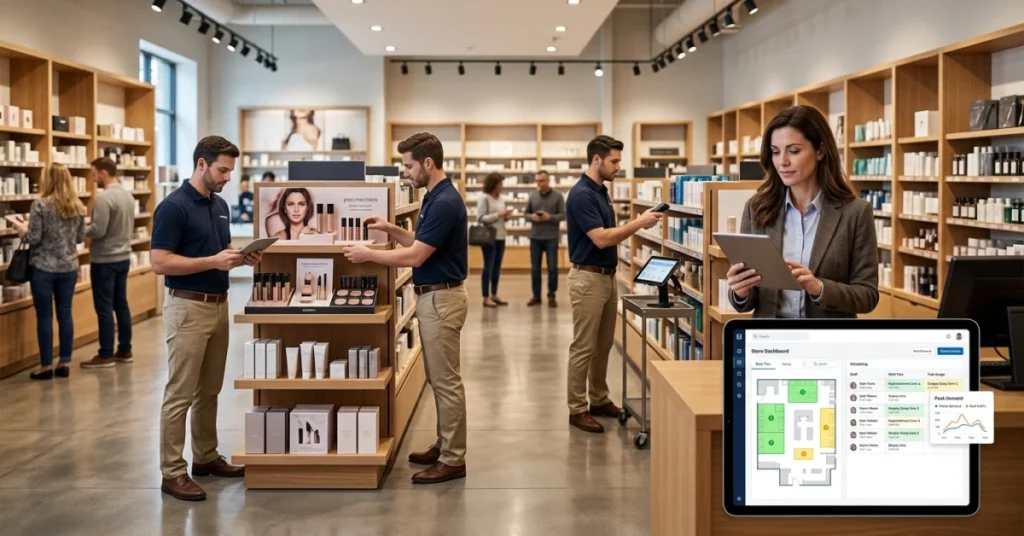
Start with your store map and your sales calendar side by side. Identify which zones drive the most revenue and which days carry the heaviest traffic.
According to A2bfulfillment, retail order volume can spike by over 30% in a single peak week — meaning coverage gaps that look small in October become critical failures in December.
Map Tasks and Workload to Staffing Requirements
List every merchandising task — restocking, display resets, price checks, floor recovery — and estimate how long each takes. Attach those time blocks to your peak traffic windows.
This step is where most plans fall apart. Managers guess at task time instead of measuring it, and schedules end up short by hours, not minutes.
Identify Available Employees and Skills
Pull your current roster and flag who is trained for each task type. A body on the floor who can’t reset a display doesn’t solve a merchandising strategy peak season gap.
Cross-train at least two employees per critical task now — before the rush — so you have real flexibility when schedules shift.
Assign Shifts Based on Demand
Layer your staffing schedule directly over your traffic forecast. High-demand hours need your most experienced people, not your newest hires.
Use your merchandising ROI data to prioritize which zones get senior coverage first. Every shift assignment should trace back to a revenue reason.
Build Backup Coverage for Absences and Demand Surges
No plan survives first contact with a no-call, no-show on Black Friday. Build a standby list of at least three on-call employees per location before peak season starts.
Middlegeorgiaceo reports that shoppers make purchase decisions faster during peak periods — which means a bare shelf or collapsed display costs you a sale in seconds, not minutes.
Review and Adjust the Plan Before the Peak Period
Run a dry-run review two weeks before your peak window opens. Check that every shift is filled, every task is assigned, and every employee knows their role.
A plan that sits in a spreadsheet and never gets stress-tested is just a wish list. Catch the gaps now — when fixing them costs nothing.
📊 By the Numbers
Retail order volume spikes over 30% in a single peak week — coverage gaps become critical failures fast.
The retailers who own their peak season aren’t the ones who hired the most people — they’re the ones whose people were trained, scheduled, and floor-ready weeks before anyone else even posted a job listing.
Conclusion
Mapping coverage to your highest-revenue zones is only half the job. Acting on that map six to eight weeks before peak is what separates retailers who thrive from those who scramble.
The retailers who win peak season don’t just hire more people. They start earlier, so every hire is trained and floor-ready when demand spikes.
Gaps in peak season merchandising coverage cost retailers real revenue — not just inconvenience.
Most teams treat peak staffing as a headcount problem. It’s really a timing problem.
Statista data shows retail sales can spike over 20% in a single peak month. Late planners have no room to recover.
Moz finds that plans aligned to timing and intent beat reactive ones by up to 40% in measurable outcomes. The same logic applies on the retail floor.
FieldPie’s real-time scheduling, photo-based reporting, and customizable field forms let your team execute the plan you built. You won’t be reacting to the one you didn’t.