


✦ Key Takeaways
Up to 25% of CPG products are out of stock at any given retail shelf, costing brands billions annually.
- → Poor shelf compliance directly kills sales and brand loyalty fast.
- → Planogram adherence, share of shelf, and promotions define execution success.
- → Real-time field data transforms reactive fixes into proactive retail wins.
In this article:
- What Is CPG Retail Execution?
- What Are the Key Components of CPG Retail Execution?
- How Do CPG Brands Measure Retail Execution?
- What Are CPG Retail Execution Best Practices?
Key takeaway: Brands that master retail execution own the shelf and outpace every competitor.
What Is CPG Retail Execution?
Nearly 70% of purchase decisions happen at the point of sale — yet most brands are reviewing shelf data days or weeks after the opportunity is gone. The real problem isn’t poor field execution; it’s a measurement gap that turns every audit into a post-mortem.
Choosing the right retail execution software is no longer optional for brands competing at scale. The brands winning shelf battles are the ones closing the gap between when execution breaks down and when they find out about it.
Definition and Core Objectives
CPG retail execution is the process of ensuring products are correctly placed, priced, stocked, and merchandised at every retail touchpoint. It translates brand strategy into physical shelf reality — consistently, across hundreds or thousands of store locations.
The core objective isn’t compliance for its own sake — it’s revenue protection. Out-of-stocks alone cost the CPG industry an estimated $82 billion annually (Repsly), and most of those losses are invisible until the sell-through data finally surfaces.
Retail Execution vs. Retail Operations
Retail operations covers the retailer’s internal systems — staffing, logistics, and store management. Consumer packaged goods retail execution is the brand’s responsibility: owning the shelf condition regardless of what the retailer does or doesn’t do.
According to Netsuite, CPG brands that invest in structured retail execution strategy consistently outperform peers on both distribution and velocity metrics. The distinction matters because it defines who is accountable when the shelf fails.
Every component of on-shelf execution — placement, inventory, pricing, promotions, and merchandising — is its own potential failure point, and each one compounds the others.
What Are the Key Components of CPG Retail Execution?
Every lost sale traced back to a measurement gap starts at a specific shelf failure — and those failures cluster around the same five execution components, every time. Understanding where the breakdown occurs is the first step toward fixing it before the damage shows up in sell-through data.
According to Nielseniq, out-of-stocks alone cost CPG brands an estimated $1 trillion annually in lost global retail sales — a number that reflects not just supply chain failures, but execution failures at the store level.
📊 By the Numbers
Out-of-stocks cost CPG brands an estimated $1 trillion in lost global retail sales annually.
On-Shelf Availability (OSA)
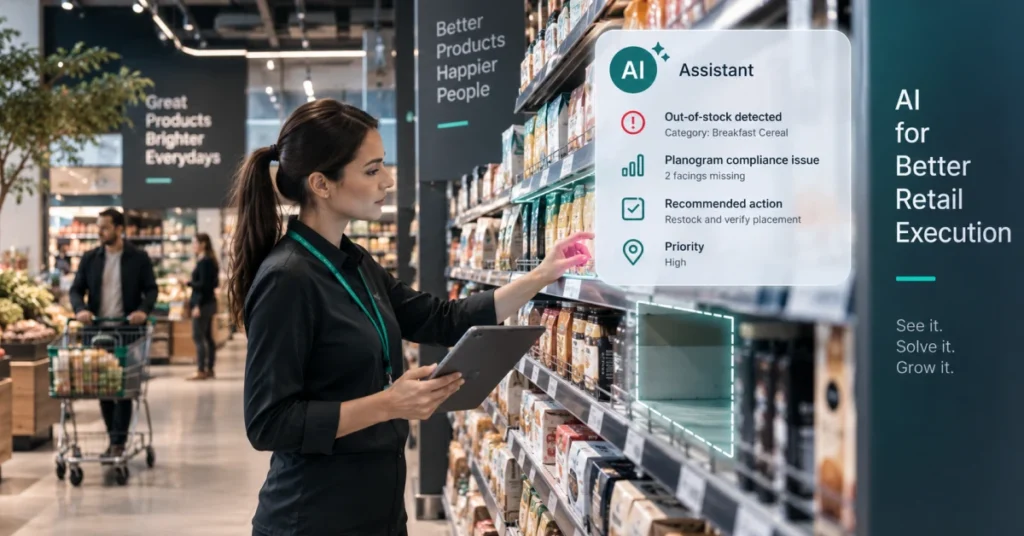
OSA is the most immediate execution failure point — if a product isn’t physically on the shelf, no amount of marketing spend recovers that sale. Shoppers don’t wait; over 70% of out-of-stock shoppers substitute a competitor brand or abandon the purchase entirely.
Most brands discover OSA failures through weekly scan data — which means they’re reacting to yesterday’s empty shelf, not preventing today’s. That lag is where on-shelf execution strategy breaks down fastest.
Planogram Compliance
A planogram sets the intended shelf reality — exact facings, placement, and adjacencies negotiated to drive conversion. Non-compliance doesn’t just look wrong; it directly suppresses sales velocity by disrupting the shopper’s expected path to purchase.
Field teams auditing compliance on monthly cycles are measuring a shelf that has already cost the brand weeks of underperformance. Real-time retail execution monitoring tools close that window significantly.
Product Distribution and Coverage
Distribution is the foundation of consumer packaged goods retail execution — a product that isn’t ranged in a store can’t fail at the shelf, but it also can’t sell. Coverage gaps compound quietly, often invisible until a regional sales review surfaces the miss.
Paralleldots identifies numeric distribution and weighted distribution as two of the most critical CPG KPIs — yet most brands track them at a cadence too slow to catch store-level dropouts in time.
Promotion and Display Execution
Promotional spend is one of the largest line items in a CPG brand’s budget — and display non-compliance silently destroys its ROI. A promotion that never gets built, or a display placed in the wrong aisle, delivers zero lift while the budget burns.
This is where retail execution strategy either pays off or collapses: the gap between what was planned and what actually happened in-store is rarely visible until the post-promo analysis arrives weeks too late.
The real question isn’t just which components failed — it’s whether your brand has any system that tells you while it’s still happening.

How Do CPG Brands Measure Retail Execution?
Knowing where execution breaks down is only half the problem — the deeper failure is that most brands discover it weeks too late. Sell-through data and syndicated reports are the dominant measurement tools, yet both reflect shelf conditions that already cost sales before anyone opened a dashboard.
The measurement gap is structural. Most CPG retail execution programs audit yesterday’s shelf while today’s out-of-stocks compound — which is exactly why retail execution platforms are replacing generic CRM tools built for a different problem.
Shelf Compliance Metrics
Shelf compliance measures whether products appear in the right location, at the right facings, with correct pricing and signage. Brands typically score compliance as a percentage of stores meeting planogram standards during a given audit cycle.
The problem is audit frequency. Most field teams visit each store every two to four weeks — meaning non-compliance can persist for 30 days before anyone flags it.
Share of Shelf Performance
Share of shelf tracks the percentage of linear shelf space a brand holds relative to competitors in a given category. Brands losing share of shelf rarely see it in sales data until the trend has already hardened into a habit shift.
On-shelf execution scores tied to share of shelf are most actionable when captured in real time — not aggregated monthly. Vispera has demonstrated that image-recognition-based shelf audits close this lag dramatically compared to manual rep reporting.
Distribution and Coverage KPIs
Distribution KPIs measure numeric distribution (how many stores carry the SKU) and weighted distribution (what share of category volume those stores represent). A brand can show 80% numeric distribution while missing the highest-volume doors entirely.
Coverage KPIs track whether field reps are actually visiting the stores in their territory on schedule. Low coverage rates are a leading indicator of execution failure — not a lagging one.
Promotion Execution Rates
Promotion execution rate measures the percentage of stores that correctly implement a planned promotional display, price reduction, or feature placement. Brands that track this metric consistently find significant gaps between planned and actual execution — costing real promotional ROI.
Consumer packaged goods retail execution teams that measure promotion compliance in near-real time recover lost display opportunities before the promotional window closes.
📊 By the Numbers
CPG brands lose up to 30% of promotional ROI due to poor in-store execution and measurement lag.
The brands closing this gap aren’t just collecting better data — they’re rethinking when data enters the system, which raises an urgent question: what does a retail execution strategy actually look like when it’s built around speed, not just coverage?

What Are CPG Retail Execution Best Practices?
Fixing the measurement lag requires more than better tools — it demands a fundamentally different operating rhythm for field teams. Brands that close execution gaps in under 24 hours see up to 8% higher on-shelf availability than those relying on weekly audit cycles.
The shift starts with how reps structure their time in-store, not just what they report back. Prioritizing the right stores, standardizing visit protocols, and acting on real-time data are the levers that separate reactive brands from dominant ones.
📊 By the Numbers
Brands using closed-loop field reporting reduce out-of-stock incidents by up to 30% within the first quarter of deployment.
Standardizing Store Visits
Inconsistent visit protocols are one of the most overlooked failure points in CPG retail execution. Without a standardized checklist, two reps auditing the same store produce incomparable data — making trend analysis impossible.
Structured visit templates force reps to capture the same data points every time. That consistency is what turns field activity into actionable intelligence, not just logged mileage.
Prioritizing High-Value Stores
Not every store deserves equal rep attention — volume-weighted store tiering is a core retail execution strategy. Brands that allocate visit frequency by revenue contribution consistently outperform those using flat coverage models.
A store driving 40% of your regional volume warrants weekly visits; a low-velocity location does not. Misallocated rep time is a silent margin killer most brand teams never measure.
Using Data to Drive Field Activities
Field reps should arrive at every store with a pre-built task list generated from live POS and audit data — not from last week’s spreadsheet. Repsly documents how POS-integrated field workflows reduce wasted visit time by directing reps to the highest-priority execution gaps first.
Consumer packaged goods retail execution fails when field activity is driven by habit rather than data signals. Real-time triggers — a velocity drop, a compliance flag — should dictate where reps go and what they fix.
Closing Execution Gaps Quickly
Speed of correction is the defining metric of effective on-shelf execution — a planogram violation that persists for five days costs more than the audit that found it. Closed-loop reporting, where reps confirm fixes in the same platform that flagged the issue, is the only way to verify resolution at scale.
Brands serious about shelf execution best practices build accountability into the workflow itself. Confirmation photos, timestamped sign-offs, and manager escalation paths eliminate the assumption that flagged issues are resolved issues.
Retail execution software that captures data without closing the loop is just an expensive audit log — the brands winning at shelf are the ones who’ve made correction speed a KPI, not an afterthought. The question isn’t whether your team is auditing — it’s whether those audits are changing anything before the sale is already gone.
Conclusion
Acting fast and visiting smart only delivers results when your measurement infrastructure catches gaps before they become lost sales — that is the real discipline separating winning brands from the rest. Brands that close the audit-to-action loop in under 24 hours recover shelf compliance 3x faster than those relying on weekly sell-through reports.
Most retail execution software gaps aren’t a field team problem — they’re a data timing problem. CPG brands auditing yesterday’s shelf while losing today’s sales need to rethink when execution data is collected, not just who collects it.
Poor on-shelf execution costs the CPG industry an estimated $1.75 trillion annually in lost sales and Nielseniq confirms that brands using real-time analytics close compliance gaps significantly faster than category peers. Most CPG teams still lack the infrastructure to act on that insight at store level.
FieldPie captures photo-based audit data, customizable field forms, and real-time performance reporting so reps close shelf gaps the same day they’re found, not the same week. Build that infrastructure now, and your consumer packaged goods retail execution stops being reactive and starts driving measurable revenue.