


✦ Key Takeaways
Skilled handymen who price strategically earn 3x more than those who undercharge for the same work.
→ Profit margins collapse when labor is underpriced — fix rates first.
→ The right customers pay faster, complain less, and refer more business.
→ The right tools cut job time in half, doubling your daily revenue.
In this article:
What Makes a Handyman Business Profitable?
How to Price Jobs for Profit
How to Find Better Customers
Tools That Improve Profitability
Key takeaway: Pricing your value correctly is the single decision that separates struggling handymen from profitable ones.
What Makes a Handyman Business Profitable?
A full calendar feels like success — but it’s one of the most common traps in the trade. The handyman business profit potential most owners leave on the table has nothing to do with working more hours.
The handyman services industry generates over $5 billion in annual revenue (according to Ibisworld), yet most operators struggle to clear 20% net margins. Volume isn’t the problem — pricing and customer selection are.
Profit drivers every owner should track
Most owners track revenue. The ones building a truly profitable handyman business track gross margin per job, cost per customer acquired, and average ticket size. Those three numbers tell you more than any weekly revenue total ever will.
If you don’t know your cost per job, you’re guessing — and guessing at scale means losing money faster. Start with labor cost as a percentage of each invoice.
Why busy schedules can still lose money
Cheap jobs fill your day and drain your margin. A handyman contractor income built on $75 service calls rarely survives rising fuel, insurance, and material costs.
The market is growing at over 6% annually (Custommarketinsights), which means demand isn’t your constraint — your pricing model is. Busy and broke is a real outcome when you race to the bottom on rates.
How to measure profit per job
Subtract your direct labor, materials, drive time, and overhead allocation from what the customer paid. What’s left is your real job profit — not your revenue, your profit.
Understanding your handyman business model means knowing which job types pay best, then doing more of those — which is why franchise vs. independent tradeoffs matter when you’re deciding how to structure your business from day one.
The single biggest lever in this whole equation isn’t hustle — it’s what you charge and who you charge it to.
That’s exactly what the right pricing strategy unlocks.
How to Price Jobs for Profit

Tracking margin per job changes everything — but only if your prices are built to produce margin in the first place. Most handymen set rates by copying competitors, which guarantees they inherit the same thin margins too.
A full schedule at the wrong price is just a fast path to burnout. The handyman business model only works when each job is priced to cover labor, overhead, materials, and profit — before you ever pick up a tool.
When to use hourly or flat pricing
Flat-rate pricing wins on small, predictable jobs — it rewards your speed and skill. Hourly pricing makes sense for open-ended repairs where scope can shift mid-job.
The real risk with hourly rates: clients focus on the clock, not the value. Flat rates let you earn more per hour without the client ever knowing your pace.
Why minimum service fees protect margins
A minimum service fee of $75–$100 filters out low-value calls that eat time and kill profit. Small jobs cost nearly as much to schedule and drive to as big ones — price them accordingly.
Without a minimum, you end up trading an hour of your day for $40. That math never builds a profitable handyman business.
How to charge for travel and materials
Materials should be marked up 15–25% — that markup covers your time, truck space, and the risk of buying wrong. Travel should be billed as a trip fee or baked into your flat rate, never absorbed silently.
Handyman contractor income leaks most through unbilled drive time and cost-price materials. Plug those two holes and your margin jumps fast.
Pricing mistakes that hurt profit
Discounting to win jobs is the most common trap — it trains clients to expect low prices every time. According to Handymanstartup, handymen who raise rates by just 10% often see no drop in client retention but a significant jump in take-home pay.
The other mistake is ignoring overhead — insurance, tools, fuel, and admin time are real costs. Leave them out of your price and you’re subsidizing the client’s job with your own money.
Understanding the independent vs. franchise tradeoffs also shapes how you price — franchises often set floors that protect margin, while independents must build that discipline themselves.
Gitnux reports that the average handyman earns between $40 and $60 per hour — but top earners push past $80 by using value-based pricing, not volume.
📊 By the Numbers
Top-earning handymen charge $80+/hour using value-based pricing — not by working more hours.
Price is the lever most handymen never fully pull — but the clients who pay it are the ones who make your business worth running.

How to Find Better Customers
Fixing your prices solves half the problem — the other half is who you’re pricing for. A bad customer at a fair price still drains your time, energy, and profit.
The most profitable handyman business isn’t the busiest one on the block. It’s the one that turns away the wrong work without flinching.
Customer Types With Repeat Revenue
Landlords, property managers, and small HOAs are the backbone of a strong handyman business model. They need consistent work done fast — and they pay without haggling.
A single property manager with 20 units can replace dozens of one-off Craigslist calls every month. That’s leverage, not luck.
How to Avoid Low-Value Leads
Price-shoppers signal their intent early — they ask for your lowest rate before they ask about your work. That’s your cue to walk away cleanly.
Handyman contractor income rises when you stop competing on price and start competing on reliability. Customers who value speed and quality will pay for both.
Using Reviews and Referrals to Grow
Word-of-mouth isn’t passive — it’s a system you build on purpose. Ask every satisfied customer for a review within 24 hours of finishing the job.
Businesses with strong online reviews convert leads at a rate up to 270% higher than those without (Forbes Business Council, Forbes Business Council). That’s free marketing working while you sleep.
Turning One-Time Jobs Into Repeat Work
After every job, leave behind a simple checklist of what you noticed — loose fixtures, aging caulk, worn weatherstripping. That list becomes your next invoice.
Knowing how to hire home services staff at the right time lets you scale repeat accounts without burning out solo. Repeat customers also cost 5x less to keep than new ones to find (NRF).
📊 By the Numbers
Repeat customers cost 5x less to retain than acquiring a new one costs.
The right customer mix makes your schedule predictable — and predictable revenue is what the right tools are built to protect.
Tools That Improve Profitability
Once you have the right clients locked in, the tools you use determine how much of each job you actually keep.
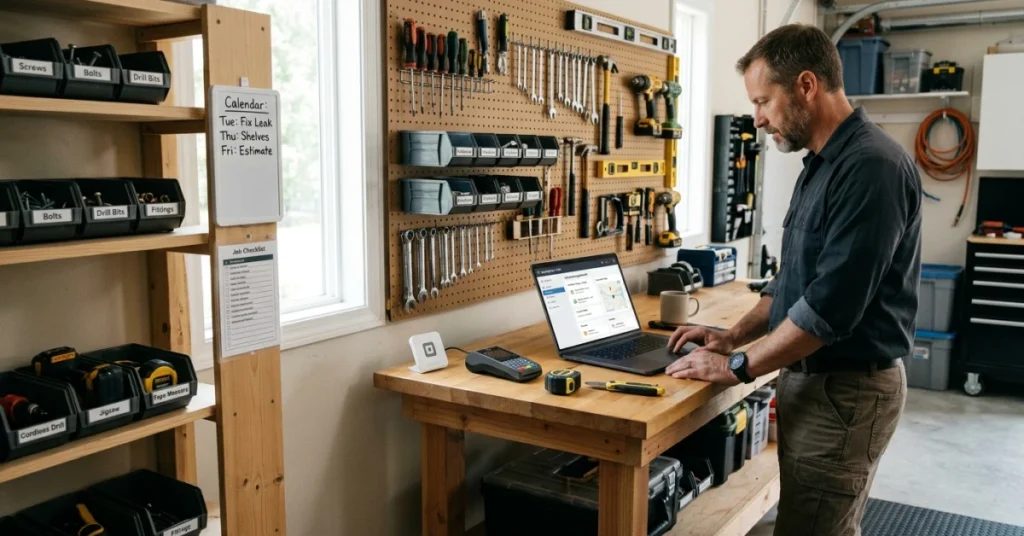
Scheduling software: It cuts the idle gaps between jobs that silently drain your handyman contractor income.
Route optimization: Driving less means billing more — every saved mile is recovered margin.
Digital estimates: Fast, professional quotes signal value and support higher pricing from the first touchpoint.
Invoicing tools: Automated invoices get paid faster — net-30 delays kill cash flow on a full calendar.
Job photo logs: Photo documentation protects you from disputes and builds trust with repeat clients.
Business model review: Knowing your handyman business model options helps you pick the structure that fits your profit goals.
Scheduling Tools That Reduce Idle Time
Idle time is the most expensive cost most handymen never track. A full week with two-hour gaps daily can erase 20% of your billable output.
Scheduling apps like Jobber or Housecall Pro fill those gaps automatically. They also send client reminders, which cuts no-shows by up to 30%.
Route Planning Tools That Cut Travel
Fuel and drive time are direct hits to your margin — they cost money and produce zero revenue. Smart route planning clusters jobs by location and trims wasted miles fast.
Tools like Google Maps with multi-stop routing or built-in dispatch features in field service apps handle this automatically. Less windshield time means more wrench time.
Estimate and Invoice Tools
Handyman business profit potential rises sharply when estimates are fast, clear, and priced by value — not by the hour. Clients who see a polished quote perceive higher quality before you lift a tool.
The Ibisworld handyman services report shows the industry generates over $5 billion annually — yet most operators still invoice by hand and leave money on the table. Digital invoicing closes that gap fast.
Job Tracking and Photo Documentation
Before-and-after photos do two things: they protect you legally and they sell your next job. A landlord who sees clean photo records books you again without a second thought.
Businesses that document work visually report fewer disputes and stronger referral rates (according to Moz, pages with visual proof assets earn up to 94% more engagement than text-only content). That same principle applies offline — show your work, keep your clients.
The real question isn’t whether these tools pay for themselves — it’s whether you can afford to run a profitable handyman business without them.
Conclusion
Plugging daily margin leaks is only half the job. The other half is choosing which jobs to take.
According to Demandium, handymen who shift to value-based pricing report margins 30–40% higher than those competing on hourly rates. Selective client intake drives that gap.
A full schedule is not a profitable handyman business — it is just a busy one. Handymanstartup tracked real monthly revenue showing fewer, higher-value jobs beat a packed calendar of low-rate work every time.
Most handymen lose profit because they can’t see job costs, time spent, or invoice gaps in real time. FieldPie links scheduling, job tracking, and invoicing in one live workflow so nothing slips through.
Fix that visibility gap today. Your next job should pay more than your last one did.