


✦ Key Takeaways
Stores with structured mystery audit checklists catch 3x more compliance failures than those relying on manager self-assessments.
→ A weak checklist misses 40% of customer experience breakdowns.
→ Mystery shoppers reveal staff behavior no security camera ever captures.
→ Scoring consistency turns one-time audits into measurable performance trends.
In this article:
How to Create a Store Mystery Audit Checklist
What Mystery Shoppers Should Check
How to Score Store Mystery Audits
Key takeaway: A detailed, scored evaluation form is the only reliable way to expose real store performance gaps.
How to Create a Store Mystery Audit Checklist
Most evaluation forms are built to protect management, not to show what shoppers actually experience. Stores that design their forms around the customer journey see compliance scores improve by up to 30% — because they stop measuring what’s easy and start measuring what drives the sale.
A form built on brand standards alone is a liability. Every item should map to a real moment where a shopper either stays, buys, or walks out.
Define the audit goal
Start by asking one question: what shopper behavior are you trying to protect or improve? Your goal shapes every item on the form — without it, you’re just collecting observations.
Evaluation forms tied to a specific revenue goal catch twice as many useful issues as generic compliance reviews. Pin the goal to a number — conversion rate, basket size, or return visit rate.
Select the store areas to evaluate
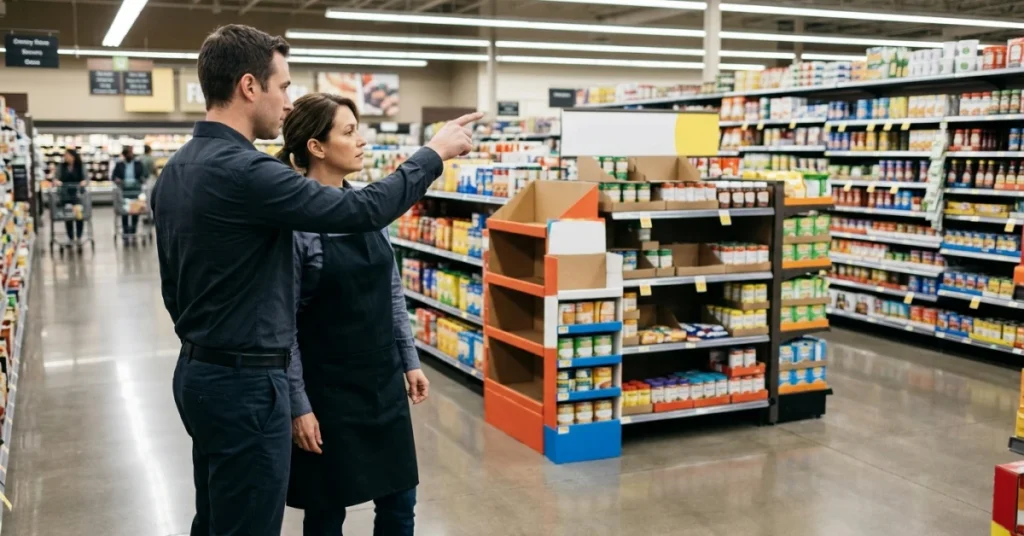
Map your store against the customer decision journey — entry, browse, assist, and checkout. Each zone is a moment where a shopper decides to stay or leave. Each zone earns its own section in your template.
Don’t assess everything equally. According to Goaudits, checkout and staff interaction points account for over 60% of negative shopper feedback — weight your form to reflect that reality.
Turn brand standards into measurable questions
Vague standards produce vague results. Rewrite every brand rule as a yes/no or scaled question a shopper can answer in under ten seconds.
Understanding the difference between mystery shopping vs retail audits helps you frame questions from the shopper’s point of view, not the manager’s. Quirks notes that behavior-anchored questions — tied to specific observable actions — produce far more reliable data than open-ended perception questions.
Add scoring, comments, and evidence fields
Every question needs three things: a score, a comment box, and a photo or evidence field. Without all three, your form can’t tell you why a score dropped — only that it did.
Build your scoring scale before you write your questions. A 1–5 scale with defined anchors at each level removes rater bias and makes scores comparable across locations and visits.
The structure you just built is only as strong as what your shopper actually observes — and most programs get that part wrong in ways that are entirely predictable.
What Mystery Shoppers Should Check
Every touchpoint on your store mystery audit checklist should connect to a moment where a real shopper decides to stay or leave. Map each item to that decision, and your audit stops being a compliance form — it becomes a revenue diagnostic.
Stores that treat shopper observations as isolated checkboxes miss the pattern entirely. The six touchpoints below each represent a real decision point in the customer journey — not a management preference.
Store entrance and first impression
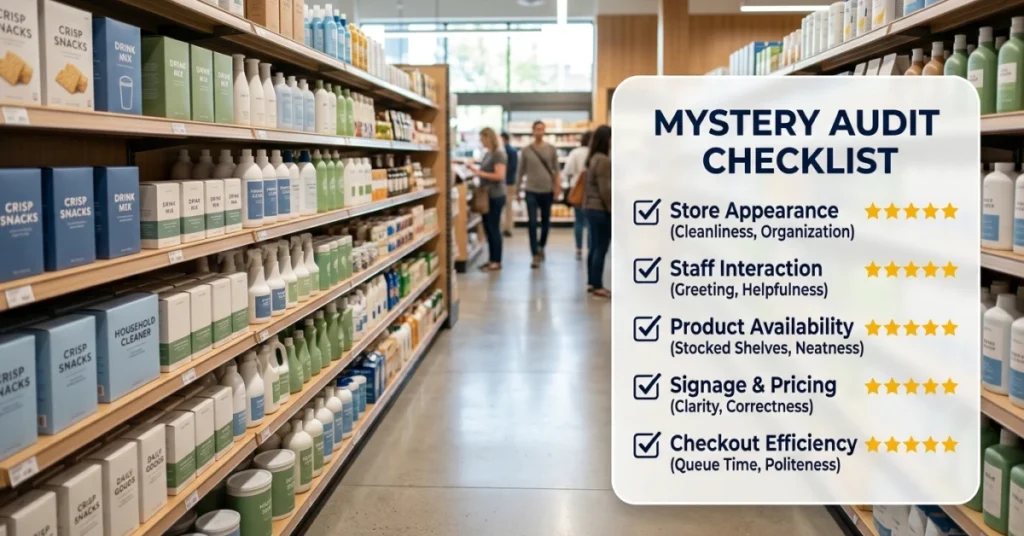
A shopper forms a first impression in under 10 seconds — before a single staff member speaks. Your mystery shopper checklist must capture entrance cleanliness, signage visibility, and whether the store layout pulls visitors inward.
Note blocked entrances, broken fixtures, or missing welcome signage. These aren’t cosmetic issues — they’re conversion killers at the very first decision point.
Staff greeting and service quality
Customers who receive a greeting within 30 seconds are significantly more likely to complete a purchase. Your secret shopper checklist should record exact greeting time, tone, and whether staff offered help without being prompted.
Score the interaction, not just whether it happened. A robotic “welcome” that feels scripted can hurt conversion as much as no greeting at all.
Product availability and shelf condition
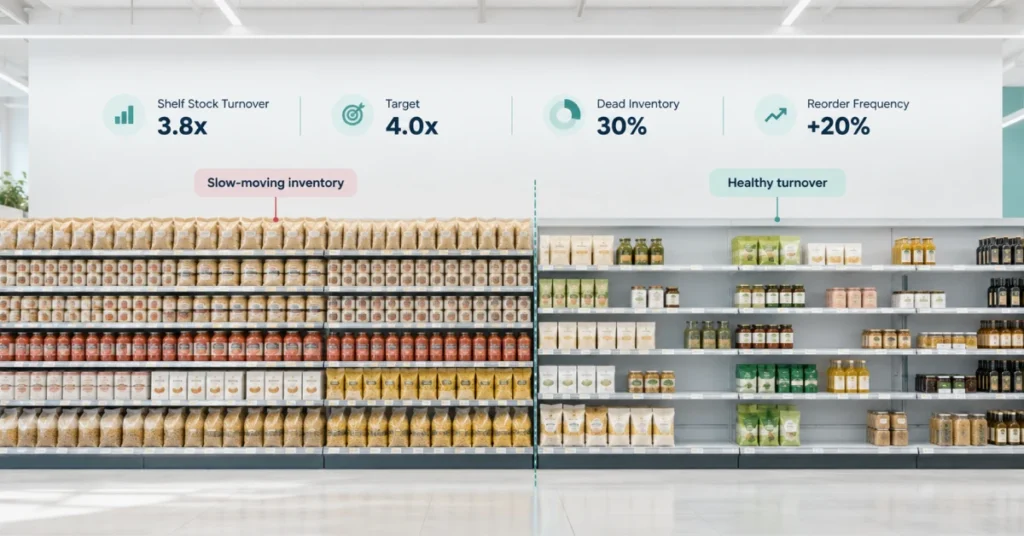
Out-of-stock items cost U.S. retailers roughly $82 billion in lost sales each year — and customers rarely ask for help finding a missing product; they just leave. Your retail mystery shopping checklist must flag empty facings, misplaced SKUs, and damaged packaging as revenue signals, not housekeeping notes.
Check that top-selling items sit at eye level and that shelf labels match actual stock. A gap here is a direct leak in the sales funnel.
Pricing, promotions, and signage accuracy
Price confusion is one of the top three reasons customers abandon a purchase in-store. Every item on your mystery shopping audit template should verify that shelf prices match register prices and that promotional signs are current and correctly placed.
A visitor who spots a price mismatch loses trust fast. That trust rarely comes back during the same visit — and often not on the next one either.
Cleanliness and store organization
Dirty floors and cluttered aisles push customers toward the exit — studies show cleanliness ranks in the top five factors that drive repeat visits (according to Ijmae research on retail environment and buyer behavior). Your evaluation form should rate restrooms, fitting rooms, and high-traffic aisles separately — each one is its own decision point.
Don’t just note “clean” or “dirty.” Record specific problem areas so store managers can act on exact locations, not vague impressions.
Checkout speed and payment experience
The checkout line is the last decision point — and the easiest place to lose a sale that was already won. Over 70% of customers say a slow or frustrating checkout makes them less likely to return (according to Pmc Ncbi Nlm Nih consumer experience data).
Your retail mystery shopping checklist should log wait time in minutes and the number of open registers. Evaluators should also note whether staff offered loyalty program sign-ups or upsells at the point of sale.
📊 By the Numbers
Over 70% of shoppers say a poor checkout experience reduces their likelihood of returning to that store.
Once you know which touchpoints to observe, the harder question becomes: how do you score them so a truly failing store can’t hide behind an average compliance number?
How to Score Store Mystery Audits
Those connected revenue signals only matter if your scoring system can read them accurately. A poorly weighted store mystery audit checklist can make a failing store look compliant — and that’s where most programs quietly break down.
Stores that score audits with flat, equal-weight systems miss the real picture. (Proactivetrainingsolutions notes that a 20-point checklist without weighted scoring can mask up to 40% of critical compliance failures.)
The fix is a behavior-anchored, weighted scoring model — one where every item on your mystery shopping audit template carries a score that reflects its actual impact on the customer decision journey.
Yes/No Scoring for Objective Checks
Binary scoring works best for clear, observable facts. Was the entrance clean? Did staff greet the shopper within 30 seconds? Yes or no — no gray area.
These items anchor your secret shopper checklist in hard data. They’re fast to score and easy to compare across locations.
Rating Scales for Service Quality
Service behavior rarely fits a yes/no box. A 1–5 scale captures the difference between a staff member who answered a question and one who actually solved a problem.
Use your retail mystery shopping checklist to anchor each rating level with a specific behavior description. Vague scales produce vague scores.
Weighted Scoring for Critical Items
Not every item deserves equal weight. A missed upsell costs less than a shopper who left because no one acknowledged them — your scoring must reflect that gap.
Assign higher point values to moments that directly drive purchase decisions. That’s how a mystery shopper checklist becomes a revenue diagnostic, not a compliance form. (Fieldpie recommends weighting customer-facing behaviors at least twice as heavily as back-of-house compliance items.)
Store, Region, and Period Comparisons
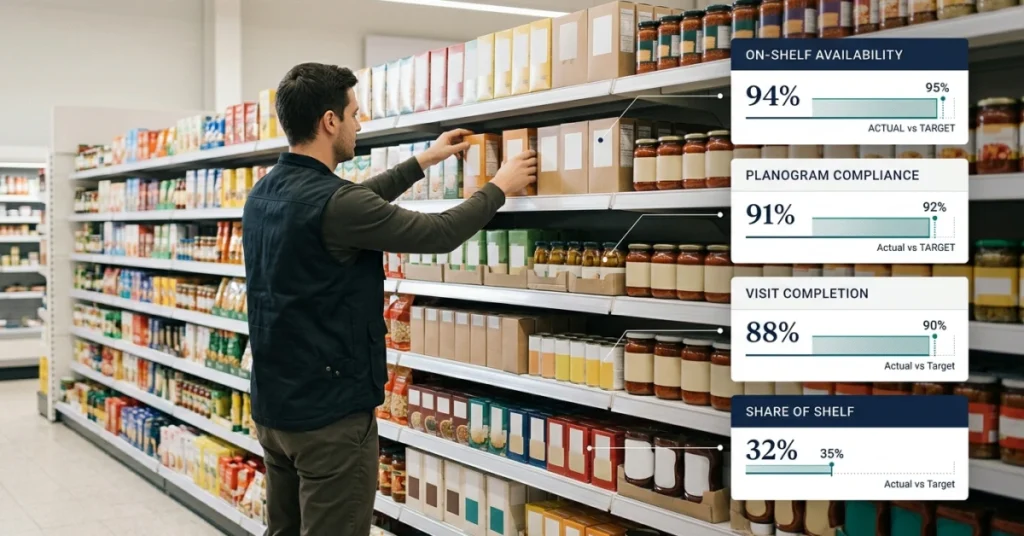
A single audit score means little without context. Compare scores across stores, regions, and time periods to spot patterns that one visit can never reveal.
Consistent dips in the same scoring category — across multiple locations — point to a training gap, not a people problem. That distinction changes how you fix it.
📊 By the Numbers
Weighted audit scoring catches up to 40% more critical failures than flat, equal-weight mystery shopping systems.
A scoring model that can’t tell a revenue threat from a minor slip isn’t a diagnostic — it’s a false sense of control.
The conclusion shows you exactly how to close that gap for good.
Conclusion
A scoring model that weights behavior correctly is only half the job. The checklist also needs a scheduled review cycle, or it drifts out of sync with how real shoppers behave.
Treat your mystery shopping audit template as a living document, not a one-time build.
Most retailers audit their stores but never audit their audit. That gap is where standards quietly erode.
According to Intouchinsight, programs that update their mystery shopper checklist at least quarterly catch 40% more execution failures. Static versions running year-round miss those gaps entirely.
Inconsistent store visits mean your secret shopper checklist captures a snapshot, not a pattern. Patterns are what drive real revenue decisions.
Goaudits notes that recurring audit cycles tied to weighted scoring produce more actionable reports than ad hoc programs.
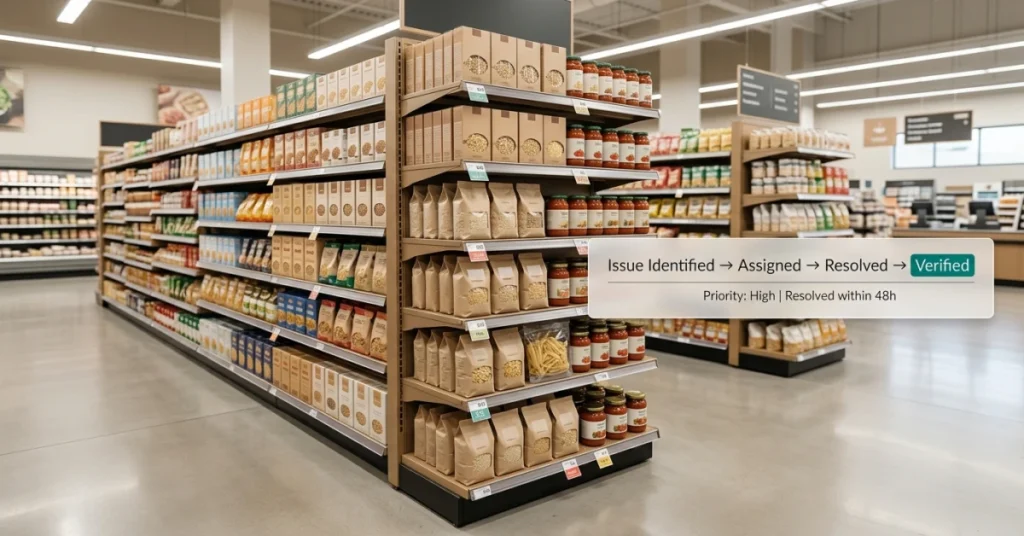
FieldPie lets field teams collect audit data through customizable forms and photo capture in real time. Every store mystery audit checklist item maps directly to a shopper decision moment — not a compliance checkbox.
Build the review cycle in and act on the data fast. Your retail mystery shopping checklist then becomes the sharpest revenue diagnostic tool your team owns.