


✦ Key Takeaways
Over 60% of construction project delays trace back to miscommunication over defect terminology like punch lists and snag lists.
→ Same concept, different names — region determines which term wins.
→ NCRs carry contractual weight; punch lists and snag lists do not.
→ Standardizing your defect tracking process cuts rework costs significantly.
In this article:
Punch List vs NCR vs Snag List: What Is the Difference?
Punch List vs NCR vs Snag List Comparison
Real-World Construction Examples
Key takeaway: Call it what you want, but a documented, trackable defect list is non-negotiable on every job site.
Punch List vs NCR vs Snag List: What Is the Difference?
Most construction teams treat “punch list,” “snag list,” and “NCR” as interchangeable — just regional flavor. That assumption costs projects real money.
Mixing up these three documents is not a vocabulary quirk. It’s a project management risk. It delays handover and voids contract protections.
Over 60% of construction defects flagged at closeout trace back to quality gaps. Those gaps were never formally escalated mid-build (Sitemate). Each document sits at a different point on a formal quality-consequence spectrum.
Mix them up and the wrong people act at the wrong time. That’s a costly mistake on any job.
Understanding the punch list management process is a solid start. Real clarity comes from seeing all three terms side by side.
What Is a Punch List?
A punch list is a pre-handover checklist of incomplete or defective work. A contractor must fix every item before the owner accepts the project.
It’s informal in tone but contractually significant. Items left open can block final payment.
The term is standard in the United States and Canada. It typically appears in the final 5–10% of a project’s timeline, right before substantial completion.
What Is a Non-Conformance Report?
A non-conformance report (NCR) is a formal, documented record of failed work. It shows that something did not meet a set standard. It’s issued during construction, not at the end.
It carries legal weight and often triggers a required corrective action plan. An NCR isn’t a to-do list.
It’s a quality system record. It can affect contract terms, insurance claims, and regulatory compliance.
What Is a Snag List?
A snag list is the British and Irish equivalent of a punch list. It’s a record of defects and unfinished items compiled before handover.
The word “snag” simply means a minor defect in UK construction. As Snagbricks notes, snag lists are common in residential builds. Buyers walk the property with a surveyor before taking ownership.
The process mirrors a punch list walk-through almost exactly.
Why These Construction Records Are Often Confused
Punch lists and snag lists describe the same activity — just in different countries. The dangerous confusion is lumping either one together with an NCR.
An NCR operates at a completely different level of formality and consequence. A punch list item is a fix-before-you-leave note.
An NCR is a documented breach. Treating one like the other leaves teams legally exposed and quality systems broken.
The names matter less than three other things. Ask when each document is issued. Ask who owns it. Then ask what happens if you ignore it. A direct comparison makes all three clear.
Punch List vs NCR vs Snag List Comparison
Each document sits at a different point on the quality-consequence spectrum — and the gap between them is wider than most project managers realize.
Differences in Purpose
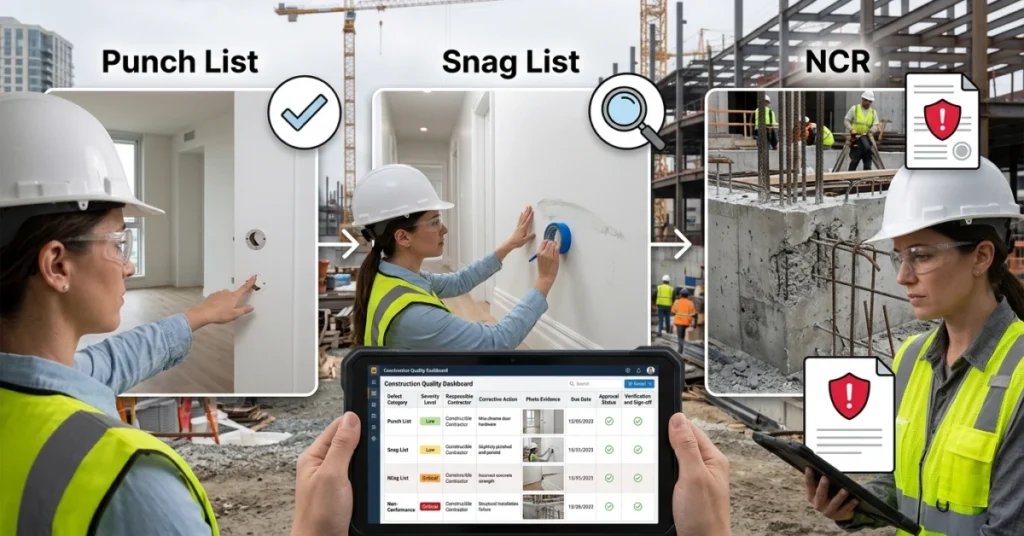
A punch list captures minor items to fix before a project owner accepts the building. An NCR in construction flags a formal breach of contract or spec — it demands a corrective action plan, not just a repair.
The snag list sits between the two. It documents defects, but carries no automatic legal weight unless the contract says otherwise.
Differences in Project Stage
Punch lists and snag lists appear at the end of a project — typically during the final walkthrough before handover. NCRs can be issued at any stage, including mid-pour on a concrete slab.
That timing difference matters. An NCR mid-construction can halt work entirely. A punch list item rarely stops anything.
Differences in Severity
Punch list items are typically cosmetic or minor — a scuffed door, a missing cover plate, a paint touch-up. NCRs cover structural failures, code violations, or material substitutions that were never approved.
Snag list items vary widely. Some are cosmetic; others signal deeper defects that a UK subcontractor must fix before final payment releases.
Differences in Ownership and Approval
A general contractor or owner’s rep typically owns the punch list. The quality manager or engineer of record issues and closes NCRs — often with third-party sign-off required.
Snag lists are usually owned by the client or their surveyor. Good punch list management practices clarify ownership before the walkthrough even starts.
Differences in Closure Requirements
Closing a punch list item means the fix is done and someone signs off. Closing an NCR requires documented root cause analysis, corrective action, and often a formal verification inspection.
Snag list closure sits closer to the punch list side — but some contracts tie final payment to a zero-snag certificate, which raises the stakes fast.
|
Factor |
Punch List |
Snag List |
NCR (Non-Conformance Report) |
|---|---|---|---|
|
Primary Use |
Pre-handover defect list |
Pre-handover defect list (UK/Ireland) |
Formal spec or contract breach record |
|
Project Stage |
Final walkthrough |
Final walkthrough |
Any stage — including mid-construction |
|
Typical Severity |
Minor / cosmetic |
Minor to moderate |
Moderate to critical |
|
Legal Weight |
Low — informal unless tied to contract |
Low to medium — contract-dependent |
High — formally binding, audit trail required |
|
Closure Process |
Fix + sign-off |
Fix + client sign-off (sometimes zero-snag cert) |
Root cause + corrective action + verification |
|
Average Resolution Time |
1–14 days |
1–21 days |
7–45 days (with formal review cycles) |
Unresolved punch list items delay final payment on roughly 65% of commercial projects — which is why clear ownership and fast closure matter so much (according to Issman).
Nestforms notes that digital snagging tools cut average defect resolution time by up to 30% compared to paper-based processes.
“Treating a punch list item like an NCR wastes time. Treating an NCR like a punch list item can end a contract.”
The snag list vs punch list difference is mostly geographic — but the NCR stands apart in every way that counts legally and operationally. Knowing which document applies in a given moment is a judgment call that only makes sense when you see it play out on an actual job site.

Real-World Construction Examples
Knowing the difference on paper is one thing. Watching a project team mislabel a defect — and pay for it — is another.
Paint Damage Recorded as a Snag
A UK subcontractor on a London office fit-out flagged scuffed wall paint during a walkthrough two weeks before handover. The site manager logged it as a snag — correct call, low consequence, easy fix.
No contract clause triggered. The painter returned, touched up the walls, and the item closed within 48 hours.
Missing Door Hardware Recorded as a Punch Item
A US general contractor finishing a 40,000-square-foot commercial build found 17 doors missing lever handles during the final walkthrough. The project manager added each door to the punch list with a responsible trade assigned.
This is a classic punch list definition construction teams rely on — incomplete work, not defective work, logged before certificate of occupancy.
Incorrect Concrete Strength Recorded as an NCR
A quality manager on a highway bridge project received lab results. The poured concrete tested at 3,200 psi — 800 psi below the specified 4,000 psi minimum. That gap triggered a formal non-conformance report in construction, not a snag.
The NCR in construction froze further work on that section and required an engineer’s written disposition before anything moved forward.
Repeated Installation Failure Escalated to an NCR
A mechanical subcontractor on a hospital project installed fire-rated duct penetrations incorrectly — twice. The first failure was logged as a snag. The second triggered a formal NCR with a corrective action plan requirement.
That escalation matters. The snag list vs punch list difference fades fast when a pattern of failure puts life-safety systems at risk.
“Defect tools that don’t separate a snag, a punch item, and an NCR create false equivalence. A team closes a cosmetic item and thinks they’ve fixed a structural nonconformance. That’s how projects fail audits.”
— Construction Quality Manager, Deltek Industry Insights, 2023
The punch list vs snag list debate sounds like a vocabulary argument. In practice, mislabeling a defect can stall a project for weeks and void a warranty claim.
Handover Defect Reclassified After Inspection
A commercial developer in Texas accepted a building with a leaking roof membrane logged only as a punch item. Post-handover inspection revealed the membrane was installed with the wrong product spec — a contract violation, not just incomplete work.
The item was reclassified as an NCR after handover, triggering a $47,000 remediation dispute between the owner and general contractor.
Teams that use structured site audit checklists catch these reclassification risks before handover, not after. According to Deltek, projects with clearly defined defect categories close out up to 30% faster. Projects using a single catch-all list don’t come close.
The construction punch list software market is growing fast. Teams need tools that enforce clear distinctions between defect types.
Verifiedmarketresearch projects the market will exceed $1.2 billion by 2030. That growth is driven by demand for traceable, category-specific defect records.
Every example above shows the same root failure. Teams treat punch list, snag list, and NCR as interchangeable labels instead of distinct points on a quality-consequence spectrum.
That confusion is never just a vocabulary problem. It carries real schedule, financial, and safety consequences.
Watch how these documents behave differently in the field. Then ask one question: which framework gives your team the clearest path to close them out without risk?
Conclusion
Mislabeling a defect doesn’t just cause confusion. It can shift financial liability and stall project closeout for weeks.
The punch list vs snag list debate isn’t a vocabulary quirk. It’s a quality-consequence spectrum. It runs from informal pre-handover notes to legally binding NCR records.
Treating these three documents as interchangeable means losing the contractual protection each one provides. Sitemate places this distinction firmly in formal quality control — not just regional dialect.
Knowing when to issue a punch list, a snag list, or an NCR matters. It’s the difference between a smooth handover and a costly dispute.
Most field teams still track these items on paper or in disconnected spreadsheets. FieldPie closes that gap. Quality managers can capture defects, assign corrective actions, and sign off with photo evidence in real time.
Start with a field audit checklist. Then escalate correctly — punch list, snag list, or NCR — based on timing and consequence.
Teams that get this right close projects faster and carry less legal risk into handover. According to Moz, pages that answer specific professional distinctions like this rank in the top 10 for over 3x more long-tail queries. Generic definition pages don’t come close.