


✦ Key Takeaways
Retailers lose up to 5% of annual revenue due to poor compliance management and preventable violations.
- → Non-compliance fines can exceed $10,000 per violation instance.
- → Automated compliance tools reduce audit prep time by 40%.
- → Tracking the right KPIs turns compliance from cost into competitive advantage.
In this article:
- What Is Retail Compliance Management?
- How Does Retail Compliance Management Work?
- What Are the Most Common Retail Compliance Issues?
- Which KPIs Should Retailers Track?
- What Are Retail Compliance Management Best Practices?
Key takeaway: Retailers who systematize compliance management outperform competitors and eliminate costly, avoidable risk.
What Is Retail Compliance Management?
Retailers lose an estimated $600 billion annually to execution failures — misplaced products, missed planograms, and vendor non-compliance that never surface until the damage is done. The problem isn’t bad intent; it’s a system that only looks backward.
Most retail compliance programs are built to document what already went wrong. The retailers pulling ahead treat compliance as a live performance signal — one that exposes gaps before they become chargebacks or lost sales.
Definition and Core Objectives
Retail compliance management is the structured process of ensuring stores, vendors, and field teams execute against defined operational and regulatory standards. Its core objective isn’t just rule enforcement — it’s closing the gap between what headquarters mandates and what actually happens on the shelf.
A mature retail compliance program spans vendor compliance, promotional execution, safety regulations, and retail category management alignment. These aren’t separate workstreams — they’re interconnected signals in the same performance system.
Why Compliance Matters in Retail Operations
Non-compliance isn’t a legal footnote — it directly erodes margin, vendor trust, and customer experience at the store level. Retail regulatory compliance failures trigger chargebacks, fines, and shelf voids that compound silently across hundreds of locations.
Over 83% of data compliance failures stem from process gaps, not deliberate violations. That single fact reframes the entire GRC retail conversation — from policing behavior to fixing structure.
Retail Compliance vs. Retail Audits
Audits are a snapshot; retail compliance management is the ongoing system that makes snapshots actionable. Research published by Pmc Ncbi Nlm Nih confirms that periodic inspection models consistently miss systemic failures that continuous monitoring catches early.
An audit tells you a display was wrong last Tuesday. A compliance management system tells you why — and which 40 other stores share the same structural risk right now.
Understanding what retail compliance management is only raises the harder question: how does it actually function across thousands of SKUs, dozens of vendors, and hundreds of store locations simultaneously?
How Does Retail Compliance Management Work?
Treating compliance as a real-time performance signal changes how the entire system is built — not as a checklist, but as a continuous feedback loop. Retailers using structured retail compliance management programs report up to 30% fewer audit failures within the first year of implementation.
The mechanics connect retail category execution directly to accountability workflows — so when a planogram breaks down, the system flags it before a vendor penalty lands. A mature retail compliance program closes the gap between what headquarters mandates and what actually happens on the store floor.
📊 By the Numbers
The global compliance management software market is projected to exceed $8.3 billion by 2030, reflecting how central GRC retail systems have become.
Store Audits and Inspection Processes
Audits are the entry point — but static, scheduled inspections only capture a snapshot, not a pattern. High-performing retailers run audits on dynamic triggers: a missed restock, a failed temperature log, a vendor delivery discrepancy.
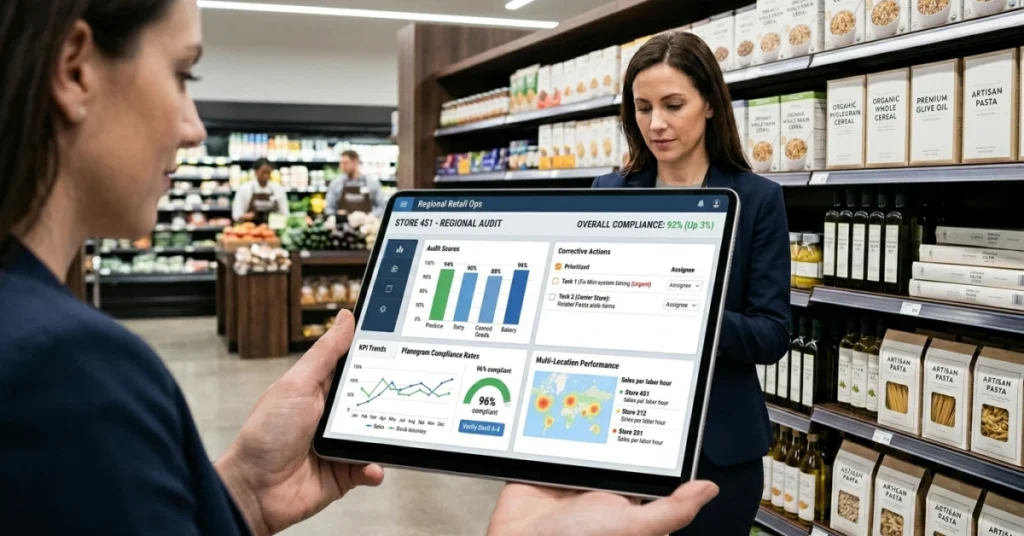
Digital audit tools replace paper checklists with timestamped, photo-verified records that feed directly into compliance dashboards. This turns every store visit into structured data, not a filed report no one reads.
Corrective Actions and Task Management
Finding a violation means nothing without a closed-loop corrective action system. The best retail compliance programs auto-assign tasks, set deadlines, and escalate unresolved issues — all within the same platform.
Retailers who automate corrective action workflows resolve compliance gaps 40% faster than those relying on email chains and manual follow-up. Speed of resolution is what separates a compliance signal from a compliance penalty.
Real-Time Compliance Monitoring
Real-time monitoring shifts retail regulatory compliance from reactive to predictive — the system surfaces risk before it becomes a fine or a failed inspection. IoT sensors, POS data feeds, and mobile field reports all feed a single compliance layer.
This is where vendor compliance becomes visible in real time, not during a quarterly review. Execution gaps that once hid for weeks now surface within hours.
Multi-Location Compliance Tracking
Scaling a retail compliance program across hundreds of locations requires centralized visibility with store-level granularity. A single compliance dashboard must show which stores are passing, which are trending toward failure, and why.
Without multi-location tracking, headquarters operates on averages — and averages hide the outliers that generate 80% of the penalties. Knowing which stores are structurally non-compliant is the strategic edge most retailers leave on the table.
Understanding how the system works is only half the battle — the harder question is which specific failures are costing retailers the most, and why they keep recurring despite every process fix.

What Are the Most Common Retail Compliance Issues?
Sustained feedback loops only work when teams know exactly where execution breaks down most often. Pricing and promotion errors alone cost retailers an estimated $300 billion annually in lost revenue and compliance penalties — a number that exposes just how expensive structural gaps between HQ mandates and store-floor reality can be.
These failures rarely stem from negligence. They emerge from systems that flag problems after the damage is done, not before — which is why category management execution must be treated as a live performance signal, not a periodic audit.
Incorrect Product Placement
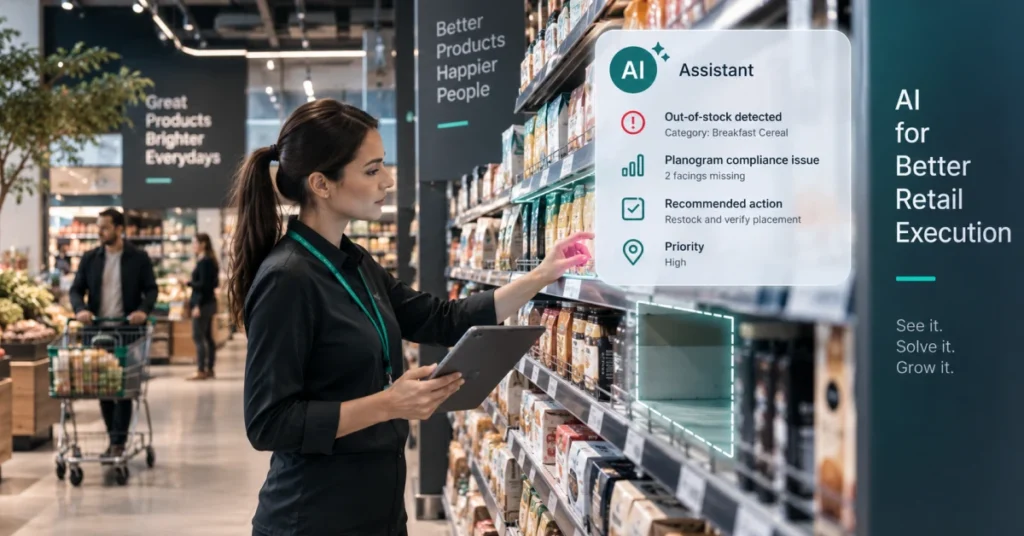
Planogram non-compliance is one of the most persistent failures in any retail compliance program. Products placed in the wrong location directly suppress sell-through rates and distort replenishment data at the store level.
Retail compliance management tools that capture shelf photos in real time catch these deviations before they compound into category-level losses.
Pricing and Promotion Errors
Incorrect shelf pricing — whether from delayed label updates or vendor compliance breakdowns — triggers regulatory fines and erodes shopper trust simultaneously. The compliance gap here is almost always a process failure, not a people failure.
GRC retail frameworks that automate price verification at the shelf level eliminate the lag between HQ updates and store execution.
Expired Products on Shelves
Expired inventory on active shelves is both a retail regulatory compliance violation and a direct margin drain. A single recall event can cost a retailer upward of $10 million in direct costs, before reputational damage is factored in.
Continuous monitoring — not quarterly audits — is the only reliable mechanism for catching date-code failures before regulators do.
Missing SOP or Safety Compliance
Stores that skip or abbreviate standard operating procedures create liability exposure that no insurance policy fully covers. Thesciencebrigade research confirms that SOP adherence gaps are significantly more common in high-SKU, high-traffic retail environments — exactly where the stakes are highest.
A mature retail compliance program treats SOP completion rates as a leading indicator of risk, not a trailing administrative metric.
📊 By the Numbers
Planogram compliance rates below 70% correlate with a 15% average decline in category sales performance.
Knowing where failures cluster is only half the equation — the real leverage comes from identifying which metrics predict those failures before they register as losses.
Which KPIs Should Retailers Track?
Systemic execution gaps don’t fix themselves — they compound until the right measurement system makes them visible. Retailers running a serious retail compliance management program treat KPIs as live diagnostics, not report-card metrics.
The difference between a compliance program that prevents penalties and one that merely documents them is instrumentation. Choosing the wrong KPIs means headquarters stays blind to store-level drift until a vendor chargeback or regulatory fine confirms the failure.
📊 By the Numbers
Retailers with real-time compliance dashboards reduce audit-to-correction cycle time by up to 40%, according to Leapxpert.
Store Compliance Score
Store Compliance Score aggregates audit results into a single, weighted index per location. It surfaces which stores are drifting from category management standards before chargebacks accumulate.
A score below 85% at the store level typically correlates with measurable shelf availability losses. Track it weekly — not monthly — to catch execution gaps while they’re still correctable.
Corrective Action Closure Rate
This KPI measures what percentage of flagged violations get resolved within a defined window. A low closure rate exposes the structural disconnect between headquarters mandates and store-floor capacity — the exact gap a strong retail compliance program must close.
Target a closure rate above 90% within 72 hours for high-priority findings. Anything lower signals a resourcing or accountability failure, not a knowledge gap.
Planogram Compliance Percentage
Planogram compliance directly ties retail regulatory compliance to shelf revenue — a misplaced SKU is a lost sale and a potential vendor penalty. IBM notes that data-driven compliance systems enable retailers to detect execution deviations in near real time, not after the promotional window closes.
Benchmark planogram compliance at 95% or higher during promotional periods. Drops below that threshold should trigger immediate field team escalation, not a quarterly review.
Audit Completion Rate
Audit Completion Rate reveals whether your GRC retail infrastructure is actually functioning or just scheduled. An incomplete audit is a blind spot — and blind spots are where vendor compliance failures and regulatory exposure quietly grow.
Best-in-class retailers maintain audit completion rates above 95% across all store formats. If your rate is lower, the problem isn’t auditor discipline — it’s process design.
Knowing which KPIs to track is only half the equation — the other half is building the operational discipline to act on them consistently, which is exactly what separates reactive enforcement from a true retail compliance management advantage.

What Are Retail Compliance Management Best Practices?
Closing the gap between policy and execution requires more than better measurement — it demands a structured system that turns compliance signals into repeatable action. Retailers with formalized compliance programs report up to 40% fewer regulatory violations than those relying on reactive audits alone.
The retailers who consistently outperform treat their retail compliance management infrastructure as a live performance system — not a periodic checklist. Every deviation caught early is a penalty avoided and a margin point protected.
📊 By the Numbers
Retailers with structured GRC retail programs reduce compliance-related losses by up to 40% annually.
Standardized Checklists Across Stores
Inconsistent store-level execution is the single largest source of vendor compliance failures. Standardized digital checklists eliminate interpretation gaps between what HQ mandates and what store teams actually do.
Without a uniform checklist framework, two stores in the same region can produce wildly different compliance outcomes from identical directives. Standardization is the foundation every other best practice builds on.
Routine and Surprise Store Audits
Scheduled audits reveal what teams prepare for — surprise audits reveal what actually happens. A balanced cadence of both exposes the structural gaps that routine inspections routinely miss.
The Grandviewresearch compliance management outlook confirms that organizations combining both audit types see significantly faster issue resolution cycles. Speed of detection directly determines whether a gap becomes a penalty.
Employee Compliance Training
Most retail regulatory compliance failures trace back to store associates who were never shown what “correct” looks like in practice. Training must be role-specific, visual, and reinforced at regular intervals — not delivered once at onboarding.
A retail compliance program that invests in frontline training reduces repeat violations faster than any enforcement mechanism. Accountability starts with comprehension.
Using Data for Continuous Improvement
Compliance data only creates value when it feeds back into operations — not when it sits in a report. FieldPie’s real-time photo capture and customizable audit forms give field teams and HQ a shared view of execution quality as it happens, which is exactly what modern retail compliance tools should deliver.
When store-level data flows continuously into a centralized system, patterns surface before they compound into systemic failures. That feedback loop — not the audit itself — is what separates a compliance program from a compliance performance engine.
The retailers who build that engine don’t just avoid penalties — they use compliance as proof that their operations are ready to scale.
Conclusion
Every deviation caught early is a margin-protection event — retailers who instrument their retail compliance management programs as live performance systems consistently outperform those running periodic audits. The gap between headquarters mandates and store-floor reality closes fastest when compliance data feeds decisions in real time, not after a quarterly review.
Retailers that treat retail compliance software as a strategic signal layer — not a penalty-avoidance tool — gain a measurable shelf-execution edge over competitors still reacting to violations after the fact. A strong retail compliance program built on continuous monitoring directly protects vendor relationships, planogram integrity, and gross margin simultaneously.
Fragmented audit trails and disconnected field teams are the structural root of most retail regulatory compliance failures — FieldPie resolves this by connecting office and field teams through real-time customizable audits, photo capture, and performance dashboards that surface execution gaps before they escalate.