


✦ Key Takeaways
Over 80% of construction project failures trace back to poor subcontractor compliance and oversight gaps.
- → Non-compliant subs expose GCs to million-dollar liability claims instantly.
- → Compliance tracking reduces project delays by streamlining documentation and audits.
- → A structured onboarding checklist catches 90% of compliance gaps before work starts.
In this article:
- What Is Subcontractor Compliance in Construction?
- Why Subcontractor Compliance Matters in Construction Projects
- What Should Be Included in a Subcontractor Compliance Process?
- How Construction Companies Manage Subcontractor Compliance
- What KPIs Should Construction Companies Track?
Key takeaway: Robust subcontractor compliance systems are the foundation every construction company must build first.
What Is Subcontractor Compliance in Construction?
Most construction firms treat subcontractor compliance as a pre-bid checklist — collect the documents, file them away, and move on. That approach leaves general contractors exposed for the other 95% of the project lifecycle.
A certificate of insurance collected in January means nothing on a jobsite in October if no one verified it was renewed. Real subcontractor compliance construction management is a continuous obligation, not a one-time intake event.
Definition and Core Requirements
Subcontractor compliance in construction means verifying that every subcontractor meets legal, financial, and safety standards throughout the entire project — not just at onboarding. Construction compliance requirements typically cover licensing, insurance, safety certifications, and contractual obligations on an ongoing basis.
The distinction matters because Scholarworks Waldenu research identifies compliance gaps mid-project as a primary driver of contractor liability exposure and schedule overruns. General contractor compliance obligations don’t pause between milestones — and neither should your monitoring system.
Common Compliance Documents and Certifications
Standard subcontractor compliance documents include certificates of insurance, W-9s, business licenses, OSHA 10/30 cards, and signed subcontract agreements. Each document carries an expiration date — which is exactly why static file collection fails.
According to Pmc Ncbi Nlm Nih, construction worksites with lapsed safety certifications face injury rates up to 34% higher than those with active, verified credentials. Document collection is the floor — not the ceiling — of a real compliance program.
Legal and Regulatory Responsibilities for Contractors
General contractors carry vicarious liability for subcontractor violations under OSHA, state labor laws, and most commercial contract frameworks. Ignorance of a subcontractor’s lapsed license or expired insurance is not a legal defense — courts have consistently ruled otherwise.
This is why construction safety compliance must be embedded into project workflows, not delegated to a pre-bid admin task. The firms that build accountability triggers into their subcontractor compliance management systems are the ones that don’t get blindsided mid-project.
Understanding what compliance is only sharpens the real question — what happens to your project, your license, and your liability when it breaks down?
Why Subcontractor Compliance Matters in Construction Projects
That continuous obligation carries real financial weight — non-compliant subcontractors contribute to over 30% of construction project failures, including cost overruns, schedule collapses, and liability disputes. Proper vetting and oversight isn’t a paperwork exercise — it’s a risk management system that either holds or fails under pressure.
Most general contractors discover documentation gaps only after something breaks: a lapsed certificate, an uninsured incident, a regulatory audit. By then, the exposure has already materialized — and no amount of document retrieval fixes it retroactively.
The Risks of Non-Compliant Subcontractors
A subcontractor working with expired insurance or lapsed licensing shifts liability directly onto the general contractor — often without any visible warning sign on the jobsite. A GC’s oversight obligations don’t pause because a subcontractor’s paperwork does.
OSHA penalties alone can reach $156,259 per willful violation, and courts routinely hold GCs responsible for subcontractor conduct when oversight systems are absent. That exposure is why construction safety compliance systems must extend beyond the pre-bid stage.
How Compliance Impacts Safety, Costs, and Project Timelines
Subcontractors who fall out of good standing mid-project create cascading delays — work stoppages, re-inspections, and insurance claim disputes that compress schedules and inflate costs. Rigorous vendor oversight isn’t overhead; it’s the mechanism that keeps every other project system functional.
Regulatory requirements are tightening across most jurisdictions, and firms relying on reactive enforcement are already behind. The question isn’t whether these failures will surface — it’s whether your process catches them before or after the damage is done.
📊 By the Numbers
Non-compliant subcontractors are linked to over 30% of construction project failures involving cost and schedule overruns.
Defining what a properly credentialed subcontractor actually looks like — and what your process must capture to enforce it — is the only way to close that gap before it costs you.

What Should Be Included in a Subcontractor Compliance Process?
A compliance gap caught after an incident is a liability — a system that catches it before is a competitive asset. Over 84% of construction compliance failures trace back to process breakdowns, not missing documents.
Document collection is the entry fee — continuous monitoring is the game. A certificate of insurance filed in January is worthless on a jobsite in October without a re-verification trigger built into your subcontractor compliance construction process.
The firms winning on subcontractor compliance management don’t chase paperwork — they build accountability loops. According to Xpedeon, subcontractor performance directly determines whether a project finishes on time and within budget.
📊 By the Numbers
Over 84% of construction compliance failures stem from process breakdowns, not missing paperwork.
Safety Training and Certifications
Every subcontractor on your site must carry current, role-specific safety certifications — not just proof they once completed a course. Expiration dates must trigger automatic re-verification, not manual reminders that get buried in email.
Construction compliance requirements mandate OSHA 10 or 30 certifications for most trades. A worker whose card expired three months ago is your liability the moment something goes wrong.
Insurance and License Verification
Collecting a COI at contract signing satisfies a checkbox — it doesn’t protect you mid-project. General contractor compliance obligations require active confirmation that coverage remains valid throughout the entire project lifecycle.
License verification carries the same risk. A contractor whose license lapses in month three of a six-month project creates real legal exposure for the GC, not just the sub.
Site Access and Workforce Documentation
Every worker on a jobsite must be traceable — name, employer, role, and authorization status. Unvetted workers create OSHA exposure, wage liability, and insurance voids that no GC can afford.
Firms using structured compliance audit tools catch unauthorized site access before inspectors do. Workforce documentation isn’t HR overhead — it’s frontline risk control.
Equipment and Operational Compliance Checks
Subcontractor compliance software must flag equipment inspection gaps the same way it flags expired insurance. An uninspected crane or unlicensed operator is a project-stopping liability waiting for a trigger.
Operational compliance checks should run on a defined schedule — not after an incident surfaces the gap. The process only works when accountability is built in, not bolted on after something breaks.
The real question isn’t what your process includes — it’s whether the way you manage it actually enforces it when the pressure is highest.
How Construction Companies Manage Subcontractor Compliance
Building a continuous monitoring system is what separates firms that catch oversight gaps from those that discover them after an incident. Over 60% of construction injuries occur at firms using subcontractors — meaning your verification process is only as strong as its weakest real-time signal (Cpwr).
Document collection is table stakes; the real work is accountability triggers that fire when a certificate expires or a safety training lapses. According to Cpwr, subcontractor injury rates are measurably higher when oversight is episodic rather than continuous.
Pmc Ncbi Nlm Nih research confirms that structured, system-driven oversight reduces incident rates by up to 34% compared to manual, document-first approaches. That’s the gap between a construction safety framework and a filing cabinet.
📊 By the Numbers
Structured oversight systems reduce subcontractor incident rates by up to 34% versus manual document-collection approaches.
Digital Compliance Checklists and Mobile Inspections
Paper checklists fail because they live in trucks, not systems. Digital versions push real-time inspection data to a central record the moment a field supervisor hits submit.
Mobile inspections enforce jobsite standards on-site, not after the fact. Every completed checklist becomes a timestamped audit trail general contractors can defend in court.
Real-Time Document Tracking and Alerts
A certificate of insurance collected in January means nothing on a jobsite in October — expiration alerts close that gap automatically. Purpose-built tracking software flags renewals 30, 60, and 90 days out, keeping general contractor obligations intact.
Automated alerts shift the burden from project managers chasing paperwork to the system enforcing deadlines. That shift alone eliminates the most common source of coverage lapses on active projects.
Incident Reporting and Corrective Actions
Incident reporting only creates value when it triggers a documented corrective action — not just a logged event. Effective vendor management requires closing the loop: report, assign, resolve, verify.
Firms that track corrective action completion rates hold subcontractors accountable beyond the initial report. That accountability loop is what transforms incident data into a safety culture.
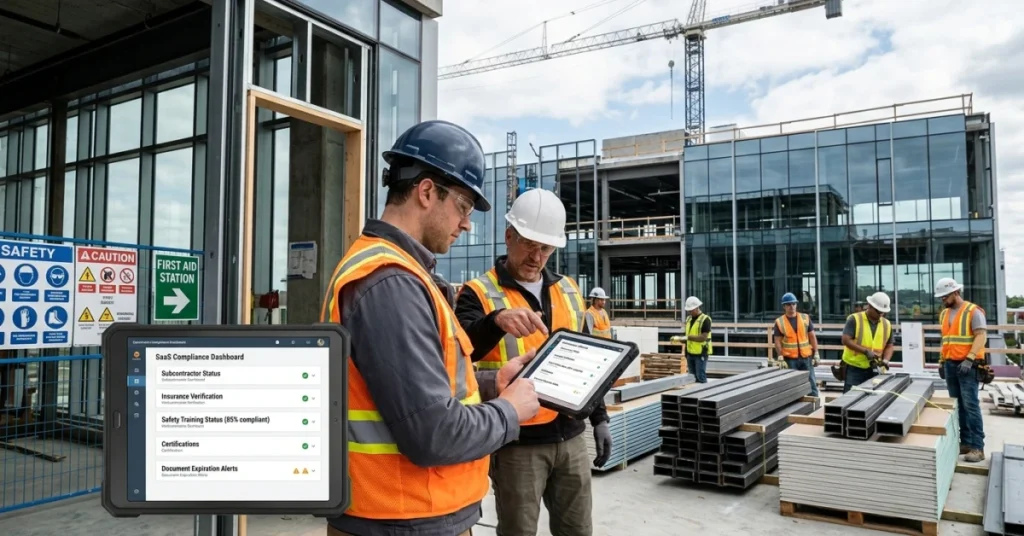
Centralized Compliance Dashboards
A centralized dashboard gives project managers a single view of every subcontractor’s standing — no email threads, no spreadsheets. When every gap is visible in one place, nothing hides in a silo.
Dashboards also expose patterns: which subcontractors repeatedly miss renewals, which sites generate the most corrective actions. The firms that act on those patterns are the ones regulators never surprise.
The real question now is whether your firm can measure program health before a gap becomes a liability — and that demands knowing exactly which numbers to watch.

What KPIs Should Construction Companies Track?
Continuous monitoring only works if you’re measuring the right signals — and most firms aren’t. Tracking subcontractor compliance construction performance requires KPIs that expose gaps in real time, not after a project closes.
According to Abccarolinas, nearly 1 in 5 construction firms report compliance failures tied directly to subcontractor documentation lapses — most of which were preventable with structured tracking. Weak subcontractor compliance management isn’t a paperwork problem; it’s a measurement problem.
FieldPie’s real-time field data platform closes this gap by triggering automated alerts when compliance thresholds drop — turning passive document storage into an active accountability system.
📊 By the Numbers
Construction firms with structured KPI tracking reduce compliance-related project delays by up to 30%.
Compliance Completion Rates
This KPI measures what percentage of active subcontractors have fully satisfied all construction compliance requirements at any given moment. A rate below 95% is a live risk — not a future one.
General contractor compliance obligations demand a complete picture, not a snapshot from onboarding. Track this weekly, not quarterly.
Safety Violations and Incident Frequency
Incident frequency rates directly correlate with subcontractor compliance gaps — firms with poor compliance management see 3x higher recordable incident rates. This KPI surfaces which subcontractors are creating systemic exposure.
Pair incident frequency with near-miss reporting rates. Together, they reveal whether your construction cost control strategy is absorbing hidden safety liabilities.
Expired Certifications and Missing Documents
A certificate collected in January is meaningless on a jobsite in October — expiration tracking is where most subcontractor compliance software earns its value. Monitor the volume of expired credentials per subcontractor per month.
As Researchgate confirms, subcontractor failures in construction projects are disproportionately linked to documentation gaps that went undetected mid-project. This KPI makes those gaps visible before they become failures.
Corrective Action Resolution Time
Identifying a compliance gap means nothing if corrective actions stall for weeks. Track average resolution time from flag to close — anything beyond 72 hours on a critical item signals a broken accountability loop.
This KPI is the clearest indicator of whether your subcontractor compliance management system has real enforcement teeth or just documentation theater. The firms that master it now will hold a structural advantage as regulatory scrutiny on construction supply chains intensifies.
Conclusion
Measurement without accountability is just data collection — and firms that treat compliance as a living system rather than a pre-bid checklist are already pulling ahead of competitors still chasing expired certificates.
Tracking the wrong signals is how a certificate collected in January creates a liability gap by October; that’s the measurement problem OSHA compliance audits consistently expose on active jobsites.
General contractor compliance obligations are intensifying — firms that formalize subcontractor compliance management now will hold a structural advantage as regulatory scrutiny on construction supply chains tightens. FieldPie connects field teams and office operations through real-time customizable forms, photo capture, and digital signatures, so compliance triggers fire automatically — not after a violation surfaces.
Cmicglobal confirms that construction compliance requirements are growing more complex, making reactive enforcement a structural liability — start building your continuous monitoring system today.