


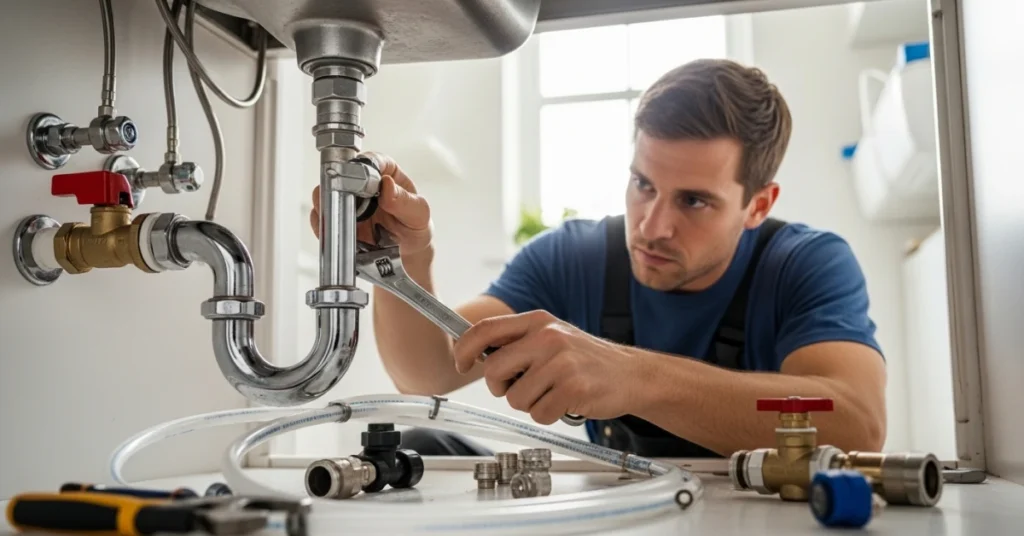
Plumbing certificate requirements are the state-mandated education, experience, and examination standards a tradesperson must satisfy before legally installing, repairing, or inspecting plumbing systems. Requirements vary by license tier and jurisdiction but universally protect public health by ensuring safe water supply and wastewater handling.
What Are Plumbing Certificate Requirements?
Plumbing certificate requirements define the minimum qualifications — formal training hours, supervised field experience, written exams, and continuing education — that a plumber must meet to receive a government-issued credential. Most states recognize three primary license tiers: Apprentice, Journeyman (Journey Level), and Master Plumber.
How Does the Plumbing License Tier System Work?
Understanding the hierarchy is the first step toward meeting plumbing certificate requirements at any level.
| License Tier | Typical Experience Required | Exam Required | Who Issues It |
|---|---|---|---|
| Apprentice | Enrollment in approved apprenticeship | No state exam | State licensing board |
| Journeyman (Journey Level) | 4–5 years / ~8,000 hours under supervision | Yes | State licensing board |
| Master Plumber | 1–2 years post-Journeyman | Yes (advanced) | State licensing board |
| Contractor/Business License | Active Master license | Yes (business law) | State licensing board |
“Iowa Example: According to the Iowa Department of Inspections, Appeals, & Licensing (DIAL), the state issues distinct Journeyman and Master Plumber licenses, each with separate application, experience, and examination requirements.”
What Education Do You Need to Meet Plumbing Certificate Requirements?
Formal Degree vs. Certificate Programs
You do not need a four-year degree to become a licensed plumber. Two pathways dominate:
1. Community College Certificate Programs Programs like the Plumbing Technology Certificate at Iowa Western Community College (IWCC) provide structured classroom instruction in pipe systems, codes, and safety — typically completable in one to two semesters. These programs cover:
- Plumbing codes and regulations (IPC/UPC)
- Pipe materials and joining techniques
- Drain, waste, and vent (DWV) systems
- Water supply systems
- Blueprint reading and job estimation
2. Apprenticeship Programs Sponsored by unions (UA — United Association) or trade associations, apprenticeships combine 144+ classroom hours per year with 2,000 field hours annually over a 4–5 year period. This is the most common route to satisfying plumbing certificate requirements at the Journeyman level.
What Are the Step-by-Step Requirements for Each License Level?
How Do You Get a Journeyman Plumbing Certificate?
According to the Iowa DIAL Journey Level License page, the standard path includes:
- Complete an approved apprenticeship — typically 4 years / 8,000 supervised hours
- Submit a verified work history — employer sign-off on all logged hours
- Pass the Journeyman exam — covers IPC codes, safety, and practical applications
- Pay the application fee — fees vary by state (typically $50–$150)
- Receive your license — valid for 1–3 years depending on the state, subject to renewal
How Do You Upgrade to a Master Plumber Certificate?
- Hold an active Journeyman license
- Accumulate 1–2 additional years of post-Journeyman field experience
- Pass the Master Plumber examination (more code-intensive than Journeyman)
- Carry required liability insurance (amounts vary by state)
- Submit a completed application to your state licensing board
What Are Plumbing Certificate Requirements State by State?
Plumbing certificate requirements are not federally standardized. Every state sets its own rules. The table below captures representative requirements across key states, based on data from NEXT Insurance’s state-by-state licensing guide.
| State | Journeyman Hours | Master Experience | Reciprocity Available |
|---|---|---|---|
| Iowa | 8,000 hrs (4 yrs) | 1 yr post-Journeyman | Limited |
| Texas | 8,000 hrs (4 yrs) | 2 yrs post-Journeyman | Yes |
| Florida | 4 yrs experience | 1 yr post-Journeyman | Yes |
| California | No state license (county-level) | N/A | N/A |
| New York | Varies by city/county | Varies | No |
| Illinois | 5 yrs / 10,000 hrs | 2 yrs post-Journeyman | Limited |
Important: Always verify current requirements directly with your state’s licensing authority. Regulations are updated regularly.
What Exams Are Required for a Plumbing Certificate?
Most state exams test knowledge in four core areas:
- Plumbing codes — International Plumbing Code (IPC) or Uniform Plumbing Code (UPC)
- Pipe sizing and hydraulics
- Drainage and venting calculations
- Safety and OSHA regulations
Many states use exams administered by third-party providers such as Prometric or PSI Exams. Passing scores typically range from 70% to 75%. Candidates often have access to open-book code references during the exam.
What Continuing Education Is Required to Renew a Plumbing Certificate?
Meeting plumbing certificate requirements doesn’t end at initial licensure. Most states mandate continuing education (CE) for renewal:
- Typical CE hours: 4–8 hours per renewal cycle (1–3 years)
- Approved topics: Code updates, backflow prevention, green plumbing, safety
- Approved providers: State-approved schools, trade associations, online platforms
- Consequence of non-renewal: License lapse, fines, or requirement to re-examine
Providers like RocketCert offer state-approved CE courses specifically designed to meet renewal requirements.
What Insurance and Bonding Requirements Come With a Plumbing Certificate?
Holding a plumbing certificate is only part of the compliance picture. Most states also require:
- General Liability Insurance — minimum $300,000 to $1,000,000 per occurrence
- Workers’ Compensation Insurance — mandatory if you employ even one worker
- Surety Bond — ranges from $5,000 to $25,000 depending on the state
- Contractor’s License Bond — required for plumbing business owners
According to Harbor Compliance, failing to carry required insurance is one of the most common reasons plumbing license applications are denied or revoked.
How Can Plumbing Businesses Manage Certification Compliance at Scale?
For solo plumbers, tracking one license is manageable. For plumbing contractors managing a team of 5, 10, or 20+ technicians, staying on top of every individual’s certification status, renewal dates, and continuing education credits becomes a serious operational challenge — and a legal liability.
This is exactly where a field operations platform like FieldPie delivers measurable value. FieldPie lets plumbing business owners:
- Centralize all technician certifications in a single digital dashboard
- Set automated renewal alerts so no license lapses unnoticed
- Assign jobs only to certified technicians based on real-time license status
- Generate compliance reports for insurance audits and client verification
- Track CE completions across the entire workforce
Rather than managing spreadsheets and calendar reminders, FieldPie turns plumbing certificate requirements compliance into an automated, auditable workflow — reducing administrative overhead and eliminating the risk of sending an unlicensed technician to a job site.
Frequently Asked Questions (FAQ)
How long does it take to get a plumbing certificate?
The timeline depends on the license level. An Apprentice certificate can be obtained immediately upon enrolling in an approved program. A Journeyman license typically requires 4–5 years of supervised experience (approximately 8,000 hours) plus passing a state exam. A Master Plumber certificate requires an additional 1–2 years beyond the Journeyman level.
Do plumbing certificate requirements differ between states?
Yes, significantly. There is no federal plumbing license. Each state — and in some cases each county or municipality — sets its own plumbing certificate requirements, including experience thresholds, exam standards, insurance minimums, and renewal cycles. States like California regulate licensing at the county level rather than statewide.
Can I transfer my plumbing certificate to another state?
Some states offer reciprocity agreements that allow licensed plumbers to transfer credentials without retaking the full exam. However, reciprocity is not universal. According to NEXT Insurance, you should always contact the target state’s licensing board directly to confirm whether your current license qualifies for reciprocal recognition.
Conclusion
Navigating plumbing certificate requirements demands attention to three moving parts: education and experience hours, state-specific examinations, and ongoing renewal compliance. Whether you’re an apprentice logging your first field hours or a contractor scaling a multi-technician operation, understanding exactly what your state requires — and staying current — is the foundation of a legally protected, professionally credible plumbing business.
The stakes are real: working without a valid certificate exposes you to fines, job-site shutdowns, and civil liability. Use the checklist above, verify requirements directly with your state licensing board, and build a compliance system that scales with your business.
Ready to simplify how you manage your field teams and daily operations? FieldPie helps plumbing businesses plan jobs, track teams in real time, and streamline workflows — so you can focus on getting more work done, not managing chaos.