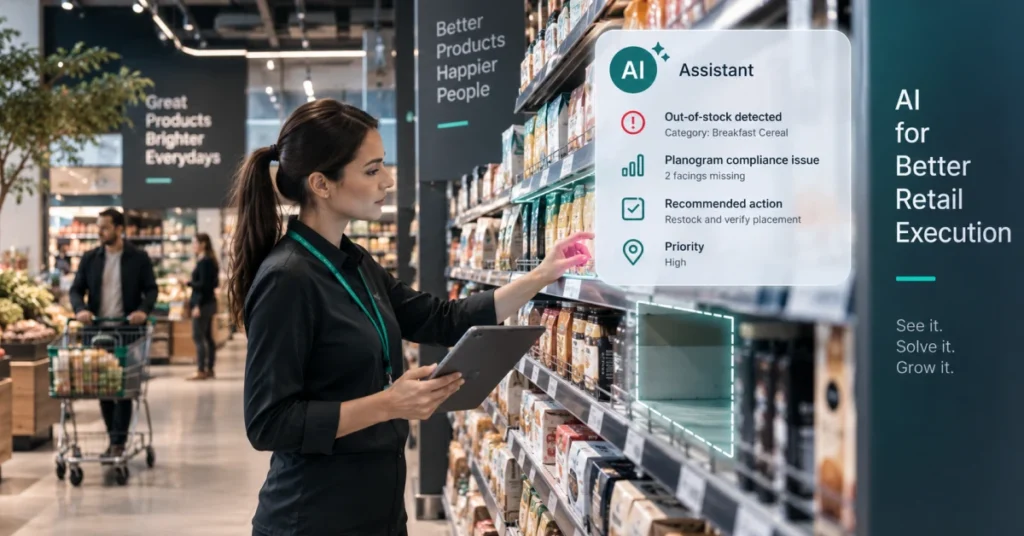



Planogram compliance is the degree to which a retail store’s physical shelf layout matches the approved planogram schematic — covering product placement, facings, shelf position, and SKU adjacency. It ensures every store location delivers the same shopper experience, protects brand equity, and directly drives sales velocity.
What Is Planogram Compliance?
Planogram compliance means every product sits in the exact position, at the correct facing count, on the right shelf level, as specified in the approved planogram. It aligns store execution with category strategy, eliminates unauthorized substitutions, and gives brands and retailers a measurable standard for auditing display accuracy across all locations.
Why Does Planogram Compliance Matter for Retail Brands?
Shelf execution gaps cost the industry billions each year. According to a National Association of Retail Marketing Services report, maintaining proper shelf compliance can recover significant lost revenue that would otherwise evaporate through out-of-stocks, misplaced products, and unauthorized substitutions.
The business case breaks down across four dimensions:
- Sales velocity: Products placed at eye level and in the correct shelf zone consistently outsell misplaced items. Brands that enforce compliance report measurable lifts in category sell-through.
- Shopper experience: Consistent, predictable shelves reduce purchase friction. Shoppers find products faster, increasing basket size.
- Inventory accuracy: Proper facings prevent phantom inventory — situations where a product appears stocked in the system but is buried or misplaced on the shelf.
- Brand consistency: Multi-location retailers need every store to reflect the same brand standards. Ensuring uniform execution protects brand equity at scale.
For CPG brands managing hundreds of retail accounts, ensuring compliance across every store is the difference between a planogram that drives growth and one that sits in a binder.
What Are the Different Levels of Planogram Compliance?
Not all compliance failures carry equal weight. The industry recognizes distinct levels that help teams prioritize corrective action:
| Compliance Level | Definition | Business Impact |
|---|---|---|
| Full Compliance | Shelf matches the planogram exactly — correct SKUs, facings, and position | Maximum sales potential; baseline for category planning |
| Partial Compliance | Correct SKUs present but facing count or shelf level is wrong | Moderate sales impact; shopper findability reduced |
| Non-Compliance | Wrong SKUs, missing products, or completely different layout | High sales risk; brand standards violated |
| Phantom Compliance | Products appear stocked but are not visible or accessible | Misleading audit data; out-of-stock conditions masked |
Understanding these levels allows category teams to set thresholds — for example, flagging any store below 85% compliance for immediate remediation — rather than treating every deviation as equally urgent.

What Are the Biggest Challenges in Achieving Planogram Compliance?
Even well-resourced retail teams struggle to maintain compliance. The most common barriers include:
1. Scale and geographic dispersion A brand managing 5,000 doors across multiple retail banners cannot manually audit every shelf every week. Field teams are stretched thin, and visits are infrequent.
2. High store staff turnover Retail associates who reset shelves often lack training continuity. When a reset team changes, institutional knowledge about planogram standards disappears.
3. Delayed feedback loops Traditional paper-based or spreadsheet audits create days-long gaps between a compliance failure and corrective action. By the time the data reaches planning teams, the gap has cost real sales.
4. Planogram version control Multiple planogram versions in circulation — seasonal resets, promotional overlays, regional variants — create confusion on the floor. Associates execute the wrong version with no malicious intent.
5. Supplier and space conflicts As Wiser’s retail execution research highlights, competing brands and retailers often have conflicting priorities at shelf level, leading to unauthorized product placements that displace compliant displays.
6. Shelf gaps and out-of-stocks Empty shelves caused by supply chain disruptions trigger improvised fills by store staff, breaking the approved layout without any formal reset process.
These challenges are not isolated — they compound. A brand dealing with high turnover, infrequent visits, and outdated software faces a compliance problem that manual processes simply cannot solve at scale.
How Do You Measure Planogram Compliance Accurately?
Measurement methodology matters as much as the audit itself. The three primary approaches:
Manual Audits Field reps photograph shelves and complete structured checklists. Reliable at low volume; breaks down past a few hundred doors. Human error and inconsistent scoring inflate reported compliance rates.
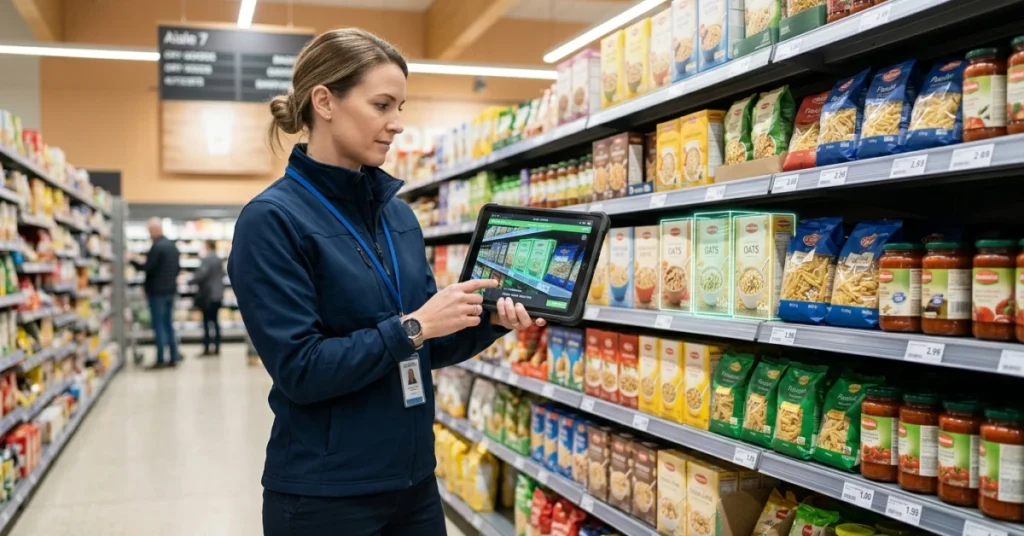
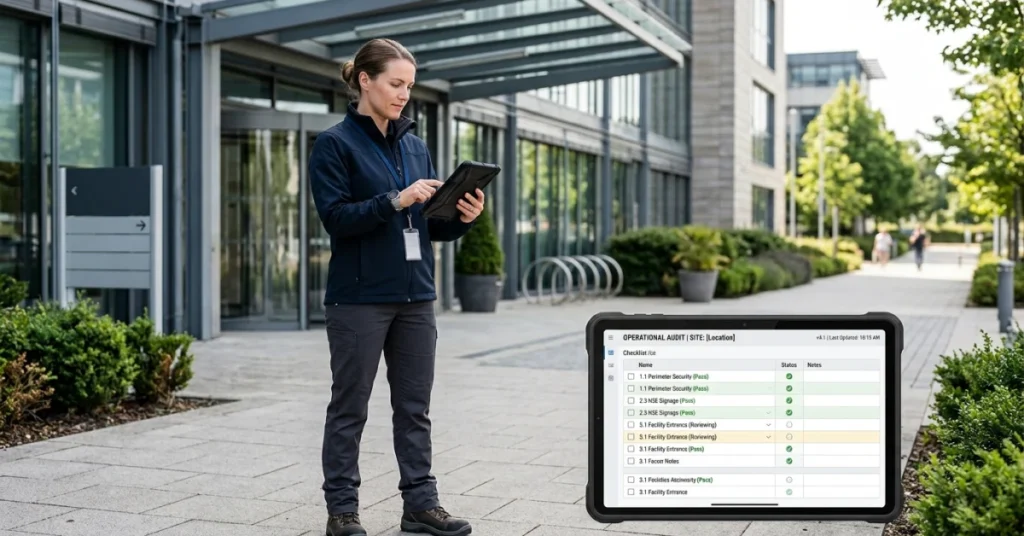
Digital Audit Software Mobile-first software platforms allow field teams to complete structured audits with photo capture, GPS verification, and automatic scoring. These solutions close the feedback loop from days to hours and give planning teams real-time dashboards.
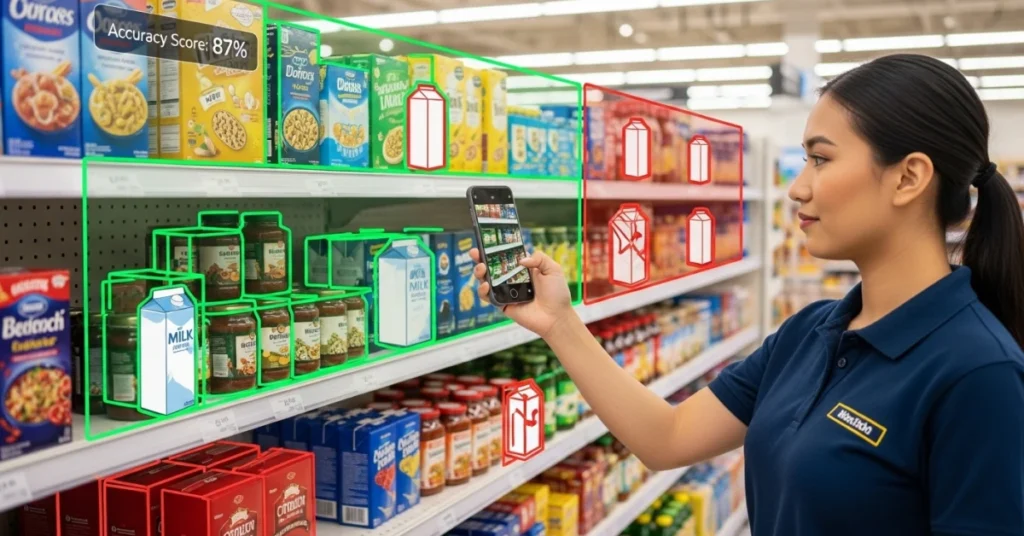
AI-Powered Image Recognition The most advanced approach. Computer vision and artificial intelligence analyze shelf photos against the approved planogram, automatically detecting gaps, wrong facings, and misplaced SKUs. As Infilect’s image recognition research demonstrates, AI-driven shelf analysis can process store images at a speed and consistency that no human audit team can match, identifying deviations at the SKU level within seconds.
This intelligence layer transforms compliance from a reactive audit function into a proactive execution management system.
How Do AI and Image Recognition Change Planogram Compliance?

Artificial intelligence is redefining what’s possible in shelf execution. Traditional audits measure compliance after the fact — AI prevents deviations from persisting.
Here’s how modern AI solutions work in practice:
- Photo capture: A field rep or in-store camera captures a shelf image.
- AI analysis: The software compares the image against the approved planogram using computer vision and machine learning models trained on thousands of SKU images.
- Gap detection: The intelligence layer flags specific deviations — wrong product, missing facing, incorrect shelf level — with location and time stamps.
- Automated alerts: The system notifies the relevant store manager or field rep with a specific corrective action task.
- Compliance scoring: Aggregated data feeds into dashboards, giving brand and category teams a real-time view of compliance rates by store, region, or banner.
The result: planning teams and field teams stop chasing paper trails and start managing by exception. ImageVision.ai’s computer vision research shows that AI-powered retail analytics can reduce audit cycle times by up to 80% compared to manual methods, freeing field teams to focus on high-value selling activities.
For brands managing large door counts, this level of intelligence is no longer a competitive advantage — it is table stakes.
Planogram Compliance vs. Planogram Execution: What’s the Difference?
These two terms are often used interchangeably, but the distinction matters operationally.
Planogram compliance is a measurement — it answers the question: Does the shelf match the approved planogram?
Planogram execution is the process — it answers: How do we build and maintain the shelf to match the planogram?
Compliance without strong execution processes is just a score on a dashboard. Execution without compliance measurement has no feedback mechanism to confirm it’s working. High-performing retail teams treat these as a closed loop: execution processes are designed to achieve compliance targets, and compliance scores inform where execution processes need to improve.
The gap between design and reality is where revenue leaks. Nexgenus’s planogram compliance research frames this clearly: a planogram that looks perfect in software but is never correctly executed in-store delivers zero commercial benefit.

What Are Proven Strategies for Improving Planogram Compliance Rates?
Beyond technology, the highest-performing retail execution teams share consistent operational practices:
1. Centralize planogram distribution Every field rep and store associate must access the current, correct planogram version from a single source of truth. Version control failures are a leading cause of execution errors. Investing in software that pushes the right planogram to the right store — automatically — eliminates this category of error entirely.
2. Set clear, quantified compliance targets Vague directives like “maintain good shelf standards” are not actionable. Specific targets — “achieve 90% compliance in top-tier accounts within 30 days of reset” — give field teams and store managers a concrete benchmark. These targets should be visible in the planning dashboard so everyone knows where they stand.
3. Train store associates, not just field reps Field teams visit stores periodically. Store associates interact with shelves daily. Ensuring that in-store teams understand the planogram and can identify deviations between field visits dramatically improves between-visit compliance rates. Short, mobile-accessible training modules tied to specific planogram resets are the most effective format.
4. Prioritize by account tier Not all doors carry equal revenue weight. A-tier accounts — high-volume, high-visibility stores — deserve more frequent audits and faster corrective action timelines than lower-volume locations. Tiered compliance management ensures resources flow to where they generate the most return.
5. Close the loop between compliance data and planning Compliance scores should feed directly back into the category planning process. Shelves that consistently fail to hold certain SKUs may be signaling a space allocation problem in the original planogram design. Planning teams that treat compliance data as a planning input — not just an execution report — continuously improve their planogram quality.
Conclusion
Planogram compliance is not just about shelf accuracy — it directly drives sales, shopper experience, and brand consistency.
As operations scale, manual processes fall short. Leading brands use digital tools and AI to ensure real-time visibility and consistent execution across every store.
Ultimately, planogram compliance is not just control — it’s a growth driver that turns strategy into measurable results.