


Retail replenishment is the process of restocking products at retail locations—stores, warehouses, or fulfillment centers—to maintain optimal inventory levels, prevent stockouts, and meet customer demand without overstocking. An effective replenishment strategy directly drives sales, reduces carrying costs, and protects profit margins.
What Is Retail Replenishment and Why Does It Matter?
At its core, retail replenishment is the systematic process of moving inventory from a supplier or distribution center to a retail point of sale before stock runs out. It sounds straightforward, but the planning behind it is anything but simple.
Consider the numbers: According to research published by GAINS Systems, retailers that implement data-driven replenishment planning consistently reduce carrying costs by 20–30% while simultaneously improving product availability. Poor replenishment, by contrast, costs the global retail industry an estimated $1.75 trillion annually in lost sales and excess inventory.
The stakes are clear. Whether you run a single grocery outlet or a national apparel chain, getting replenishment right is non-negotiable.
How Does the Retail Replenishment Process Work?
The replenishment cycle follows a logical sequence, but each step requires precise data and cross-functional coordination between procurement, logistics, and store operations.
Step 1: Monitor Inventory Levels
Real-time visibility is the foundation. Point-of-sale (POS) systems, barcode scanners, and RFID technology feed live data into inventory management platforms. Without accurate stock counts, every subsequent step breaks down.
Step 2: Set Reorder Points and Safety Stock
A reorder point (ROP) triggers a replenishment order when inventory drops to a defined threshold. The formula is:
ROP = (Average Daily Sales × Lead Time) + Safety Stock
Safety stock acts as a buffer against demand spikes or delivery delays. Most retailers calculate safety stock using:
Safety Stock = Z-score × Standard Deviation of Demand × √Lead Time
For a product selling 50 units per day with a 7-day lead time and a desired 95% service level (Z = 1.65), safety stock would be approximately 218 units.
Step 3: Generate Replenishment Orders
Orders can be generated manually, automatically via an inventory management system, or through AI-driven demand forecasting tools. Automated systems dramatically reduce human error and free up planning time.
Step 4: Coordinate Logistics and Delivery
Once an order is placed, logistics execution begins. This includes supplier confirmation, transportation scheduling, cross-docking at distribution centers, and final delivery to store shelves. Delivery time windows directly impact shelf availability.
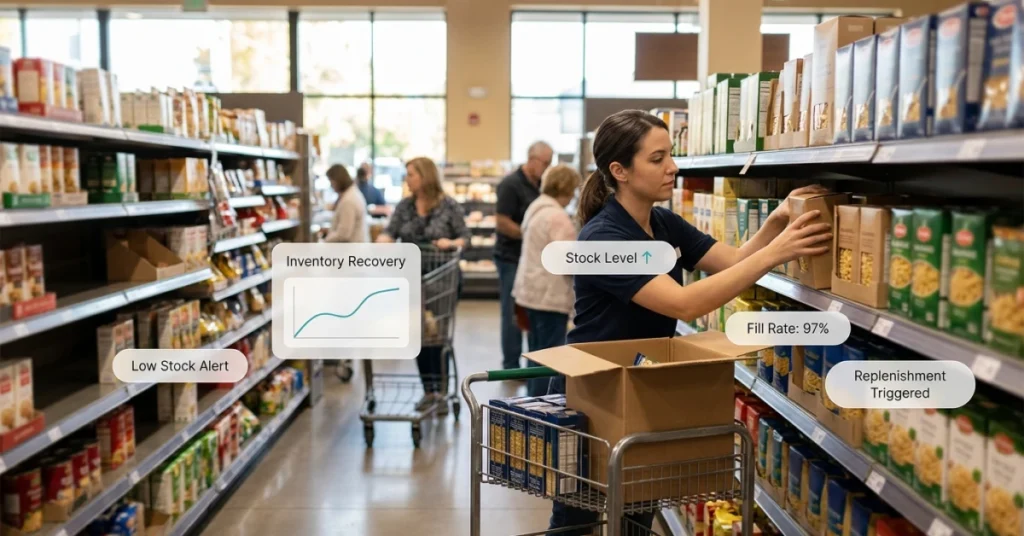
Step 5: Receive, Verify, and Shelve Stock
Incoming shipments must be verified against purchase orders before shelving. Discrepancies—damaged goods, short shipments, incorrect SKUs—must be flagged immediately to avoid phantom inventory issues.
Step 6: Analyze and Adjust
Post-replenishment analysis closes the loop. Teams review fill rates, stockout frequency, and carrying costs to refine future planning cycles.

What Are the Main Retail Replenishment Strategies?
Choosing the right strategy depends on your product category, demand variability, supplier lead times, and storage capacity. Here are the four dominant approaches:
| Strategy | How It Works | Best For | Key Risk |
|---|---|---|---|
| Periodic Replenishment | Orders placed at fixed intervals (weekly, monthly) | Stable-demand staples | Stockouts between cycles |
| Continuous Replenishment | Orders triggered automatically at reorder point | High-velocity SKUs | Requires real-time data |
| Demand-Driven Replenishment | Orders based on actual POS data signals | Seasonal or volatile items | Complex data integration |
| Vendor-Managed Inventory (VMI) | Supplier monitors and restocks inventory | Large-scale retail, FMCG | Dependency on supplier accuracy |
Periodic Replenishment
This time-based model is simple to manage but less responsive. A grocery store that orders from its produce supplier every Monday regardless of current stock levels uses periodic replenishment. The risk: a sales spike mid-week can create a stockout before the next order cycle.
Continuous Replenishment
Also called the min/max method, this approach sets a minimum (min) and maximum (max) stock level. When inventory hits the min threshold, an order fires automatically to bring stock back to the max. The min/max system works exceptionally well for high-velocity items where stockouts cause immediate revenue loss.
Demand-Driven Replenishment
Demand-driven planning uses real-time POS data, historical sales trends, and external signals—weather, promotions, local events—to generate replenishment orders. As Datawiz explains, this approach significantly reduces both overstock and stockout situations by anchoring orders to actual consumption rather than estimates.
Vendor-Managed Inventory (VMI)
In a VMI model, the supplier takes ownership of the replenishment planning process. The retailer shares sales and inventory data; the vendor decides when and how much to ship. VMI reduces the retailer’s planning burden but requires a high-trust supplier relationship and transparent data sharing.
What Are the Most Common Retail Replenishment Challenges?
Even well-resourced retailers struggle with these recurring issues:
- Inaccurate demand forecasting: Seasonal shifts, promotions, and external disruptions (weather events, supply chain shocks) make forecasting difficult without robust AI tools.
- Poor supplier lead time visibility: When delivery windows are unpredictable, safety stock calculations become unreliable.
- Data silos: Disconnected POS, ERP, and warehouse management systems produce conflicting inventory data, leading to phantom stock or unnecessary orders.
- Manual processes: Spreadsheet-based replenishment planning is error-prone and cannot scale with SKU complexity.
- Omnichannel complexity: Retailers serving both brick-and-mortar and e-commerce channels must balance fulfillment priorities across multiple demand streams simultaneously.
How Does AI Transform Retail Replenishment Planning?
Artificial intelligence has moved from a buzzword to a genuine operational differentiator in replenishment planning. Here is what AI-powered systems do that traditional tools cannot:
Predictive demand forecasting: AI models analyze hundreds of variables—historical sales, promotions, competitor pricing, weather, macroeconomic signals—to generate more accurate demand forecasts than any spreadsheet formula.
Dynamic safety stock calculation: Instead of static safety stock buffers, AI recalculates optimal stock levels in real time based on shifting lead times and demand patterns.
Automated order generation: AI removes human latency from the replenishment cycle. When a reorder point is hit, an order is generated, approved, and transmitted to the supplier within minutes—not days.
Anomaly detection: AI flags unusual consumption patterns (a sudden sales spike or an unexpected drop) before they become stockout or overstock crises.
According to ShipBob’s research on retail replenishment, retailers using automated, data-driven replenishment tools report fill rate improvements of up to 15% and carrying cost reductions of 25% compared to manual planning methods.
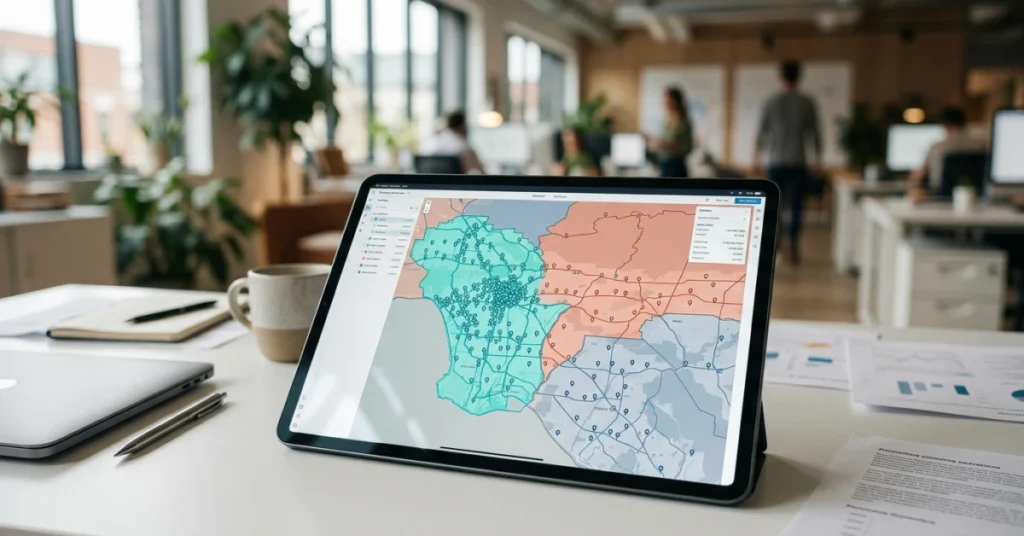
For teams managing field-based replenishment operations—such as route-based restocking of off-site retail locations—AI-assisted field operations software provides the real-time visibility needed to keep every location stocked and on schedule.
Retail Replenishment Checklist: 10 Steps to Optimize Your Process
Use this checklist to audit and strengthen your current replenishment operations:
- Establish real-time inventory visibility across all locations and channels
- Define reorder points and safety stock for every active SKU using current lead time data
- Implement a min/max system for high-velocity items to prevent stockouts
- Integrate POS data with your inventory management and purchasing systems
- Audit supplier lead times quarterly and update safety stock calculations accordingly
- Segment SKUs by demand variability (ABC/XYZ analysis) and apply appropriate replenishment strategies per segment
- Automate order generation for fast-moving products to eliminate manual processing delays
- Set up demand-driven alerts for seasonal SKUs at least 6–8 weeks before peak periods
- Review fill rates and stockout reports monthly to identify systemic gaps
- Evaluate AI or machine learning tools for demand forecasting if you manage more than 500 active SKUs
How Does Replenishment Planning Differ from Allocation?
These two terms are often used interchangeably but describe distinct processes:
Allocation happens before inventory reaches stores. It determines how initial stock is distributed across locations based on store size, historical sales, and demographic data. Think of it as the first distribution of a new product shipment.
Replenishment happens after initial stock is deployed. It is the ongoing process of restocking locations as inventory is consumed. Replenishment is reactive to real-world demand; allocation is proactive.
As GAINS Systems notes, the most effective retail operations treat allocation and replenishment as a continuous, integrated planning cycle rather than two separate events. This integration is especially important for omnichannel retailers managing fulfillment across both physical stores and digital channels.
Effective inventory allocation and distribution planning requires the same data infrastructure that powers replenishment—making the two functions natural partners.
Key Metrics to Measure Retail Replenishment Performance
Tracking the right KPIs keeps your replenishment process accountable. Focus on these:
| KPI | Definition | Target Benchmark |
|---|---|---|
| Fill Rate | % of orders fulfilled completely from available stock | ≥ 95% |
| Stockout Rate | % of time a SKU is out of stock during selling period | ≤ 2% |
| Days of Supply (DOS) | How many days current inventory will last at current sales rate | Category-specific |
| Inventory Turnover | COGS ÷ Average Inventory Value | 4–12x annually (varies by sector) |
| Order Cycle Time | Average time from reorder trigger to shelf availability | ≤ lead time + 1 day |
| Carrying Cost % | Total holding costs as % of average inventory value | 20–30% is industry norm |
Monitoring these metrics consistently enables your planning team to identify where the replenishment cycle breaks down—whether in forecasting, logistics execution, or supplier performance.

Frequently Asked Questions (FAQ)
What is the difference between replenishment and restocking?
Restocking is the physical act of placing products on shelves. Replenishment is the broader strategic process—including forecasting, ordering, logistics coordination, and delivery—that ensures the right products are available at the right location at the right time. Restocking is one step within the replenishment cycle.
How often should retail replenishment orders be placed?
Order frequency depends on the replenishment strategy in use. Continuous (min/max) systems trigger orders automatically when stock hits a threshold, so frequency varies by sales velocity. Periodic systems place orders on fixed schedules—daily, weekly, or monthly. High-velocity SKUs typically require more frequent replenishment cycles, sometimes daily or even intraday for fast-moving consumer goods.
What is a good fill rate for retail replenishment?
A fill rate of 95% or higher is the standard benchmark for most retail categories. Grocery and FMCG operations often target 97–99% given the high frequency of customer purchases and low tolerance for stockouts. Specialty retail may accept slightly lower thresholds, but any fill rate below 90% signals a systemic replenishment problem that requires immediate planning review.
Conclusion
Effective retail replenishment is not a back-office function—it is a front-line revenue driver. Every stockout is a lost sale, and every unit of excess inventory is capital that could be working harder elsewhere. The retailers winning in 2026 are those who combine rigorous planning frameworks with real-time data, AI-assisted forecasting, and field-level execution visibility.
Start with the checklist above. Audit your reorder points, close your data silos, and evaluate whether your current tools can support the speed and complexity your replenishment operations demand. The gap between reactive restocking and proactive replenishment planning is where margin is made—or lost.