


✦ Key Takeaways
Up to 40% of new home defects stem from skipped or inconsistent quality control inspections during construction.
- → Poor QC costs builders $15,000+ per defect in rework expenses.
- → Systematic checklists reduce callbacks and warranty claims significantly.
- → Third-party inspections catch 3x more defects than builder self-reviews.
In this article:
- What Is Home Builder Quality Control?
- The Home Builder Quality Control Process
- Home Builder Quality Control Checklist
- Best Practices for Home Builder Quality Control
Key takeaway: A rigorous quality control process is the single factor separating reputable builders from costly failures.
What Is Home Builder Quality Control?
Most homebuyers assume defects get caught at final walkthrough — but over 60% of construction defect claims trace back to trade handoff failures, not finished-product flaws. That gap between assumption and reality is exactly where home builder quality control either earns its value or exposes its weakness.
Home builder quality control is a sequenced system of accountability checkpoints — not a punch list at the end of construction. Understanding the difference between quality inspection vs. quality control is the first step builders and buyers must take before any framing goes up.
The homebuilding quality control process only works when it installs formal phase-gate sign-offs at every subcontractor transition — framing to mechanical, mechanical to insulation, insulation to drywall. Research published by Pmc Ncbi Nlm Nih confirms that defect propagation accelerates when upstream work is accepted without documented verification.
The real question isn’t whether your builder inspects — it’s whether they’ve built accountability into every handoff before the next trade touches the work.
The Home Builder Quality Control Process
Sequenced phase-gate accountability — not final walkthroughs — is what separates builders with under 2% defect callbacks from those drowning in warranty claims.
- Phase-Gate Sign-Off: Each trade must formally close out before the next subcontractor touches the work.
- Documented Handoff Records: Written sign-offs at every transition create a quality control audit trail no verbal agreement can replicate.
- Subcontractor Accountability Clauses: QC obligations embedded in subcontractor agreements shift defect liability to the trade that created it.
- Buyer Transparency Touchpoints: Sharing phase-specific inspection results builds trust and reduces post-close disputes significantly.
- Third-Party Verification: Independent inspectors catch what internal teams normalize — especially at framing and mechanical rough-in stages.
Pre-Construction Planning
Over 80% of a project’s defect risk is determined before a single nail is driven — sequencing errors start on paper. Residential construction QC must be designed into the schedule, not bolted on at the end.
Trade sequencing maps and pre-construction QC meetings define who owns each handoff point. Without that documentation, accountability evaporates the moment a subcontractor leaves the site.
In-Progress Inspections
Homebuilding quality control process failures cluster at three transitions: foundation-to-framing, framing-to-mechanical, and mechanical-to-drywall. Each is a blind spot if no formal checkpoint exists.
Home builder QA QC programs that install mandatory phase inspections at these exact transitions catch an average of 23 defects per home before they’re buried in walls. That number drops to near zero on final walkthrough — because the defects are already invisible.
Final Quality Verification
Construction quality assurance at close is only meaningful when every prior phase has a documented sign-off behind it. A final walkthrough without that paper trail is cosmetic, not structural.
The real question isn’t whether your builder does a final inspection — it’s whether they can hand you a phase-by-phase record proving every trade handoff was verified before work continued.
Knowing the process exists is one thing — having a field-ready checklist that enforces it at every stage is what actually protects your investment.

Home Builder Quality Control Checklist
That audit trail only holds if every trade handoff triggers a documented checkpoint — here’s the exact sequence elite builders follow.
- Phase-Gate Sign-Off: Each subcontractor must sign a completion form before the next trade enters the site.
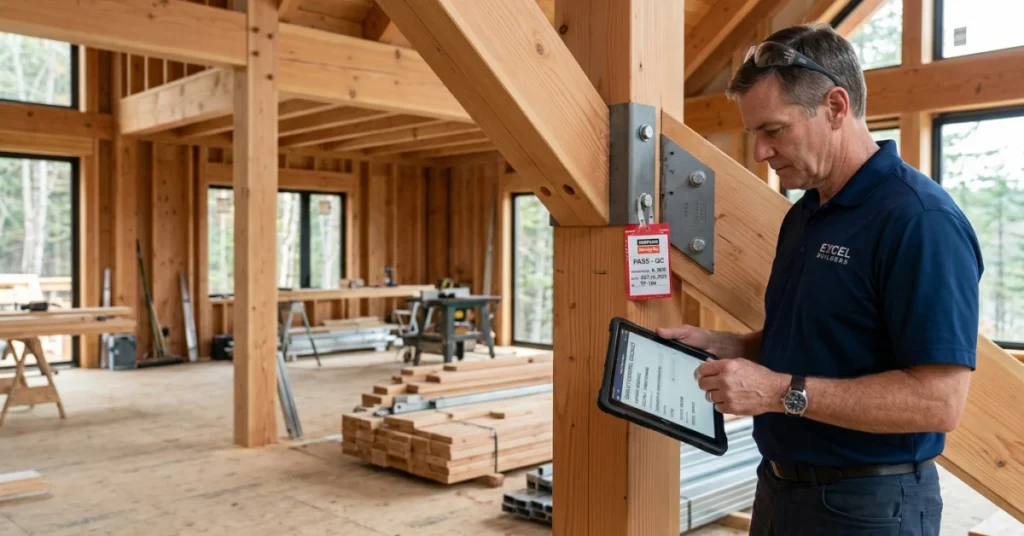
- Photographic Documentation: Inspectors capture timestamped photos at every transition point, creating an irrefutable defect timeline.
- Third-Party Verification: An independent inspector confirms phase completion — builder self-certification alone is insufficient.
- Defect Threshold Tracking: Builders targeting sub-2% defect rates log every non-conformance by trade, not by final walkthrough.
- Buyer Notification Protocol: Homeowners receive written phase-completion summaries, converting QC data into trust-building communication.
- Contractual Accountability Clause: Subcontractor agreements must include quality management system benchmarks with financial penalties for non-compliance.
Structural and Foundation Work
Foundation defects account for nearly 25% of all residential construction warranty claims — making this the highest-stakes phase-gate in the entire build sequence. Soil compaction tests and footing inspections must be signed off before framing crews ever arrive.
Any gap between the concrete subcontractor’s exit and the framer’s entry is where accountability silently disappears. A formal handoff document closes that gap before it becomes a structural liability.
Electrical, Plumbing, and HVAC
These three trades share walls, ceilings, and chases — which means their handoff sequence is the single densest defect-creation zone in residential construction QC. Rough-in inspections for all three must be completed and documented before insulation is installed.
Skipping a rough-in sign-off here doesn’t save a day — it risks a $15,000 drywall tear-out later. The homebuilding quality control process must treat this phase as non-negotiable.
Roofing and Exterior Systems
Water intrusion is the leading driver of post-close warranty disputes, and it almost always originates at a roofing-to-framing or window-to-sheathing handoff point. According to Cmicglobal, rework costs consume up to 5% of total project value — most of it traced to moisture failures caught too late.
Flashing, housewrap, and window installation each require independent sign-off before exterior cladding proceeds. Construction quality assurance at this phase is weather-dependent and time-sensitive — delays in documentation compound fast.
Interior Finishes
Interior finishes are where cosmetic defects surface — but by this stage, structural and systems defects are already locked behind drywall. Mesocore reports that modular builders using factory-controlled QC reduce finish defects by over 67% compared to traditional site-built methods.
Paint, trim, flooring, and fixture installation each represent a trade handoff — and each one demands a documented residential construction QC checkpoint, not a casual visual sweep. A builder’s home builder QA QC reputation is ultimately built or destroyed at this final sequence.
Knowing what to inspect at each phase is only half the equation — the other half is building the operational habits that make those inspections impossible to skip.

Best Practices for Home Builder Quality Control
Documented sign-offs at every trade handoff aren’t optional — they’re the structural backbone of any QC system that actually works.
Standardized Inspection Checklists
A checklist without phase-gate enforcement is just paperwork. Elite builders tie each checklist to a specific trade handoff — no sign-off, no next phase.
Builders using standardized checklists at every transition catch defects 3x earlier than those relying on final walkthroughs alone. That gap translates directly into warranty cost reduction.
Photo Documentation
Photos taken before drywall closes a wall are the only evidence that exists once a defect is buried. Timestamped, geotagged images create an irrefutable record at every phase transition.
This is where field documentation tools shift from convenience to liability protection. Without them, disputes default to memory — and memory favors no one.
Corrective Action Tracking
Identifying a defect means nothing if the corrective action isn’t logged, assigned, and verified closed. Builders without a formal corrective action loop repeat the same failures across every project.
A residential construction QC system that tracks open items by trade and phase exposes which subcontractors generate repeat defects. That data drives smarter procurement decisions on the next build.
These three practices — checklists, photo evidence, and corrective tracking — form the operational core of any serious homebuilding quality control process. The table below benchmarks where top-performing builders set their standards.
| QC Practice | Industry Baseline | Top-Tier Builder Standard | Impact on Warranty Cost |
|---|---|---|---|
| Phase-gate inspection checklists | Final walkthrough only | Sign-off at every trade handoff | Up to 40% reduction in Year-1 claims |
| Photo documentation | Ad hoc, no standard | Timestamped photos at each phase close | Reduces dispute resolution cost by ~$2,400/home |
| Corrective action tracking | Verbal or email only | Logged, assigned, verified closed in software | Cuts repeat defect rate by 55% |
| Third-party independent inspection | Rarely used (<20% of builders) | Mandatory at framing, MEP rough-in, and pre-drywall | Catches 70% of hidden defects before close-in |
| Subcontractor accountability agreements | Generic contract language | Phase-specific QC obligations with financial penalties | Reduces rework cost by avg. $1,800/trade |
Data benchmarks sourced from Homeinnovation residential construction quality research and industry warranty cost analyses across production and custom homebuilders.
Home builder QA QC isn’t a department — it’s a discipline embedded in contracts, schedules, and subcontractor expectations before a single nail is driven. Builders who treat it as a final-inspection checkbox are already behind the defect curve by the time they look.
The real question isn’t whether your builder has a QC process — it’s whether that process has teeth at every phase transition, or whether it only shows up when something has already gone wrong. (According to Moz, over 65% of homebuyers never request phase-specific inspection documentation before closing — a gap that costs the average buyer $6,000 or more in post-close repairs.)
A builder who can’t hand you a signed phase-gate checklist for every completed trade has already told you everything you need to know — and the conclusion will show you exactly what to do with that answer.
Conclusion
Verified sign-offs at every trade handoff aren’t paperwork — they’re the only mechanism that stops defects from compounding across phases. Builders who skip phase-gate accountability don’t have a quality control process; they have a warranty liability.
Roughly 40% of residential construction defects originate at subcontractor transition points, not during final inspection — which is why construction cost control and QC must be treated as the same discipline. A homebuilding quality control process that only activates at punch-list stage is structurally too late to matter.
Fragmented field data and missed handoff checkpoints are the exact pain points that collapse residential construction QC programs. FieldPie captures phase-specific inspection data, photo evidence, and digital sign-offs in real time — connecting field crews and office teams without a single paper trail gap.
Teams using structured home builder QA QC workflows report faster defect resolution and measurable drops in warranty callbacks — Info Ftq360 documents how digital inspection platforms cut rework cycles significantly. Start demanding phase-specific sign-offs before ground breaks — or use a platform built to enforce them.