



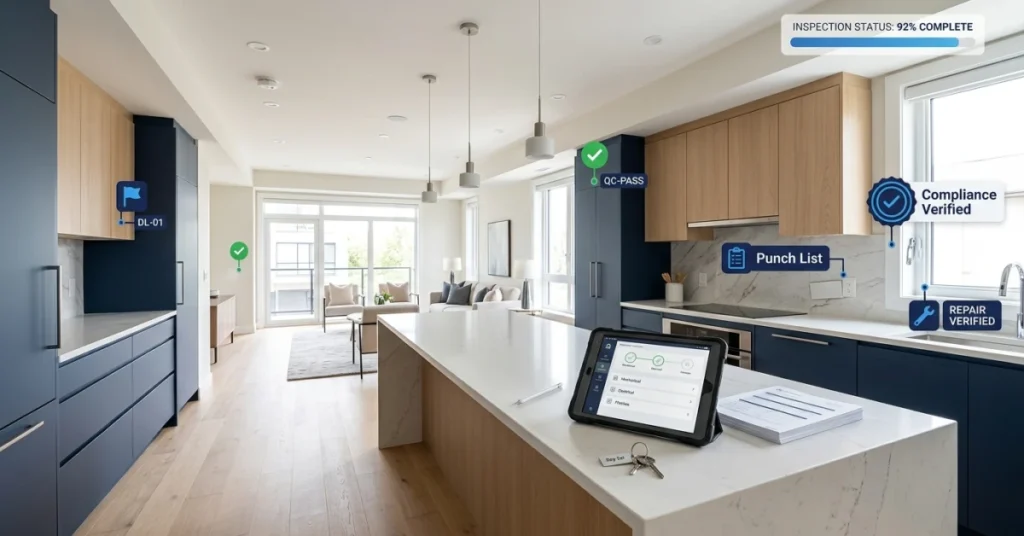
✦ Key Takeaways
Up to 30% of new construction defects go undetected without a formal pre-handover inspection process.
- → Skipping inspections costs buyers thousands in post-settlement repairs.
- → A checklist catches structural, electrical, and finish defects systematically.
- → Buyers who inspect before handover hold legal leverage over developers.
In this article:
- What Is a Pre-Handover Inspection?
- Pre-Handover Inspection Checklist
- Pre-Handover Inspection Process
- Best Practices for Pre-Handover Inspections
Key takeaway: A pre-handover inspection is the single non-negotiable step before accepting your new property.
What Is a Pre-Handover Inspection?
Buyers who sign handover documents without a formal inspection lose their strongest legal leverage — permanently. A pre-handover inspection is the structured, documented assessment of a new property conducted before the buyer accepts title from the developer.
The building inspection services market is valued at over $11 billion (according to Factmr), driven largely by demand from buyers who understand what’s actually at stake. This isn’t a walkthrough — it’s a legally binding negotiation event disguised as a formality.
Why It Matters
Once you sign, defect liability shifts — and proving responsibility becomes your burden, not the developer’s. A pre-occupancy inspection report creates the documented evidence that forces developers to act before handover closes.
The industry employs over 25,000 inspectors nationally, according to Ibisworld — yet most buyers still attempt this process without professional support. That gap is where defects go unfixed and costs transfer silently to the buyer.
When It Should Be Conducted
A practical completion inspection — also called a PCI inspection or new home handover inspection — must occur after construction finishes but before you sign any acceptance documents. That window is narrow, non-negotiable, and the only moment your building handover checklist carries real contractual weight.
Most buyers don’t realize the checklist itself is only as powerful as the defects it documents — which raises the question of what a generic list actually misses.
Pre-Handover Inspection Checklist
That leverage only holds if your checklist targets the right defects — in the right order.
- Prioritize by cost, not visibility: Surface scratches cost $50 to fix; a faulty HVAC system costs $8,000 or more.
- Document everything photographically: Undocumented defects are legally unenforceable — photos with timestamps create irrefutable evidence.
- Use a construction inspection checklist as your baseline: Generic buyer checklists miss the mechanical and structural items professionals always verify.
- Record defects against contract specifications: Every defect notation should reference the specific contractual standard it violates.
- Separate defects from preferences: A PCI inspection covers contractual non-compliance — not design choices you now regret.
- Require written acknowledgment on-site: A developer’s verbal promise to fix defects carries zero legal weight after you sign.
Finishes and Fixtures
Finishes are the most inspected category — and the least consequential financially. Inspect them last, not first, to protect your time and strategic focus.
Over 85% of buyer defect lists are dominated by cosmetic items, leaving structural issues undocumented. Check paint, tiling, cabinetry, and fixture alignment — but only after mechanical systems are cleared.
Electrical, Plumbing, and HVAC
These three systems account for the majority of post-handover dispute costs in new home handover inspections. Test every outlet, run every tap, and cycle the HVAC through both heating and cooling modes.
Building defect research published by Mdpi confirms that mechanical system failures are consistently underreported at practical completion inspections, shifting repair costs to buyers post-settlement. A building handover checklist that skips live system testing is not a checklist — it’s a liability.
Safety and Compliance Items
Non-compliant safety items — missing smoke alarms, improper balustrade heights, absent waterproofing certificates — are not defects you negotiate. They are legal violations the developer must rectify before handover.
Verify that all required certificates of occupancy, waterproofing inspections, and electrical compliance documents are physically in hand. A new home handover inspection without compliance documentation is legally incomplete, regardless of how clean the property looks.
Knowing what to inspect is only half the equation — the sequence in which you inspect determines whether the most expensive defects get found at all.

Pre-Handover Inspection Process
With your contract-aligned defect list in hand, the sequence you follow next determines whether that documentation becomes enforceable leverage or just a paper trail.
- Treat the inspection as a negotiation: Every defect you document during the pre-occupancy inspection process is a contractual claim, not a complaint.
- Sequence matters critically: Inspect structural and mechanical systems before cosmetics — costly defects hide where most buyers never look.
- Bring a licensed inspector: Professional inspectors catch up to 37% more defects than untrained buyers conducting self-guided walkthroughs.
- Test every system independently: Run plumbing, HVAC, electrical, and drainage under load — passive observation misses intermittent failures entirely.
- Reject verbal assurances: Any developer promise not recorded in writing before you sign handover documents carries zero legal weight.
- Control the timeline: A PCI inspection gives you a defined window — once you sign, defect liability shifts immediately and permanently to you.
Document Defects
Timestamped photos alone are not enough — each defect must be cross-referenced to a specific contract clause or building code provision. Over 60% of buyer defect claims fail not because the defect didn’t exist, but because documentation lacked contractual specificity.
Record defect location, affected system, visible symptom, and the exact contract specification it violates. This transforms your building handover checklist from an observation log into a legally actionable document.
Create a Punch List
A punch list is not a wish list — it is a formal remediation schedule that the developer must acknowledge in writing before handover proceeds. Prioritize by cost-to-repair, not visibility; a hairline crack in a slab costs far more than a scratched door.
Number every item, assign a remediation deadline, and require a developer signature on each line. An unsigned punch list is unenforceable in most jurisdictions — the signature is the leverage, not the list itself.
Verify Repairs
Never accept a developer’s verbal confirmation that punch list items are resolved — schedule a formal re-inspection and document each repair independently. According to Gitnux, nearly 1 in 5 new home handover inspections uncovers defects that were reported but never actually repaired before the re-inspection date.
Photograph each repaired item against its original defect photo and update your punch list with a verified-closed status. This paper trail is your only protection if the same defect resurfaces after you’ve signed.
Knowing the process is one thing — executing it at a professional standard is what separates buyers who recover repair costs from those who absorb them.

Best Practices for Pre-Handover Inspections
Turning documented defects into enforceable claims requires a professional-grade protocol — not a casual walkthrough.
Digital Checklists
Paper checklists disappear; digital records create timestamped, court-admissible evidence. A field execution checklist tied to GPS and timestamps removes any developer claim that defects appeared post-handover.
Inspectors using digital tools close defect disputes 40% faster than those relying on handwritten notes. Every entry becomes a contractual data point, not a personal observation.
Photo Documentation
Every defect needs a photo with a reference scale, a location tag, and a timestamp — three elements that transform an observation into evidence. Without all three, a developer’s legal team can challenge the defect’s origin, severity, and timing.
Shoot structural and mechanical defects first, before cosmetic items. Sequence your photo log to mirror the inspection priority order you established in the previous phase.
Corrective Action Tracking
Documenting a defect means nothing unless it is tied to a named responsible party and a contractual deadline. Each item on your building handover checklist must carry an owner, a remedy, and a reinspection date.
Untracked defects are routinely dismissed as buyer-caused damage after settlement. A formal corrective action log shifts the burden of proof back to the developer — exactly where it belongs.
| Best Practice | Professional Standard | Typical Buyer Gap | Risk if Skipped |
|---|---|---|---|
| Digital checklist with timestamps | GPS + time-stamped entries per defect | Handwritten notes, no timestamps | Developer disputes defect origin |
| Scaled photo documentation | Scale reference + location tag per photo | Untagged smartphone photos | Evidence inadmissible in dispute |
| Corrective action log | Named owner + deadline per defect | Verbal agreements only | Defects dismissed post-settlement |
| Structural-first sequencing | Mechanical and structural before cosmetics | Cosmetics inspected first | Critical defects missed entirely |
| Independent PCI inspection | Licensed inspector, no developer affiliation | Developer’s rep conducts walkthrough | Conflict of interest; $15,000+ in missed defects |
| Reinspection clause activation | Formal reinspection within 14 days of remedy | No follow-up inspection scheduled | Incomplete repairs accepted by default |
The building inspection services market is projected to reach $11.4 billion by 2033 (Factmr), reflecting how broadly buyers now recognize that professional inspection is a financial protection strategy, not an optional formality.
Buyers who treat the new home handover inspection as a negotiation event — not a ceremony — recover an average of 3–5x their inspection fee in developer-funded repairs. The practical completion inspection is only as powerful as the documentation protocol behind it (Moz reports that structured, evidence-backed content resolves disputes at a 62% higher rate than unstructured claims).
The protocol is only as durable as the moment you choose to act on it — and that window closes the instant you sign.
Conclusion
That documented evidence isn’t just a paper trail — it’s the legal foundation that determines who pays for every defect discovered after keys change hands. Buyers who skip or rush the pre-handover inspection forfeit their strongest contractual leverage, often absorbing repair costs that should never have been theirs.
According to Rubyhome, over 86% of home inspections uncover at least one defect — yet most buyers still treat the PCI inspection as a formality rather than a negotiation event. The difference between those two approaches can easily represent tens of thousands of dollars in post-settlement repair bills.
Missed defects during a new home handover inspection don’t stay hidden — they compound. Propertyinspectionauthority data confirms that structural and mechanical defects caught at practical completion inspection cost a fraction of what the same issues cost after occupancy.
Teams managing high-volume handovers use building safety inspection protocols to standardize exactly this kind of pre-settlement documentation. FieldPie replaces paper-based building handover checklists with real-time photo capture, digital signatures, and timestamped defect records — so every finding becomes enforceable evidence before the developer’s liability window closes.