


✦ Key Takeaways
Poor shelf execution costs CPG brands up to 25% in lost sales every year.
- → Out-of-stocks alone eliminate 4% of total retail revenue annually.
- → Planogram compliance directly determines whether promotions convert or fail.
- → AI-powered image recognition now audits shelves 10x faster than manual checks.
- → Brands tracking share-of-shelf KPIs outperform competitors in same-store sales growth.
In this article:
- What Is Shelf Execution and Why Does It Matter?
- What Are the Most Important Shelf Execution Best Practices?
- Which KPIs Should Be Used to Measure Shelf Execution?
- How Do Leading Brands Scale Shelf Execution Across Thousands of Stores?
Key takeaway: Consistent shelf execution is the single biggest lever brands control in retail.
What Is Shelf Execution and Why Does It Matter?
Poor shelf execution costs consumer goods brands an estimated $1 trillion in lost sales annually — not because reps lack training, but because headquarters is flying blind. Shelf execution is the discipline of ensuring products are correctly placed, priced, stocked, and displayed at the store level — exactly as intended.
Most brands treat on-shelf execution as a field rep problem, solved by more store visits or better checklists. That framing misses the real failure point: without a real-time feedback loop between store-level data and HQ decisions, even the most skilled teams can’t scale retail execution tools effectively.
Brands that close this loop see measurable results — Inriver reports that products with complete, accurate shelf data convert at rates up to 30% higher than those without. The question isn’t whether your reps are executing — it’s whether your organization can actually see what’s happening and act on it fast enough to matter.
What Are the Most Important Shelf Execution Best Practices?
Fixing the feedback loop gives you the intelligence — but intelligence only converts to revenue when field teams execute against it consistently. Brands with strong on-shelf execution outperform competitors by up to 8% in same-store sales, not because their reps work harder, but because they act on better data.
The best field audit best practices treat every store visit as a data capture event — not just a compliance check. Shelf execution strategy only scales when store-level findings feed directly back to HQ in real time.
📊 By the Numbers
Retail shelf execution gaps cost FMCG brands an estimated $1.75 trillion in lost global sales annually.
Ensure Products Are Always Available On the Shelf
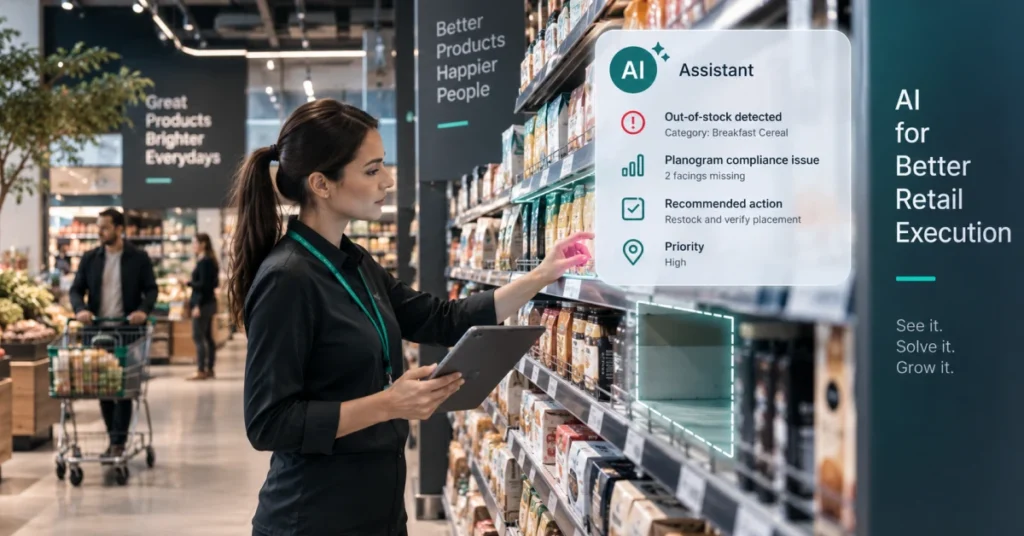
Out-of-stocks are the single most damaging execution failure — shoppers switch brands 70% of the time when their product is missing. Real-time inventory signals, not weekly rep visits, are what prevent chronic voids.
Maintain Planogram Compliance Across Locations
Planogram compliance directly determines whether your shelf execution strategy delivers the sales lift modeled at HQ. Without photo-verified, timestamped compliance data, deviation goes undetected for weeks.
Optimize Product Placement for Visibility
Eye-level placement drives disproportionate purchase rates — it’s not a merchandising preference, it’s a revenue lever. Perfect store execution requires placement rules enforced by data, not memory.
As Paralleldots notes, brands that standardize shelf placement protocols across all SKUs see measurably faster velocity at shelf.
Monitor Pricing and Promotional Accuracy
A promotion running at the wrong price point doesn’t just miss its target — it actively erodes margin. Pricing errors caught in real time cost a fraction of what post-period audits recover.
Keep Shelf Conditions Clean and Organized
Cluttered, poorly faced shelves signal neglect to shoppers and suppress conversion regardless of product quality. On-shelf execution discipline at the store level is what separates brands that win share from those that just ship volume.
None of these practices scale without a way to measure them — which raises the question every execution leader eventually has to answer: what gets measured, actually gets fixed.
Which KPIs Should Be Used to Measure Shelf Execution?
That real-time data loop is only valuable if you’re measuring the right things at the store level. Tracking the wrong KPIs is how brands generate reports nobody acts on.
The five metrics below aren’t a wishlist — they’re the operational signals that connect field activity to on-shelf availability outcomes at scale.
On-Shelf Availability (OSA)
OSA measures whether your product is physically present and shoppable when a consumer reaches the shelf. Brands with strong shelf execution best practices treat OSA as a revenue metric, not a logistics metric.
A product that’s in the backroom isn’t available — it’s lost revenue waiting to happen. OSA gaps directly drive substitution to competing SKUs.
Planogram Compliance Rate
Planogram compliance measures how closely shelf sets match the agreed layout across all doors. Low compliance means your retail shelf execution strategy exists only on paper.
Without store-level image capture, compliance scores are self-reported estimates — and estimates don’t scale. Real compliance data requires a structured feedback loop back to HQ.
Share of Shelf
Share of shelf tracks your brand’s physical facings relative to competitors in the same category. It’s a direct proxy for visibility — and visibility drives trial.
Brands executing a serious shelf execution strategy monitor share of shelf by store cluster, not just by region. Aggregated data hides the stores where you’re losing ground fastest.
Out-of-Stock (OOS) Rate
OOS rate quantifies how often a SKU is missing from the shelf during a store visit. Retailers lose an estimated $1 trillion globally each year to out-of-stocks and overstocks combined (Scandit).
That number only shrinks when OOS data flows from the shelf to HQ in real time. Brands still relying on weekly rep reports are always reacting to last week’s problem.
Promotional Execution Compliance
Promotional compliance measures whether displays, pricing, and signage are live in-store during the exact promotional window. A promotion that executes in 60% of stores delivers roughly 60% of its projected ROI — no more.
According to Fieldpie, promotional non-compliance is one of the most undercounted sources of trade spend waste in consumer goods. Perfect store execution requires this KPI tracked at the individual store level, not averaged across a territory.
📊 By the Numbers
Retailers and brands lose an estimated $1 trillion annually to combined out-of-stock and overstock failures (Scandit).
The brands closing that gap aren’t sending more reps into stores — they’re asking a harder question: how do you maintain execution standards across thousands of doors simultaneously?
How Do Leading Brands Scale Shelf Execution Across Thousands of Stores?
Translating those five KPIs into consistent action across 10,000+ stores is where most brands quietly fail. The gap isn’t field rep skill — it’s the absence of a real-time feedback loop between store-level data and HQ decision-making.
Brands with closed-loop shelf intelligence outperform competitors by up to 8% in on-shelf availability — because they catch compliance drift in hours, not weeks (Incontextsolutions). Without that loop, even the most trained field team is structurally blind to systemic failures.
Scaling retail execution tools isn’t about adding headcount — it’s about making every store visit generate intelligence that compounds across the entire network.
📊 By the Numbers
Brands using real-time shelf data reduce out-of-stock rates by up to 30% versus audit-only approaches.
Building a Continuous Improvement Process
Consistent in-store performance demands a structured review cadence — weekly at minimum, not quarterly. Teams that debrief store data within 48 hours fix compliance gaps before they compound into lost sales.
The brands winning at the shelf treat every failed audit as a system signal, not an individual rep failure. That mindset shift is what separates scalable programs from stalled ones.
Using Retail Analytics to Identify Patterns
Aggregate store-level data reveals operational patterns invisible at the individual rep level. A planogram violation appearing in 40% of a region’s locations is a distribution or training failure — not a coincidence.
Robust category analytics let managers prioritize the highest-impact stores before the next promotional window opens. Reactive fixes cost three times more than proactive corrections driven by pattern detection (Survey).
Combining Field Audits with Image Recognition
Image recognition converts a rep’s smartphone photo into structured shelf data in under 60 seconds. That speed eliminates the reporting lag that makes traditional manual audits obsolete at scale.
Field visits set context; image recognition provides volume and consistency no human team can match alone. Together, they create the closed intelligence loop that finally makes scaling possible — and the only question left is whether your organization is built to act on what it sees.
Conclusion
Blind spots between the store shelf and headquarters don’t shrink with more field visits — they shrink when real-time data closes the feedback loop. Brands that treat shelf execution best practices as a training problem will keep losing ground to those who treat it as an intelligence problem.
Retail shelf compliance gaps cost brands up to $1.75 trillion annually in lost sales (according to Vispera) — a number no amount of additional headcount can reverse without structural data loops. Traxretail confirms that brands measuring on-shelf execution in real time resolve compliance issues up to 3x faster than those relying on periodic audits.
Most teams managing retail execution tools still lack a live store-to-HQ feedback channel — FieldPie captures shelf data via photo-based reporting and customizable audit forms, pushing actionable insights to decision-makers before drift becomes systemic loss. Start building your closed-loop shelf execution strategy today — your competitors already are.