


✦ Key Takeaways
Retailers with omnichannel strategies retain 89% more customers than those running single-channel operations.
→ Consistent product presentation across channels drives measurably higher conversion rates.
→ Siloed inventory data kills omnichannel execution before it starts.
→ A structured workflow turns multichannel chaos into repeatable, scalable revenue.
In this article:
What Is Omnichannel Retail Merchandising?
How Omnichannel Merchandising Works
How to Build an Omnichannel Merchandising Workflow
Omnichannel Merchandising Checklist
Omnichannel vs. Traditional Merchandising
Key takeaway: Omnichannel merchandising wins only when your product data, inventory, and messaging move as one unified system.
What Is Omnichannel Retail Merchandising?
You spot a jacket online, drive to the store, and it’s either gone or costs $20 more. That gap — between what a brand promises and what a shopper finds — is the exact problem omnichannel retail merchandising exists to close. It’s a real and costly disconnect.
Omnichannel retail merchandising means keeping product presentation, pricing, and availability in sync across every channel a shopper might use. That includes the app, website, store shelf, and catalog. The goal is simple: every touchpoint should feel like one brand, not four separate ones.
Most retailers assume the fix is better technology. It isn’t. The real barrier is the lack of one shared source of product data that every channel can draw from.
Without that single source, each touchpoint makes its own rules. Customers end up paying the price.
Omnichannel vs. Multichannel Merchandising
Multichannel means a retailer sells in more than one place. Omnichannel means every one of those places shares the same product truth — same price, same stock status, same story.
The difference sounds small. It isn’t. Retailers with strong omnichannel strategies retain 89% of their customers. Those without one retain just 33% (Porchgroupmedia).
Which Retail Touchpoints Must Stay Consistent?
Every channel a customer can reach must show the same product data at the same time. That means the website, mobile app, physical shelf, and staff tablets. Consistency isn’t a nice-to-have. It’s the baseline shoppers now expect from every brand.
Shoppers who use three or more channels spend 13% more per order than single-channel buyers (Emarsys). That’s exactly why retail merchandising standards matter across every touchpoint.
Knowing what omnichannel merchandising is raises a harder question. How does a retailer actually build it — and where does the system break down first?
How Omnichannel Merchandising Works
Syncing product, pricing, and availability across every channel takes one key fix. You need a single source of truth for all product data.
Without it, your website shows one price. Your app shows another. Your store team works from a spreadsheet updated last Tuesday.
Omnichannel retail merchandising connects every touchpoint — online, in-store, mobile, and social — to the same live data. Shoppers get a seamless shopping experience because every channel draws from the same well.
Connecting Product, Pricing, Promotion, and Inventory Data
Most retailers run product data in silos — one team owns the website, another owns the store, and nobody owns the overlap.
That gap is where pricing errors, out-of-stock surprises, and missed promotions live.
A unified retail channel strategy routes every update through one central system. That means a price change, a new photo, or a promo end date hits every channel at once — automatically.
Coordinating Online and In-Store Merchandising
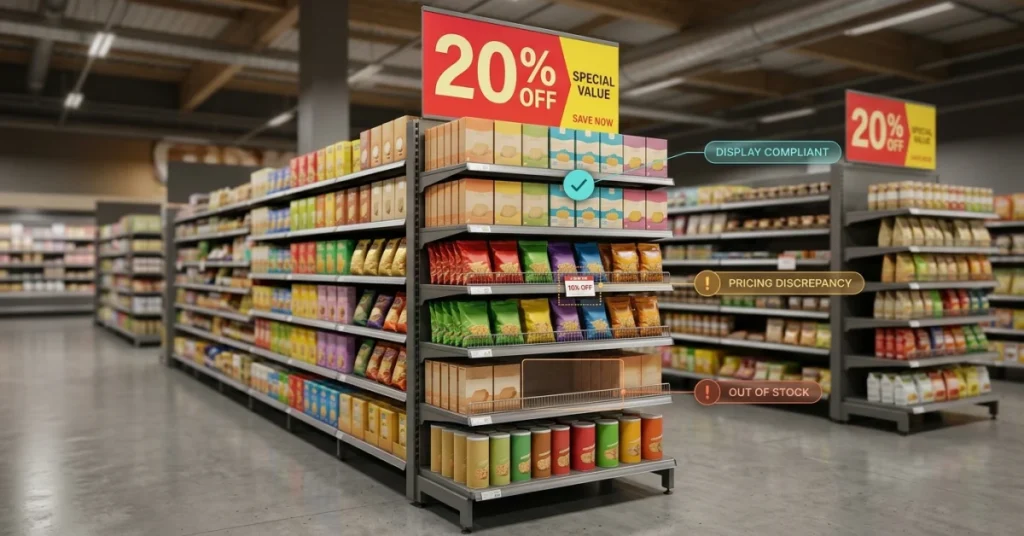
Online and in-store teams often plan promotions separately. That means a customer sees a “20% off” banner online and finds full price on the shelf.
That disconnect erodes trust fast — and trust is hard to rebuild.
Retailers who sync digital and physical merchandising calendars cut those mismatches dramatically. Consistent retail execution standards keep both channels telling the same story at the same time.
Managing BOPIS, Ship-from-Store, and Endless Aisle
Buy online, pick up in-store (BOPIS) sounds simple — but it breaks the moment inventory data goes stale. Customers who drive to the store for an order that isn’t ready don’t come back.
Endless aisle and ship-from-store programs share the same need: accurate, real-time stock data across every location. Omnichannel customer experience only works when the inventory layer is honest and current.
📊 By the Numbers
Omnichannel shoppers spend up to 10% more per purchase than single-channel shoppers, according to Capitaloneshopping.
Bigcommerce also reports that omnichannel customers are retained at a 90% higher rate.
Getting these systems to work together is not a one-time technology fix. It is a workflow problem you must design on purpose — and that is exactly what the next step demands.
How to Build an Omnichannel Merchandising Workflow
That live data foundation only works if your team has a clear process for acting on it. Building a real omnichannel retail merchandising workflow means defining who owns each step — and making sure every channel pulls from the same playbook.
Shoppers who engage across three or more channels spend 13% more per order than single-channel buyers (Uniformmarket) — which means a broken workflow doesn’t just frustrate customers, it costs you revenue directly.
Map the Customer Journey
Start by listing every place a shopper touches your brand — app, website, store shelf, social ad. You cannot sync channels you haven’t named yet.
Draw a simple path from first click to final purchase. Flag every spot where product info, price, or stock could show up differently across those touchpoints.
Define Channel Standards
Set one approved version of every product name, image, description, and price — then document it. This is the retail merchandising standard every channel must match, no exceptions.
Assign a single owner for each data field. When no one owns it, everyone edits it — and that’s how conflicts start.
Synchronize Products and Promotions
Push every product update and promotion from your single source of truth — never enter data separately into each channel. According to Ringly, brands with a unified omnichannel retailing strategy retain 89% of their customers, compared to just 33% for those without one.
Schedule promotions in one place and let the system distribute them. Manual channel-by-channel updates are where pricing errors are born.
Monitor Store Compliance and Availability
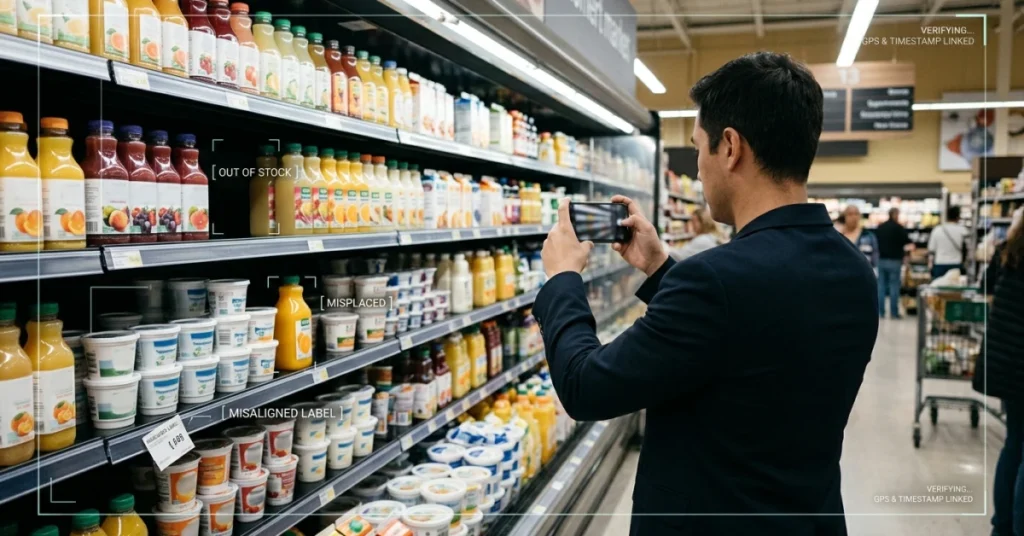
A workflow doesn’t end at publishing — it ends when the shelf matches the plan. Check that in-store displays, price tags, and stock levels reflect what every other channel is showing right now.
Use field audits or retail execution software to catch gaps fast. A seamless shopping experience breaks the moment one channel goes out of sync with the rest.
📊 By the Numbers
Brands with unified omnichannel customer experience strategies retain 89% of customers vs. 33% without one.
Knowing the steps is a strong start — but the fastest way to put this workflow into action is a ready-made audit you can run today.
Omnichannel Merchandising Checklist
That revenue drain has a fix. Start with a clear, channel-by-channel audit of your own execution.
Product Availability and Assortment
Shoppers who find a product online but not in-store lose trust fast — and rarely come back.
Retailers with consistent assortment across channels see up to 30% fewer abandoned purchases (Digitalcommons Bryant).
Sync inventory daily: Every channel must pull stock counts from one shared, live data source.
Flag low-stock items early: Set automatic alerts before a product hits zero — not after.
Audit assortment gaps weekly: Compare what is listed online against what is physically on the shelf.
Pricing and Promotion Consistency
A customer who sees one price on your app and a different price at the register will not accept it. That mismatch kills trust on the spot.
That single moment breaks the seamless experience your omnichannel retailing strategy is built to deliver.
Use one pricing master file: All channels — app, website, and store — must read from the same source.
Activate promotions simultaneously: Launch sales across every touchpoint at the exact same time.
Audit promotional signage in-store: Confirm physical tags match the digital offer before the sale goes live.
Product Content and Visual Standards
Inconsistent product photos, descriptions, or specs across channels quietly erode buyer confidence.
When content differs by channel, it shows the retailer has no single source of truth. Customers feel that disconnect — even when they cannot name it.
A strong store merchandising checklist locks in visual standards before a product ever hits the floor.
Emarsys reports that brands with a consistent omnichannel experience keep 89% of their customers. Brands without that consistency keep just 33%.
Standardize image specs: Use the same photo angles, backgrounds, and resolutions on every platform.
Lock product descriptions centrally: One approved copy block feeds every channel — no local edits allowed.
Review content quarterly: Catch outdated specs or discontinued features before customers do.
Store Execution and Fulfillment Readiness
Online strategy means nothing if the store team cannot execute it on the floor.
Unified retail channels only work when the people closest to the product know exactly what to do and when.
Assign clear channel owners: Every product update needs one person responsible for confirming it went live.
Train staff on fulfillment workflows: Buy-online-pick-up-in-store fails when store teams are not ready for it.
Run weekly execution checks: Walk the floor and compare physical placement against the planogram and digital listing.
The checklist is only as strong as the data behind it. Every item above breaks down the moment two channels are working from different versions of the truth.
Checking these boxes makes one thing clear. Most retailers underestimate the gap between omnichannel merchandising and old channel-by-channel thinking. That gap is wide — and it is costly.
Omnichannel vs. Traditional Merchandising
Daily inventory syncs and weekly audits close gaps — but they only work if both approaches are held to the same standard.
Inventory and Assortment Planning
Traditional retailers plan inventory by channel — one buyer for stores, another for the website. That split creates the stock mismatches shoppers hate most.
Omnichannel retail merchandising pulls all channels from one shared inventory pool. One source of truth means fewer surprises at checkout — online or in-store.
Store Execution and Customer Experience
In a traditional setup, a store manager learns about a promotion from a printed memo — sometimes days after it went live online. That lag breaks the seamless shopping experience customers expect.
Omnichannel execution pushes real-time updates to every touchpoint at once. Field teams see the same product data the website does — no lag, no guesswork.
Measurement and Reporting
Traditional merchandising measures each channel in its own silo — store sales here, web conversions there. You never see the full picture of how a customer actually shops.
Unified retail channels share one reporting layer, so you can track a shopper from ad click to in-store pickup. That visibility is where merchandising ROI gains actually show up.
Here is how the two models stack up across the metrics that matter most to retail teams today.
|
Factor |
Traditional Merchandising |
Omnichannel Merchandising |
Impact |
|---|---|---|---|
|
Inventory source |
Separate pools per channel |
Single shared pool |
Reduces stockouts by up to 30% |
|
Pricing consistency |
Often differs by channel |
Synced in real time |
Cuts price-dispute complaints |
|
Promotion speed |
Days to reach all stores |
Instant across all channels |
Protects full promo window |
|
Customer retention |
~33% repeat purchase rate |
~89% retention rate |
Nearly 3× loyalty lift |
|
Reporting view |
Siloed by channel |
Unified cross-channel dashboard |
Faster, smarter decisions |
|
Product data source |
Multiple, often conflicting |
One authoritative record |
Eliminates info gaps at scale |
Businesses using omnichannel retailing strategy retain roughly 89% of their customers, versus 33% for those without it (Capitaloneshopping). Omnichannel customers also spend 10–15% more per transaction than single-channel shoppers (according to Sciencedirect).
“The gap between these two models is not a technology gap. It is a data gap — specifically, who owns the single version of product truth that every channel draws from.”
FieldPie closes that gap by giving field teams and office managers one live platform for product data, task updates, and photo-based execution reports. When every channel pulls from the same record, the omnichannel customer experience stops being a promise and starts being a result.
The numbers make the case for switching — but knowing what to do next is what separates retailers who close the gap from those who keep patching it.
Conclusion
A shared pool of truth is not optional. It is the fix that makes omnichannel retail merchandising actually work.
Retailers with unified product data see up to 30% fewer stockouts across channels (according to Envive). A single source of truth is exactly what closes that gap.
Most teams still manage product info, pricing, and inventory in separate systems. Shoppers pay the price every time those systems disagree.
Tracking your merchandising execution results against a unified data standard sets you apart. It separates retailers who grow from those who drive loyal customers away.
Disconnected channels make it impossible to deliver a consistent omnichannel customer experience at scale. FieldPie connects your field and office teams through real-time photo reporting, customizable audit forms, and live inventory visibility. Every channel then reflects the same truth.
Start with the checklist in Section 4. Pick one channel to unify first, and build from there.