


✦ Key Takeaways · 6 min read
Nestlé’s internal study proved AI shelf monitoring cuts out-of-stocks by 20%, and that’s just the beginning.
→ Computer vision catches stockouts faster than any human employee.
→ Choosing the right hardware determines whether your rollout succeeds or fails.
→ AI shelf monitoring pays for itself through smarter, automated replenishment decisions.
In this article:
AI Shelf Monitoring Is Smarter Than You Think
How Does Computer Vision Actually Detect Stockouts?
Cameras, Robots, or Mobile Devices: Stop Guessing
- 4 Essential Retail KPIs AI Shelf Monitoring Can Support
Does AI Shelf Monitoring Actually Deliver ROI?
Scale It Without Breaking It
Conclusion
Key takeaway: Retailers who ignore AI shelf monitoring are actively choosing to lose sales.
AI Shelf Monitoring Is Smarter Than You Think
Walk down any grocery aisle and you’ve already felt the problem. A gap where a product should be, a shelf tag with nothing behind it. That frustration costs retailers far more than a single lost sale. Most have quietly accepted it as an unavoidable cost of doing business.
AI shelf monitoring challenges that assumption directly. It doesn’t just speed up the old process of sending someone to walk the floor with a clipboard. It reveals a structural blind spot that retailers built into their operations long before cameras were smart enough to catch it.
One company spans 187 countries with over 2,000 brands. It turned to AI-powered shelf intelligence because human audits simply couldn’t keep up with that scale.
This article breaks down how retail shelf management AI actually works and what hardware choices make or break a rollout. The real payoff turns out to be organizational, not just operational. Cameras can see every shelf in real time, yet retailers took years to ask what those shelves were hiding.
How Does Computer Vision Actually Detect Stockouts?
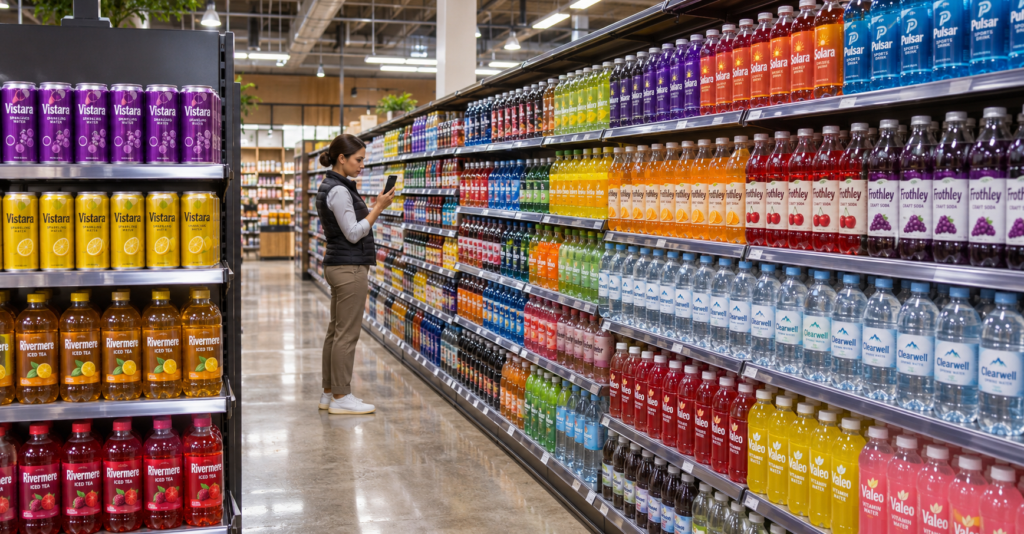
That blind spot exists because human auditors can only check a shelf at one moment, then walk away. Computer vision shelf monitoring works differently. Cameras watch every shelf continuously, and a trained AI model compares what it sees against what’s supposed to be there.
The gap between expected and actual is how a stockout gets flagged, automatically, without anyone walking the aisle. Say your store runs a planogram that calls for three facings of a cereal brand on row two. The camera captures an image and the model counts the facings. If it sees one or zero, it fires an alert to a store associate’s device within minutes. No clipboard, no scheduled walk, no delay.
What the Camera Sees vs. What AI Decides
The camera captures raw pixels, nothing more. The AI model does the real work: it identifies each product by shape, color, and label. It then maps that product to a specific shelf position. This is why planogram compliance data is so critical to the system’s accuracy.
Without a clean planogram as a reference, the model has no baseline to compare against, and every alert it fires becomes a guess. Garbage in, garbage out applies here just as much as anywhere else in retail operations.
Edge AI vs. Cloud: Where Inference Really Runs
On-shelf availability AI can process images in two ways. One option runs on a small computer attached to the camera itself, called edge inference. The other sends images to a remote server, which is cloud inference.
Edge inference is faster and keeps working if the internet goes down, but the hardware costs more upfront. Cloud inference is cheaper to deploy but adds latency and depends on a stable connection. Most large retailers use a hybrid approach. Edge devices handle real-time alerts on the floor, while the cloud handles trend analysis and model retraining overnight.
The choice you make here shapes how fast your alerts arrive and how much your infrastructure bill grows as you scale.
📊 By the Numbers
“With Shelf Inspector we are looking at 20% out of stock reduction across multiple categories,” per Datasentics.
The hardware you pick to run this detection is not a footnote. It’s the decision that quietly determines whether your entire AI shelf monitoring rollout succeeds or stalls before it proves its value.
Cameras, Robots, or Mobile Devices: Stop Guessing
That automatic flagging only works if the camera actually sees the shelf. The hardware you pick determines what your AI shelf monitoring system can and cannot detect. Most failed rollouts trace back to that choice, not to the software.
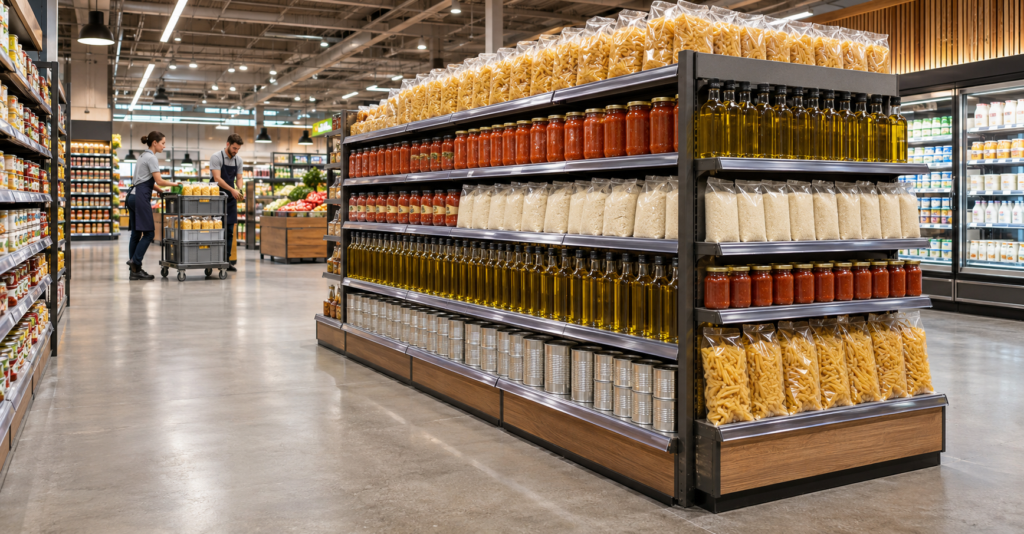
Say your team installs fixed overhead cameras in a grocery store. They cover the main aisles well, but end caps and bottom shelves fall outside the frame. The AI flags what it sees and misses everything else, leaving the same blind spots your old paper audits had.
Fixed Cameras: High Coverage, Hidden Trade-Offs
Fixed cameras are the most common starting point for computer vision shelf monitoring because they run continuously and need no staff to operate. They cover exactly what they’re aimed at and nothing more. A layout change or a new display can instantly create a dead zone.
Retailers often underestimate how much store layouts shift across seasons, promotions, and resets. A camera grid that worked in January may miss a third of the floor by March. On-shelf availability AI can’t flag a gap it never sees.
Robots and Mobile: When Flexibility Beats Precision
Autonomous robots scan shelves on a set schedule and adapt to layout changes more easily than fixed cameras. They’re expensive, though, they slow down in crowded aisles, and they still miss real-time gaps between patrol runs. Mobile devices give field teams a way to capture shelf data anywhere, on demand.
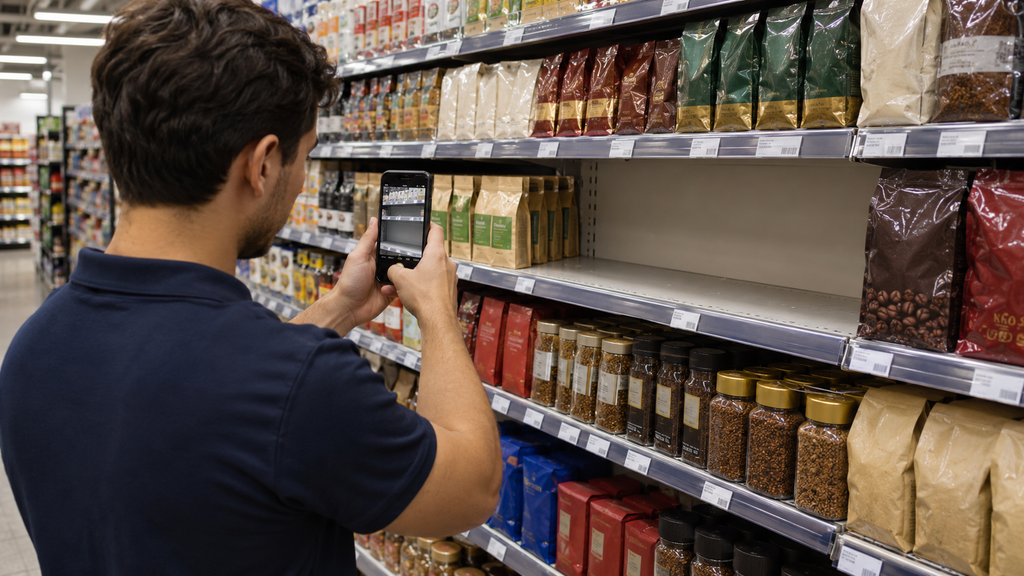
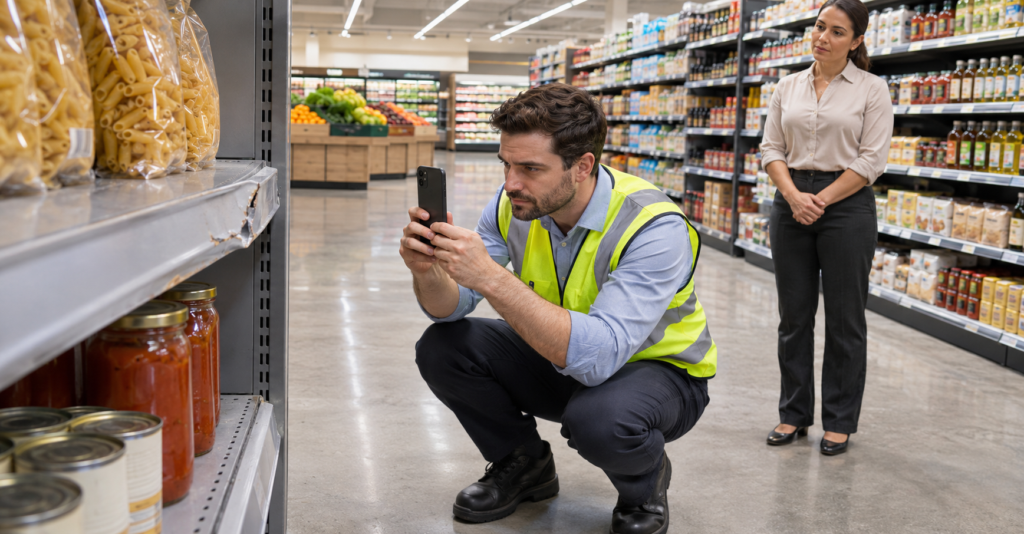
That flexibility is why mobile field audit methods are gaining ground with retailers who need coverage without the robot price tag. The smartest deployments match the detection method to the store format, the audit frequency, and the specific gaps that cost the most money. Retail shelf management AI is only as good as the data it receives. And the data is only as good as the hardware collecting it.
Once you’ve chosen the right detection setup, the obvious next question is whether any of this actually moves the revenue needle.
4 Essential Retail KPIs AI Shelf Monitoring Can Support
AI shelf monitoring becomes useful when shelf observations translate into measurable results and clear actions. These four KPIs connect product availability and placement with the work needed to correct issues.
1. On-Shelf Availability (OSA)
On-shelf availability measures whether required products are physically present on the shelf when checked. A product recorded in store inventory may still be unavailable to shoppers if it remains in the stockroom.
Calculation:
On-shelf availability (%) = Available required SKUs ÷ Total required SKUs checked × 100
If 95 of 100 required SKUs are available, OSA is 95%.
Data source: Shelf images analyzed against the applicable product assortment. Record the capture time and distinguish unavailable products from products the system could not assess.
Action: Check whether missing products are available in the stockroom. Assign replenishment where possible; otherwise, investigate inventory discrepancies or supply constraints.
2. Planogram Compliance
Planogram compliance measures how closely observed shelf conditions match the approved layout. Checks may cover product position, sequence, and facing counts.
Calculation:
Planogram compliance (%) = Passed applicable checks ÷ Total applicable checks × 100
If 72 of 80 applicable checks pass, compliance is 90%. Define the checks consistently so scores remain comparable.
Data source: Shelf images, product identification results, and the correct planogram version for the store and fixture.
Action: Assign specific corrections, such as moving a misplaced SKU or restoring its facing count. Request updated evidence to verify completion.
3. Share of Shelf
Share of shelf measures the proportion of a defined category’s shelf space occupied by a brand. It helps teams compare actual placement with an agreed allocation.
Calculation using facings:
Share of shelf (%) = Brand facings ÷ Total category facings × 100
A brand occupying 12 of 40 category facings has a 30% share of shelf.
Data source: Facing counts from shelf images covering the defined category. If measuring linear shelf width instead, use that method consistently; different package widths can produce different results.
Action: Compare the observed share with the agreed target. Investigate whether a gap reflects missing stock, incorrect placement, or an approved assortment change before requesting a correction.
4. Corrective Action Resolution Time
Corrective action resolution time measures how long a recorded shelf issue takes to reach verified correction. This KPI requires task and closure records alongside image analysis.
Calculation:
Average resolution time = Total elapsed time from issue creation to verified closure ÷ Number of verified closed issues
If three issues take two, four, and six hours to resolve, average resolution time is four hours.
Data source: Issue creation timestamps, task assignments, and verified closure records, including follow-up photos where appropriate.
Action: Review delays by issue type and store. Separate tasks awaiting staff action from those blocked by unavailable stock, and monitor overdue open issues alongside completed ones.
Keep Measurement Coverage Visible
Report these KPIs with their capture frequency and coverage. Mobile photos represent conditions during a visit; scheduled robot scans leave intervals between observations; fixed cameras cover only their configured views.
Do not treat an unobserved shelf as compliant or an uncertain product match as a confirmed stockout. Making those limits visible helps teams act on the results with appropriate confidence.
Does AI Shelf Monitoring Actually Deliver ROI?
You’ve locked in the right hardware. Now the fair question every skeptic asks: does any of this actually pay off? The short answer is yes, but the more useful answer explains why the payoff is bigger than most retailers expect.
AI shelf monitoring doesn’t just catch empty shelves faster. It closes a financial blind spot that retailers have quietly accepted for decades. When a stockout goes undetected for hours, that lost sale never shows up anywhere obvious. Nothing flags it, so there’s no pressure to fix the system that let it happen.
A Pygmalios analysis found that a 4% boost in on-shelf availability recovers sales that would otherwise vanish without a trace. That figure sounds modest until you multiply it across thousands of SKUs and hundreds of store locations every single week.
📊 By the Numbers
A 4% boost in on-shelf availability, the kind AI-powered auditing delivers, recovers sales that would otherwise disappear without a trace., Pygmalios
Planogram Compliance: Automated Enforcement vs. Reality
A planogram is the blueprint for how products sit on a shelf. It defines which item goes where, how many face forward, and how much space each gets. In theory, store teams follow it. In practice, manual checks happen too rarely to catch every drift, and small violations quietly add up into real revenue loss.
On-shelf availability AI flags planogram breaks in real time, so a store manager gets an alert before a customer walks away empty-handed. Think of it like a spell-checker for your shelves. It doesn’t replace the person who stocks the product, but it catches errors the human eye misses at scale. Understanding digital shelf planogram basics is a smart first step before rolling out any automated enforcement system.
Where FieldPie Fits Into the Execution Gap
The gap between a detected problem and a fixed shelf is where most retail execution tools fall apart. Retail shelf management AI is only as valuable as the workflow it triggers. Who gets the alert, how fast they act, and whether the fix gets confirmed all determine whether the system earns its keep.
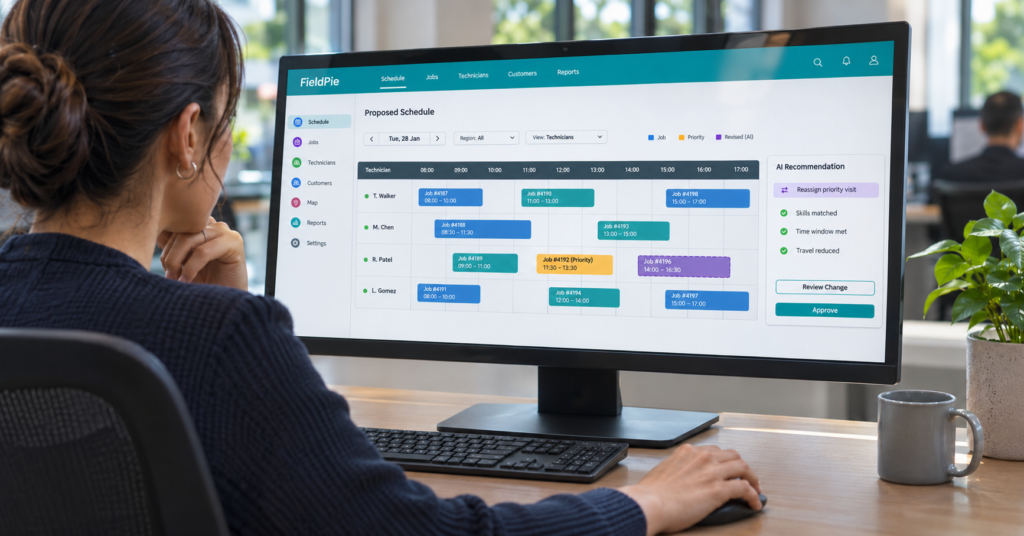
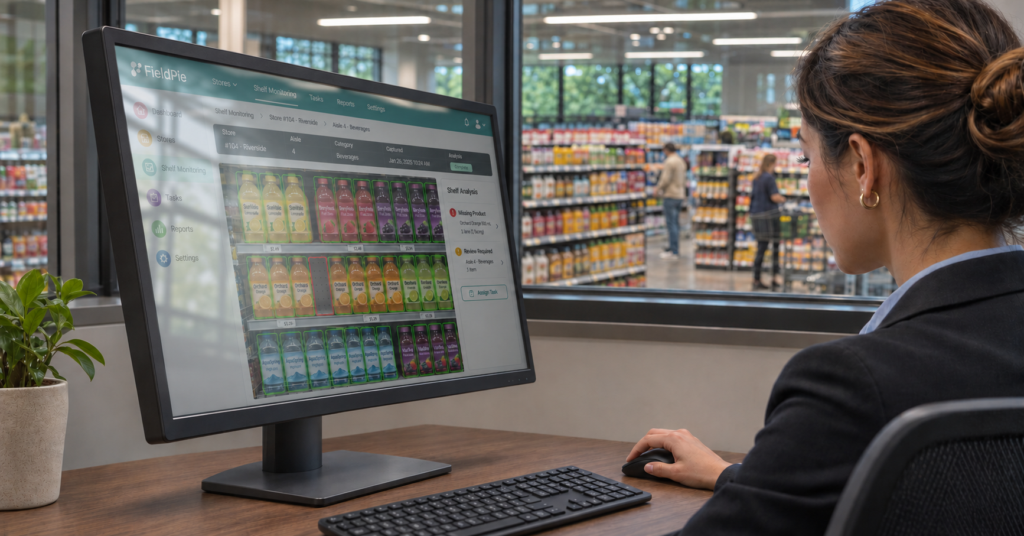
FieldPie connects computer vision shelf monitoring data directly to field teams. It turns a detected gap into a task with a deadline and a confirmation photo. That closed loop is what separates a system that generates reports from one that actually moves product back onto shelves.
Getting ROI right at one location is straightforward. The real test is whether your process holds up when you push it across fifty stores at once.
Scale It Without Breaking It
Surfacing that hidden financial blind spot is only half the battle. Scaling AI shelf monitoring across dozens or hundreds of stores is where most retail programs quietly fall apart. The technology rarely fails, the organization around it just isn’t ready.
Say your team runs a successful pilot in three stores. Alerts fire on time, restocking improves, and everyone is impressed. Then you roll out to fifty stores and the data floods in faster than anyone can act on it. Integrations break, and field reps don’t know whose job it is to respond.
ERP and Inventory System Integration Pitfalls
Most retailers assume their ERP will simply “talk to” a new AI layer. In practice, legacy inventory systems use data formats and update cycles that shelf label accuracy tools and AI platforms were never built around. Alerts arrive with no matching inventory record to act on.
The fix takes real groundwork. Map every data field before you sign a vendor contract. Confirm update frequency on both sides, then run a live sync test with real store data before you commit to a wider rollout. Skipping this step is the single most common reason a working pilot becomes a broken deployment at scale.
One Pilot Store Is Not Proof of Scale
A single pilot controls for too many variables: a motivated store manager, a clean planogram, a tech-savvy team. On-shelf availability AI behaves very differently across store formats, traffic patterns, and staff turnover rates. What works in one location can collapse in ten.
FieldPie addresses this directly by letting operations teams schedule, audit, and track field activity across all locations from one platform. Managers see compliance gaps in real time rather than finding them weeks later in a spreadsheet.
Fewer than 22% of global retail chains with revenues above $500 million have deployed Dataintelo-tracked AI shelf monitoring at full-store scale, which means most retailers are still working through exactly this problem.
📊 By the Numbers
Fewer than 22% of global retail chains with annual revenues exceeding $500 million have deployed AI shelf monitoring at full-store scale, per Dataintelo.
Once you understand why scaling breaks down, the path forward gets clearer. So does a harder question: has your organization actually fixed the structural problem that made stockouts invisible in the first place?
Conclusion
The real lesson here isn’t that your pilot failed or that scaling got messy. Retailers have spent decades building organizations that were never designed to act on shelf data quickly. AI shelf monitoring exposes that structural gap more clearly than any audit ever has.
Picture your team deploying computer vision in ten stores where the alerts fire perfectly. Nobody owns the fix, and the stockout sits for six hours anyway. The technology worked. The organization didn’t.
Fixing that gap means pairing shelf stock turnover insights with clear ownership at every level. The right person needs to act the moment on-shelf availability AI flags a problem. Retail shelf management AI only delivers its full value when someone is accountable for closing the loop. That accountability must connect detection to replenishment, every single time.
Most retail operations teams still chase stockouts reactively, losing revenue on gaps that AI-powered shelf intelligence could surface in minutes. FieldPie connects field audit data directly to the teams responsible for restocking. That means alerts trigger action instead of sitting in a dashboard. FieldPie sells an AI-powered field operations platform. It helps businesses schedule, track, audit, and manage field teams across retail, home services, and distribution.