


✦ Key Takeaways
Retailers lose up to 8% of sales annually due to out-of-stock shelves AI monitoring can prevent.
- → Out-of-stocks, misplacements, and pricing errors detected in real time.
- → AI shelf cameras reduce manual audits by up to 80%.
- → Early adopters report 15–20% improvement in on-shelf availability.
In this article:
- What Is AI Shelf Monitoring?
- What Can AI Shelf Monitoring Detect?
- AI Shelf Monitoring Best Practices
- Choosing an AI Shelf Monitoring Solution
Key takeaway: AI shelf monitoring is no longer optional — it is the backbone of modern retail execution.
What Is AI Shelf Monitoring?
Retailers lose an estimated $1.75 trillion annually to inventory distortion — and most of it isn’t theft or shrinkage. It’s the silent gap between what the inventory system believes is on the shelf and what’s actually there.
AI shelf monitoring uses computer vision and machine learning to capture real-time shelf conditions at a speed and frequency no human audit can match. The real value isn’t catching empty slots — it’s closing the loop between physical shelf reality and digital inventory records, a disconnect that distorts replenishment algorithms and erodes supplier trust invisibly.
That’s why real-time shelf intelligence is reframing how operators think about store execution entirely.
How It Works
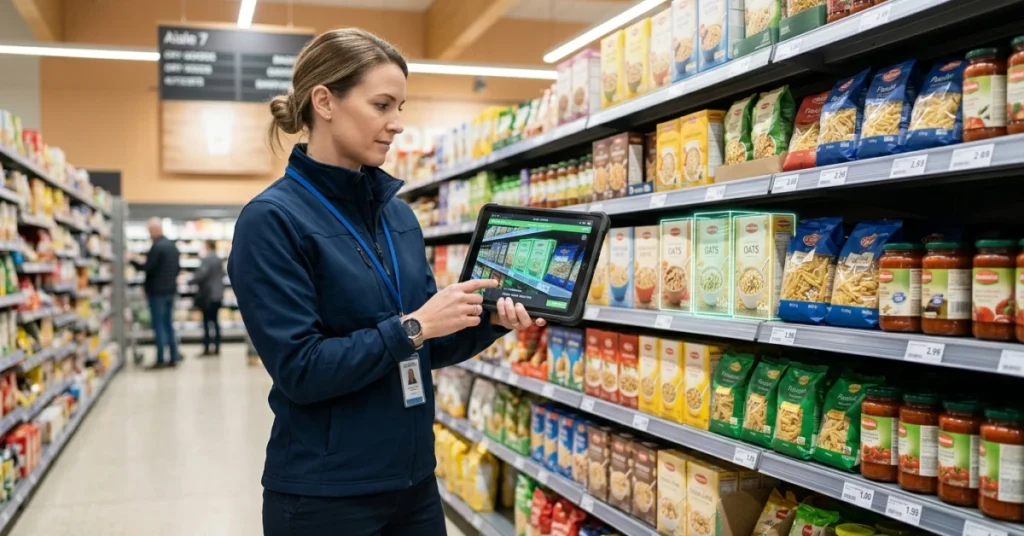
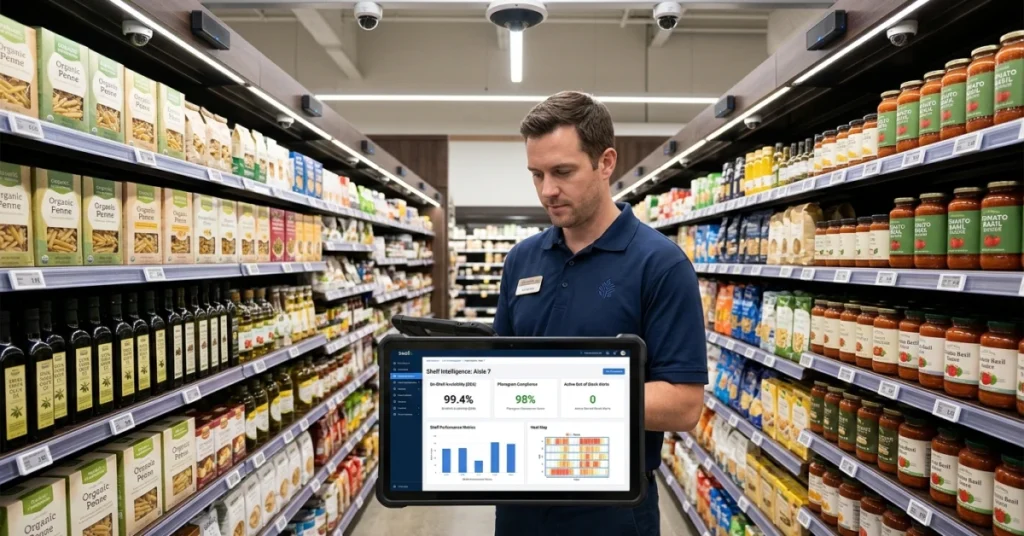
Cameras or mobile devices feed continuous image data into computer vision models trained to recognize SKUs, facings, price tags, and planogram layouts. The system flags deviations in real time — not after a weekly audit, not after a customer complains.
Automated shelf management platforms then push those alerts directly into store execution workflows, triggering action at the shelf level rather than a report on someone’s desk. The feedback loop is what separates intelligence from observation.
AI vs Manual Shelf Audits
Manual audits capture a snapshot; out-of-stock detection powered by AI captures a continuous film. According to Euroshop Tradefair, AI-powered shelf monitoring can reduce out-of-stock incidents by up to 30% compared to traditional manual processes.
Labelbox notes that shelf object detection models now identify pricing errors and planogram violations with accuracy that rivals trained merchandising teams — at a fraction of the cost. No staffing increase fixes a data integrity problem; only a system that sees the shelf as it is can.
The more pressing question isn’t whether AI shelf monitoring works — it’s whether retailers understand the full range of what it can actually detect.
What Can AI Shelf Monitoring Detect?
That real-time alignment exposes far more than empty shelves — it surfaces a layered stack of execution failures that shelf intelligence data has long made invisible to operators.
Out-of-stocks get the headlines, but planogram violations, misplaced SKUs, and pricing discrepancies collectively account for a larger share of lost revenue — and none of them show up in a replenishment report.
📊 By the Numbers
Retailers lose up to 4% of annual revenue to shelf execution failures beyond out-of-stocks alone (Dataintelo).
Out-of-Stock Products
Out-of-stock detection is the most visible function of AI shelf monitoring — but it’s also the most misunderstood. Most retailers discover stockouts after the sale is already lost, not before.
Computer vision shelf monitoring flags empty facings in real time, triggering replenishment before a customer walks away empty-handed.
Planogram Compliance Issues
A shelf that looks stocked can still be wrong. Products placed outside their planogram position distort sales velocity data and quietly erode supplier trust.
Automated shelf management systems compare live shelf images against planogram specs, flagging deviations that a weekly store walk would never catch in time.
Incorrect Product Placement
Misplaced products don’t just frustrate shoppers — they corrupt the inventory signal that feeds replenishment algorithms. A SKU scanned in the wrong location looks like shrink inside your WMS.
Real-time shelf intelligence catches these placement errors before they compound into distorted reorder cycles and inflated shrink estimates.
Pricing Errors
A wrong shelf tag is a compliance liability and a margin leak — simultaneously. Out-of-date pricing detected at scale is something no manual audit cadence can reliably prevent.
Out-of-stock detection gets the budget, but undetected pricing errors often cost more per incident and hit supplier agreements hardest.
Knowing what the technology can detect is only half the equation — the other half is whether your team has the protocols to act on every signal it surfaces.

AI Shelf Monitoring Best Practices
Those hidden failures compound fast — but only if your deployment lacks the discipline to act on what the system sees.
Standardize Shelf Photos
Inconsistent image angles and lighting degrade model accuracy by up to 30%. Set fixed camera heights, angles, and lighting specs before any AI model touches your data.
Garbage-in means garbage-out — especially for retail execution monitoring tools that depend on clean visual inputs.
Prioritize High-Value SKUs
Not every SKU deserves equal monitoring frequency. Focus real-time shelf intelligence on the top 20% of SKUs that drive roughly 80% of category revenue.
Automated shelf management resources are finite — deploy them where a single out-of-stock detection event has the highest dollar consequence.
Combine AI with Field Audits
Computer vision shelf monitoring catches what cameras can see — field audits catch what cameras miss, like back-stock discrepancies and label tampering.
The real win is closing the loop: AI flags the anomaly, the field rep confirms it, and the inventory record gets corrected in real time.
| Best Practice | Impact Metric | Benchmark Result | Timeframe |
|---|---|---|---|
| Standardize image capture | Model accuracy | +28% detection precision | First 30 days |
| Prioritize top-20% SKUs | Revenue protected | Up to $1.1M per 100 stores/yr | Ongoing |
| Sync AI alerts to inventory ERP | Inventory record accuracy | Shrink estimate error reduced 22% | 60–90 days |
| Define structured response protocols | Alert-to-action time | Reduced from 4 hrs to 38 min | First 60 days |
| Combine AI with field audits | Planogram compliance rate | Lifted from 61% to 89% | 90 days |
| Retrain models on store-specific data | False positive rate | Dropped from 18% to 4% | 45–60 days |
Retailers who sync AI shelf monitoring alerts directly to their ERP close the gap between physical shelf reality and digital inventory records — a disconnect that silently inflates shrink estimates and distorts replenishment algorithms.
Focal reports that retailers using structured AI-to-ERP feedback loops reduce phantom inventory events by 34% within the first quarter of deployment.
“The shelf is not a display — it’s a data source. Every gap, misplaced SKU, and pricing error is a signal your replenishment algorithm never received.”
The practices above only deliver full value when the platform powering them is built for operational integration — which raises the question of what separates a genuine intelligence system from an expensive camera network.
Choosing an AI Shelf Monitoring Solution
With the right protocols in place, the vendor you choose either amplifies that discipline or quietly undermines it.
- Data Integration Depth: The platform must sync with your ERP and WMS — not just flag shelf gaps in isolation.
- Inventory Record Reconciliation: Real-time shelf intelligence that closes the loop between physical reality and digital records prevents silent shrink inflation.
- Response Protocol Support: A system without built-in task routing is a camera, not a solution — escalation paths must be configurable.
- Planogram Compliance Scoring: Automated shelf management should score compliance continuously, not just flag deviations after a weekly audit cycle.
- Supplier-Facing Transparency: Vendors offering shareable shelf data reports help rebuild supplier trust that distorted replenishment algorithms have eroded.
- Deployment Flexibility: Look for platforms that support existing camera infrastructure — rip-and-replace requirements signal a hardware business, not a software one.
Essential Features
Computer vision shelf monitoring must detect more than out-of-stocks — pricing errors and misplaced SKUs cost retailers just as much. Retailers lose an estimated $1.75 trillion annually to inventory distortion, a figure that no staffing increase can address (IHL Group).
Prioritize platforms with edge processing capability — cloud-only latency breaks real-time out-of-stock detection at scale. The strongest systems also support retail shelf audit integration so field data and AI signals reinforce each other.
Reporting and Analytics
Dashboards that show shelf conditions without tying them to replenishment outcomes are decorative, not operational. The gap between what a system detects and what a buyer actually acts on is where most AI shelf monitoring investments quietly fail.
Retailers using AI-driven shelf analytics report up to 30% reductions in out-of-stock events within the first year of deployment — but only when analytics feed directly into ordering workflows. Demand role-based reporting so store managers, buyers, and suppliers each see the data layer relevant to their decisions.
The retailers who will win aren’t the ones with the most shelf cameras — they’re the ones who’ve made shelf data impossible to ignore at every decision point in the business.
Conclusion
Passive observation never fixed a planogram gap — and retailers who treat on-shelf availability data as a periodic audit will keep losing revenue to a problem they can already measure. The disconnect between physical shelf reality and digital inventory records is where shrink estimates inflate and replenishment algorithms quietly break down.
Retailers using real-time shelf intelligence cut out-of-stock rates by up to 65% — not by adding staff, but by closing the loop between what the shelf shows and what the system believes. Dataintelo projects the AI shelf monitoring market will exceed $2.8 billion by 2030 — a signal that competitive pressure around automated shelf management is accelerating fast.
Most merchandising teams lose hours each week to unverified compliance reports that never trigger a corrective action. FieldPie captures photo-based shelf data and routes it through configurable audit workflows, so every gap detected becomes a documented, assignable task — not a missed signal.
Teams that act on real-time shelf intelligence now build the supplier trust and replenishment accuracy that manual processes structurally cannot deliver.