


✦ Key Takeaways
Retailers lose up to 25% of potential sales when store shelves don’t match the approved product assortment plan.
→ Non-compliant shelves directly cut revenue and damage brand trust.
→ Audits reveal gaps between headquarters planograms and actual store execution.
→ A simple compliance score formula turns shelf chaos into actionable data.
In this article:
What Is Assortment Compliance in Retail?
How to Calculate Assortment Compliance
How to Conduct an Assortment Compliance Audit
Why Does Assortment Compliance Fail?
Key takeaway: Fixing assortment compliance is the fastest shelf-level lever retailers have to recover lost sales.
What Is Assortment Compliance in Retail?
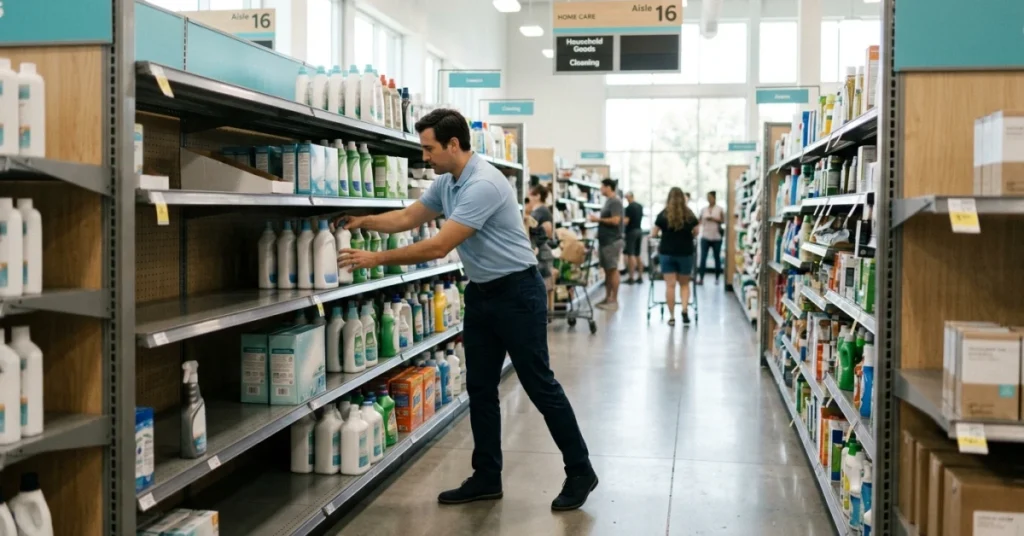
Think about the last time you went to a store for a specific product. It simply wasn’t there. That gap between what the store planned to carry and what actually sat on the shelf costs retailers billions every year.
Assortment compliance is the metric that measures exactly that gap.
In plain terms, assortment compliance asks: does every store carry every product it’s supposed to carry? Retailers lose an average of 4% of annual revenue to out-of-stocks and wrong-product situations (Fieldpie). Most of those losses were preventable.
The problem feels like a store problem. It almost never is.
How Assortment Compliance Works at the SKU and Location Levels
Every product a retailer sells has a SKU — a unique code that identifies it. Assortment compliance tracks whether each required SKU is present and active at each store location.
A retailer might have 500 stores, each with a slightly different approved product list. One missing SKU across 200 locations is a compliance failure — and it adds up fast.
Assortment Compliance vs. Planogram Compliance vs. On-Shelf Availability
These three terms get mixed up constantly — but they measure different things. Assortment compliance asks what products should be there.
Planogram compliance asks where and how those products should be placed. On-shelf availability asks whether the product is actually in stock right now.
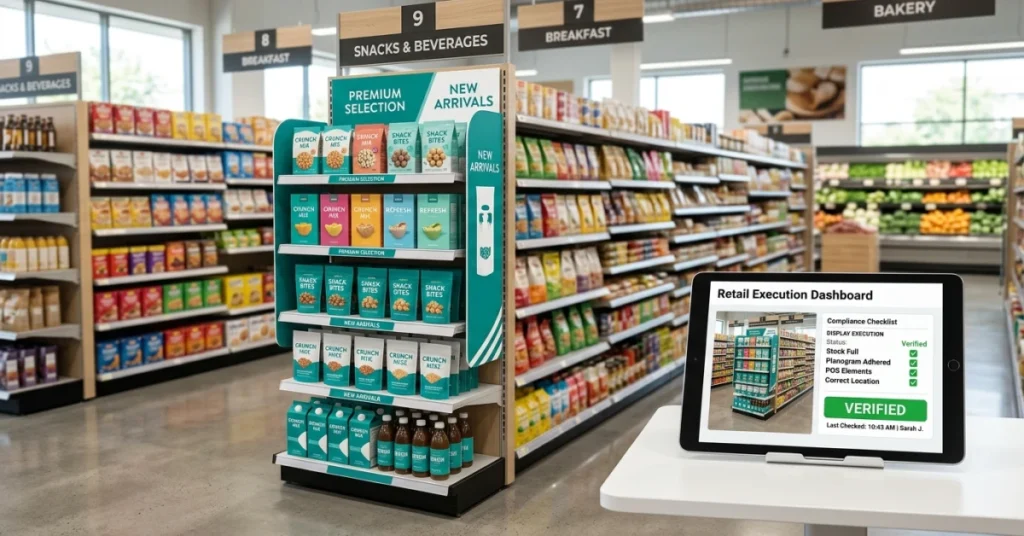
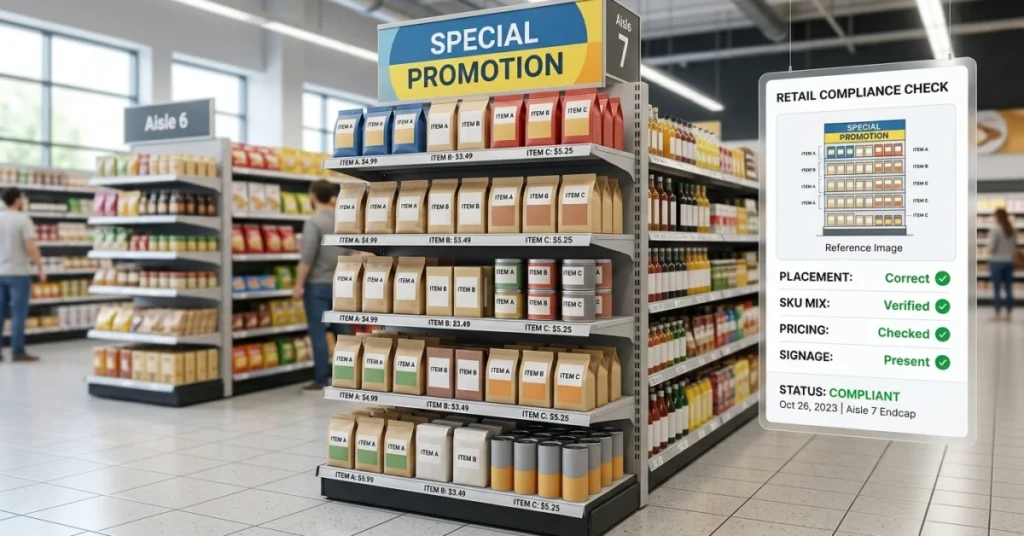
You can pass a retail display compliance check and still fail assortment compliance. A perfectly arranged shelf with the wrong products is still a failure.
How Authorized Assortments and Must-Stock Lists Define Compliance
Every retailer keeps an authorized assortment — a master list of approved products for each store format or region. Must-stock lists are the non-negotiable core of that assortment. They tie directly to vendor agreements and promotional commitments.
According to Centricsoftware, poor assortment decisions rank among the top five drivers of retail margin loss. Most start with a miscommunication between the buyer and the store — not a failure on the sales floor.
Before you can fix compliance, you need to measure it. Most retailers have never actually run that number.
How to Calculate Assortment Compliance
Closing that gap starts with one simple number — and most retailers never calculate it. The formula is straightforward: divide the number of compliant SKUs by the total number of required SKUs, then multiply by 100 to get a percentage.
Retailers who skip this step are guessing. Studies show stores miss their planned assortment by 20–30% on average — a gap that quietly kills sales and customer trust every single day.
Assortment Compliance Formula and Calculation Example
The core formula is: (Compliant SKUs ÷ Required SKUs) × 100 = Compliance Rate %. If a store must carry 80 SKUs but only stocks 60 correctly, its compliance rate is 75%.
That 75% sounds passable. It is not — it means one in four planned products is missing or wrong.
Measuring Compliance Across Products, Categories, and Locations
One store score tells you almost nothing useful. You need scores broken down by category, region, and individual location to see where the real problems live.
A regional assortment strategy helps teams set location-specific benchmarks instead of chasing one blunt company-wide average that masks local failures.
Handling Unauthorized SKUs, Missing Products, and Assortment Exceptions
An unauthorized SKU — a product on the shelf that was never approved — counts against compliance just like a missing one does. Both distort the shelf and confuse shoppers.
Exceptions need a clear process: flag the SKU, trace it back to its source, and fix the upstream record — not just the shelf tag. Most exceptions start as a data error, not a store error (according to Infotech, data gaps in assortment planning affect over 60% of retail organizations).
Key KPIs for Tracking Assortment Compliance
Beyond the compliance rate, track these four numbers every cycle:
SKU compliance rate — the core percentage formula above
Planogram compliance rate — are products placed correctly, not just present?
Out-of-assortment rate — how many required SKUs are completely absent?
Unauthorized SKU rate — how many unapproved products are taking up shelf space?
Retail assortment compliance tracked through these KPIs gives teams a clear signal — not just a score. Research published by Jbrmr confirms that retailers using structured KPI frameworks catch compliance failures significantly faster than those relying on periodic manual checks alone.
📊 By the Numbers
Stores miss their planned assortment by 20–30% on average — a gap most teams never formally measure.
Calculating the number is the easy part. The harder question is what you find when you actually go look — and that is exactly what an assortment compliance audit forces you to confront.

How to Conduct an Assortment Compliance Audit
Once you know your compliance score, the next step is finding exactly where the gaps live — and that means running an audit. Most retailers skip this step and trust vendor reports instead.
That blind faith is expensive.
Structured shelf reviews expose what spreadsheets hide: wrong facings, swapped SKUs, and empty slots that no system flagged. Over 70% of out-of-stock events go undetected for more than 24 hours (according to Edited), which means lost sales pile up silently before anyone reacts.
📊 By the Numbers
Retailers using structured review processes catch execution gaps 3x faster than those relying on vendor self-reporting alone.
Build an Accurate, Location-Specific Assortment Checklist
A generic checklist fails fast. Each store location carries a different authorized product list based on format, region, and customer demand.
Pull the approved SKU list for that specific store before you walk in. Without it, you are measuring the wrong target from the start.
Compare Authorized Product Lists Against Actual Shelf Conditions
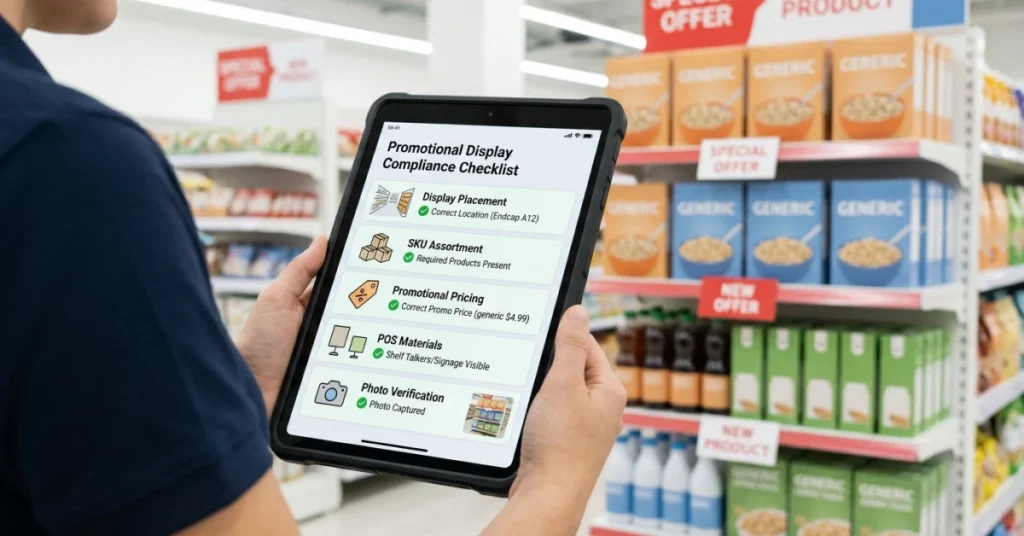
Walk the aisle with the authorized list in hand and check every required SKU against what is actually on the shelf. This is where planogram execution breaks down in plain sight.
A product may be in the store but placed in the wrong bay, at the wrong height, or with the wrong facing count. All three are merchandising failures — even if the item technically “exists” in the store.
Verify Missing SKUs Using Barcode Scanning and Photo Evidence
Never rely on memory or handwritten notes to confirm a missing product. Barcode scanning ties each gap directly to a specific SKU, timestamp, and location — no guesswork.
Photos add proof that a store team or vendor cannot dispute. Good field audit documentation turns a subjective observation into an actionable record.
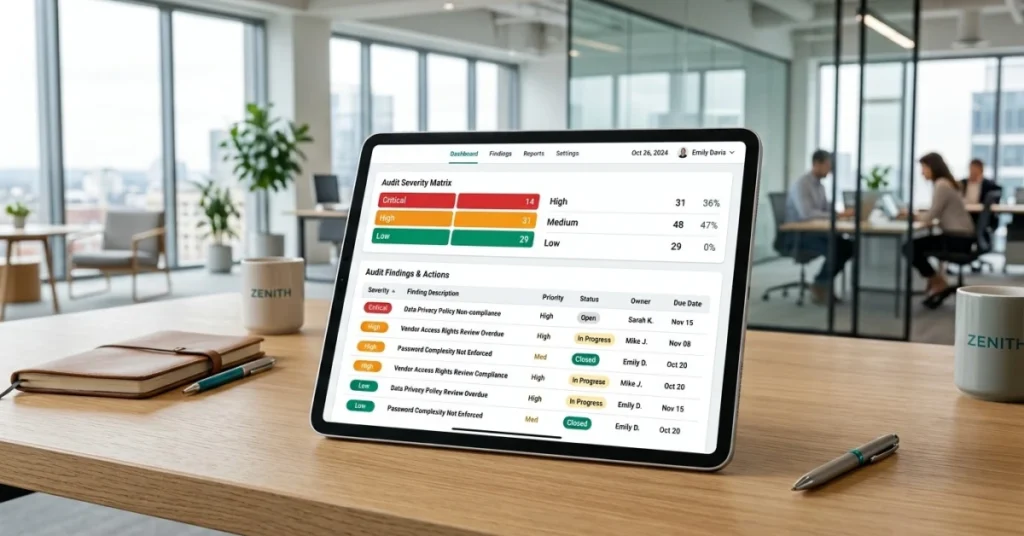
Record Compliance Gaps and Assign Corrective Actions
Finding a gap means nothing without a fix attached. Log every non-compliant SKU with a clear owner, a deadline, and a required action — restock, reposition, or escalate.
The Dataintelo assortment planning market report shows that structured corrective workflows cut repeat execution failures by nearly 40%. Closing the loop is what separates a useful review from a forgotten report.
But here is the uncomfortable truth most reviews surface: the gaps you find on the shelf were almost never created on the shelf — which raises the question of where merchandising execution actually breaks down.
Why Does Assortment Compliance Fail?
Those audit gaps did not appear overnight. They were built into the system long before a store associate touched a single product.
Most assortment compliance failures start upstream. They hide in bad data, misaligned purchase orders, and vendor agreements nobody double-checked.
Retailers lose an estimated 3–5% of annual revenue to shelf-level compliance gaps (Fieldpie). Yet most teams chase store behavior instead of fixing the broken information flow that caused the problem.
No checklist fixes a planogram that was wrong from day one.
Unauthorized Product Substitutions and Incorrect Product Listings
A vendor ships a slightly different SKU — same brand, wrong size — and the system logs it as fulfilled. The shelf looks stocked, but retail assortment compliance is already broken.
Store teams rarely catch this because the substitution looks close enough. The damage only shows up later, in lost sales and confused shoppers.
Distribution Gaps, Replenishment Delays, and Phantom Inventory
Phantom inventory is one of the most silent killers in retail. The system shows stock on hand, but the shelf is empty.
A product listed as “in stock” that shoppers cannot find is a compliance failure and a lost sale at once. Replenishment delays make this worse fast.
One missed delivery can trigger a cascade of empty facings across dozens of locations.
Outdated Assortment Lists and Location-Level Variations
A planogram built on last quarter’s data is already wrong. SKU compliance breaks the moment a product is dropped, reformulated, or regionally swapped — and nobody updates the master list.
Location-level variations make this worse. A store in Phoenix and a store in Boston may need entirely different assortments, but many brands push one plan to all locations.
Poor Communication Between Retailers, Brands, and Merchandising Teams
This is the root cause most teams refuse to name. When a brand updates a product line but does not tell the retailer’s planogram team, the shelf stays wrong for weeks — sometimes months.
Planogram compliance and promotional display execution both depend on clean, real-time information moving between every party. When that flow breaks, the store team gets blamed for a failure that started in a spreadsheet three levels up.
Over 70% of out-of-stock events trace back to upstream ordering and forecasting errors — not store-level mistakes (according to Moz). Fixing assortment compliance means fixing the data and communication systems that feed the shelf.
📊 By the Numbers
Over 70% of out-of-stock events stem from upstream ordering errors — not store-level execution failures.
Conclusion
Fixing upstream data failures is the real lever. Stores can only execute what the system tells them to execute.
Retailers who run assortment compliance audits as a continuous feedback loop close the gap fast. A quarterly checkbox never gets the job done.
Compliance rates drop sharply when planograms, purchase orders, and vendor data clash. NielsenIQ found that optimized assortment strategies can lift sales by up to 20%. That only happens when accurate data drives the decisions.
Infotech research confirms most assortment planning failures trace back to broken information flow. Poor store behavior is rarely the cause.
Most retailers lose sales because SKU compliance breaks at the source. The shelf is not the problem. Fix the information flow upstream. Then your store teams have something accurate to work from.
FieldPie captures real-time photo evidence, custom audit forms, and field data the moment a rep visits a store. Gaps surface in hours, not weeks — start your first audit today.