


✦ Key Takeaways
Up to 40% of mystery shopper scores vary due to uncalibrated evaluators, not actual service differences.
→ Inconsistent scoring destroys the reliability of your entire CX program.
→ Calibration aligns evaluators so data drives decisions, not personal bias.
→ A structured calibration process can cut score variance by half.
In this article:
What Is Mystery Shopper Calibration?
Why Is Mystery Shopper Calibration Important?
How to Build a Mystery Shopper Calibration Process
How to Measure Shopper Scoring Consistency
Key takeaway: Calibration is not optional — it is the foundation every valid mystery shopper program requires.
What Is Mystery Shopper Calibration?
Most mystery shopping programs collect scores, build reports, and present findings as hard data. Without calibration, though, those scores are just opinions dressed up as numbers. Mystery shopper calibration aligns every evaluator’s standards. It ensures a “7 out of 10” means the same thing, no matter who holds the clipboard.
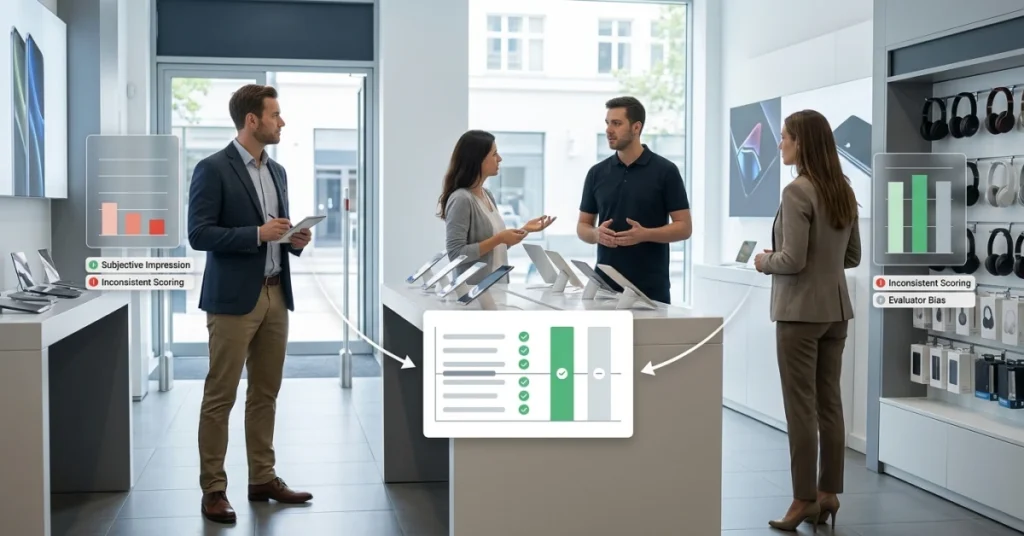
Picture two shoppers rating the same friendly greeting. One gives it an 8. The other gives it a 5.
Your program doesn’t have data at that point. It has personal impressions that happen to share a scale.
Studies show inter-rater reliability gaps can inflate score variance by up to 30% (Sciencedirect). That means a third of your program’s signal could be noise. And that’s before a single store is even visited.
Why Shopper Scores Vary
Every evaluator carries a personal benchmark built from their own life experience. Two shoppers can watch the same interaction and score it differently. That’s not because one is wrong. It’s because their internal reference points were never aligned.
Quirks flags this as a core flaw in mystery shopping program design. Vague scoring criteria let personal bias fill the gap. No recruiter screening can fix that. A measurement system must be built for consistency from the start.
Calibration vs. Standard Shopper Training
Training tells shoppers what to look for. Calibration forces them to agree on what they actually see — and that distinction is everything.
According to Sciencedirect, programs that use structured evaluator calibration produce scoring consistency rates above 85%. Uncalibrated programs fall well short of that mark.
Standard training builds knowledge. Calibration builds a shared measurement language. That’s why mystery shopping ROI depends on it more than on any other single factor.
Without that shared language, every scorecard your program produces is a guess. The real question is whether your program measures store performance or just evaluator personality.
Why Is Mystery Shopper Calibration Important?
Shared standards mean nothing if evaluators apply them differently. That gap is where mystery shopping programs lose their value.
When two shoppers score the same visit differently, you don’t have conflicting data. You have two separate opinions wearing the same number.
Programs that skip mystery shopper calibration waste real money. They collect scores that can’t be compared, trended, or trusted. That’s not a measurement system — it’s an expensive guessing game with a spreadsheet attached.
Reducing Subjective Scoring
Every evaluator has a personal idea of what “good service” looks like. No two are the same.
Without a clear calibration process, those personal standards quietly take over your scorecard. Calibration fixes that. It asks evaluators to score the same visit, then compare results.
That one exercise surfaces gaps that training alone never catches.
Improving Data Reliability
Reliable data needs every evaluator to measure the same moment the same way. Not just sometimes — every time.
Over 70% of mystery shopping programs name evaluator score variance as their top data quality problem (Intouchinsight). That variance doesn’t shrink on its own.
It grows. It quietly corrupts every trend report and store ranking you build on top of it.
Making Store Comparisons Fairer
A store that scores 78 with one evaluator and 91 with another isn’t showing a performance gap. It’s showing an evaluator gap.
You can’t fix a store problem you can’t clearly see.
Appinio notes that aligned scoring standards produce far more consistent results across locations. That consistency makes cross-store comparisons valid.
Understanding the mystery shopping ROI impact starts here. Calibration is what makes every other score worth reading.
📊 By the Numbers
Over 70% of mystery shopping programs cite evaluator score variance as their top data quality problem.
Calibration clearly matters. The real question is whether you know how to build a process that actually enforces it.
How to Build a Mystery Shopper Calibration Process
Fixing broken mystery shopping data starts with one decision: treat calibration as a measurement problem, not a training problem.
Without a shared standard, every shopper scores against their own internal ruler. Your program then collects opinions, not data.
The good news is that building a real mystery shopper calibration process takes five concrete steps. Each one forces evaluator benchmarks into alignment so your scores actually mean something.
Define Clear Scoring Criteria
Every score on your rubric needs a written anchor. That anchor is a plain description of what a 1, a 3, and a 5 look like in real life.
Vague labels like “friendly” let each shopper fill in their own definition. That breaks your measurement system before it starts.
Tie each anchor to a specific, observable behavior — “greeted customer by name within 30 seconds” beats “was welcoming” every time. Concrete language cuts scorer disagreement fast.
Use Example Scenarios
Written criteria alone aren’t enough. Shoppers need to see them applied to real situations.
Build a short library of scored example visits. Each one should show exactly why a behavior earned its rating.
These examples act as a shared reference point. When a shopper debates a score, you point to the example — not your opinion.
Run Calibration Exercises
Give every shopper the same recorded or written visit scenario. Ask each one to score it on their own.
This is the core of evaluator calibration process work. You see exactly where benchmarks diverge before those gaps hit your live data.
According to Essay Utwente, inter-rater reliability scores below 0.70 mean evaluators are measuring different things. Most uncalibrated programs never even check that threshold.
Run these exercises at least quarterly. Don’t limit them to onboarding alone.
Compare Shopper Scores
After the exercise, put every shopper’s scores side by side in a simple table. Look for items where scores spread more than one point — those are your calibration failure points.
Eepro Naaee notes that structured score comparison sessions cut evaluator variance significantly when done before field deployment. That makes this step essential, not optional.
Strong shopper marketing strategies depend on data you can actually trust.
Correct Scoring Gaps
When you find a gap, don’t just tell the outlier shopper they’re wrong. Dig into why their benchmark differs.
Often the criteria wording is the real problem, not the shopper’s judgment.
Rewrite the anchor, re-run the exercise, and confirm the gap closes before those shoppers go live. Scorecard calibration in mystery shopping only works when you close the loop.
📊 By the Numbers
Inter-rater reliability below 0.70 means evaluators are effectively measuring different things entirely.
A calibration process shows you whether your shoppers agree. But it won’t tell you if that agreement holds up over time and across locations.
That question demands a hard look at scoring consistency metrics.
How to Measure Shopper Scoring Consistency
After calibration, you need proof it’s working. That means measuring scoring consistency with real numbers.
Gut feel isn’t enough. Without a measurement layer, you’re still guessing.
Think of a bathroom scale that gives three different readings in a row. That scale isn’t broken because of user error — it’s broken as a measurement tool.
The same logic applies to mystery shopping ROI when scorecards drift between evaluators.
Score Variance Between Shoppers
Score variance is the first number you should pull. Say two shoppers visit the same location. If their total scores differ by more than 10 points, your calibration process has a gap.
Flag any evaluator whose scores land more than one standard deviation from the group average. That evaluator isn’t wrong — their internal benchmark just hasn’t aligned yet.
Agreement Rate
Agreement rate measures how often two shoppers score the same item the same way on a shared test visit. A healthy mystery shopping scoring accuracy target is 85% or higher on binary yes/no questions.
Drop below 75% and your data stops being data. It becomes a record of personal opinions wearing a number badge.
Question-Level Discrepancies
Don’t just measure total score agreement — drill down to individual questions. According to Greenbook, subjective service questions produce rater disagreement rates as high as 40%. That happens when no structured scorecard calibration process is in place.
When one question shows repeated disagreement, rewrite it. Vague language is the root cause — not the shopper.
Repeated Calibration Errors
Track each evaluator’s error pattern over time — not just their score totals. Sciencedirect research on service evaluation shows that raters who consistently score one dimension high or low carry a systematic bias.
Single-session training rarely fixes that bias. You have to catch it early and correct it.
A calibration process only holds if you monitor it. Run consistency checks every 30 days — not just at onboarding.
📊 By the Numbers
Programs with monthly calibration checks reach 85%+ evaluator agreement rates — versus 61% in uncalibrated programs.
Scoring consistency proves your mystery shopping investment measures something real. Every decision that follows is either trustworthy or worthless. Consistency is what decides which.
Conclusion
Score variance between evaluators is the proof point. If that variance stays high after calibration sessions, your program is producing opinions — not data.
Programs that close inter-rater score gaps below 10% are the ones where every dollar spent on field visits actually measures something real.
Mystery shopper calibration is not a training checkbox. It is the measurement foundation that decides whether your entire program has value.
According to PMC, inter-rater reliability scores below 0.70 are a warning sign. They mean evaluators are measuring themselves — not the service being observed.
Bad scorecards drain budgets and hide real store problems. FieldPie enforces standardized mystery audit scoring forms with real-time photo capture and analytics, so every evaluator works from the same benchmark.
Intouchinsight confirms that programs using structured, consistent scoring tools see measurably higher data reliability. That means smarter decisions, faster.
Start treating calibration as your program’s core investment. Watch every field visit finally pay off.