



✦ Key Takeaways
Retailers lose up to 8% of sales annually due to poor shelf availability tracking failures.
- → Out-of-stocks cost global retailers $1 trillion yearly in lost revenue.
- → Real-time shelf tracking reduces stockouts by up to 30% immediately.
- → Human audits miss 52% of shelf gaps that automated systems catch.
In this article:
- What Is Retail Shelf Availability Tracking?
- Why Shelf Availability Matters in Retail
- How Retailers Track Shelf Availability
- What Causes Poor Shelf Availability?
- What KPIs Should Retailers Monitor?
Key takeaway: Retailers without automated shelf tracking are surrendering profit to competitors who have it.
What Is Retail Shelf Availability Tracking?
Retailers lose an estimated $1 trillion annually to out-of-stocks worldwide — yet most inventory systems show those items as fully stocked. That gap between system data and physical reality is the core problem this discipline exists to solve.
The fix isn’t smarter ordering upstream. It’s closing the data-reality gap at store level, where on-shelf availability monitoring catches what replenishment logic never sees.
Definition and Core Objectives
Retail shelf availability tracking is the systematic process of verifying that products are physically present and shoppable on the floor — not just logged as received in a warehouse. Its primary objective is detecting the gap between inventory records and store-floor reality before a shopper encounters an empty peg.
Out-of-stock detection, real-time inventory tracking, and on-shelf monitoring all serve one goal: making the last 50 feet of the supply chain as visible as the first 500 miles.
Manual vs Automated Shelf Tracking
Manual audits rely on store associates walking aisles on fixed schedules — a method that captures a snapshot, not a continuous signal. Automated shelf tracking uses computer vision, RFID, and IoT sensors to flag gaps in real time, shrinking detection windows from days to minutes.
The difference isn’t just speed — it’s structural. Traditional processes institutionalize the data-reality gap; automation closes it.
Key Data Captured During Shelf Monitoring
Effective on-shelf monitoring captures more than a binary in-stock or out-of-stock flag. It records facing counts, planogram compliance, phantom inventory incidents
Why Shelf Availability Matters in Retail
That gap between system data and physical reality costs retailers more than most realize. Out-of-stocks drain an estimated 4% of annual retail revenue — a silent, recurring leak that standard inventory systems are structurally blind to.
Most retailers treat this as a replenishment problem and fix it upstream. The real failure happens in the last 50 feet — where on-shelf availability monitoring reveals what ordering logic never can.
How Empty Shelves Impact Sales and Customer Loyalty
A shopper facing an empty shelf doesn’t wait — they switch brands or walk out entirely. Retail shelf availability tracking shows that nearly 70% of out-of-stock responses result in lost sales or a permanent brand switch.
That loyalty erosion compounds quietly over time. One missed purchase becomes a habit of buying elsewhere — and no replenishment algorithm catches that shift.
The Relationship Between Shelf Availability and OSA
On-shelf availability (OSA) is the measurable expression of what shelf availability monitoring actually tracks. It’s not a warehouse metric — it’s a store-execution metric, owned at the floor level.
Real-time inventory tracking closes the data-reality gap only when it captures what’s physically present, not what the system assumes is there. Out-of-stock detection without store-level execution data is just a lagging indicator of a problem already lost.
📊 By the Numbers
Retailers lose up to 4% of annual revenue directly to out-of-stock shelf conditions.
Understanding the scale of the problem is only half the equation — the sharper question is how retailers actually detect and act on shelf gaps before the sale is already gone.
How Retailers Track Shelf Availability
Closing that gap requires more than better ordering — it demands real-time visibility into what’s physically on the shelf, not what the system assumes is there. Retailers who treat on-shelf availability monitoring as a store-execution discipline consistently outperform those who rely on replenishment logic alone.
Out-of-stock detection has evolved from manual clipboard audits to sensor-driven, AI-assisted workflows — yet the core challenge remains the same. Retail shelf availability tracking only works when the data it captures reflects store reality, not system assumptions.
Mobile Store Audits and Field Reporting
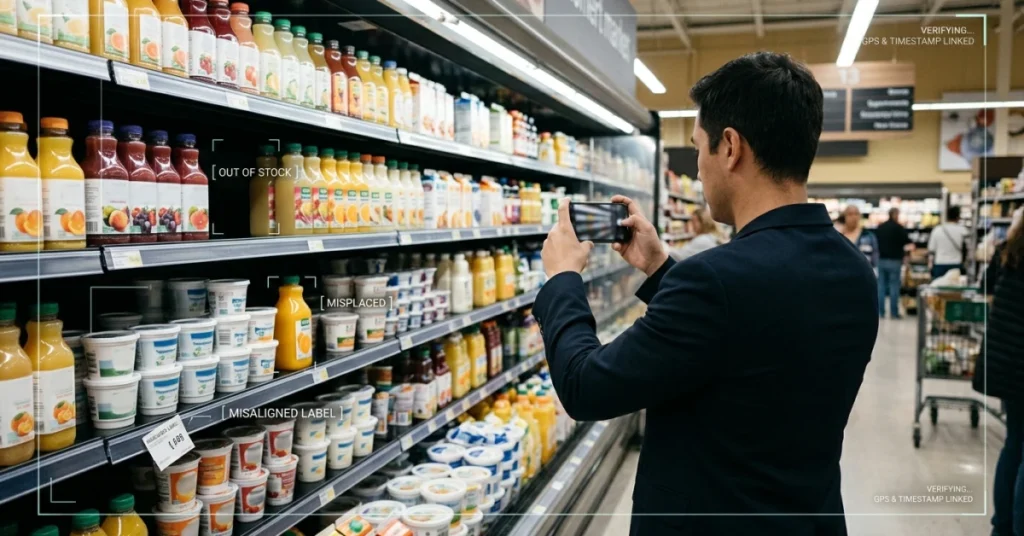
Field reps use mobile audit apps to photograph shelves, log gaps, and trigger replenishment tasks in real time. This method catches the execution failures that inventory systems never see — misplaced stock, facing issues, and phantom inventory.
Speed matters here. A gap identified at 10 a.m. and resolved by noon loses far less revenue than one discovered during an end-of-week report.
AI-Powered Image Recognition Technology
Image recognition software scans shelf photos and flags out-of-stocks, planogram violations, and misplaced SKUs within seconds. Retailers using this technology report up to 30% faster response times to shelf gaps compared to manual auditing methods.
The technology doesn’t replace human judgment — it eliminates the delay between a gap appearing and someone knowing about it. That latency is where revenue quietly disappears.
Real-Time Shelf Monitoring Dashboards
Centralized dashboards aggregate field audit data, POS signals, and sensor feeds into a single real-time inventory tracking view. Store managers and HQ teams can see shelf availability status by SKU, store, and region — simultaneously.
Promotional periods expose the biggest gaps. OSA rates can drop by as much as 13 percentage points during high-traffic events when replenishment cycles can’t keep pace.
📊 By the Numbers
OSA rates drop up to 13 percentage points during promotions — when shelf execution pressure peaks most.
Every tracking method above captures a symptom. The harder question is what’s actually causing those gaps to appear in the first place.
What Causes Poor Shelf Availability?
That data-reality gap doesn’t appear randomly — it has specific, repeatable causes that standard inventory systems are structurally designed to miss. Retailers lose an estimated $1 trillion annually to out-of-stocks and overstocks combined, yet most of that loss originates in the final 50 feet of the supply chain, not upstream ordering logic.
The disconnect between what a system believes is on the shelf and what a shopper actually finds is the core failure. Understanding on-shelf availability drivers reveals that execution breakdowns — not replenishment errors — are the dominant cause.
Out-of-Stock (OOS) Products
Out-of-stocks are rarely a buying failure — inventory often exists in the back room while the shelf sits empty. Over 70% of OOS events are caused by store-level execution gaps, not supplier shortfalls (IHL Group).
Real-time inventory tracking can’t fix what it can’t see. Without out-of-stock detection at the shelf level, replenishment signals fire too late — or never.
Poor Merchandising Execution
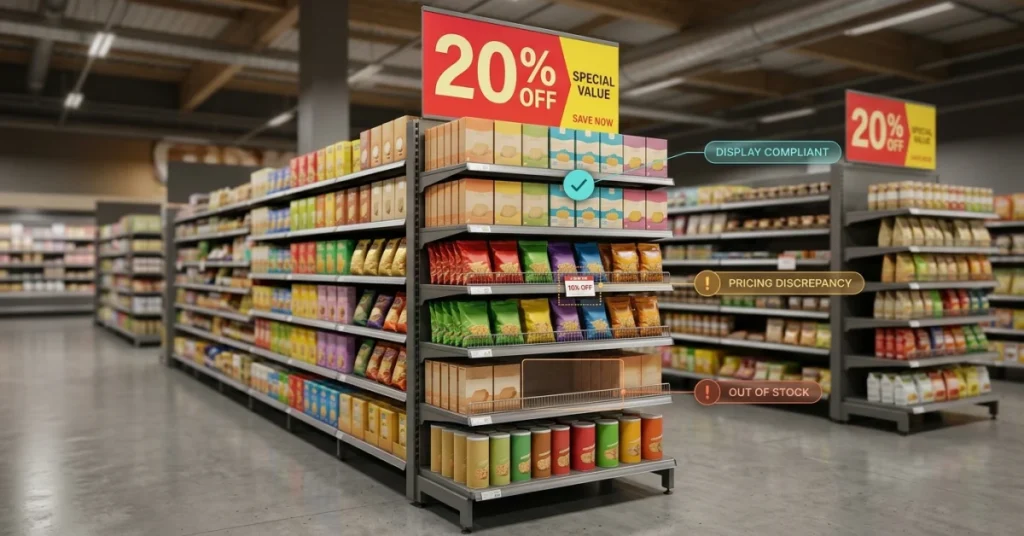
Misplaced products, collapsed facings, and planogram non-compliance create phantom availability — items the system counts as present but shoppers can’t find. Shelf availability monitoring catches these failures; periodic audits don’t.
A Survey analysis found that poor in-store execution accounts for a significant share of preventable lost sales — separate from any supply chain failure. Retail shelf availability tracking must extend to execution compliance, not just stock counts.
Lack of Real-Time Store Visibility
When store teams rely on overnight inventory reports, they’re managing yesterday’s shelf — not today’s. That latency is where OSA (on-shelf availability) erodes silently, sale by sale.
Visibility gaps compound every other cause on this list. Without real-time store visibility, neither OOS events nor execution failures trigger fast enough responses to protect revenue.
📊 By the Numbers
Over 70% of out-of-stock events stem from store-level execution failures — not supplier or ordering errors.
Knowing what breaks shelf availability is only half the equation — the other half is knowing exactly which numbers to watch to catch it early.

What KPIs Should Retailers Monitor?
Execution failures in the last 50 feet demand KPIs that expose the data-reality gap — not just flag low stock after the damage is done. Standard inventory metrics measure what systems believe; these KPIs measure what shoppers actually find.
Tracking the right shelf-level signals turns on-shelf availability data from a lagging report into a live diagnostic. Each KPI below targets a specific failure point in store-level execution.
On-Shelf Availability (OSA)
OSA measures the percentage of SKUs physically present and shoppable at any given moment. Retail shelf availability tracking that targets OSA directly catches phantom inventory before it costs a sale.
An OSA rate below 95% is considered a performance threshold requiring immediate investigation. Even a 1% OSA drop translates to measurable revenue erosion across high-velocity SKUs.
Out-of-Stock (OOS) Rate
OOS rate quantifies how often a product is unavailable when a shopper reaches for it. This is the most direct measure of execution failure — not supply chain failure.
Research published by Sciencedirect confirms that over 70% of out-of-stock events originate in-store, not upstream. Out-of-stock detection at the store level is where intervention actually prevents lost sales.
Shelf Share and Planogram Compliance
Planogram compliance tracks whether products occupy the correct shelf position and facing count. Deviations directly suppress visibility and shopper conversion — even when inventory is technically in the store.
Real-time inventory tracking alone won’t catch a misplaced facing or a blocked shelf. Shelf availability monitoring must include compliance scoring to close the gap between stock records and physical reality.
Replenishment Response Time
This KPI measures the lag between an out-of-stock detection and the moment product returns to the shelf. FieldPie’s photo-based field reporting captures this gap in real time, giving managers an auditable execution trail — not just a timestamp.
A long response time exposes structural breakdowns in store communication and task accountability. Reducing it is the operational lever that converts good shelf availability monitoring into actual recovered revenue.
📊 By the Numbers
Over 70% of out-of-stock events originate from in-store execution failures, not upstream supply chain gaps.
These four KPIs don’t just score performance — they pinpoint exactly where the gap between system data and shelf reality opens up, making the case for a fundamentally different execution strategy impossible to ignore.
Conclusion
Those KPIs only deliver value when the data feeding them reflects store reality — not what the inventory system assumes is there. Out-of-stocks cost retailers up to 4% of annual sales, and most of that loss originates in the last 50 feet of the supply chain, not upstream ordering logic.
The data-reality gap — where systems report full shelves while shoppers find empty ones — is the core failure that shelf availability monitoring must close. Researchgate confirms that store-level execution failures — not replenishment errors — drive the majority of on-shelf availability (OSA) breakdowns.
Retailers still losing sales to out-of-stock detection failures need real-time inventory tracking at the shelf level, not better purchase orders. FieldPie captures photo-based shelf audits, customizable compliance forms, and live field reporting — closing the gap between what the system believes and what the shopper actually sees.
Teams that deploy this execution layer consistently improve retail shelf availability tracking outcomes and recover revenue that standard inventory tools never flag.