


✦ Key Takeaways
Retailers using planogram solutions see up to 15% higher sales per square foot than non-compliant competitors.
- → Non-compliance with planograms costs retailers millions in lost sales annually.
- → Automated planogram tools cut reset time by 30% or more.
- → Real-time compliance tracking catches shelf errors before customers notice them.
In this article:
- What Are Planogram Solutions?
- How Do Planogram Solutions Improve Retail Execution?
- How Does Planogram Compliance Work?
- Which Industries Use Planogram Solutions the Most?
- Which KPIs Should Retailers Track?
Key takeaway: Planogram solutions are the single most powerful lever retailers have for maximizing shelf profitability.
What Are Planogram Solutions?
Most retailers have planograms. Few have execution. The shelf diagram sitting in headquarters means nothing if no one knows it’s wrong until the weekly store audit.
Definition and Core Purpose
Planogram solutions are systems that translate shelf strategy into store-level reality — combining retail space planning tools with compliance tracking and real-time field visibility. They go far beyond layout diagrams; they close the gap between what headquarters planned and what shoppers actually see.
Optimized planogram compliance lifts category sales by up to 15% — but only when execution is verified, not assumed (Explorerresearch). According to Explorerresearch, most of that lift evaporates when shelf conditions go unchecked between store visits.
Why Retailers Use Planogram Solutions
The retail planogram solutions market is expanding rapidly because retailers are finally naming the real problem: information latency, not shelf design. By the time a compliance failure surfaces through traditional reporting, the revenue damage is already done.
Planogram optimization only delivers ROI when corrective action happens fast — which is why execution visibility, not shelf aesthetics, is the real competitive differentiator.
The question worth asking: how quickly does your current system tell you a shelf is wrong?
How Do Planogram Solutions Improve Retail Execution?
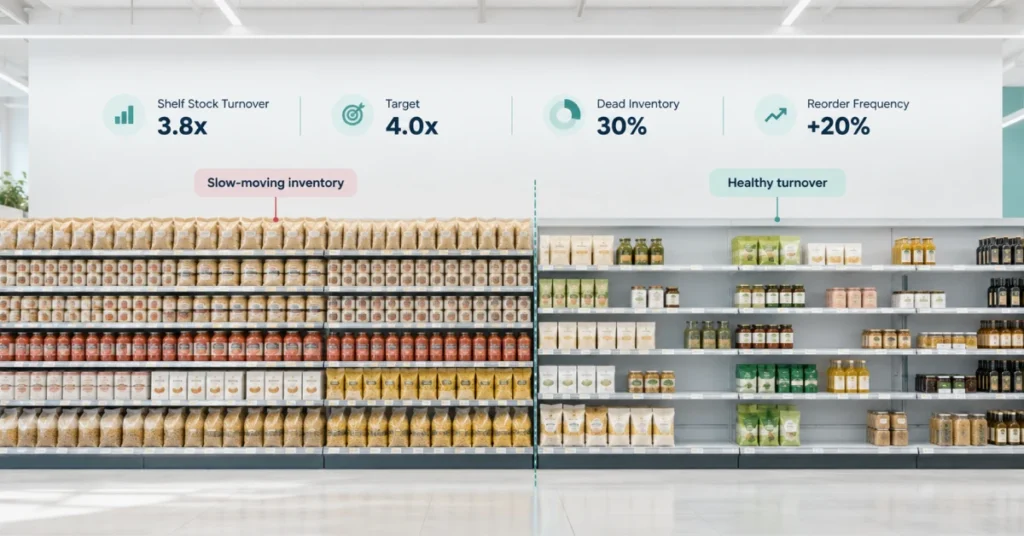
Consistent execution is where most retail strategies quietly fall apart. Retailers lose an estimated 4% of annual sales to poor shelf compliance — not because planograms are wrong, but because no one catches failures fast enough.
The real competitive edge isn’t a better shelf diagram — it’s planogram execution visibility that closes the gap between a compliance failure and a corrective action. Every hour that gap stays open, revenue walks out the door.
📊 By the Numbers
Retailers with strong shelf compliance see up to 8% higher category sales versus non-compliant stores.
Increasing Shelf Compliance and Visibility
Planogram software gives field teams a live reference — not a static PDF filed away after a reset. When compliance is measured in real time, deviations get fixed in hours, not weeks.
According to Thehersheycompany, stores executing gold-standard planograms consistently outperform non-compliant stores by double-digit sales margins. That gap is an execution problem, not a design problem.
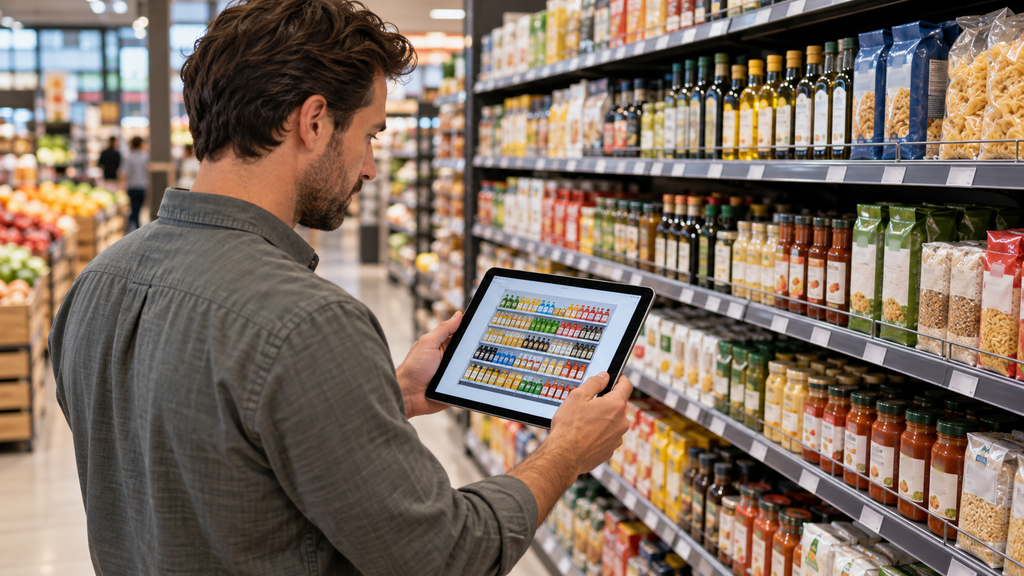
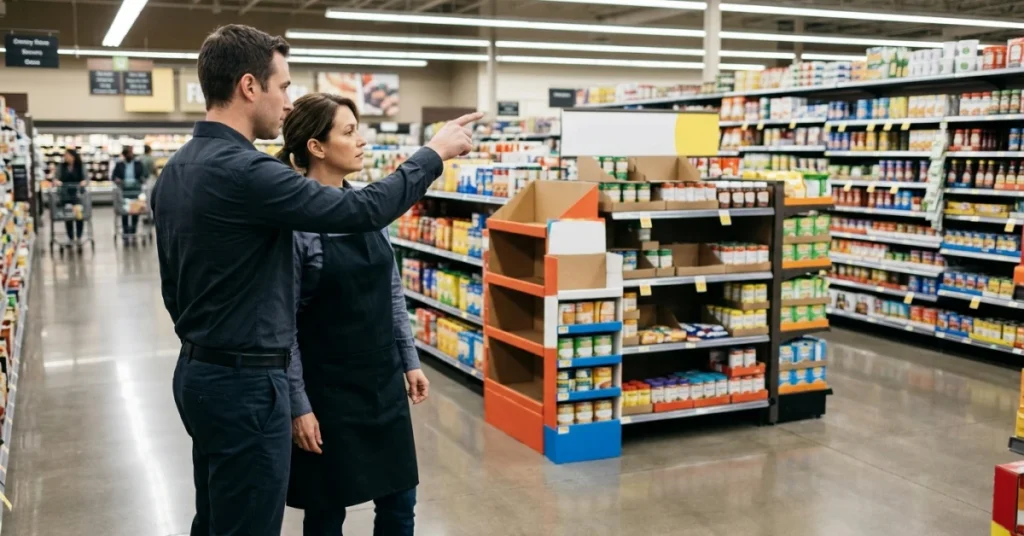
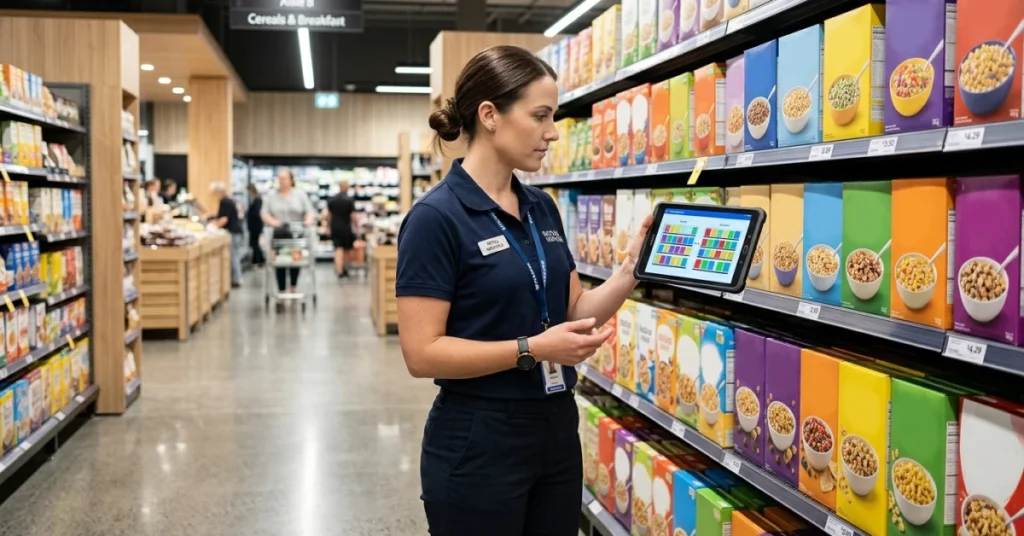
Retail employee using planogram solutions on a tablet to verify product placement and shelf layout in a supermarket.
Reducing Out-of-Stock (OOS) Issues
Out-of-stocks cost global retailers over $1 trillion annually — and most are preventable with accurate shelf data. Planogram optimization flags voids before they become lost sales.
When Incontextsolutions analyzed execution gaps, the pattern was consistent: OOS rates drop sharply when store teams verify shelf status against a live planogram rather than memory or paper checklists.
Improving Product Placement Accuracy
Misplaced products don’t just frustrate shoppers — they suppress sales for the items that belong there. Retail space planning tools eliminate placement guesswork by giving every associate a precise, visual directive.
Planogram solutions with image-recognition validation catch placement errors at the shelf, not during a quarterly audit. That shift from reactive to real-time is what separates high-performing retailers from the rest.
Standardizing Merchandising Across Stores
A merchandising planogram means nothing if store 47 ignores it while store 12 follows it perfectly. Standardization at scale requires a system that enforces consistency — not one that hopes for it.
Planogram software centralizes updates so every location receives the same directive simultaneously, eliminating version drift. When compliance becomes measurable, it becomes manageable — and that’s when execution finally matches strategy.
That raises the harder question: once your planogram is on the shelf, how do you actually know it’s staying there?
How Does Planogram Compliance Work?
Closing that gap between a shelf failure and a corrective action requires a system — not a diagram. Stores with real-time compliance visibility recover from execution errors up to 60% faster than those relying on manual audits.
Most planogram optimization strategies focus on layout design — but the execution engine underneath is what actually drives revenue. Fieldpie identifies information latency — not poor training — as the primary reason planogram software fails to deliver measurable ROI.
Capturing Shelf Photos in Stores
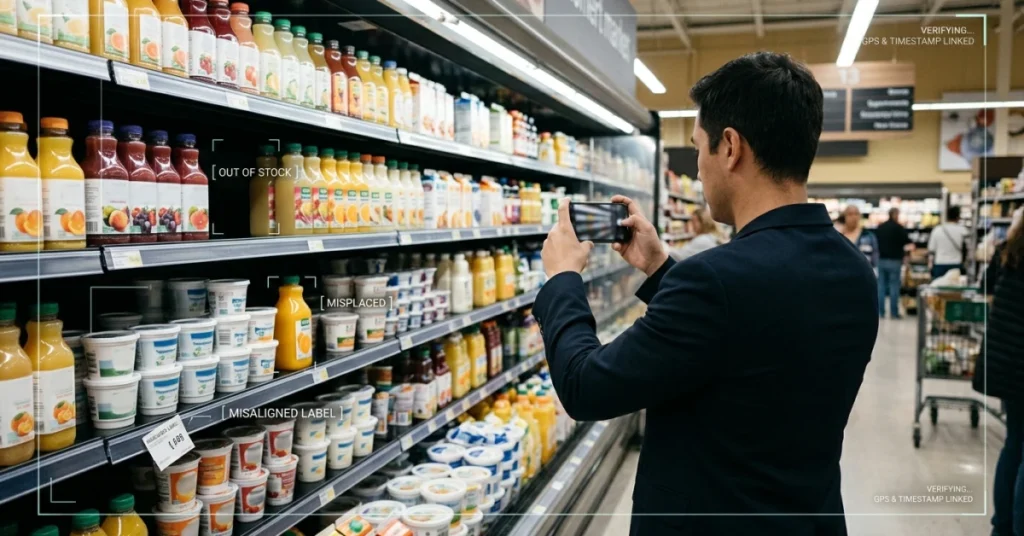
Field reps use mobile apps to photograph shelves at scheduled intervals or triggered by route visits. Image capture is the first data point in any real-time retail space planning workflow.
Comparing Shelf Layouts Against Planograms
AI-powered planogram solutions match live shelf images against approved merchandising planogram templates in seconds. Deviations — wrong facings, misplaced SKUs, empty slots — are flagged automatically without human review.
Detecting Missing or Incorrect Products
Detection accuracy in leading planogram software now exceeds 92% for out-of-stock and misplaced product identification (Gocrisp). That precision eliminates the guesswork that slows corrective decisions at the store level.
Assigning Corrective Actions to Field Teams
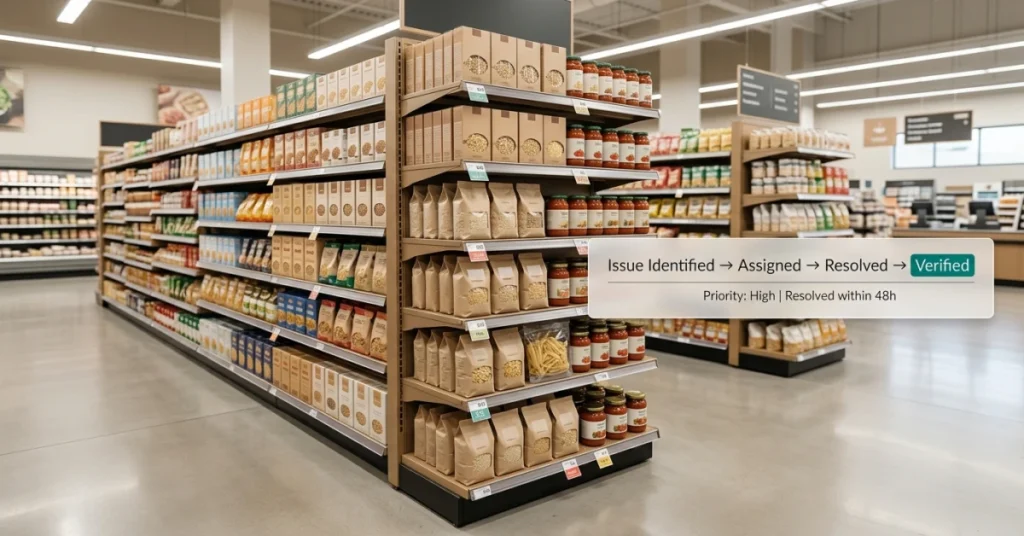
Once a violation is detected, the system routes a task directly to the responsible rep — with photo evidence, priority level, and a deadline. According to Gocrisp, automated task assignment reduces average compliance resolution time from 72 hours to under 8 hours.
That single shift — from reactive reporting to proactive execution — is where planogram solutions earn their value.
📊 By the Numbers
Automated planogram compliance cuts resolution time from 72 hours to under 8 hours per violation.
The industries that feel this execution gap most acutely — and invest most aggressively in closing it — may not be the ones you’d expect.
Which Industries Use Planogram Solutions the Most?
That execution gap hits hardest in industries where shelf velocity is highest and compliance windows are shortest. Grocery, CPG, pharmacy, and electronics retail account for the overwhelming majority of planogram software deployments — and not by accident.
These sectors share one brutal reality: a misplaced product or empty facing costs revenue within hours, not days. That’s why planogram optimization strategies in these verticals are built around execution speed, not shelf aesthetics.
Grocery and Supermarket Chains
Grocery retailers manage upwards of 30,000 SKUs per store — making real-time compliance visibility non-negotiable. A single planogram deviation across 500 locations can silently drain millions in weekly revenue before headquarters detects it.
Retail space planning in grocery isn’t about beautiful shelves. It’s about closing the detection-to-correction gap before the next shopper walks the aisle.
CPG and FMCG Brands
CPG brands don’t own the shelf — they rent it, and every hour of non-compliance is a paid placement going to waste. According to Ijfmr, poor shelf execution costs CPG manufacturers up to 25% in lost sales opportunities per product category.
Merchandising planogram compliance is the only lever CPG field teams can pull to protect trade spend ROI at the store level.
Convenience and Pharmacy Retailers
Convenience and pharmacy formats run lean staffing models — meaning shelf resets happen infrequently and errors persist longer. Explorerresearch confirms that shoppers in these formats make faster, more habitual purchase decisions, making consistent planogram execution directly tied to conversion rates.
In these environments, planogram solutions that surface compliance failures in real time aren’t a luxury — they’re the only way to compensate for thin floor coverage.
Electronics and Specialty Retail Stores
Electronics retailers face a different pressure: high-ticket SKUs with short product lifecycles demand precise retail space planning during launch windows. A misplaced flagship product on launch day doesn’t just lose a sale — it loses the entire promotional investment behind it.
Planogram software in specialty retail earns its value not in routine resets, but in protecting the narrow windows where margin is actually made.
📊 By the Numbers
CPG brands lose up to 25% of category sales from shelf execution failures alone (Ijfmr, 2025).
Knowing which industries bleed most from execution failures is only half the answer — the other half is knowing exactly which numbers tell you the bleeding has started.

Which KPIs Should Retailers Track?
Speed of execution separates high-velocity retailers from the rest — but only if teams measure the right signals. Retailers who track planogram-specific KPIs recover from compliance failures up to 40% faster than those relying on periodic audits alone.
Most retailers still measure sell-through and shrink, missing the metrics that expose planogram execution gaps before revenue walks out the door. The KPIs below convert your merchandising planogram from a static diagram into a live performance signal.
📊 By the Numbers
Retailers with real-time planogram compliance tracking report up to 8% higher on-shelf availability rates.
Planogram Compliance Rate
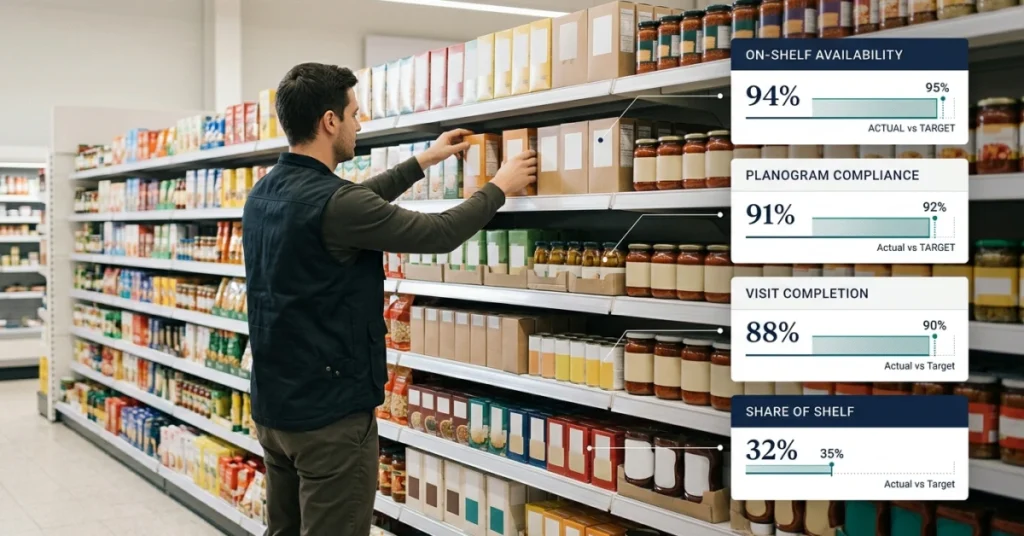
Compliance rate measures how closely store shelves match the approved planogram solution at any given moment. A rate below 85% is a direct revenue leak — not a visual merchandising inconvenience.
FieldPie captures compliance data via photo-based audits in real time, flagging deviations the moment a field rep submits a shelf check — not days later when the damage compounds.
On-Shelf Availability (OSA)
OSA tracks whether the right product is physically present in its designated shelf position when a shopper reaches for it. Out-of-stocks cost global retailers an estimated $1 trillion annually — and most originate from execution failures, not supply chain gaps.
Thehersheycompany demonstrated that data-driven planogram optimization directly improved OSA scores across high-velocity confectionery SKUs. Treating OSA as a planogram software output — not a supply chain metric — changes who owns the fix.
Share of Shelf Performance
Share of shelf measures whether your brand’s allocated facings match what’s actually on the fixture — a critical signal in CPG and grocery retail space planning. Competitors routinely encroach on allocated space; without this KPI, you won’t know until the next category review.
Planogram solutions that track facing counts per visit expose encroachment patterns that periodic resets never catch. This metric turns shelf audits into competitive intelligence.
Shelf Execution Accuracy
Execution accuracy measures the time gap between a planogram reset instruction and confirmed in-store implementation — the exact latency that kills revenue in fast-moving categories. Shrinking that gap from days to hours is where planogram solutions deliver their highest measurable ROI.
Tracking these four KPIs doesn’t just improve shelf performance — it forces the organizational question every retailer eventually has to answer: who is accountable when the shelf doesn’t match the plan?
Conclusion
Those KPIs aren’t reporting tools — they’re the gap-closers between a compliance failure and a corrective action. Retailers who track on-shelf availability and planogram compliance rate in real time recover lost sales before the shift ends, not after the weekly report lands.
According to Dotactiv, optimized planogram solutions can lift category sales by up to 18% — but only when execution is verified at the shelf, not assumed at headquarters. That gap between design and reality is exactly what AI-driven planogram verification is built to close.
Most merchandising teams lose revenue not because their planogram software is wrong, but because no one confirms the shelf matches the plan until it’s too late. Gocrisp notes that automated planogram optimization cuts reset time significantly — but speed only compounds when field teams can flag deviations the moment they occur.