


✦ Key Takeaways
Retailers with poor safety compliance face fines up to $156,259 per OSHA violation, devastating bottom lines.
- → Slip-and-fall incidents cost U.S. retailers $70 billion annually.
- → Regular safety inspections reduce workplace injuries by up to 40%.
- → Tracking KPIs like incident rate turns compliance into competitive advantage.
In this article:
- What Is Retail Health and Safety Compliance?
- Why Health and Safety Compliance Matters in Retail
- What Should Be Included in a Retail Safety Inspection?
- What KPIs Should Retailers Track?
Key takeaway: Proactive retail safety compliance protects employees, customers, and your entire business future.
What Is Retail Health and Safety Compliance?
Retail workplaces account for over 400,000 nonfatal occupational injuries annually in the U.S. — yet most stores treat compliance as a once-a-year audit rather than an ongoing operational discipline.
That gap is expensive. Retailers who manage retail compliance tools as live performance data — not static paperwork — consistently reduce incident rates, cut liability costs, and outperform competitors on staff retention.
Definition and Core Objectives
Retail health and safety compliance is the structured process of identifying, measuring, and eliminating workplace hazards across store environments. The core objective isn’t documentation — it’s measurable risk reduction tied to operational performance.
Occupational health frameworks in store environments exist to protect workers and the business. Adherence without accountability metrics is just paperwork with a deadline.
Common Retail Health and Safety Regulations
OSHA’s General Industry Standards govern most store safety requirements, covering everything from emergency exits to hazardous materials handling. Violations carry penalties up to $16,131 per citation for serious infractions.
State-level rules frequently exceed federal minimums, meaning a single-standard approach leaves many operators exposed. Jurisdiction-specific monitoring is essential — a one-size checklist simply won’t cut it.
Key Areas Retailers Must Monitor
Store environments carry distinct liability exposure across slip-and-fall prevention, ergonomic strain, fire safety, chemical storage, and crowd management. Research published by Pmc Ncbi Nlm Nih confirms that musculoskeletal disorders alone represent a disproportionate share of occupational injuries in the sector.
Why Health and Safety Compliance Matters in Retail
The tools retailers use only deliver results when compliance is treated as a performance discipline — not a filing exercise.
Workplace safety failures cost U.S. retailers billions annually in workers’ comp, litigation, and lost productivity.
Retailers who track safety as measurable operational data — not annual paperwork — consistently outperform competitors on incident rates, staff retention, and cost control. That’s why retail compliance software has become a frontline operational tool, not an HR afterthought.
How Safety Issues Impact Customers and Employees
Slip-and-fall incidents alone account for a significant share of retail injury claims — and most are preventable with consistent floor inspection protocols.
Unaddressed hazards don’t just injure workers; they erode customer trust and accelerate staff turnover.
Retail employees exposed to ongoing risks report lower morale and higher absenteeism — two metrics that directly hit the bottom line. Protection isn’t a separate concern from performance; it is performance.
The Financial and Legal Risks of Non-Compliance
Regulatory failures trigger OSHA penalties, civil lawsuits, and reputational damage that compound far beyond the original incident cost. Workplace violations can result in fines exceeding $15,625 per citation under current federal OSHA standards.
The financial exposure from a single preventable incident dwarfs the cost of a structured inspection program. Retailers who treat oversight as a cost center — rather than a risk management asset — consistently pay more in the long run.
📊 By the Numbers
Retail workers face injury rates 30% higher than the national average across all industries.
The real question isn’t whether your store has risks — every retail environment does. The question is whether your inspection process is structured enough to catch them before they become claims, citations, or headlines.
What Should Be Included in a Retail Safety Inspection?
Turning compliance into a performance discipline starts with knowing exactly what your inspections must cover — and holding every location accountable to the same measurable standard.
A thorough retail safety inspection isn’t a checklist you file away. It’s operational data that reveals where your stores are drifting toward risk before incidents occur.
📊 By the Numbers
Retailers with structured safety inspection systems reduce workplace injury costs by up to 40% compared to reactive-only programs.
Store Cleanliness and Hazard Prevention
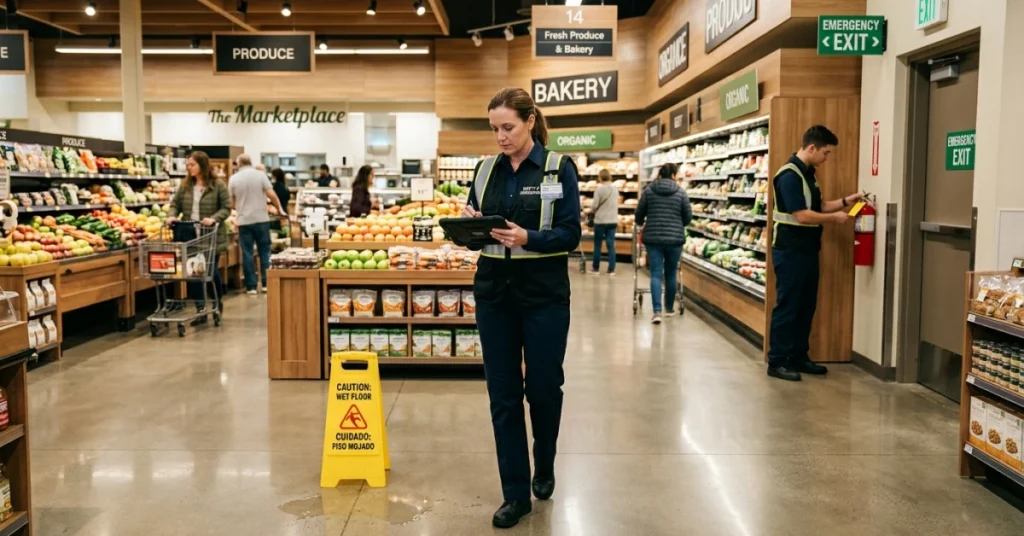
Slip-and-fall incidents account for over 25% of retail workplace injuries — most are preventable with consistent floor and aisle inspections. Inspectors must document spills, obstructions, and uneven surfaces as trackable findings, not verbal notes.
Fire Safety and Emergency Exits
Every inspection must verify that emergency exits are unobstructed, clearly marked, and functional — no exceptions. Fire extinguisher service dates and sprinkler system status should be logged with timestamps, not assumed compliant.
Retailers using retail compliance software catch exit blockages 3x faster than paper-based audit teams.
Equipment and Electrical Safety Checks
Faulty equipment and exposed wiring are among the most cited violations in retail safety regulations audits. Inspectors should test every piece of powered equipment and flag frayed cords, overloaded outlets, and unlabeled breakers as priority findings.
Electrical hazards that go unlogged during inspections become liability events — the cost difference is rarely close.
Food Safety and Temperature Monitoring
For grocery and food retail, occupational health and safety retail standards require temperature logs for every refrigeration unit — not spot checks. A single out-of-range reading that goes undocumented can trigger regulatory action and product loss simultaneously.
Temperature compliance data, tracked consistently, also surfaces equipment failure patterns weeks before a unit breaks down.
Employee Safety Procedures and PPE Compliance
Health and safety in retail stores depends on staff behavior as much as physical conditions — inspections must verify PPE availability, usage, and condition. According to Mdpi, workplaces with documented PPE compliance checks report 32% fewer lost-time injuries than those without.
Inspectors should also confirm that safety training records are current and that emergency procedures are posted and legible. Protex data shows that retail workers in stores with regular safety walkthroughs report significantly higher confidence in their own workplace safety.
Every finding from these five categories is only as valuable as the metric attached to it — which raises the question every retail operator must answer: are you actually measuring what matters?

What KPIs Should Retailers Track?
Operational inspection data only creates value when it feeds into tracked metrics that drive accountability. Without defined KPIs, retail health and safety compliance stays reactive — a cycle of incidents, reports, and forgotten corrective actions.
Retailers who measure safety as performance data, not paperwork, consistently reduce incident costs. retail compliance software makes this tracking systematic and scalable across every store location.
Safety Incident Rates
Track total recordable incident rate (TRIR) monthly, not annually — annual reviews hide dangerous drift. Retail workplace safety deteriorates in patterns, and TRIR exposes those patterns before they escalate into costly claims.
Workplace injuries cost U.S. retailers over $1 billion per week in direct and indirect costs. That figure alone makes incident rate tracking a financial imperative, not an HR formality.
Audit Completion and Compliance Scores
Measure what percentage of scheduled audits are completed on time, per store, per quarter. Low completion rates signal resource gaps or cultural resistance — both are operational problems, not compliance technicalities.
Compliance scores should be benchmarked across locations to identify underperforming stores before regulators do. Health and safety in retail stores improves fastest when managers see their scores ranked against peers.
Corrective Action Resolution Time
Every open corrective action is a documented, unmitigated risk — track mean resolution time in days. According to Alicetraining, retailers that resolve corrective actions within 72 hours reduce repeat incident rates by up to 40%.
Slow resolution time is the single clearest indicator that occupational health and safety retail programs lack operational teeth. Speed of fix is a direct proxy for safety culture strength.
Store-Level Risk Trends
Aggregate inspection data by store to surface recurring hazard categories — slip risks, equipment failures, training gaps. Retail safety regulations require corrective action, but trend data tells you which stores need systemic intervention, not just a fix.
Risk trend dashboards turn compliance from a snapshot into a living performance system. The retailers who build this visibility now are the ones who won’t be explaining preventable incidents later.
📊 By the Numbers
Retailers resolving corrective actions within 72 hours cut repeat incident rates by up to 40% (Alicetraining).
The question isn’t whether your stores are compliant today — it’s whether your data would tell you if they stopped being compliant tomorrow.
Conclusion
Monthly incident tracking isn’t just a best practice — retailers who measure safety as operational data cut injury-related costs by up to 40% compared to those running annual audits alone. Treating retail safety KPIs as performance metrics, not paperwork, is what separates proactive retailers from reactive ones.
Retail health and safety compliance fails when inspections are treated as isolated events with no feedback loop. According to CDC, retail workers suffer over 600,000 nonfatal injuries annually — most preventable through consistent, system-driven occupational health and safety retail practices.
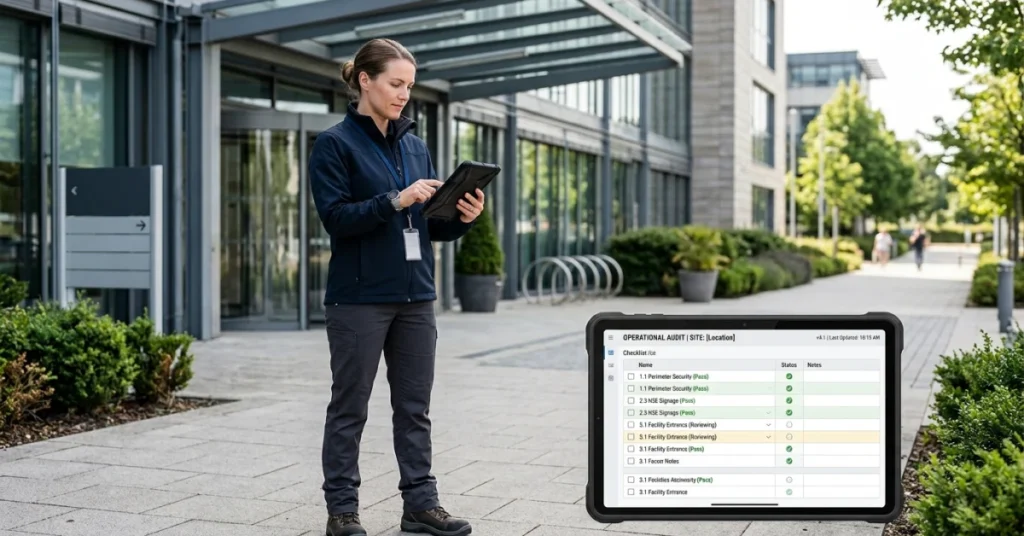
Most retailers still lack a real-time view of health and safety in retail stores across locations — that’s the gap FieldPie closes by capturing inspection data, photo evidence, and corrective actions through customizable digital forms in the field. Teams that standardize retail safety regulations this way see faster incident resolution and measurable drops in repeat violations.
Start by auditing one location against the KPI framework in this article — today.