


A safety audit is a systematic, documented review of your organization’s health and safety management systems, physical workplace conditions, and compliance with applicable regulations — conducted to identify gaps, reduce risk, and verify that policies are functioning as intended. Think of it as a structured health check for your entire safety program.
What Does a Safety Audit Actually Examine?
Before you can prepare for a safety audit, you need to understand its scope. Audits typically assess three distinct layers:
- System-level compliance — Are your written policies aligned with OSHA 29 CFR, ISO 45001, or applicable state/provincial regulations?
- Physical workplace conditions — Do actual site conditions match documented standards?
- People and culture — Are employees receiving adequate training, and are they following procedures?
Auditors don’t just review paperwork. They walk the floor, interview workers, and cross-reference records. A gap in any one of these layers can produce a finding — or worse, a citation.
Why Does Preparing for a Safety Audit Matter?
Many organizations treat audits as a surprise inspection they must survive. That mindset is costly. According to research published by Peuneo, regular safety audits can reduce workplace injury rates by up to 40%. That reduction doesn’t happen by accident — it’s the direct result of structured preparation and corrective action.
The business case is equally clear. OSHA penalties for serious violations can reach $16,550 per violation as of 2024, with willful or repeated violations climbing to $165,514 each. No health and safety program is worth ignoring.
Beyond fines, a well-prepared audit positions your organization to:
- Demonstrate due diligence to regulators, insurers, and clients
- Identify systemic risk before it becomes an incident
- Reduce workers’ compensation costs
- Strengthen employee trust in management

How Do You Prepare for a Safety Audit? A Step-by-Step Framework
Step 1: Confirm the Audit Scope and Type
Not all audits are identical. Clarify whether you’re facing:
| Audit Type | Triggered By | Focus |
|---|---|---|
| Internal audit | Management decision | Continuous improvement |
| External / third-party audit | Client, insurer, or certification body | Objective compliance verification |
| Regulatory inspection | OSHA, EPA, state agency | Legal compliance |
| ISO 45001 certification audit | Certification body | Management system conformance |
Knowing the type determines which documents you pull, who participates, and how deeply you need to review physical conditions. If your organization is pursuing ISO 45001 certification, for example, the auditor will scrutinize your management review records and corrective action logs far more rigorously than a routine internal check.
Step 2: Gather and Review Your Documentation
Documentation is the backbone of any health safety review. Auditors request records first — then verify them against field conditions. Start pulling these files at least four weeks before audit day.
Core documents to prepare:
- Written health and safety policies and procedures (current revision dates)
- Risk assessment registers and job hazard analyses (JHAs)
- Incident and near-miss logs for the past 12–36 months
- OSHA 300, 300A, and 301 logs (or equivalent)
- Equipment inspection and maintenance records
- Emergency response and evacuation plans
- Employee training records with completion dates and competency sign-offs
- Contractor and visitor induction records
- Internal audit reports and corrective action tracking logs
The British Safety Council recommends that organizations treat document review as a pre-audit audit in itself — if you can’t find a record, an auditor can’t verify compliance. If it isn’t documented, it didn’t happen.
Step 3: Conduct a Pre-Audit Internal Walk-Through
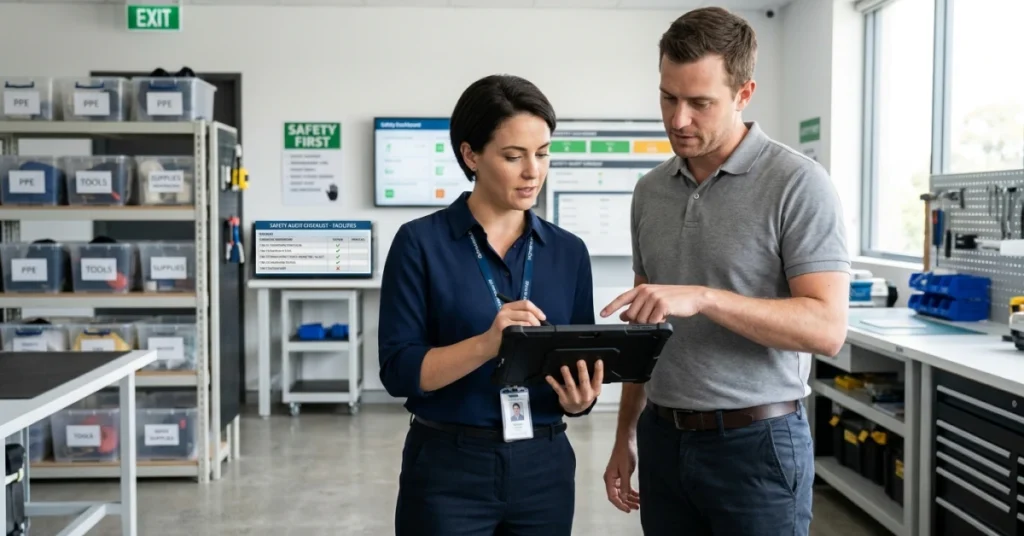
Walk every area that will be inspected. Bring your audit checklist and a camera. You’re looking for the delta between what your policies say and what actually exists on the floor.
Common physical deficiencies that surface during this step:
- Blocked emergency exits or missing exit signage
- Outdated or improperly stored chemical safety data sheets (SDS)
- PPE that is damaged, expired, or not being worn
- Unlabeled hazardous materials containers
- Missing machine guarding or lockout/tagout (LOTO) procedures posted at equipment
- Fire extinguishers with overdue inspection tags
- First-aid kits with expired supplies
Assign every deficiency to a responsible owner with a due-date that falls before the audit. This creates a corrective action log that itself demonstrates proactive safety management — auditors respond favorably to organizations that self-identify and address gaps.
Step 4: Review and Update Your Risk Register
Your risk register should be a living document, not a spreadsheet that was last touched during onboarding. Before any audit, verify that:
- All significant hazards identified in the past 12 months are captured
- Risk ratings reflect current controls, not theoretical ones
- Residual risk levels are acceptable under your organization’s criteria
- Any new processes, equipment, or chemicals introduced since the last review are assessed
As outlined by MapTrack’s safety audit preparation guide, a stale risk register is one of the most common findings auditors cite — because it signals that risk management is not embedded in day-to-day operations.
Step 5: Verify Employee Training Records
Training is a high-scrutiny area in every health safety audit. Auditors will cross-check training records against your policies, then often interview employees directly to test knowledge retention. Discrepancies between what records say and what workers know are red flags.
Before the audit:
- Confirm every employee has completed mandatory training for their role (HAZCOM, LOTO, fall protection, confined space, forklift, etc.)
- Check that training is current — many certifications expire every 1–3 years
- Ensure refresher training was completed after any incident or near-miss
- Verify that new hires received safety orientation before starting work
- Review training for contractors working on your site
If your organization manages a distributed or field-based workforce, a centralized field operations management platform can automate training expiry alerts and maintain a single source of truth for compliance records — eliminating the manual spreadsheet chaos that causes audit failures.
Step 6: Brief Your Team
The audit is not a solo performance. Employees will be interviewed. Supervisors will be asked to explain procedures. If your team is caught off guard, it creates the impression that safety is a management exercise rather than an organizational value.
Conduct a pre-audit briefing that covers:
- The audit date, scope, and who the auditor is
- What types of questions employees may be asked (e.g., “Where is your SDS?” or “What do you do if you see an unsafe condition?”)
- The importance of honest, direct answers — auditors are not looking to punish individuals
- Where to direct the auditor for document requests
Do not coach employees to give scripted answers. Auditors are trained to detect rehearsed responses, and inconsistency between employee accounts and management accounts is itself a finding.
Step 7: Prepare Your Audit Logistics
Practical logistics matter more than most organizations realize. A disorganized audit day sends a signal about how seriously your management team takes health and safety.
- Designate a single point of contact (the safety manager or equivalent) to accompany the auditor
- Reserve a quiet space for document review and interviews
- Pre-organize all physical files and digital records for fast retrieval
- Ensure relevant managers are available and not traveling on audit day
- Have a copy of your organizational chart ready
- Prepare a brief site orientation for the auditor, including emergency exits and PPE requirements for your facility
Step 8: Establish a Corrective Action Process for Post-Audit Findings
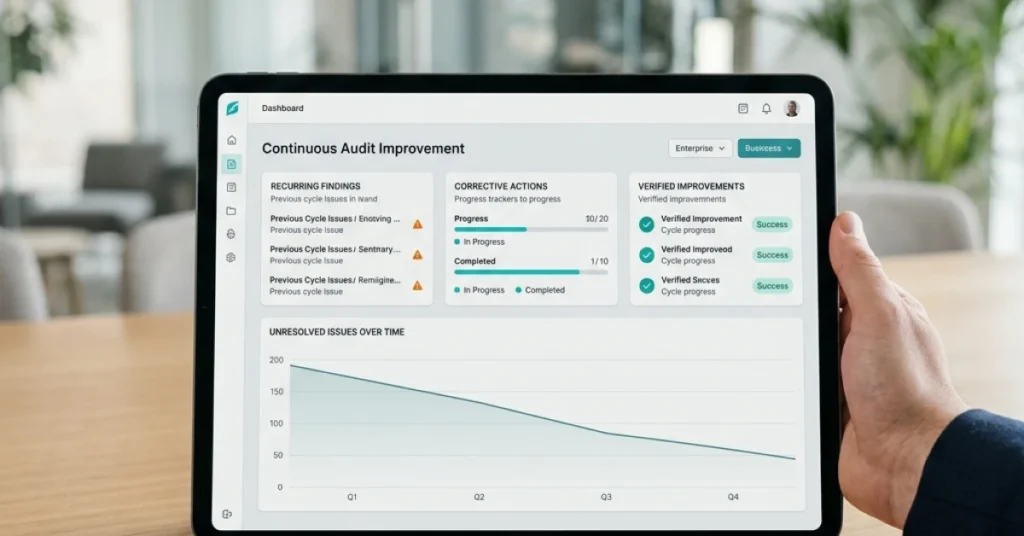
Preparation doesn’t end when the auditor leaves. The value of an audit is in the corrective actions it generates. Organizations that receive a finding and fail to close it out before the next audit cycle demonstrate a systemic management failure — the worst possible signal to a regulator or certification body.
Build a corrective action management process that assigns:
- Each finding to a responsible owner
- A root-cause analysis (not just a surface fix)
- A target completion date
- Verification that the corrective action was effective
This is where technology earns its place. FieldPie’s digital safety management tools allow teams to log audit findings in real time, assign corrective actions to field personnel, and track closure rates on a live dashboard — replacing the email chains and spreadsheets that let findings slip through the cracks.
Safety Audit Preparation Checklist
Use this checklist in the four weeks leading up to your audit. Check off each item as it’s completed.
Documentation (4 Weeks Out)
- Pull and review written safety policies — confirm current revision dates
- Compile incident and near-miss logs for the past 36 months
- Verify OSHA 300/300A logs are complete and posted (Feb 1–Apr 30 annually)
- Gather all equipment inspection and maintenance records
- Collect employee training records by role and certification type
- Review contractor induction and qualification records
- Pull previous internal audit reports and corrective action logs
Risk and Compliance (3 Weeks Out)
- Update the risk register with all new hazards from the past 12 months
- Confirm all significant risks have documented controls
- Review emergency response plan — verify contact numbers are current
- Check that all permits (hot work, confined space, etc.) are being used correctly
Physical Workplace (2 Weeks Out)
- Walk all work areas with audit checklist in hand
- Verify emergency exits are clear and properly marked
- Inspect fire extinguishers, first-aid kits, and AEDs for current inspection tags
- Confirm SDS are accessible at point of use for all chemicals
- Check PPE condition and availability at all required locations
- Inspect machine guarding and LOTO procedures at all relevant equipment
- Confirm hazardous materials are properly labeled and stored
People and Training (2 Weeks Out)
- Identify any employees with expired certifications and schedule refresher training
- Verify new hires completed safety orientation before starting
- Confirm supervisors can explain their team’s key safety procedures
Logistics (1 Week Out)
- Confirm auditor name, credentials, and arrival time
- Assign a single point of contact to accompany the auditor
- Book a quiet room for document review and interviews
- Brief all employees on the audit date and what to expect
- Ensure all relevant managers are available on audit day
What Are the Most Common Safety Audit Failures — and How Do You Avoid Them?
Why Do Organizations Fail Safety Audits?
The most frequent root causes of audit failures are not dramatic — they’re mundane. According to the Altius Group’s workplace health and safety audit guidance, the most common gaps include:
- Outdated or missing documentation — Policies that reference superseded regulations, or training records with no completion dates
- Policies that exist on paper but not in practice — Written procedures that employees have never seen or cannot explain
- Corrective actions from previous audits that were never closed — The single fastest way to escalate a finding to a major nonconformance
- Inadequate contractor management — Assuming that contractors manage their own safety is a liability that auditors consistently flag
- Poor housekeeping — Cluttered walkways, improperly stored materials, and unlabeled containers are visible on the first walk-through and set a negative tone for the entire audit
Each of these failures has a common thread: they reflect a safety management system that operates on paper rather than in practice. The fix isn’t more documentation — it’s embedding safety into daily operational routines.

How Do Internal and External Audits Differ in Preparation Requirements?
Internal audits are conducted by your own personnel — typically the safety manager, a cross-functional team, or a trained internal auditor. The goal is continuous improvement, and the tone is collaborative.
External audits are conducted by a third party: a certification body (for ISO 45001), a client’s supply chain team, or a regulatory inspector. The stakes are higher, the documentation scrutiny is deeper, and the findings carry legal or contractual consequences.
For external audits, add these preparation steps:
- Review the specific standard or regulation the auditor will use as their benchmark
- Prepare a management review summary if the audit is ISO 45001-related
- Ensure your legal register is current — all applicable health and safety laws and regulations that apply to your operations, with evidence of monitoring
- Conduct a full mock audit using the same checklist the external auditor will use
Organizations that run structured internal audit programs on a quarterly or semi-annual basis consistently outperform their peers in external audits — because they’ve normalized the process and eliminated the element of surprise.
Conclusion
Preparing for a safety audit is not a one-time task — it’s an ongoing discipline that reflects how seriously an organization manages risk, compliance, and employee safety. Leading organizations treat audits not as pressure, but as an opportunity to strengthen their safety systems.
From documentation and risk assessments to training and on-site conditions, everything must align in practice — not just on paper. Most audit failures happen when this gap is ignored.
In 2026, organizations that embed audit readiness into daily operations are not only more compliant, but also safer, more efficient, and better prepared for long-term success.