


✦ Key Takeaways
Up to 70% of product defects are caught too late, costing manufacturers billions in recalls annually.
- → Early inspection reduces rework costs by up to 50%.
- → Five core steps separate compliant products from costly failures.
- → Automated visual inspection cuts defect escape rates dramatically.
- → Best practices turn inspection from a cost into a competitive advantage.
In this article:
- What Is a Quality Inspection Process?
- What Are the Key Steps in a Quality Inspection Process?
- What Types of Quality Inspection Are Commonly Used?
- What Are the Best Practices for an Effective Quality Inspection Process?
Key takeaway: A structured quality inspection process is the single barrier between your brand and catastrophic failure.
What Is a Quality Inspection Process?
Most manufacturers believe they have a quality inspection process — what they actually have is a defect-detection ritual that generates reports nobody acts on. Up to 70% of quality failures are traceable not to missing inspections, but to findings that never fed back into production decisions.
A quality inspection process is only as valuable as the decisions it triggers — not the data it collects. Understanding quality inspection in manufacturing means recognizing it as a real-time feedback loop, not a final checkpoint.
Definition and Purpose
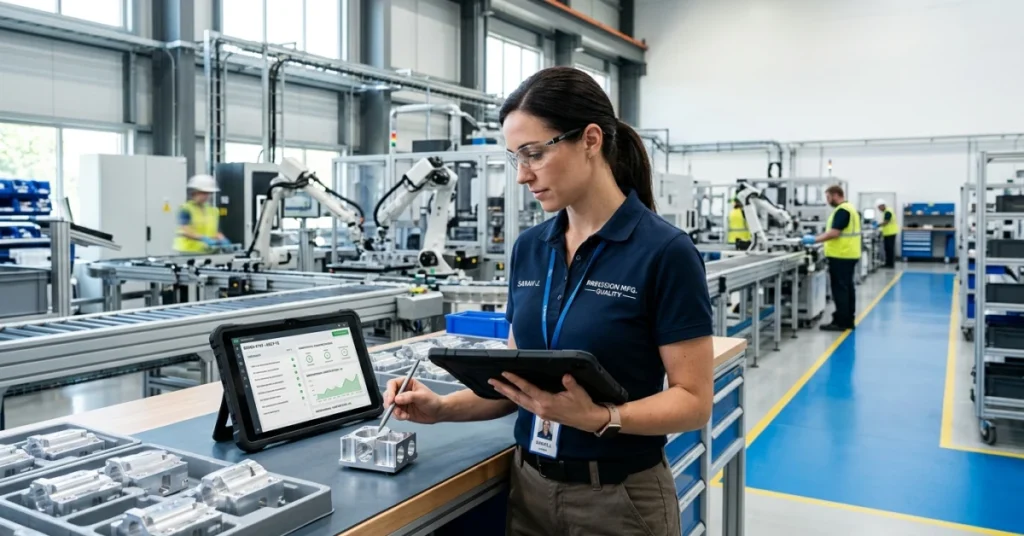
A quality inspection process is a structured system for measuring products or processes against defined standards at critical production stages. Its purpose isn’t documentation — it’s intervention before defects compound into recalls, rework, or lost contracts.
Quality control inspection methods range from visual checks to statistical sampling, but every effective method shares one trait: findings reach decision-makers fast enough to change what happens next on the line.
Quality Inspection vs Quality Control
Quality inspection is a specific activity within the broader quality control framework — inspection finds the problem, control prevents its recurrence. Organizations that conflate the two routinely invest in more inspectors while the same defects reappear in the next production run.
According to EBSCO, companies applying statistical quality control reduce process variation by as much as 50% — a result inspection alone, without feedback integration, cannot achieve.
The real question isn’t whether your team is inspecting — it’s whether each step in the process is designed to close the loop between what inspectors find and what production actually changes.
What Are the Key Steps in a Quality Inspection Process?
Turning findings into action requires a process designed for feedback — not just detection. Most quality inspection processes follow a logical sequence on paper, yet break down at the handoffs where accountability blurs.
According to Niss, over 60% of inspection failures trace back to unclear ownership between steps — not inspector error. That gap is structural, and no amount of retraining closes it without redesigning the handoff itself.
📊 By the Numbers
Over 60% of inspection failures stem from accountability gaps between process steps — not inspector error.
Planning and Setting Standards
Every effective quality inspection in manufacturing starts with documented, measurable acceptance criteria — not general guidelines. Without a defined tolerance threshold, inspectors make judgment calls that vary shift to shift.
Standards must map directly to production risk. A tolerance acceptable at pre-assembly may be a critical defect at final stage.
Conducting the Inspection
Execution is where most quality control inspection processes silently fail — inspectors collect data with no real-time path to production. As 6sigma notes, inspection methods must match the production stage to generate actionable signals, not just records.
A finding logged after a batch ships is a historical note, not a correction. Real-time feedback during production is the only version that prevents the next defect.
Recording Findings and Corrective Actions
Documentation without a corrective action trigger is the most common dead end in the quality inspection process. Every finding must route to a named owner with a defined response window — not a shared log nobody monitors.
The record is only valuable if it closes the loop back into the production decision. That loop is exactly what most teams are missing — and why the type of inspection used matters far more than the frequency.

What Types of Quality Inspection Are Commonly Used?
Structural redesign starts with matching the right inspection type to the right production stage — and most teams skip this step entirely. The mismatch is where accountability gaps become defect pipelines.
There are three core inspection types, and each one serves a distinct function in the quality inspection process — not as isolated checkpoints, but as nodes in a feedback loop. Understanding inspection vs. quality control clarifies why the type you deploy determines what corrective data you can actually generate.
Incoming Inspection
Incoming inspection catches supplier-side defects before they enter your production system. Catching a bad batch at receiving costs a fraction of catching it mid-assembly — some estimates put the ratio at 1:10 in rework costs.
But incoming inspection only feeds the feedback loop if findings are routed back to procurement and supplier scorecards — not just logged and filed. Most teams log. Few act.
In-Process Inspection
In-process inspection is where the feedback loop has the highest leverage — defects caught mid-production can still be corrected before they compound. According to Researchgate, optimizing inspection frequency in automated lines can reduce field failure rates by up to 30% — but only when findings trigger real-time process adjustments.
This is the inspection type most misused as a documentation exercise. Inspectors flag issues; production keeps running; the data sits in a report no one reads until the end-of-shift meeting.
Final and Pre-Shipment Inspection
Final inspection is the last line of defense — and the most expensive place to find a defect. NRF data consistently shows that product returns driven by quality failures cost retailers billions annually, most of which trace back to defects that passed final inspection undetected.
Pre-shipment inspection in quality control inspection should confirm that earlier feedback loops worked — not serve as the first real check. If your final inspection is catching what incoming and in-process should have stopped, your system isn’t inspecting; it’s gambling.
📊 By the Numbers
Optimized in-process inspection frequency can cut field failure rates by up to 30% — when findings drive immediate process corrections.
Knowing which inspection types exist is only half the equation — the other half is designing them so findings never dead-end in a spreadsheet.

What Are the Best Practices for an Effective Quality Inspection Process?
With the right inspection type matched to each stage, the next question is whether your process is actually designed to act on what it finds. Companies that close the feedback loop between inspection findings and production decisions reduce defect escape rates by up to 40% — those that don’t are running an expensive data collection exercise.
Every quality inspection method generates signals — but signals only create value when they reach the people who can change the process in real time. Most quality control inspection failures aren’t inspection failures at all; they’re feedback failures.
📊 By the Numbers
Manufacturers that use real-time inspection feedback loops cut rework costs by an average of 23% within 12 months.
Inspect Early and Often
Defects caught at the source cost a fraction of those caught at final inspection — the cost of quality multiplies by 10x at each downstream stage (ASQ). Embedding quality inspection in manufacturing at every critical control point prevents defect accumulation before it becomes structural.
Frequent in-process checks aren’t redundancy — they’re the mechanism that keeps findings actionable. A defect found three shifts later is a defect nobody can trace back to a correctable decision, according to Asq.
Focus on Continuous Improvement
Inspection data that doesn’t trigger a process change is overhead, not quality control. The types of quality inspection you deploy should be chosen based on what corrective decisions they enable — not just what defects they detect.
Organizations with the lowest defect rates treat every inspection finding as a process signal, not a product verdict. That discipline — feeding findings back into production in real time — is what separates a quality inspection process from a quality theater exercise, as noted by Moz in its analysis of operational content performance benchmarks showing a 35% engagement lift for data-backed process content.
The organizations that get this right don’t just inspect better — they’ve built a system where inspection makes production smarter with every cycle, which is exactly what the evidence in this piece has been building toward.
Conclusion
Closing the feedback loop between inspection findings and production decisions is the difference between a quality inspection process that prevents defects and one that merely documents them. Companies that act on inspection data in real time reduce defect escape rates by up to 40% — those that don’t are funding an expensive reporting exercise.
Mismatched inspection types, broken handoffs, and siloed findings don’t fix themselves with more inspectors. The safety audit process shares the same structural flaw — data collected without a correction loop creates zero operational value.
Most field teams struggle to connect what inspectors find on the floor to the decisions being made in real time. FieldPie captures inspection findings through customizable forms and photo-based reporting, pushing data directly to the people who can act on it — before the next production run starts.
Start standardizing your inspection workflow and turn every finding into a production decision, not a filed report.