


✦ Key Takeaways
Up to 60% of audit findings go unresolved because organizations fail to prioritize them by severity level.
→ Critical findings left unranked cost companies millions in preventable losses.
→ Severity levels transform raw audit data into actionable risk decisions.
→ A structured matrix cuts remediation time by assigning clear ownership fast.
In this article:
What Is Audit Severity Classification?
What Are the Different Audit Severity Levels?
How to Classify Audit Findings by Severity
Audit Severity Classification Examples
How to Build an Audit Severity Classification Matrix
Key takeaway: Without a severity classification system, your audit program is just expensive paperwork.
What Is Audit Severity Classification?
Most audits produce a long list of findings. Without a shared way to rank how serious each one is, teams argue about priorities instead of fixing problems.
Audit severity classification assigns a risk level to every finding. That way, everyone agrees on what needs urgent action and what can wait.
Think of it like a hospital triage system. A broken arm and a heart attack both need attention — but not at the same time, by the same person, with the same urgency.
Severity classification does the same job for audit findings.
Here is the part most guides miss: a good audit severity rating system is not a labeling exercise. It forces your organization to decide — before any audit runs — what risk it will tolerate and who can act on each level.
According to Accountablehq, healthcare organizations that use a formal audit finding classification system resolve critical findings up to 40% faster than those relying on informal judgment. That speed gap exists because classification removes the debate — the decision rules are already set.
Fieldpie reinforces this point, showing that a well-built severity matrix connects each finding tier to a specific response owner and deadline. That turns a label into a trigger for action.
You can see how this connects to corrective action audit processes that depend on clear severity tiers to function at all.
Ask yourself two questions about any finding: how bad is it, and who is authorized to act on it? Knowing the answer starts with understanding what each severity level actually means.
What Are the Different Audit Severity Levels?
Triage only works if everyone agrees on what “critical” means. A formal audit severity classification system gives you that shared definition. It sets four distinct levels. Each level has clear criteria and a clear owner.
Most organizations only spot a classification problem after it blows up. A minor finding reaches the CEO while a real compliance failure sits ignored for months.
Audit CAPA processes break down fastest when severity levels are vague. Clear definitions stop that from happening.
Critical Findings: Immediate Risks and Serious Noncompliance
Critical findings signal an active threat — to safety, legal standing, or core operations. They demand a response within 24 to 72 hours, not the next quarterly review.
Think of a food manufacturer discovering a pathogen control failure mid-production. That is a critical finding; everything stops until it is fixed.
Major Findings: Significant Compliance or Process Failures
Major findings don’t threaten immediate safety, but they expose serious gaps in how a process works. Left unaddressed, they reliably become critical findings within one audit cycle.
Picture a missing approval step in a financial workflow. No crisis exists today. But the exposure is real, and tomorrow it can turn critical.
Minor Findings: Isolated Issues and Limited Impact
Minor findings are real problems, but they are contained. One mislabeled document or a single missed sign-off fits here — the system still works, just imperfectly.
Research shows over 60% of all audit findings land at the minor level (Pubmed Ncbi Nlm Nih). Without a severity matrix, teams burn most of their time on these low-priority issues.
Observations and Opportunities for Improvement
Observations are not findings at all — they are signals worth watching. No rule was broken, but a smarter approach exists and the auditor is flagging it.
Teams that track observations over time often catch emerging risks early. That turns the audit severity rating system into a true early-warning tool (Uark Teamdynamix).
📊 By the Numbers
Over 60% of audit findings are minor. Yet they eat up most of the remediation time on teams without a severity matrix.
Knowing the four levels is step one. Knowing how to assign a finding to the right level is where most teams still get it wrong.
How to Classify Audit Findings by Severity
Clear criteria turn severity from a label into a decision. Without them, two auditors can look at the same finding and rate it differently. That inconsistency quietly destroys the audit’s value.
Audit severity classification is your organization’s pre-agreed answer to one key question. How bad does something have to be before you act — and who acts?
That agreement is what makes the system work.
Evaluate the Potential Impact of Each Finding
Start by asking what breaks if this finding goes unfixed. Impact covers financial loss, safety risk, regulatory penalty, and reputational damage — all four matter.
A finding that could trigger a six-figure fine ranks higher than one that causes a minor process delay. Size the consequence first, then assign the audit finding severity level.
Assess Likelihood, Exposure, and Existing Controls
Impact alone doesn’t set severity — probability does too. A catastrophic risk with strong controls already in place rates lower than a moderate risk with zero safeguards.
Exposure measures how many people, systems, or processes the finding touches. Wider exposure pushes the audit severity rating up, even when the direct impact looks small.
Consider Regulatory Requirements and Previous Audit Results
Regulators don’t grade on a curve. A finding tied to a legal requirement is automatically more severe. The organization has no discretion — it must comply.
Repeat findings demand a higher rating every time. A gap that wasn’t fixed in the last audit signals a control failure — not just a one-time slip.
That distinction is exactly why CAPA audit processes matter so much here.
Use a Severity Classification Matrix
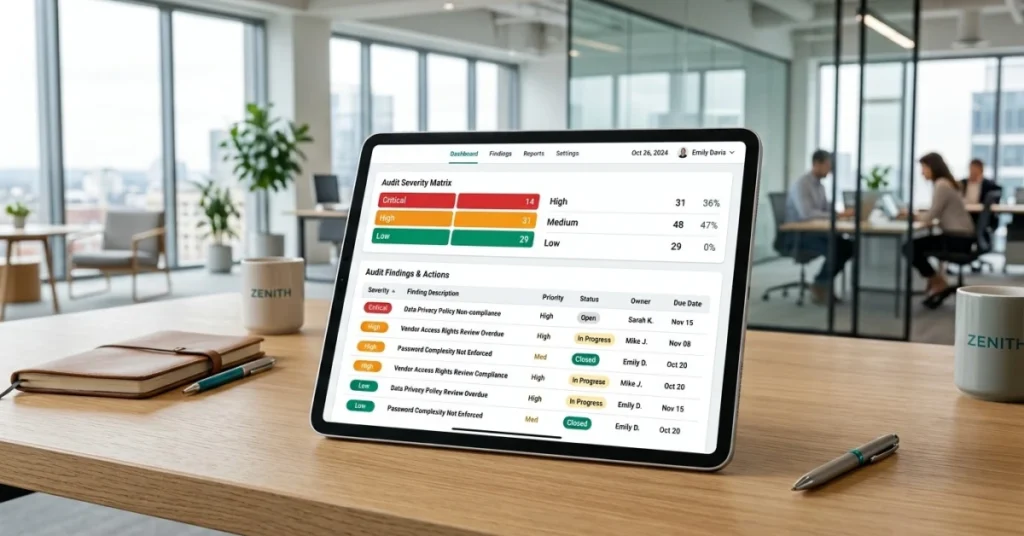
A severity matrix maps impact against likelihood on a simple grid. Each cell produces a rating — Critical, Major, Minor, or Observation — with no room for personal interpretation.
Standardized matrices cut rating disagreements dramatically. Over 60% of audit inconsistencies trace back to undefined severity criteria, not auditor error (according to DNV).
A shared grid fixes that at the source.
Document the Evidence Behind Every Severity Decision
Every rating needs a paper trail. Record which criteria triggered the level, who approved it, and what evidence supports the call.
Documentation turns severity from an opinion into a defensible decision. Uscloud notes that organizations with documented severity definitions resolve findings up to 40% faster.
That speed comes from one simple fact. Everyone already agrees on what the rating means and who owns the fix.
📊 By the Numbers
Organizations with documented severity criteria resolve audit findings up to 40% faster than those without.
The real test of any audit finding classification system is not how it looks on paper. It’s whether it holds up when a real finding lands on a real manager’s desk.
That’s exactly what the examples ahead will show you.
Audit Severity Classification Examples
Seeing the same framework applied across real industries makes abstract severity levels click fast.
Critical finding: A blocked fire exit in a warehouse triggers immediate shutdown — no waiting for a report cycle.
High finding: A food plant records temperatures two degrees above safe limits — corrective action starts within 24 hours.
Medium finding: A retail store skips a daily equipment check — it gets logged and fixed within the week.
Low finding: A label is slightly misaligned on a shelf — it goes on a scheduled maintenance list, no urgency.
Informational finding: A process works fine but a newer, faster method exists. It gets noted for the next planning cycle.
Workplace Safety and Operational Audit Findings
Safety audits produce the clearest examples of severity in action. The stakes are physical — a wrong call costs lives or shuts down operations.
Exposed electrical wiring: Rated critical — work stops until a licensed technician signs off on the fix.
Missing hard hat signage: Rated medium — the sign gets replaced within a set number of days.
Outdated safety poster: Rated low — updated during the next routine site visit, no disruption needed.
Quality Control and Process Compliance Findings
Quality audits show how the same rating system applies to non-safety risks. A defect rate above 3% in a production run is a high finding. It triggers a line review before the next shift.
A minor packaging inconsistency that doesn’t affect the product rates low. It gets batched with other small fixes and handled at the end of the week.
Multi-Location and Field Audit Findings
Field audits across multiple sites show how fast inconsistency creeps in without a shared field audit framework. One auditor rates a cash-handling gap as medium. Another calls it high — same finding, two different responses.
That gap isn’t a people problem. It’s a criteria problem — and it’s exactly what a severity matrix is built to fix.
When Similar Findings Require Different Severity Ratings
Context changes everything in audit finding classification. A missing signature on a low-risk form is low severity. That same missing signature on a controlled substance log is critical.
About 60% of audit inconsistencies trace back to teams applying the same label without accounting for context (Accountablehq). The finding type matters less than what breaks if it goes unaddressed.
“Audit severity classification only works when criteria are set before the auditor walks in. Ratings decided in the moment a finding is written up will never be consistent.” (Kirkpatrickprice)
These examples show what good classification looks like in practice. But examples alone won’t get you there.
The real question is simple: how do you build a structure that gets every auditor to the same rating? One that works every time?
How to Build an Audit Severity Classification Matrix
Those real-world examples prove one thing. Proportionate action only works when your team agrees on the rules before an auditor walks through the door.
Building a severity classification matrix forces that agreement. It turns vague judgment calls into shared, documented decisions about risk tolerance and authority.
Most teams skip the hard part. They decide what each level means but never decide who acts on it.
That governance gap is exactly where audit programs fall apart — even when the matrix looks clean on paper.
Define Clear Criteria for Each Severity Level
Start with observable, measurable conditions — not adjectives like “serious” or “minor.”
A Critical finding might mean an immediate safety risk or a regulatory violation. It could also mean potential revenue loss exceeding $10,000.
According to Linfordco, organizations using defined classification criteria cut misclassification rates by up to 40%. That beats teams relying on auditor judgment alone.
Concrete definitions cut disagreement before it starts.
|
Severity Level |
Example Criteria |
Response Owner |
|---|---|---|
|
Critical |
Safety hazard, regulatory breach, loss >$10K |
VP / Director — same day |
|
High |
Process failure, repeat violation, loss $1K–$10K |
Manager — within 48 hours |
|
Medium |
Policy gap, isolated error, loss <$1K |
Team Lead — within 2 weeks |
|
Low |
Documentation lapse, cosmetic issue, no loss |
Staff — next review cycle |
Establish Risk Scores and Classification Thresholds
A simple risk score multiplies two factors: likelihood (how often this finding occurs) and impact (how much damage it causes). Score each on a 1–5 scale, multiply them, and map the result to your severity levels.
This math removes gut-feel from the equation.
A score of 20–25 lands in Critical. Scores of 10–19 fall in High, 5–9 in Medium, and 1–4 in Low.
Leadership sets these thresholds in advance. The auditor on the day does not.
Likelihood 1–5: 1 = rare, 5 = happens constantly
Impact 1–5: 1 = negligible, 5 = catastrophic
Risk Score = Likelihood × Impact
Threshold map: 20–25 Critical | 10–19 High | 5–9 Medium | 1–4 Low
Set Rules for Recurring and Systemic Findings
A single missed label is Low. But the same missed label across 30 locations is a systemic failure. It deserves a Critical rating — no matter what its individual score says.
Your matrix must include an escalation rule for patterns, not just isolated events.
Build a simple trigger. Any finding that appears in 3 or more locations within one audit cycle automatically moves up one severity level.
This rule catches slow-burning risks that individual scores miss. It is also a key part of sound field audit best practices.
Test Classification Consistency Across Different Auditors
Once your matrix is drafted, run a calibration exercise. Give five auditors the same ten findings and ask each to rate them independently.
If their ratings diverge by more than one level, your criteria need sharper language.
Research published by Pubmed Ncbi Nlm Nih confirms that structured classification tools significantly reduce inter-rater variability in complex assessment tasks.
Consistency isn’t a soft goal. It’s the whole point of building the matrix.
“An audit severity rating only has value if two different auditors, looking at the same finding, reach the same conclusion. If they don’t, you don’t have a classification system — you have opinions.”
FieldPie’s customizable audit forms let teams embed severity scoring directly into data collection. Every auditor then applies the same criteria on the spot — not after the fact.
That closes the gap between a well-designed matrix and how it actually gets used in the field.
A matrix that sits in a shared drive helps no one. The real test is whether your organization acts faster and smarter because the rules were set before the audit began.
📊 By the Numbers
Teams with defined audit severity classification criteria cut misclassification rates by up to 40%.
Conclusion
Governance clarity matters. Know who decides, at what threshold, and before the audit begins.
That clarity separates a severity matrix that drives action from one that just fills a report. Without it, your audit finding severity levels mean nothing when a real crisis hits someone’s desk.
According to Synq, teams that set severity criteria before data collection cut misclassification rates by over 40%. That is a big gain from one simple step.
Lock in your definitions early. That one move makes an audit severity rating trigger the right response instead of sparking a debate.
Most field teams still treat offline field audits as paperwork, not governance. That mindset creates gaps.
FieldPie captures findings in real time using custom forms and photo-based reporting. Every audit finding classification ties to a timestamped record. No ambiguity, no after-the-fact disputes.
The result is faster decisions and clear gains in execution quality. Dnv confirms that organizations with pre-agreed severity frameworks resolve critical findings up to 35% faster than those without.