


✦ Key Takeaways
Retailers lose up to 25% of projected promotional sales when in-store displays fail compliance standards.
→ Non-compliant displays directly cut into measurable promotional ROI.
→ Compliance is tracked through audits, photos, and real-time field reporting.
→ A structured checklist eliminates guesswork and closes execution gaps fast.
In this article:
What Is Promotional Display Compliance?
How Is Promotional Display Compliance Measured?
How to Build a Promotional Display Compliance Checklist
Key takeaway: A strong promotional display compliance program is what separates a promotion that sells from one that wastes budget. Get it right, and every dollar works harder.
What Is Promotional Display Compliance?
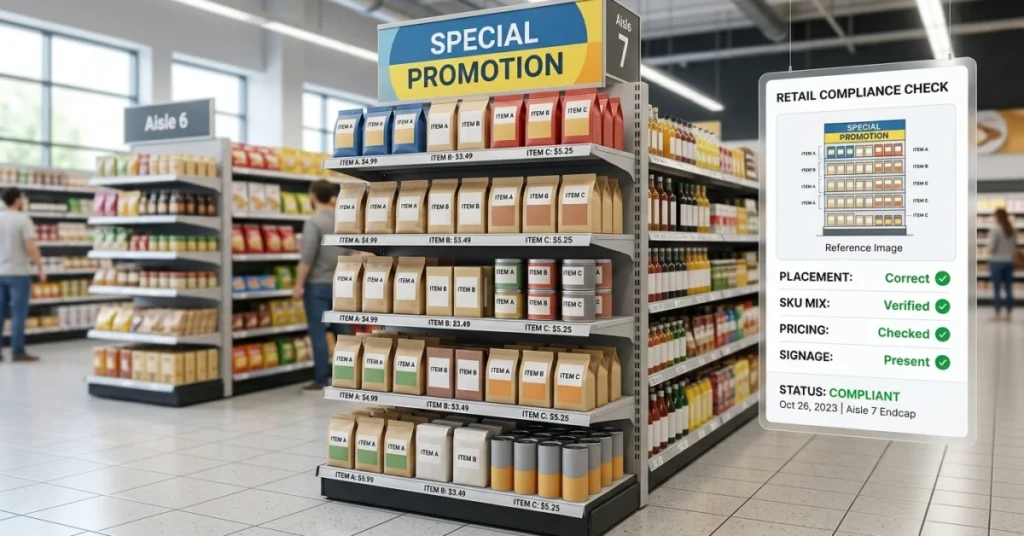
Picture a shopper walking past a blank endcap — no sign, no product, no promotion. That empty space means promotional display compliance broke down. The brand team designed the display. The store associate never built it.
Nearly 1 in 4 retail displays never gets executed correctly at the store level (Rapideyeinspections). That gap costs brands real revenue on every campaign they run.
What Counts as a Promotional Display in Retail?
A promotional display is any in-store fixture built to drive attention and sales. Endcaps, floor stands, shelf talkers, and seasonal setups all qualify. If a brand paid to place it and a store team has to build it, it counts.
What Does “Compliant” Actually Mean?
A display is compliant when it matches the brand’s original plan — right location, right products, right signage, right timing. Retail display compliance is not about perfection. It is about whether the shopper sees what the brand intended.
Pubsonline Informs supply chain research confirms that shelf-level execution gaps cut promotional lift directly. A non-compliant display is simply a promotion that never ran.
Why Promotional Display Compliance Matters for Brands and Retailers
Most brands treat in-store display standards as a logistics checklist. The real problem is a communication breakdown. The people who design displays and the people who build them rarely share the same picture of success.
A strong display compliance audit closes that gap. It gives both sides a shared language — not a policing tool. Visual merchandising compliance only sticks when store teams understand the “why,” not just the “what.”
Most brands know what compliance means. The harder question is whether their measurement method catches failures before those failures cost them sales.
How Is Promotional Display Compliance Measured?
Knowing that displays fail is one thing — knowing why and where they fail is what separates brands that fix the problem from brands that repeat it.
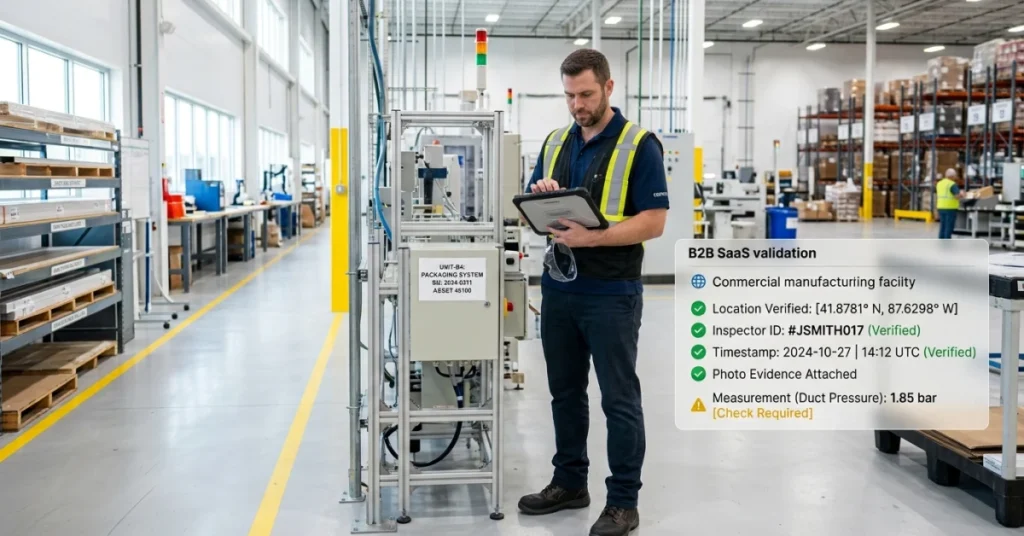
Most companies track promotional display compliance through sporadic store audits or rep self-reporting. Both methods share the same fatal flaw: the data arrives too late to rescue the promotion.
Self-reporting is especially blind. Store associates tell you what they think you want to hear. (Spartapewter found that brands lose up to 30% of promotional revenue to poor in-store execution.) That gap almost never shows up in a self-reported checklist.
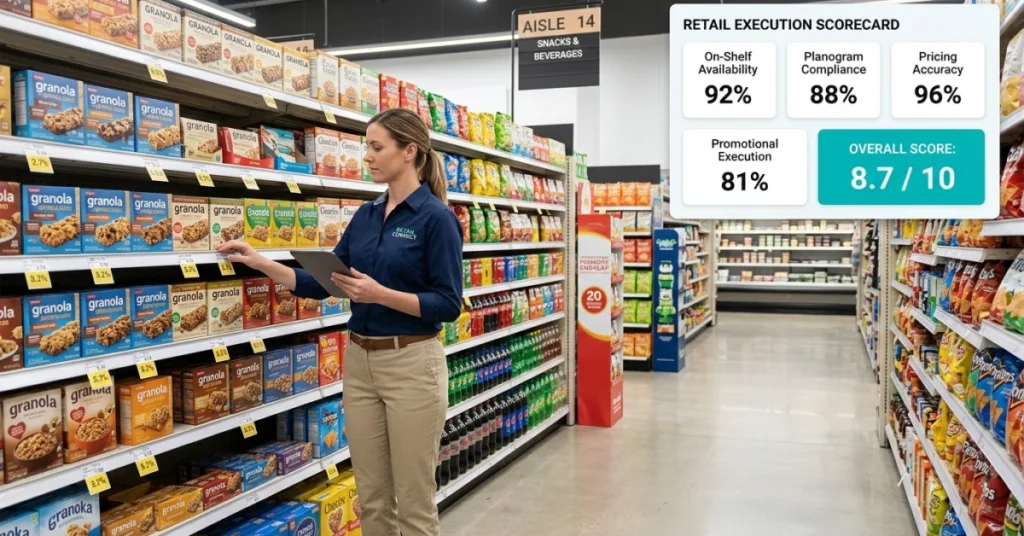
Real measurement breaks compliance into specific, observable signals — not a single pass/fail grade. Understanding display compliance ROI starts with knowing exactly which signals to track.
Display Presence and Placement
The first signal is simple: is the display actually there? Auditors check whether the unit exists in the right zone — endcap, aisle, or floor — as the brand specified.
Wrong placement can cut shopper exposure by more than half. That holds true even when the display is fully stocked and correctly priced.
Correct SKU and Assortment
A display built with the wrong products still fails retail execution standards. Auditors verify that every SKU on the fixture matches the approved planogram exactly.
One wrong product swap can trigger a failure across an entire chain — even if 95% of the display looks right.
Product Availability and Stock Levels
An empty display is a failure, full stop. Auditors check that stock meets the minimum fill level the brand set before the promotion launched.
Low stock signals a replenishment breakdown. It costs the brand a sale every time a shopper reaches for a product that isn’t there.
Pricing and Promotional Label Accuracy
Price errors are among the most damaging gaps because shoppers notice them instantly. In-store standards require that every promotional price tag match the approved offer — down to the cent.
A wrong price erodes trust and can trigger regulatory issues in some states. It also directly undercuts the promotion’s value to the shopper.
POS Material and Signage Compliance
Visual merchandising standards cover every piece of signage — header cards, shelf talkers, and brand graphics. Auditors confirm that approved materials are present, undamaged, and correctly positioned.
Missing or wrong signage breaks the brand story the display was designed to tell. Shoppers who never see the message won’t act on it. PubMed confirms that visual cues at the point of sale directly shape purchase decisions.
Display Timing and Promotion Dates
A display that goes up three days late — or stays up a week after the promotion ends — fails a timing check on its own. Brands set specific go-live and teardown dates for a reason.
Timing is the most overlooked signal. Yet it determines whether the display ever aligns with the ad, the circular, or the digital campaign driving shoppers to the store.
📊 By the Numbers
Brands lose up to 30% of promotional revenue when in-store execution misses the mark — and most never know it.
Tracking these six signals turns a vague audit into a precise diagnostic. But measurement alone doesn’t close the gap between what brands design and what stores actually build.

How to Build a Promotional Display Compliance Checklist
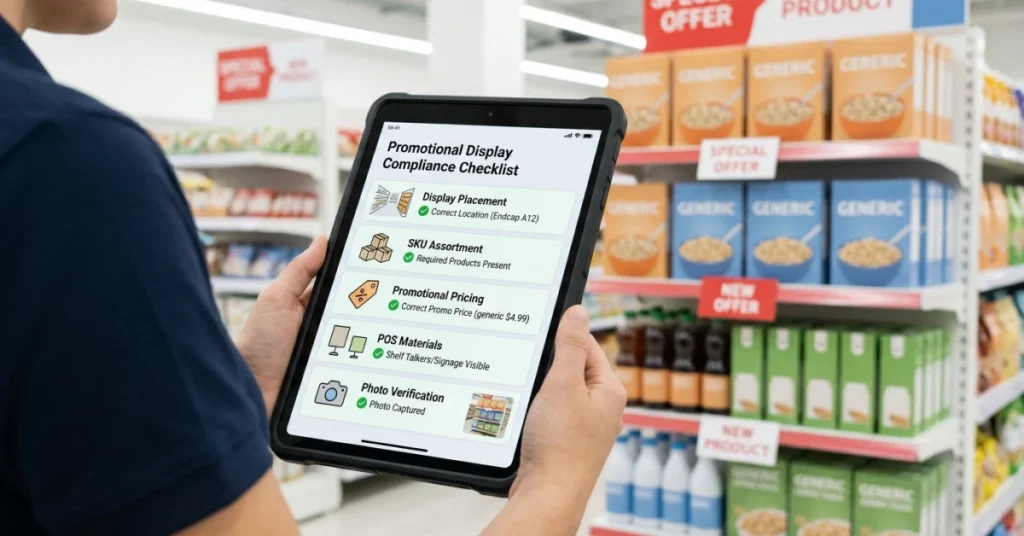
Real-time visibility solves the timing problem — but only if field teams know exactly what to verify when they arrive at a store. A structured review built as a shared communication tool, not a policing form, is what finally closes the gap between brand intent and store reality.
Most brands treat their checklist as a pass/fail audit sheet. That framing guarantees friction — store associates see it as judgment, not guidance, and execution stays inconsistent.
📊 By the Numbers
Brands with structured display compliance audits recover up to 25% more promotional revenue per campaign cycle.
Confirm the Display Is Installed in the Assigned Location
A fixture placed in the wrong aisle is invisible to the shopper it was designed to reach. Verify the exact floor position against the planogram before reviewing anything else.
Verify Required SKUs and Product Quantities
Missing SKUs rank among the most common retail execution failures — and the easiest to overlook on a quick walk-by. Count every product slot against the approved SKU list before moving on.
Over 30% of promotional setups launch with at least one wrong or absent SKU (according to Roamler). That single gap can cut a promotion’s sales lift in half.
Check Display Layout Against the Approved Standard
Visual merchandising accuracy lives or dies on layout precision. Compare the physical fixture to the approved image or schematic — shelf by shelf, not just at a glance.
Validate Promotional Pricing and Labels
Incorrect pricing at the fixture destroys shopper trust fast. Confirm every price tag matches the approved promotional rate before the store opens for the day.
According to Brandelity, 68% of purchase decisions happen at the point of sale — meaning an incorrect price label can redirect that decision to a competitor in seconds.
Confirm Signage and POS Materials Are Present
A fixture without its signage is just a shelf. Verify that every header card, shelf talker, and banner is present, undamaged, and facing the shopper correctly.
Capture Photo Evidence Before Completing the Visit
Photo proof turns a subjective walkthrough into a verifiable record. Shoot the full setup, close-ups of pricing, and any execution gaps — timestamp included — before leaving the floor.
When every field rep follows this same sequence, the process stops being a form and becomes a shared language — one that brand teams and store associates both trust. That trust is what separates brands with consistent in-store standards from those still chasing gaps after every campaign ends.
Conclusion
That mindset shift — from policing tool to shared language — is the single thing that separates brands with consistent promotional display compliance from those chasing it every campaign cycle.
Brands that close the communication gap between designers and store associates stop treating compliance as a cleanup task. They start treating it as a launch condition.
Missed displays cost more than most teams realize. According to Sellerscommerce, over 70% of purchase decisions happen at the point of sale.
A blank endcap doesn’t just look bad — it kills a sale that was already close. That’s why display execution ROI depends on getting the checklist right before the promotion launches, not after.
Brands that still rely on sporadic audits and self-reporting are flying blind. Rapideyeinspections found that non-compliance rates drop sharply when field teams use structured, photo-based checks at the store level.
Most retail display compliance failures aren’t execution failures. They’re communication failures that a clear checklist could have prevented.