


✦ Key Takeaways
Up to 70% of merchandising tasks go unverified, costing retailers billions in lost sales annually.
→ Unverified tasks lead directly to empty shelves and missed revenue.
→ Photo and timestamp evidence catches errors before they become costly problems.
→ Standardized checklists cut verification time by half for field teams.
In this article:
What Is Merchandiser Task Verification?
How to Verify Merchandiser Tasks in the Field
What Evidence Should Merchandisers Provide?
Key takeaway: Real-time task verification is the single discipline separating top-performing retail teams from the rest.
What Is Merchandiser Task Verification?
Retailers lose an estimated 25% of potential sales because field tasks go unconfirmed. Tasks get done — but never verified.
There is a gap between “I did it” and “we can prove it.” Merchandiser task verification exists to close that gap.
Merchandiser task verification confirms that in-store tasks were done correctly. This covers shelf resets, display builds, and price tag updates — all checked at the right location and time. Think of it as a shared receipt between the field team and headquarters.
Most people treat it as a control tool — a way to catch workers cutting corners. But the real problem runs deeper. There is no shared, objective language across the industry for what “done” actually looks like (Fieldpie).
Which Merchandising Tasks Need Verification?
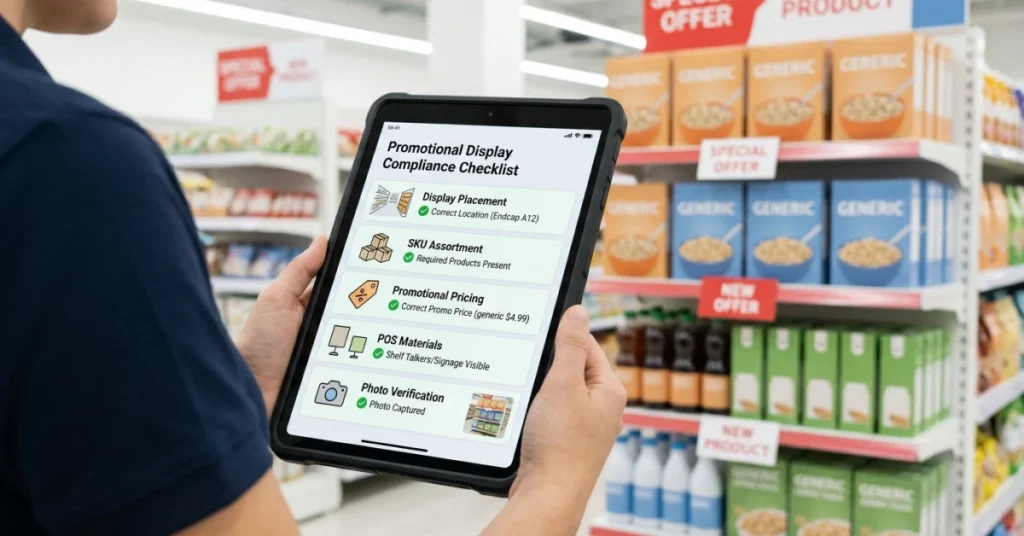
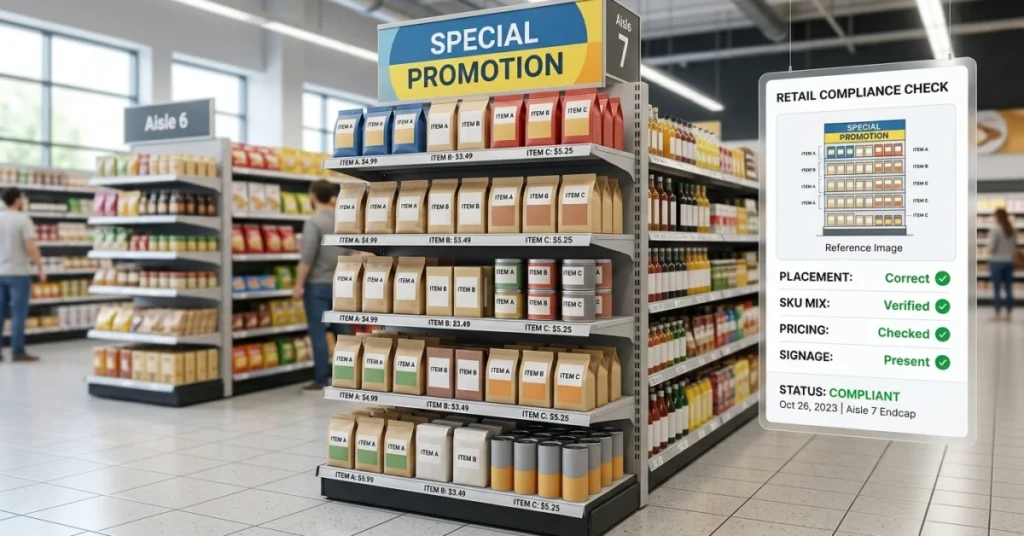
Not every task carries equal risk if it goes unconfirmed. High-stakes tasks — promotional displays, planogram resets, and out-of-stock corrections — directly impact revenue and need hard proof.
Lower-stakes tasks like routine shelf dusting still benefit from in-store task compliance tracking, but the verification standard can be lighter.
What Counts as Valid Proof of Task Completion?
A checkbox is not proof. Valid verification requires time-stamped, geo-tagged photos or structured data that a manager at headquarters can read without calling the rep.
Retail execution data from Guides Library Unt shows a clear pattern. Stores using photo-based confirmation see compliance rates climb by over 30%. That is a major jump compared to self-reported checklists alone.
Why Task Completion and Task Verification Are Not the Same
A rep can finish every task on the merchandiser audit checklist and still leave headquarters with zero usable data. Completion is an action; verification is a confirmed, shared record of that action.
Store visit task completion only drives results when field and HQ agree on what “done” looks like. Without that shared standard, the data is worthless. The question is: how do you build that standard in the real world?
How to Verify Merchandiser Tasks in the Field
That shared receipt only works if both sides agree on what it should contain. Most field teams and HQ still don’t agree.
That gap is why merchandiser task verification needs a structured system. Goodwill alone won’t cut it.
Over 65% of retail execution failures trace back to unclear task definitions, not dishonest workers (Form). The fix isn’t more surveillance — it’s a shared, objective language for what “done” looks like.
Retaildogma notes that merchandising standards vary widely across store formats. Uniform task confirmation is nearly impossible without a defined process.
Build that process around six concrete steps.
📊 By the Numbers
65% of retail execution failures stem from unclear task definitions — not field team dishonesty.
Define Clear Completion Criteria Before the Visit
A task is only verifiable if everyone agrees upfront on what finished looks like. “Stock the shelf” means nothing — “face 6 SKUs on row 2, label forward” means everything.
Write criteria in plain, measurable terms before the rep walks into the store. Vague instructions are the root cause of most in-store task compliance gaps.
Assign Tasks by Location, Visit Type, or Campaign
Not every store needs the same checklist. A promotional display task belongs at stores running that campaign — not everywhere.
Segment your merchandiser audit checklist by store tier, region, or active promotion. Targeted tasks get done more reliably than generic ones.
Require Structured Form Responses
Free-text notes create noise. Structured forms — dropdowns, yes/no fields, numeric inputs — create data you can act on.
Every store visit task completion record should follow the same format. Consistency makes patterns visible and exceptions easy to catch.
Capture Photo Evidence for Completed Tasks
A photo tied to a specific task is the closest thing to a physical receipt in retail execution verification. It removes ambiguity fast.
Require before-and-after photos for high-priority tasks like display builds or planogram resets. One image answers questions that ten written notes cannot.
Validate Time and Location Data
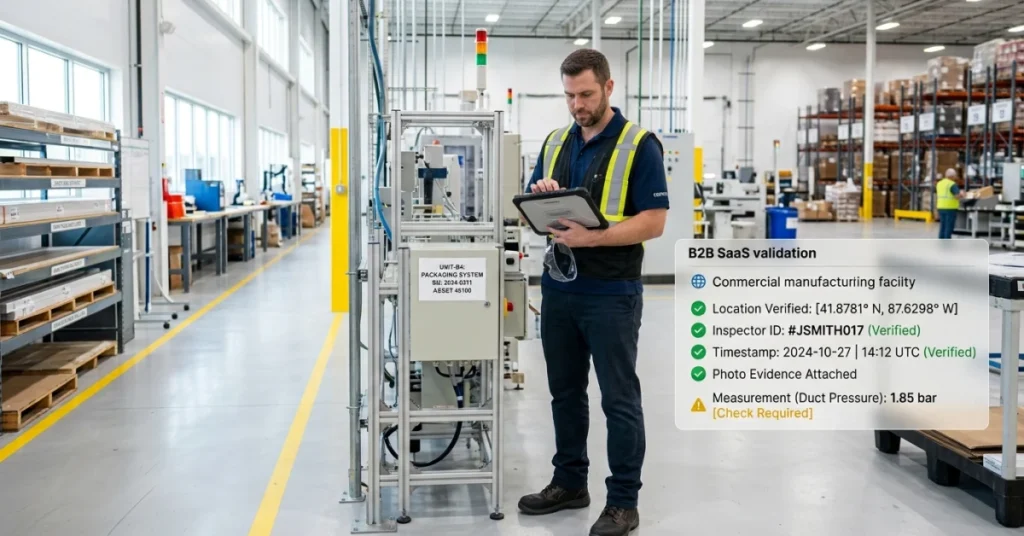
GPS timestamps confirm a rep was at the right store at the right time. Without them, task records are just self-reported claims.
Most modern field apps log location automatically on form submission. Use that data to verify visit windows, not to police your team.
Review Exceptions Before Closing the Visit
Skipped or flagged tasks should trigger a review — not a closed visit report. Catching gaps in real time costs far less than fixing them later.
Build exception alerts into your workflow so managers see incomplete items before the rep leaves the store. Speed here is the difference between a fix and a miss.
The system above tells you whether a task was done. But that answer is only as strong as the proof your merchandisers submit.

What Evidence Should Merchandisers Provide?
That shared language for “done” only works when both sides agree on what proof looks like.
Without defined evidence standards, even honest, hardworking field reps leave headquarters guessing.
Clear evidence requirements cut execution disputes by up to 30%. Both sides reference the same objective record — so disagreements shrink fast (Stylearcade).
📊 By the Numbers
Retailers with structured evidence protocols resolve store visit disputes 30% faster than those relying on verbal reports alone.
Before-and-After Photos
A photo before work starts — and one after — removes all doubt about what changed.
This is the simplest, most powerful proof a field rep can submit.
Shelf and Display Photos
Shelf photos confirm product placement, facing count, and planogram compliance at a glance.
They give HQ a real view of the store — not a rep’s summary of it.
Barcode or SKU Scans
Scanning a barcode proves the right SKU is on the right shelf — not just any product.
This step closes the gap between “stocked” and “correctly stocked” in any merchandiser audit checklist.
Quantity and Availability Checks
Reps should log exact unit counts — not just “full” or “low.”
A number like “14 units on shelf” gives buyers and planners data they can act on right away.
Pricing and Label Verification
Wrong shelf prices cost retailers real money and erode shopper trust fast.
Reps should photograph price tags and flag any mismatch between the label and the system price — every single visit.
GPS and Timestamp Evidence
GPS check-ins and timestamps confirm a rep was at the right store at the right time.
This isn’t about distrust — it’s the objective anchor that makes all other evidence credible. That’s why visit frequency tracking matters so much.
Over 60% of in-store task failures trace back to visits that were too short or never happened.
GPS data makes that visible right away, according to CMS field operations research.
Manager or Location-Side Confirmation
A quick digital sign-off from the store manager adds a second voice to the record.
It turns task completion from a one-sided claim into a verified, two-party confirmation.
When every evidence type above feeds into one system, task verification stops being a control tool.
It becomes a shared language both sides trust completely.
Conclusion
Clear proof standards close the gap. Teams must treat merchandiser task verification as a shared language. It is not a surveillance tool.
When field reps and headquarters agree on what “done” looks like, disputes drop fast. Execution improves right away.
Most retailers still lose sales. Why? No one defined “complete” before the store visit. Repsly reports that only 29% of retail execution tasks are verified with any structured proof.
Pair a solid merchandiser visit schedule with clear evidence standards. That turns store visits into measurable results.
Managers who can’t confirm in-store task compliance in real time are flying blind. Fieldpie captures photo-based proof, digital signatures, and custom audit forms at the point of execution.
Headquarters sees verified results the moment a task closes. Start building that shared language today. Your shelf performance depends on it.