✦ Key Takeaways · 5 min read
AI in retail is growing fast. The market is projected to jump from USD 11.61 billion in 2024 to USD 40.74 billion by 2030.
→ Execution failures silently drain revenue before anyone notices.
→ Field data becomes worthless without systems that interpret it fast.
→ AI transforms store-level chaos into clear, actionable priorities.
In this article:
The Hidden Cost of Retail Execution Failures
What Is the Retail Execution Gap and Why Does It Happen?
How AI Diagnoses Retail Execution Problems at Scale
AI-Powered Insights: Turning Field Data into Smarter Decisions
Key takeaway: Retailers who deploy AI in execution today will own the shelf tomorrow.
The Hidden Cost of Retail Execution Failures
Internal theft alone costs retailers $110 billion a year, according to the National Retail Federation via Apu Apus. That figure covers only one piece of what poor store-level performance drains from the industry each year. Most brands track sales numbers closely but never see the shelf-level detail that explains why those numbers fall short.
The losses that get the least attention aren’t from fraud or theft. A misplaced product is one culprit. A promotion that never got set up is another. So is a shelf that ran empty on a Saturday afternoon with nobody around to catch it. These problems are quiet, routine, and almost never traced back to their true source.
Why HQ strategy breaks down at store level
A brand’s headquarters can build a perfect planogram, approve a flawless promotion, and ship the right product to every store. What it can’t do is confirm that any of it actually landed correctly on the shelf. That gap between what was planned and what a shopper sees is where retail execution failures quietly compound.
The root causes of poor retail execution are rarely laziness. They’re almost always a visibility problem.
How much revenue poor execution actually costs
Every out-of-stock item, every misplaced display, and every skipped compliance check is a sale that simply didn’t happen. Scale that across thousands of locations and dozens of weekly store visits, and the retail execution gap stops looking like an operational nuisance. It starts looking like a revenue crisis.
AI in retail execution is starting to surface exactly this kind of loss. It connects shelf-level signals to sales data in ways that manual audits never could. The real question is why this gap has persisted so long, and what’s been standing in the way of fixing it.
What Is the Retail Execution Gap and Why Does It Happen?
Those invisible losses don’t happen by accident. The retail execution gap is the distance between what a brand plans for its products and what shoppers actually find on the shelf. A product might be perfectly stocked in the back room while the shelf sits empty, and nobody flags it as a problem.
Think of it this way: say your team runs a promotion for a new snack brand, complete with a custom display and a price tag. If the display never gets built, or gets buried behind a competitor’s product, the promotion fails silently. AI in retail execution exists precisely because these failures are nearly impossible to catch through manual store visits alone.
Detection vs. root cause: a critical distinction
Most retailers can tell you a product didn’t sell. Very few can tell you why it didn’t sell. Spotting a sales dip is detection. Understanding that a shelf tag was wrong, a facing was collapsed, or a rep skipped a store is root cause analysis, and that second step is where most brands fall short.
Without root cause clarity, the fix is always a guess. Teams send more reps, reprint more tags, and run more audits, but the same failures repeat the next week at a different store.
Most common root causes of execution failures
Retail execution failure usually traces back to a short list of recurring breakdowns, not bad intentions or lazy teams. The problems are structural, and they compound across hundreds of locations at once.
Out-of-stocks: product sells through faster than replenishment cycles catch up
Planogram non-compliance: store staff reset shelves incorrectly or skip resets entirely
Missed promotional setups: displays, price cards, or secondary placements never get built
Phantom inventory: the system shows stock on hand, but the product is buried, misplaced, or damaged
Infrequent field coverage: a rep visits once a month, so problems sit unresolved for weeks
Each of these root causes of poor retail execution leaves a data trail, but only if someone collects it consistently and fast enough to act. That’s the gap AI-powered store execution tools are built to close, by reading shelf images, cross-referencing sales signals, and surfacing problems before a shopper ever notices them.
The harder question isn’t whether these failures happen. It’s whether the data to diagnose them at scale has ever truly been within reach.

How AI Diagnoses Retail Execution Problems at Scale
Those silent revenue leaks happen because no human team can watch thousands of shelves at once. AI in retail execution fixes that by doing something field reps simply can’t do. It processes photos, sales signals, and store reports from every location at the same time, then flags the exact spots where reality doesn’t match the plan.
Say your team launches a new product in five hundred stores. A field rep visits each location once a month, so a misplaced display could sit wrong for weeks before anyone catches it. AI analyzes shelf images the moment a store associate uploads them and surfaces the problem the same day, not the same quarter.
Image recognition and planogram compliance
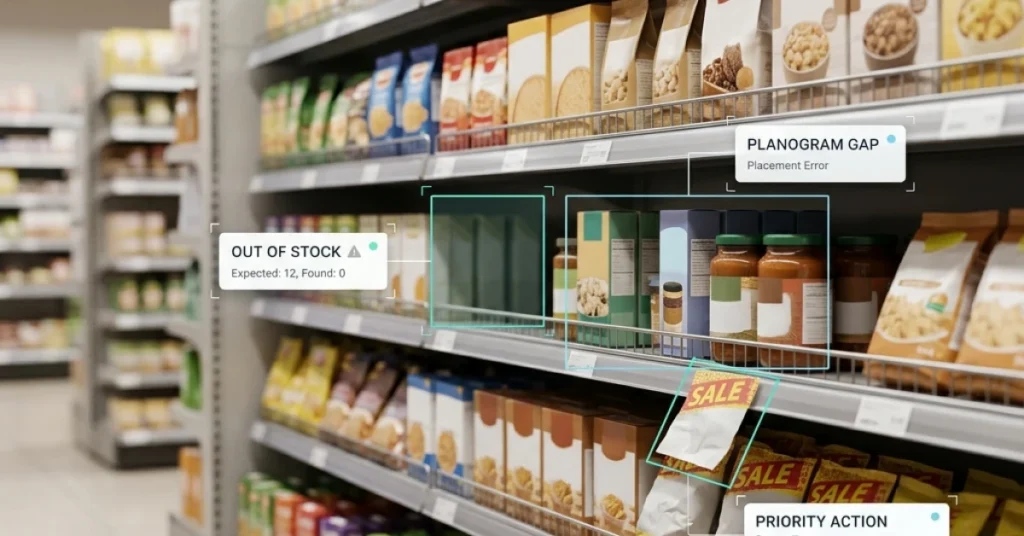
A planogram is simply a diagram that shows exactly where each product should sit on a shelf. AI-powered store execution tools use image recognition to compare a photo of the actual shelf against that diagram and score the gap in seconds.
This closes the retail execution gap that manual audits always leave open. A rep eyeballing a shelf might miss a facing turned sideways or a competitor product creeping into the wrong slot. A trained image model catches both every time, across every store in the network.
What data AI needs to diagnose accurately
Accurate diagnosis depends on feeding the model the right inputs: shelf photos, point-of-sale data, and field visit notes, all tied to a specific store and time stamp. Without that connection, the AI sees fragments instead of a full picture, and its output is just noise.
Understanding the root causes of retail execution failure matters here, because AI is only as useful as the questions you ask it. Combining image data with sales velocity lets brands tell the difference between a product that’s out of stock and one that’s shelved in the wrong aisle. Those are two very different problems that need two very different fixes.
Diagnosing the problem is only half the equation. The real value comes when those diagnoses feed directly into the decisions your field teams make every single day.
AI-Powered Insights: Turning Field Data into Smarter Decisions

Catching a misplaced display fast is only half the job. The real shift happens when that single flag becomes part of a pattern your team can actually act on before the next store visit.
Field reps have always collected data. The problem was that it sat in spreadsheets, got summarized in weekly calls, and arrived too late to fix anything. AI store visit forecasting changes that by processing signals from hundreds of locations the moment they come in, not days later.
A rep visits each one roughly once a month. That means on any given day, 290 of those stores are running on stale information. AI closes that gap by reading sales data, shelf photos, and visit notes together, spotting drift before it becomes a full retail execution failure.
How AI Turns Raw Field Data Into Decisions
Most field data tools collect information. AI-powered tools connect it, rank it by urgency, and push the right alert to the right person at the right time.
|
Data Type |
What AI Does With It |
Decision It Enables |
Speed vs. Manual Review |
|---|---|---|---|
|
Shelf photos from reps |
Scans for out-of-stock and planogram gaps automatically |
Dispatch a rep or alert the store manager same day |
High (minutes vs. days) |
|
Point-of-sale signals |
Flags stores where sales drop without a clear reason |
Prioritize which stores need a visit this week |
High (real-time vs. weekly report) |
|
Rep visit notes |
Groups recurring complaints by region or store type |
Fix a systemic root cause, not just one store’s problem |
Medium (pattern visible in days, not quarters) |
|
Promotion compliance photos |
Compares actual display against the approved setup |
Recover a promotion before it ends, not after |
High (automated vs. manual audit) |
|
Historical visit frequency |
Predicts which stores are overdue for attention |
Build smarter route plans before problems appear |
High (proactive vs. reactive scheduling) |
The pattern across every row is the same: AI compresses the time between a problem forming and a person knowing about it. That compression is what separates AI-powered store execution from traditional field management.
“The retail execution gap isn’t a people problem. It’s a timing problem. By the time a human reviews the data, the window to fix it has already closed.”
What Smarter Decisions Actually Look Like in Practice
A brand manager sees a heatmap of stores where a new product is consistently shelved in the wrong aisle, and fixes the planogram brief before the next shipment goes out.
A field team lead gets a ranked list every Monday morning showing which stores need a visit most urgently, based on sales dips and time since last check.
A regional director spots that one store type across three cities keeps breaking the same display rule, and traces it back to a training gap, not a compliance problem.
A sales rep arrives at a store already knowing what’s likely wrong, because the AI flagged a photo anomaly from the previous visit.
This is what closing the retail execution gap looks like in practice. It’s not about replacing field reps. It’s about making every hour they spend in a store count for more.
Brands that have been losing value quietly for years, through missed promotions, empty shelves, and ignored planograms, are starting to see those losses as fixable. That shift in mindset is exactly what makes the next question worth asking: is AI in retail execution still a competitive edge, or has it already become the baseline cost of staying in the game?
Conclusion
Stale field reports never match real-time shelf reality. That gap is exactly where brands bleed revenue without ever seeing it happen. AI in retail execution turns scattered store signals into decisions a field team can act on before the next visit. It closes the loop faster than any manual process can.
Say your team spots a planogram violation in one region on a Tuesday morning and fixes it that same day. That’s the shift from reactive to proactive that separates growing brands from struggling ones.
The retail execution gap isn’t new, but the tools to close it finally are. For decades, brands accepted that some stock would sit wrong and some displays would go unbuilt. Some promotions would quietly fail between store visits, and no one would know until the numbers came in.
Digital twin retail technology is one signal that the industry is done accepting that as normal.
Most brands still lose shelf performance to execution failures they can’t see until it’s too late. FieldPie catches those failures in real time by connecting field audits, rep activity, and store data into a live picture managers can actually use. FieldPie offers an AI-powered field operations platform built for businesses. It handles scheduling, routing, audits, sales, merchandising, and team tracking from a single mobile-friendly tool.