


✦ Key Takeaways
Up to 43% of out-of-stocks occur when product sits in the backroom instead of on the shelf.
→ Stockouts cost U.S. retailers $82 billion in lost sales annually.
→ Poor replenishment timing breaks the link between inventory and revenue.
→ A structured workflow cuts shelf gaps faster than hiring more staff.
In this article:
What Is Backroom to Shelf Replenishment?
What Causes Backroom to Shelf Replenishment Gaps?
How to Build a Backroom to Shelf Replenishment Workflow
Key takeaway: Fix your backroom-to-shelf process first — everything else in retail execution depends on it.
What Is Backroom to Shelf Replenishment?
Retailers lose an estimated 4% of annual sales to out-of-stock shelves — yet the product is often sitting 30 feet away in the backroom.
That gap between stockroom and sales floor is the real problem, and it has a name: backroom to shelf replenishment.
This process covers every step a product takes from the backroom to the shelf. It sounds simple. In practice, it breaks down constantly.
How Backroom Stock Becomes Shelf Availability
Someone has to physically move product from storage to the sales floor — scan it, sort it, and place it in the right slot. That handoff is the shelf replenishment process, and it depends entirely on store-level execution, not upstream logistics.
A shipment can arrive on time and still never reach the shelf. The failure happens in the last few feet, which is why AI retail shelf tools are changing how stores track and close that gap.
Backroom Inventory vs. On-Shelf Inventory
Backroom inventory is stock the store owns but shoppers cannot reach. On-shelf inventory is what actually drives sales.
These two numbers are rarely the same. The difference between them is where revenue quietly disappears.
Backroom inventory management means actively shrinking that gap. It is not just counting boxes — it is moving them fast and to the right place.
Researchgate finds that backroom size and replenishment frequency directly shape how much shelf space a product can profitably hold.
Why Products Can Be in Stock but Still Out of Stock on the Shelf
Inventory systems often show a product as “available” when it is buried in the backroom. That phantom availability fools managers and frustrates shoppers.
Cocoa Ethz research confirms that inaccurate store-level inventory records are a leading driver of preventable out-of-stocks.
This is a last-yard execution problem. The supply chain did its job, and the store still fails the shopper. The question is what, exactly, causes that final breakdown.
What Causes Backroom to Shelf Replenishment Gaps?
That breakdown almost never starts in the supply chain — the product is already in the building. The problem lives in the last few feet between the stockroom and the sales floor.
This makes it a store-level execution issue, not a logistics one. The right fixes happen inside the four walls of the store.
Retailers lose an estimated 8% of sales annually to out-of-stocks. Many of those empty shelves have full cases sitting just yards away in the backroom (Sciencedirect).
That gap is a process failure. It has specific, fixable causes.
Missed or Delayed Replenishment Tasks
Restocking tasks get skipped when no one owns them. Without a clear schedule and assigned accountability, they get pushed behind unloading, cleaning, and customer service.
Poor Backroom Organization
A disorganized backroom slows every part of the stocking process. When product is buried, mislabeled, or stacked out of order, workers waste time searching instead of filling shelves.
Inaccurate Inventory Records
Systems often show stock as available when it is damaged, misplaced, or already sold. Teams trust the number on the screen and skip the backroom check entirely.
This is where AI shelf audit tools make a real difference. They spot the mismatch between what the system shows and what the shelf actually holds.
High Product Velocity and Small Shelf Capacity
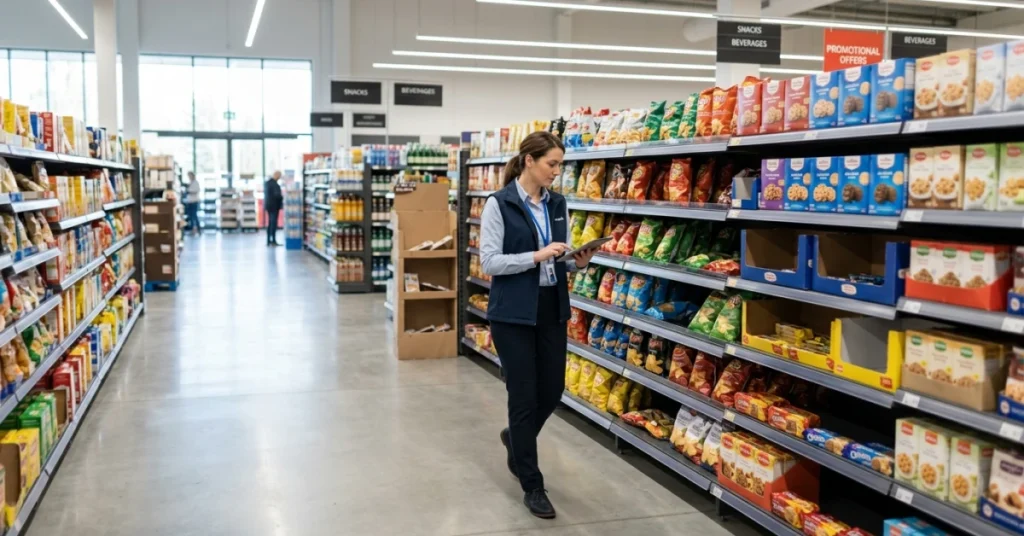
Fast-moving items like beverages and snacks can sell out within hours of a morning restock. Limited shelf space means high-velocity products need more frequent fill cycles than most stores plan for.
Misplaced or Hidden Backroom Stock
Product gets stacked in the wrong aisle, buried under new freight, or pushed to a corner during a rush. Locus notes that weak backroom inventory management is one of the top drivers of phantom out-of-stocks.
These are shelves that look empty while stock sits nearby. The product exists — it just cannot be found.
Communication Gaps Between Store and Field Teams
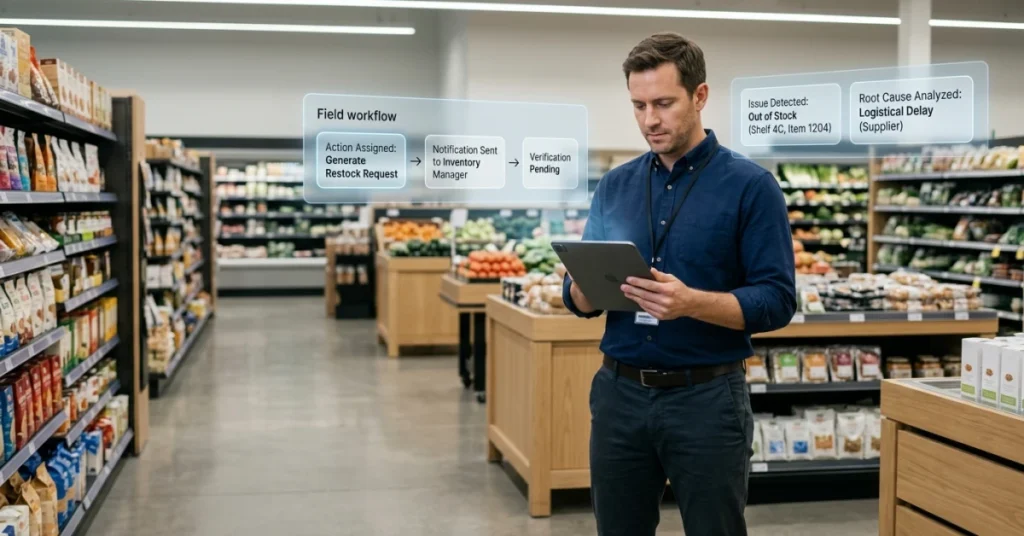
Field managers often don’t know which shelves are empty until a shopper complains or a report surfaces days later. Without real-time visibility, shelf restocking stays reactive instead of proactive.
Every one of these causes shares a common thread. They are all solvable with the right process design and clear ownership at the store level.
📊 By the Numbers
Retailers lose roughly 8% of annual sales to out-of-stocks — many caused by product already in the backroom.
Knowing the causes is only half the work. The real question is what a disciplined backroom to shelf replenishment workflow looks like in practice.
How to Build a Backroom to Shelf Replenishment Workflow
Fixing the replenishment gap starts with a repeatable process — not a pep talk or a new hire. The product is already in the building; the workflow is what gets it to the shelf.
Stores that run a structured shelf replenishment process see fewer out-of-stocks and higher on-shelf availability — which directly protects sales. (Econstor found that on-shelf availability failures cause retailers to lose up to 4% of annual sales per item.)
The six steps below build a last-yard execution system — one that puts clear ownership on every action from backroom to shelf.
📊 By the Numbers
Retailers lose up to 4% of annual sales per item due to on-shelf availability failures.
Step 1 — Check On-Shelf Availability
Walk the aisle before you touch the backroom. You need to see exactly which shelf slots are empty or running low.
Don’t rely on memory or gut feel — use a scan gun or checklist so every gap is recorded, not guessed.
Step 2 — Confirm Backroom Inventory
Cross-check your shelf gaps against actual backroom stock — not just what the system says is there. Inventory records drift; physical counts don’t lie.
This is where shelf intelligence data pays off — it shows you what’s truly available versus what’s just logged.
Step 3 — Identify Shelf Gaps and Replenishment Priorities
Not every empty slot is equal. Prioritize high-velocity items — the ones that sell fast and hurt revenue most when they’re gone.
Rank your gaps by sales rate, then work top-down so your team fills the most critical spots first.
Step 4 — Move Available Stock to the Shelf
Pull the prioritized items from the backroom and move them to the sales floor in one focused trip. Avoid partial runs — they waste time and leave gaps open longer.
Assign one person to own each aisle or zone so nothing falls through the cracks.
Step 5 — Verify Facings, Placement, and Quantity
Putting product on the shelf isn’t the finish line. Check that each item is in the right slot, facing forward, and stocked to the correct depth.
A misplaced item is nearly as bad as a missing one — shoppers won’t find it, and sales still drop.
Step 6 — Record Unresolved Out-of-Stocks
When backroom stock can’t fill a gap, log it immediately — don’t leave it for the next shift to discover. Retailtouchpoints notes that unrecorded out-of-stocks are one of the most common — and costly — blind spots in backroom inventory management.
A logged gap triggers a reorder. An unlogged gap just stays empty until a customer walks away frustrated.
A workflow like this turns the last-yard execution problem into a solved one — and the stores that run it consistently are the ones that never have to explain an empty shelf to a customer.
Conclusion
That six-step workflow is not just theory. It is the difference between a shelf that sells and a backroom that quietly kills revenue.
Retailers lose up to 4% of annual sales to out-of-stocks. Most of that loss happens after the product is already in the building (Researchgate).
The backroom-to-shelf replenishment gap is a last-yard execution problem. It is not a supply chain failure.
Good shelf intelligence practices show that ownership, sequence, and accountability at store level matter. Those three things separate high-performing teams from ones chasing empty pegs.
Empty shelves drain revenue fast. No upstream fix can recover that lost sales opportunity.
FieldPie captures real-time photo proof, task completion data, and replenishment audit trails from the sales floor. Managers spot gaps before customers do.
Teams using structured field execution see real gains in on-shelf availability. Moz notes that brands with consistent retail execution data improve local search-driven foot traffic by up to 23%.
Start building your replenishment process with FieldPie’s scheduling, photo reporting, and real-time field visibility tools today.