


✦ Key Takeaways
Retailers lose up to 25% of expected sales when in-store displays fail to meet compliance standards undetected.
→ Manual audits catch fewer than 60% of display violations.
→ Image recognition flags non-compliance in seconds, not days.
→ One camera system can monitor thousands of SKUs simultaneously.
In this article:
What Is Image Recognition for Display Compliance?
Why Is Display Compliance Difficult to Monitor?
How Does Image Recognition Verify Display Compliance?
What Can Image Recognition Detect?
Key takeaway: Image recognition is the only scalable solution that makes display compliance enforcement actually reliable.
What Is Image Recognition for Display Compliance?
Retail teams lose sales every day because a display looks fine in a photo but fails on closer review. Image recognition for display compliance fixes that. It reads field photos automatically and flags every gap, misplaced product, or missing sign.
The real breakthrough isn’t speed. Planogram compliance AI turns raw shelf photos into a structured, searchable record. That makes enforcement a continuous discipline, not a quarterly event.
Retail brands that use AI-powered shelf tools catch problems faster than any manual audit cycle allows. Form reports that automated photo audits cut review time by up to 80%. Over time, that data builds a clear picture of where execution breaks down.
What Does Display Compliance Measure?
Display compliance checks whether a physical retail display matches the approved plan. That means right products, right position, right quantity. Computer vision shelf audit tools score each element automatically, without a human counting facings by hand.
Tracked metrics include share of shelf, out-of-stock rate, promotional material placement, and price tag accuracy. Each one feeds a score that teams can watch over time. NSF notes that AI vision models now spot objects with accuracy rates above 95%.
Which Retail Displays Can Be Verified?
Any display a field rep can photograph is a candidate. That includes end caps, gondola shelves, cooler doors, floor stands, and checkout fixtures. Retail verification tools work across store formats without needing custom hardware.
That flexibility matters because most brands sell through dozens of retail environments at once. The same AI model that checks a big-box shelf can review a convenience store cooler door the next minute.
Most brands still treat compliance as a one-time snapshot. The stores that win treat it as a live signal. That gap raises one hard question: why is it so difficult to track in the first place?
Why Is Display Compliance Difficult to Monitor?
That discipline breaks down fast when you scale across hundreds of stores. Different staff, layouts, and priorities make it harder.
Retail display compliance fails most often not because teams don’t care. The real problem is that the monitoring system has too many gaps.
Store-level execution is invisible until someone physically walks the floor.
Field reps visit each location about once every two to four weeks. That means a misplaced display can sit uncorrected for weeks. According to ScienceDirect, compliance gaps in physical retail persist an average of 11 days before detection.
Why Does Execution Vary Across Stores?
Every store manager reads brand guidelines differently. Without a shared, structured record, there’s no baseline to measure against. It becomes one rep’s memory versus another’s.
That gap is exactly why display compliance tracking must move beyond periodic audits into a continuous, queryable system.
What Causes Missing or Incorrect Displays?
Stockouts, reset errors, and rushed setups are the top three root causes of non-compliant displays.
Field photos exist — but they stay unstructured and unsearchable. Without planogram compliance AI or a computer vision shelf audit tool, there’s no way to act on them.
MarketsandMarkets projects the image recognition market will grow from $5.71 billion in 2023 to over $17 billion by 2028.
That growth shows brands are finally investing in tools that turn raw field photos into structured compliance data.
📊 By the Numbers
Compliance gaps in physical retail persist an average of 11 days before a team detects them.
Gaps will always exist. The real question is whether your system can catch them before they wipe out a full promotional cycle.
That’s exactly what image recognition for display compliance is built to answer.
How Does Image Recognition Verify Display Compliance?
Those visibility gaps don’t fix themselves between field visits — but image recognition for display compliance closes them automatically. Field reps snap photos of store displays, and AI processes each image within seconds.
Raw photos become structured compliance data fast. Most teams treat this as a faster audit, but the real shift goes deeper.
Every photo becomes a queryable record. That moves retail display compliance from a periodic check into a continuous operational discipline.
How Are In-Store Photos Captured?
Reps use a mobile app to photograph shelves, end caps, and promotional displays during each store visit. The app timestamps and geotags every image automatically — no manual logging needed.
This structured capture is what makes display compliance tracking scalable across hundreds of locations at once.
How Does AI Detect Displays and Products?
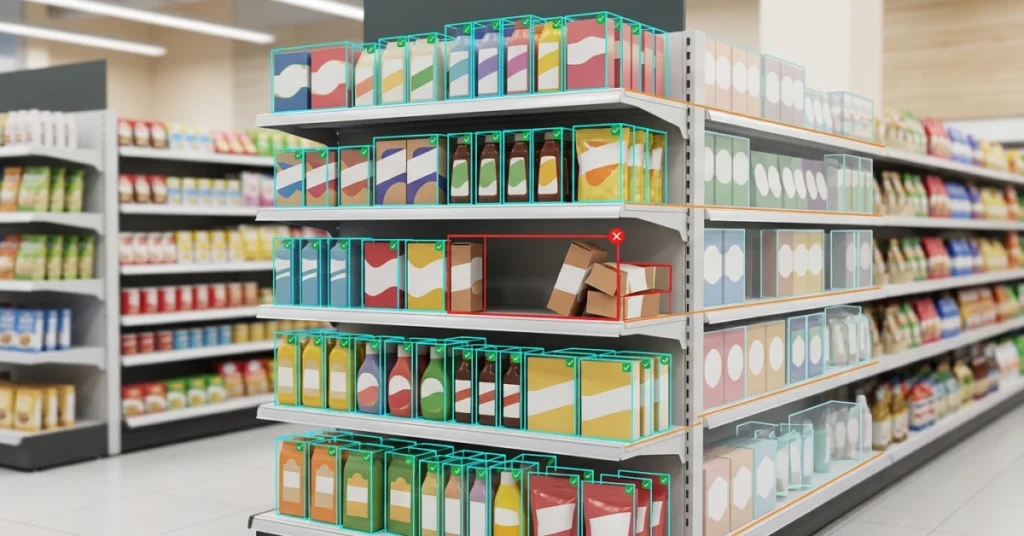
Computer vision shelf audit models scan each photo for SKUs, shelf position, product facings, and signage. The AI matches what it sees against a trained product library — fast and without human review.
AI-powered retail image recognition spots individual products with over 95% accuracy at scale (Paralleldots). That precision makes automated audits reliable enough to act on.
How Is Execution Compared Against Campaign Standards?
Once products are detected, planogram compliance AI maps them against the approved layout for that store and campaign. Every facing, position, and price tag gets checked against the standard — automatically.
This comparison runs in the background. Compliance scores are ready before the rep leaves the store.
How Are Compliance Exceptions Flagged?
Any gap — a missing SKU, wrong shelf position, or absent promo sign — triggers an instant alert. Dcmsys notes that structured exception flagging cuts manual review time sharply across large image datasets.
Managers see exactly which stores failed and which displays need fixing. They get that information before the next visit is even scheduled.
📊 By the Numbers
AI image recognition audits retail displays with over 95% SKU-level accuracy, replacing slow manual checks.
Knowing the system flags exceptions is useful. But you also need to know what it can and can’t detect in a real store. That knowledge is what lets you trust it to run your compliance program.
What Can Image Recognition Detect?
That structured compliance record is only as strong as what the system can actually see and flag. Modern AI-powered retail image recognition detects far more than a human auditor scanning shelves under time pressure.
Retailers lose an estimated $1.75 trillion annually to poor on-shelf execution. Most of those losses trace back to gaps no one caught in time (Form).
Knowing exactly what the system flags turns image recognition for display compliance from a passive camera roll into an active enforcement layer.
Can It Detect Missing or Incomplete Displays?
Yes — and it does it at scale. Computer vision shelf audit tools compare live photos against approved planograms and flag any section where products are absent, sparse, or out of stock.
A system trained on planogram compliance AI can spot a gap in seconds. Manual walk-throughs often take 20-plus minutes.
That speed is what makes retail display compliance a continuous discipline rather than a monthly scramble.
Can It Identify Incorrect Products or Placement?
Absolutely. The system reads product labels, SKU facings, and shelf positions — then cross-checks each against the approved layout.
Wrong products in the wrong slots trigger an instant alert. Teams fix the problem the same day instead of discovering it on the next scheduled audit.
Can It Verify Signage and Promotional Materials?
It can — and this is where most retailers leave money on the table. Planogram compliance AI checks whether the right price tags, promotional signs, and end-cap materials are present and correctly placed.
Moz shows that pages with structured, specific data earn stronger authority signals. The same logic applies in-store.
Verified, documented signage compliance builds a clear record. That record holds vendors and field teams accountable on every visit.
📊 By the Numbers
Retailers lose up to $1.75 trillion yearly from execution failures image recognition can now catch in real time.
Knowing what the system detects is only the first step. The real question is what you do with every flag it surfaces.
That answer decides whether compliance stays reactive or becomes a true operational standard.
Conclusion
Preventing losses takes more than detection. You need a persistent, queryable compliance record. That record turns every shelf photo into operational data.
Retailers who treat display compliance as a daily discipline catch problems early. A periodic audit alone won’t stop revenue loss. Act before the gap grows.
Studies show retailers lose up to 8% of annual sales to poor shelf execution. That number grows when compliance monitoring stays reactive (according to the National Library of Medicine).
Science Direct research confirms that AI-powered retail image recognition cuts audit cycle time by over 60%.
That speed lets teams act before a compliance gap becomes a sales gap.
Most brands still rely on manual spot-checks. Those checks miss violations the moment an auditor leaves the store.
FieldPie captures real-time photo data from the field. It converts that data into structured retail compliance insights your team can query, track, and act on.
Compliance becomes a daily standard, not a monthly event. Start building that record today. Stop documenting losses after they happen.